
Preconception Supplements for Women: What to Take and When
Published:Updated:
Many women treat a prenatal vitamin as a response to a positive test. You buy it after the lines appear, and you hope you started in time. That habit overlooks the window that matters most. The months before you try are when preconception supplements for women do their quietest, most useful work, building stores your body will spend before you even feel pregnant.
Think of those months as stocking a pantry before a long road trip. You don't want to hunt for the one missing item at a gas station halfway through the night. Some nutrients have to be on the shelf before conception. Others can wait for a blood test and a conversation with your provider. This guide walks that sequence in plain language, mama, so you know what to start, what to eat, and what to leave for your visit.
Table of Contents
- Which Supplements Should You Start Before Pregnancy?
- Why Does Folic Acid Need to Start Before You Conceive?
- How Much Iron and Iodine Do You Need?
- Which Foods Supply DHA, Choline and Vitamin D?
- What Should You Take at Each Stage, From Planning to Postpartum?
- What Should You Look for on a Supplement Label?
- What Are the Upper Limits and Medication Interactions?
- How Do You Confirm Your Plan With Your Provider?
Which Supplements Should You Start Before Pregnancy?
Preconception means the months before you try to conceive. You are not "late" if you are still planning. You are early, which is the point. The table below is a calm map of typical daily amounts for healthy adults. Food counts toward your total. Your provider may raise or lower any row after a history and, when it helps, blood work.
| Nutrient | Typical Daily Amount | Main Role Before Pregnancy | Timing or Testing Note |
|---|---|---|---|
| Folic acid | 400 mcg | Helps the neural tube close early in pregnancy | Start at least 1 month before trying to conceive |
| Iodine | 150 mcg | Supports thyroid hormones and fetal brain development | Count iodized salt, dairy, and seafood in your total |
| Iron | 18 mg for nonpregnant women ages 19–50; 27 mg in pregnancy | Builds blood volume and red blood cells | Ask your provider whether a blood count is needed |
| Vitamin D | 600 IU (15 mcg) | Supports bones and immune function | Your provider may check blood levels |
| DHA | At least 200 mg | Supports brain and eye development | Often sourced from fish oil or algae oil |
| Choline | 450 mg | Supports brain development and cell membranes | Eggs are one of the richest food sources |
| Vitamin B12 | 2.6 mcg | Supports nerve function and red blood cell formation | Ask about extra needs if you follow a vegan diet |
How to read a row without spiraling
Read one nutrient at a time, the way you'd check a grocery list, not a report card.
Folic acid is the one that cannot wait for a clinic date. Iodine is easy to double-count if you already use iodized salt and eat dairy or seafood. Iron looks different before pregnancy than during it, so don't assume the higher number is your target today. Vitamin D is hard to judge from diet alone, which is why a level can be more useful than a guess. DHA and choline show up in fewer everyday foods than people expect. Vitamin B12 matters for nerves and red cells, and a vegan pattern often needs a planned source.
These amounts are starting points, not a personal prescription. A thyroid condition, anemia, bariatric surgery, or several bottles already in your cabinet can change the plan.
Practical rule: Write down what you already eat in a normal week, then circle the rows you rarely hit. Those circles are the gaps to bring to your visit, not a reason to buy five new bottles tonight.
Why Does Folic Acid Need to Start Before You Conceive?
Picture the neural tube as a zipper. It closes the structure that becomes your baby's brain and spinal cord. That zipper finishes its job very early, often before you know you are pregnant. If the folic acid isn't already in your system, you can't rewind the week and zip it later.
That is why folic acid is the preconception supplement with the firmest clock. The World Health Organization recommends that all women take 400 micrograms (µg) of folic acid daily when they start trying to conceive and continue through 12 weeks of gestation. U.S. public-health guidance matches that 400 µg daily for women who could become pregnant, beginning at least 1 month before conception and continuing through the first 3 months.
Why the first prenatal visit can be too late
The same WHO summary of CDC evidence indicates that adequate folic acid in this window can prevent approximately 50%–70% of neural tube defects, including spina bifida and anencephaly. Waiting until the first prenatal appointment may be too late to prevent those defects, because closure often happens before that visit is even booked.
You don't need to be scared to take this seriously. You need a start date. If you might become pregnant this year, a daily 400 mcg is a reasonable default to confirm with your provider, whether or not you have a due-date goal circled on the calendar.
Folate and folic acid are not the same swap
Folate is the family name. You get it naturally in beans, leafy greens, and citrus. Folic acid is the form used in supplements and fortified grains, and it is the form tied to that prevention evidence. Your body converts folic acid into the folate it can use.
Methylfolate products are marketed as already "active." They can have a place, but they are not a silent substitute you should make on your own. If a label leans on methylfolate, or if you've been told you have an MTHFR variant, bring the bottle to your clinician instead of swapping it in after a late-night search. A fuller walk-through of food folate versus the supplement form lives in our piece on extra folate and folic acid in pregnancy.
The higher dose is a medical plan, not a stack
A previous pregnancy affected by a neural tube defect changes the number. U.S. guidance has identified 4.0 milligrams daily under medical supervision, not a standard prenatal you pick off the shelf. The NIH Office of Dietary Supplements notes that ACOG recommends discussing 4 milligrams (mg) daily as a separate supplement, beginning at least 3 months before conception and continuing through the first 3 months, with your obstetric clinician.
Don't reach that amount by taking several prenatal vitamins. The extra iron, vitamin A, and other ingredients come along for the ride, and that stack can be unsafe. One separate folic acid tablet, prescribed and watched, is a different plan from "more of everything."
If your last pregnancy was affected, call before you conceive. The higher dose is real, and it belongs in a supervised plan, not a shopping cart.
How Much Iron and Iodine Do You Need?
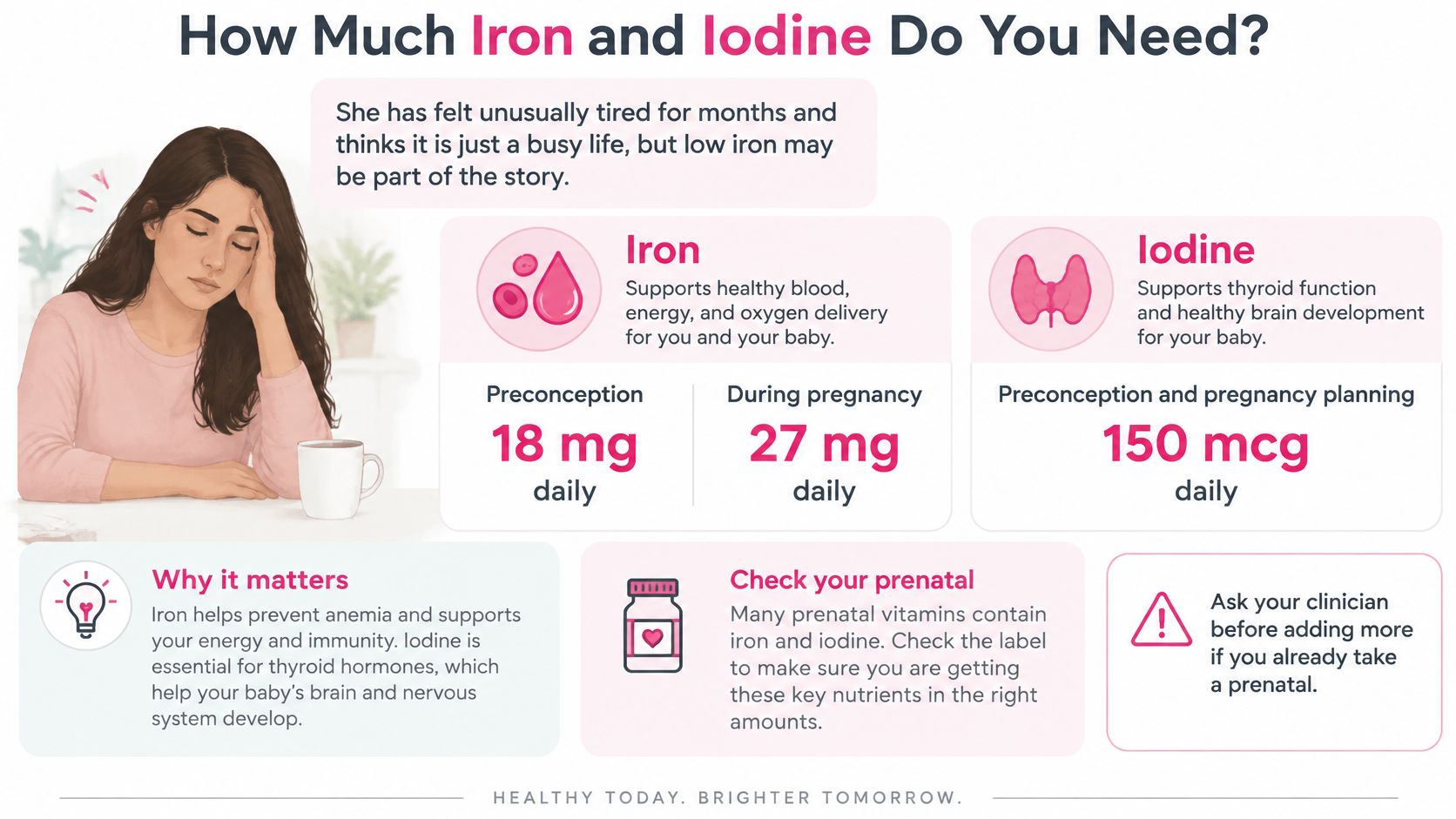
Say you've been unusually tired for months. You blame the job, the short nights, the full calendar. Sometimes that story is complete. Sometimes low iron is sitting underneath it, and a preconception visit is the first time anyone checks.
Iron's job is oxygen delivery. It helps you build red blood cells. Pregnancy asks for more because your blood volume expands, and the placenta and baby draw on the same supply. The NIH iron fact sheet lists 18 mg of iron per day for nonpregnant women ages 19–50, compared with 27 mg per day during pregnancy. That is an increase of 9 mg, about half again as much. Too little can contribute to iron-deficiency anemia. Too much is not a shortcut to energy.
More iron is not automatically kinder
High-dose iron can cause constipation, nausea, and abdominal discomfort. Taking it when your stores are already fine may be the wrong move. Your clinician can use your history plus tests such as a complete blood count and ferritin when indicated, then decide between the iron in a prenatal and a separate treatment dose.
Bring these details if they fit you:
- Existing anemia: You already know your levels run low, or you've been treated before.
- Heavy menstrual bleeding: Monthly loss can drain stores long before pregnancy.
- A vegetarian or vegan pattern: Non-heme iron from plants is absorbed less readily, so pairing it with vitamin C foods helps, and a lab still beats a guess.
- Bariatric surgery: Absorption changes, and a standard label may not match your anatomy.
Iodine is a small daily amount with a thyroid-sized job
Iodine feeds thyroid hormone, which supports your metabolism and your baby's brain development. The NIH iodine fact sheet lists an RDA of 150 mcg per day for nonpregnant adults, rising to 220 mcg per day during pregnancy and 290 mcg per day while breastfeeding. Several groups, including the American Thyroid Association, recommend a supplement with 150 mcg of iodine daily, commonly as potassium iodide, for women planning pregnancy, pregnant, or breastfeeding.
That 150 mcg is the supplement piece, not your whole intake. Iodized salt, dairy, eggs, and seafood count. Both too little and too much iodine can bother the thyroid, so don't stack a separate iodine dropper on a prenatal without reading both labels. If you want a closer look at how iodine shows up in a multi, our note on a multivitamin with iodine walks through the label logic.
Ask sooner if you are dairy-free or vegan, rarely use iodized salt, have thyroid disease, or take thyroid medication. The question for your visit is simple. Do I need iron or iodine beyond what my prenatal already gives me?
Which Foods Supply DHA, Choline and Vitamin D?
Food is the foundation. A supplement is the bridge that carries you when one road is closed, not a replacement for the meal. Scan the groups below for the ones you almost never eat. That thin spot is your gap.
DHA from fish, or from algae if fish isn't your food
DHA is an omega-3 fat that supports brain and eye development. Useful fish include:
- Salmon: A familiar weekly fillet covers a lot of ground.
- Sardines: Small, inexpensive, and easy from a can.
- Trout: Another lower-mercury option for people who don't love salmon.
Choose lower-mercury fish, and skip high-mercury types such as swordfish, shark, and king mackerel. If you don't eat seafood, algae-based DHA is the practical stand-in. Our guide to foods rich in DHA lists more plate ideas if the three fish above aren't your habit.
Choline hides in the yolk, not the white
Choline supports brain development and the membranes around every cell. Eggs lead the list, and the yolk holds most of it, so an egg-white-only breakfast gives you the protein and skips the point. Also useful:
- Beef and chicken liver: Very rich, so a small portion goes far.
- Milk and soybeans: Everyday options if organ meats aren't appealing.
- Cooked broccoli or Brussels sprouts: Helpful add-ons, not a full day's worth on their own.
Vitamin D from the carton, the fish, and the sky
Vitamin D supports bones and immune function, and food sources are quite limited. Fortified cow's milk and fortified plant milks, fatty fish, and egg yolks help. Sunlight helps too, but season, latitude, and skin tone change how much you make. A winter in a northern city is not the same as a summer farther south.
Vegetarian and vegan eating can cover a lot, and it usually needs a plan for DHA, choline, and B12. A supplement fills what the plate can't, after your provider agrees. Which food group do you eat least often? That is the gap to name out loud at your visit.
What Should You Take at Each Stage, From Planning to Postpartum?
A timeline beats a pile of bottles. Move one phase at a time. You don't have to perfect all five this weekend.
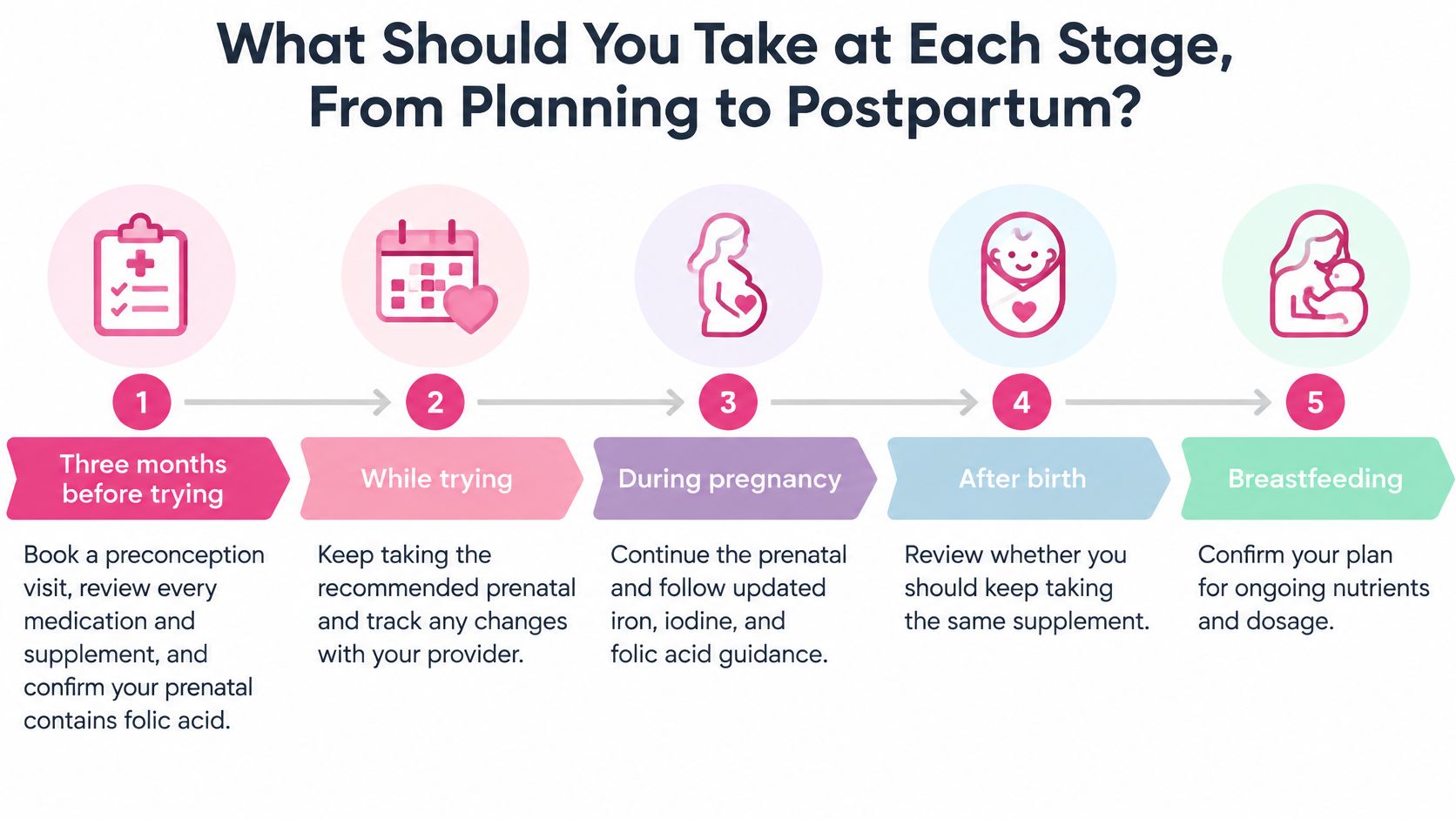
- Three months before trying. Book the preconception visit. Bring every medication and supplement, including the "natural" ones. Confirm the prenatal you are considering contains folic acid, DHA, and choline. Expect the visit to feel ordinary, not dramatic. Habit that sticks: put the appointment on the calendar before you comparison-shop.
- One month before trying. Take 400 mcg of folic acid daily unless your provider has already set something else. If a past pregnancy was affected by a neural tube defect, follow the high-dose plan they set, which usually begins about three months before conception. Expect this month to feel quiet. Habit that sticks: pair the capsule with breakfast so it isn't floating in your memory.
- While you are trying. Keep the same daily routine. Take iron and calcium at different times of day so they don't compete. Take thyroid medication on an empty stomach, apart from iron and calcium. Expect some cycles to pass without news. Habit that sticks: a weekly pill box shows you whether yesterday happened.
- If pregnancy is a surprise. Keep taking folic acid and your prenatal. Don't panic, and contact your provider promptly. Starting now still supports you and the pregnancy, even if the ideal month already slipped by. Expect a mix of joy and "I wasn't ready." Habit that sticks: one phone call this week, not a total life overhaul tonight.
- Postpartum and breastfeeding. Needs don't drop the day you give birth. Keep iodine and choline in view, with choline around 550 mg and iodine at 290 mcg while breastfeeding, unless your provider adjusts them. The difference between a prenatal and a postnatal plan is spelled out in our comparison of prenatal vs postnatal vitamins. Habit that sticks: a phone reminder during a feed you already never miss.
What Should You Look for on a Supplement Label?
A label is a checklist, not a vibe. Stand in the aisle, or zoom in on a photo, and ask one question per line.
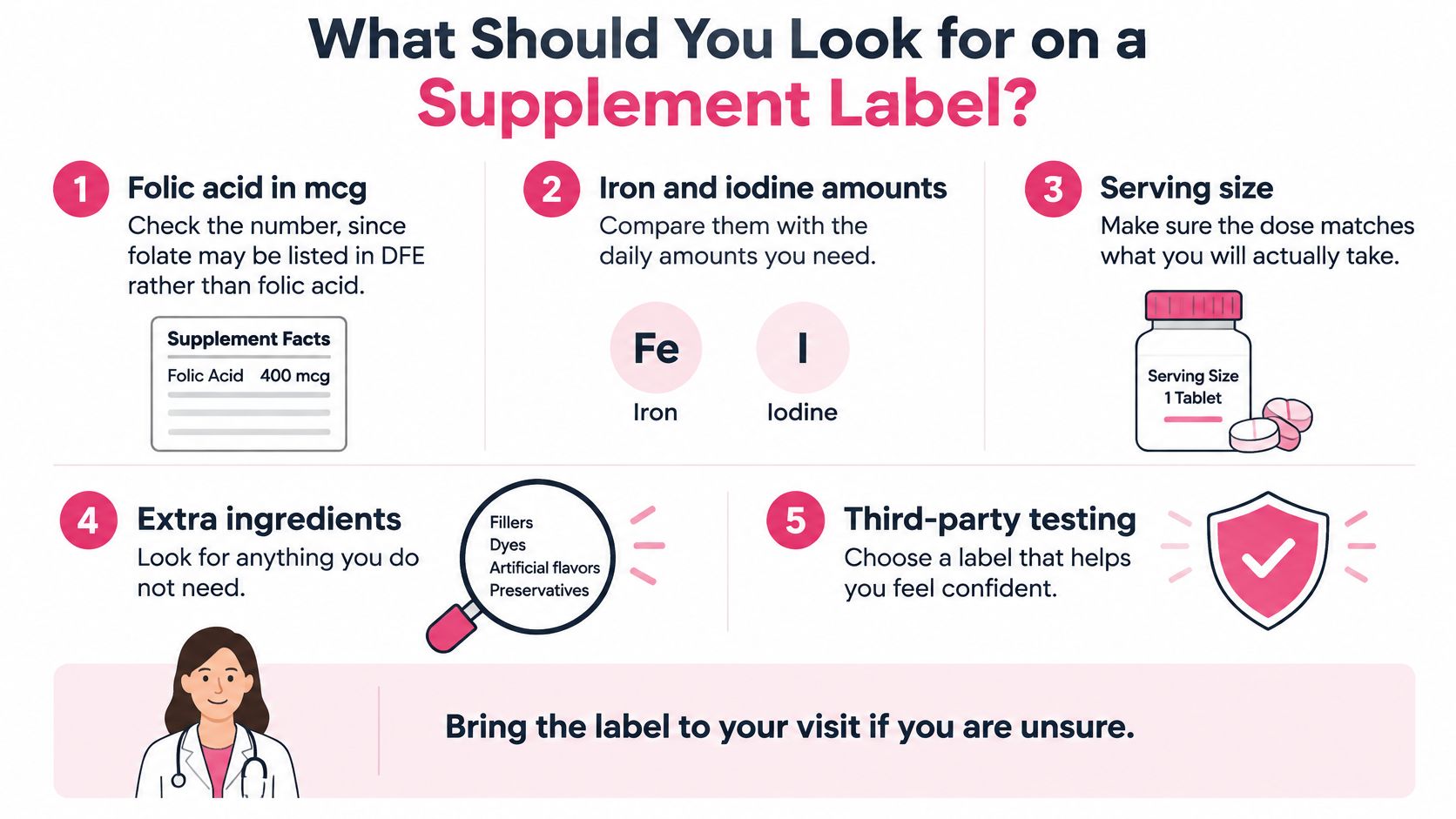
- Folic acid in mcg. Is the number folic acid, or is folate listed as DFE (dietary folate equivalents)? DFE math can make a label look larger than the folic acid you meant to take. Ask what form, and how many micrograms, you would swallow.
- Iron and iodine. Do these match the daily amounts you and your provider already agreed on, or are you about to double them with a second product?
- DHA in mg, and the source. Is it fish oil or algae? Algae matters if you avoid fish. A tiny splash of DHA can hide behind a big "plus DHA" claim, so read milligrams, not the front panel.
- Choline and vitamin D. Are they listed with amounts, or missing while the front still sounds complete?
- No doubled nutrients. If you take a multi plus singles "for insurance," add the overlapping lines. Insurance can become excess.
- Third-party testing. Seals such as USP Verified or NSF Certified mean an outside lab checked contents, not just the brand's own story. We manufacture in an FDA-registered facility, and a third-party lab tests each batch twice for heavy metals, microbes, allergens, and other contaminants. Our explainer on third-party testing shows what those checks are for.
- Lot number, date, and storage. Can you read an expiration date and a lot number? Heat and a damp bathroom cabinet age capsules faster than a cool cupboard.
- Extras you may want to skip. Artificial dyes, or gelatin if you eat vegan or halal, are reasons to choose another bottle, not reasons to ignore the nutrients.
- The capsule itself. Can you swallow it whole? If not, can it be opened? A perfect formula you can't get down is not a plan.
A clear label is a better starting point. The dose you take still belongs with your provider, especially if you already use more than one product.
What Are the Upper Limits and Medication Interactions?
More is not more protective. Upper limits exist so a helpful nutrient doesn't tip into harm. Adults planning pregnancy generally stay under these daily ceilings from supplements and, where noted, fortified foods. Food folate from vegetables is a different story from a fistful of pills.
| Nutrient | Upper Limit Per Day | Why Excess Matters |
|---|---|---|
| Iron | 45 mg | Can cause constipation, stomach upset, and iron buildup |
| Iodine | 1,100 mcg | Can disrupt thyroid function |
| Folic acid from supplements and fortified foods | 1,000 mcg | High amounts can mask a vitamin B12 deficiency |
| Preformed vitamin A | 3,000 mcg RAE | Excess is linked to birth defects, so choose beta-carotene sources |
| Vitamin D | 4,000 IU | High levels can raise blood calcium |
| Choline | 3,500 mg | High doses can cause a fishy body odor, sweating, and low blood pressure |
Interactions that surprise people who "only take vitamins"
Pills share space with medications. A few pairings need space on the clock, not just space in the cabinet.
- Thyroid medication: Levothyroxine works best on an empty stomach. Separate it from iron and calcium by about four hours.
- Calcium, antacids, and some high-fiber meals: These reduce iron absorption. A prenatal with breakfast and a calcium chew at the same bite can cancel the iron you meant to get.
- Iron itself: It can darken stools and cause constipation. That color change is common. Severe pain or vomiting is a reason to call, not to push through.
- Fish oil or high-dose DHA: These may add to the effect of blood-thinning medication. Ask before you combine them.
- Herbal products: "Plant" doesn't mean "neutral." Review them before you start, especially if you are already on fertility or thyroid treatment.
Stacking a multivitamin with separate singles is the usual way people drift past a ceiling without noticing. Keep a written list of every product and medication, including dose and time of day, and bring that page to your preconception visit. Your provider can cross off what doesn't belong.
How Do You Confirm Your Plan With Your Provider?
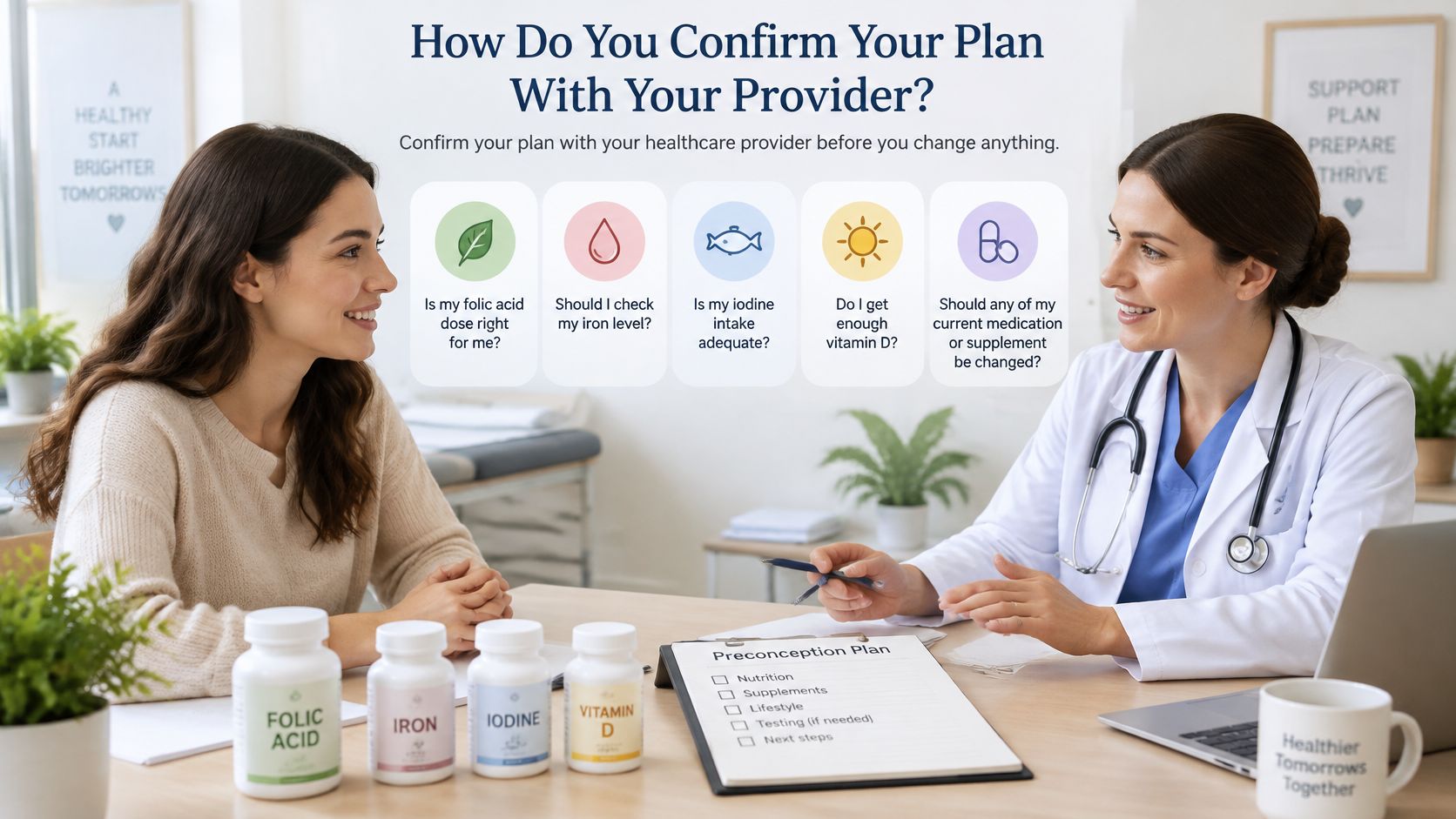
The decision is simple, and it is yours to make with a clinician, not with a comment thread. Confirm the plan before you change doses. Five questions cover most of the ground:
- Do I need folic acid above 400 mcg?
- Is my iron level healthy, and do I need iron beyond my prenatal?
- Should I add iodine if I avoid dairy or iodized salt?
- Are my DHA and choline sources enough for how I eat?
- Which products fit the medications I already take?
Bring the bottles. A photo of the Supplement Facts panel is enough if the cabinet is crowded.
One option you can hold up against those questions is Feed Mom & Me Complete Prenatal Vitamin Plus DHA. It was formulated by an OBGYN and a registered dietitian, by moms building for moms. The multi contains folic acid, DHA, choline, and 15 other key nutrients, with 50 mg of DHA and 18 mg of iron per serving. That iron amount sits with the nonpregnant figure, below the 27 mg pregnancy target, so your provider may want an additional source once you are pregnant. Compare the label to your list. Don't treat any bottle as the whole answer.
You can hear a short, plain walk-through of how we think about daily nutrients here.
You are not doing this alone, mama. A community built by moms is in your corner, and your provider is the person who knows your labs, your history, and the dose that fits you.
Feed Mom & Me is a women-owned brand, built by moms, with a Complete Prenatal Vitamin Plus DHA you can start in the planning months and keep discussing through pregnancy and postpartum. If you want a label you can compare with your provider, plus recipes and plain-language notes on the nutrients in this guide, visit Feed Mom & Me and bring what you find to your next visit.