
Prenatal Vitamin for MTHFR Mutation What to Choose
Published:Updated:
You've just received an MTHFR result, or perhaps a prenatal label has made you wonder whether folic acid is the right choice. Suddenly, a simple vitamin feels like a high-stakes decision. You may be asking yourself whether you need methylfolate, extra B vitamins, genetic testing, or a completely different prenatal.
Take a breath, mama. MTHFR variants are common, and having one doesn't automatically mean something is wrong with you or your pregnancy. The most important step is to separate established prenatal guidance from online claims that make the folate-form debate sound more alarming than it is.
This guide will help you understand how MTHFR relates to folate, how folic acid compares with L-5-MTHF, which nutrients deserve attention beyond folate, and when laboratory testing may add useful context. You'll also find practical questions to bring to your clinician, because your medical history, diet, symptoms, and previous pregnancies matter more than a genetic label by itself.
A prenatal vitamin can help fill nutritional gaps, but it doesn't replace meals, medical care, or individualized guidance. You can also review the broader role of prenatal supplementation in this practical guide to prenatal vitamin benefits.
Table of Contents
- What Is an MTHFR Mutation and How Does It Affect Folate
- Why Methylfolate Matters and How It Compares to Folic Acid
- What to Look for in a Prenatal Vitamin When You Have MTHFR
- Do You Need Testing or Extra Monitoring During Pregnancy
- How to Choose and Talk About Your Prenatal With Your Clinician
- Finding Confidence in Your Prenatal Choice
What Is an MTHFR Mutation and How Does It Affect Folate
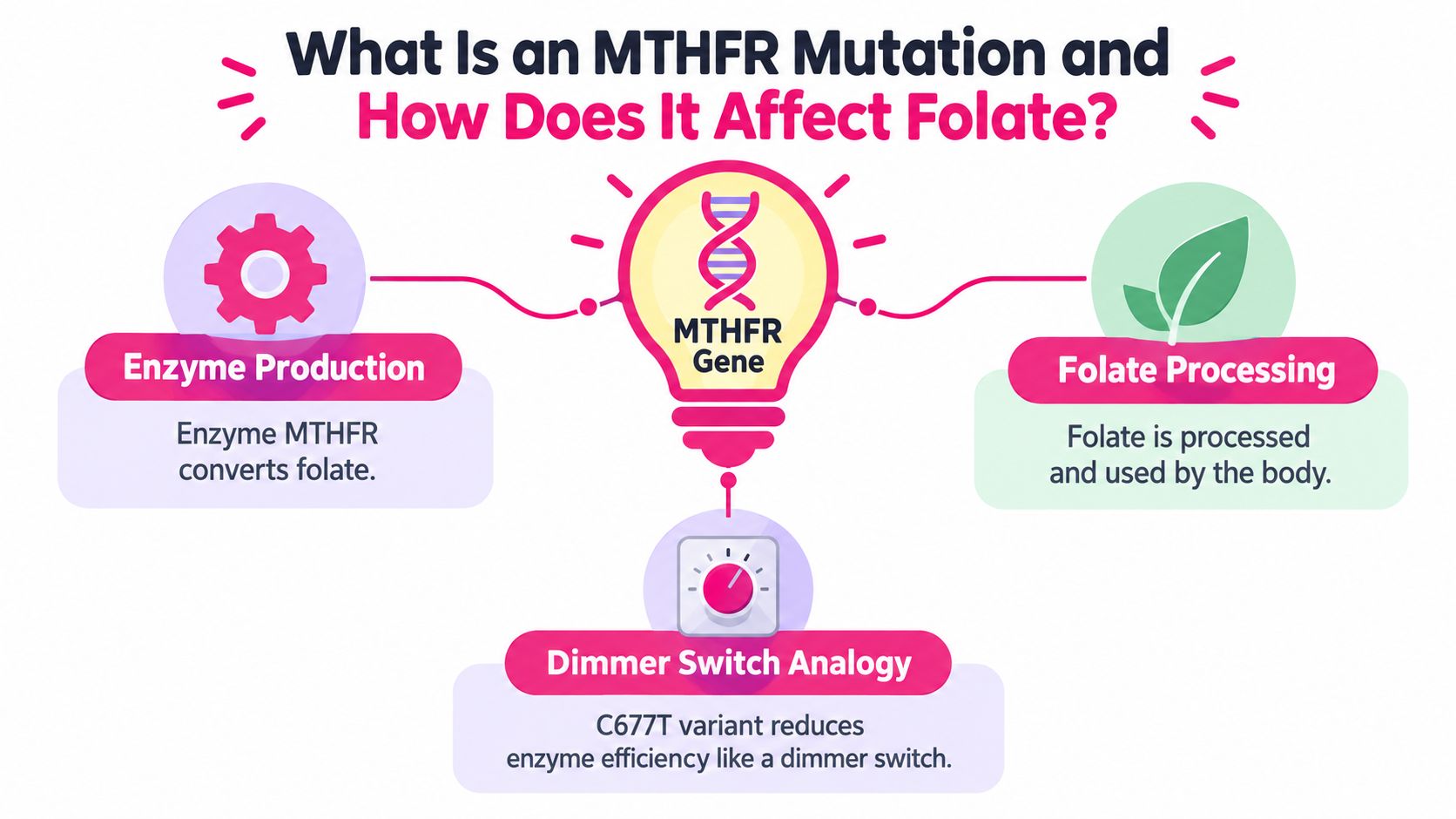
Your genes are like instruction manuals. The MTHFR gene contains instructions for making an enzyme that helps your body process folate into forms involved in important cellular reactions. One commonly discussed variant is C677T.
A helpful analogy is a dimmer switch. The MTHFR enzyme may still work, but the C677T variant can reduce how efficiently that pathway operates. The result isn't a simple on-or-off failure, and it doesn't automatically indicate disease. It means folate processing may function differently from person to person.
The NIH Office of Dietary Supplements explains that people with the common MTHFR 677C>T variant have a reduced ability to convert folate into its active form, 5-MTHF, because the enzyme is less active. The same NIH guidance says this doesn't change the general recommendation for women of childbearing age to take standard folic acid for neural tube defect prevention. Read the NIH folate fact sheet for health professionals for the scientific background.
Why common matters
The CDC says more people in the United States have one or two copies of the common MTHFR C677T variant than have none. That reframes MTHFR as a common genetic variation, not an unusual condition that automatically requires a special treatment plan.
Some people with a variant fall into what clinicians may describe as an intermediate metabolizer range for folate. That phrase describes enzyme activity, not your identity or your overall health. It also doesn't tell your clinician everything about your folate status, B12 status, diet, medications, or pregnancy history.
Core idea: An MTHFR result is one piece of information. It isn't a diagnosis, and it doesn't automatically tell you to abandon standard prenatal guidance.
The CDC specifically says routine MTHFR testing isn't recommended for deciding folic-acid intake, because 400 mcg of folic acid daily can adequately raise folate levels whether or not the variant is present. You can explore the relationship between methyl donors and prenatal nutrition in this plain-language guide to methyl donor supplements, but avoid turning a genetic result into a reason for self-prescribing high doses.
Why Methylfolate Matters and How It Compares to Folic Acid
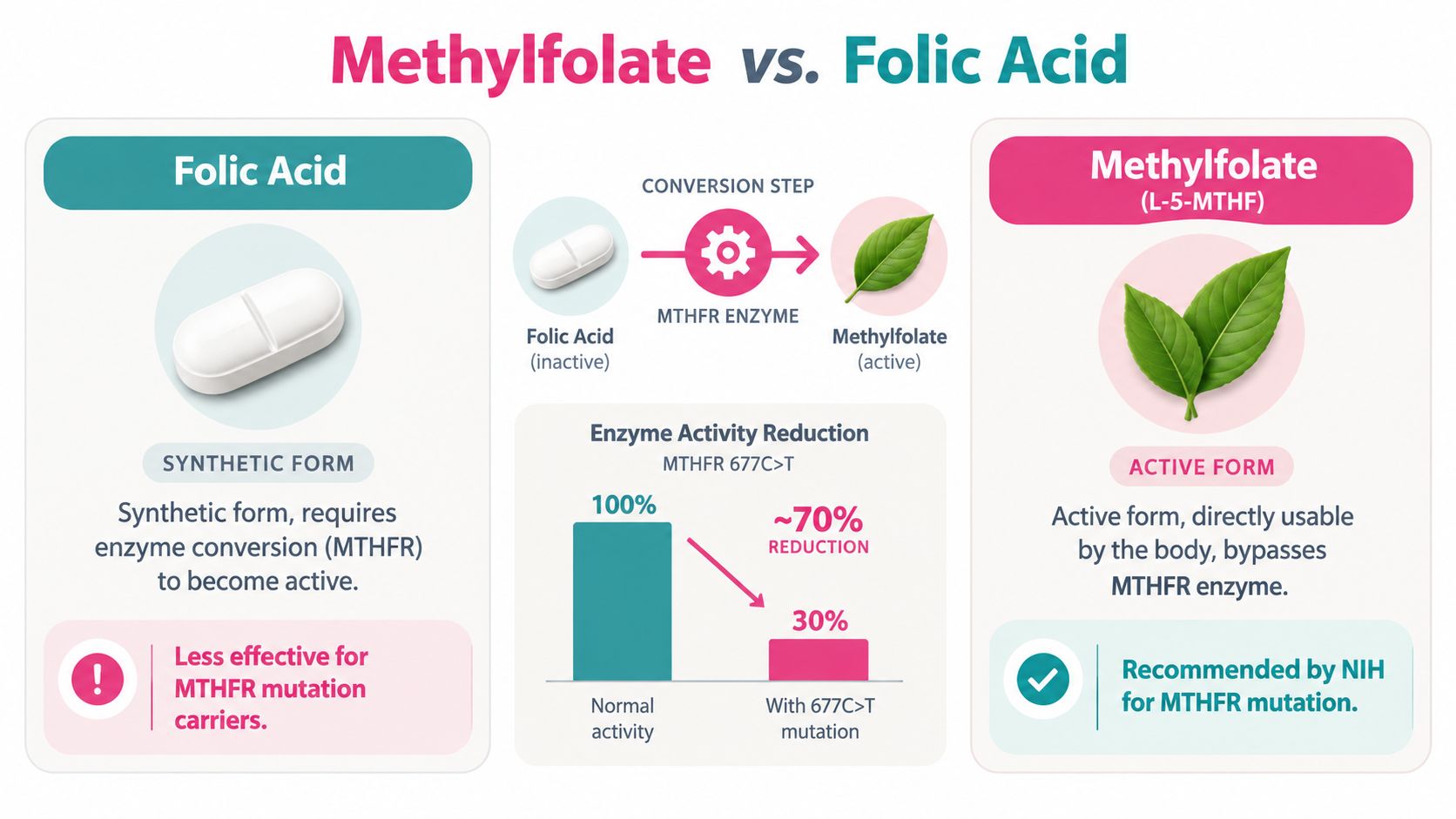
Folate is a family of vitamin B9 forms. Folic acid is the synthetic form used in supplements and fortified foods. L-5-MTHF, commonly called methylfolate, is an active form that the body can use more directly.
That difference can make methylfolate appealing if you have learned that an MTHFR variant may reduce enzyme activity. L-5-MTHF does not depend on the same conversion step as folic acid. Still, a biochemical difference does not automatically prove better pregnancy outcomes. This methylfolate vs folic acid comparison can help you see the distinction without treating one label as the whole decision.
| Question | Folic acid | L-5-MTHF |
|---|---|---|
| What is it? | A synthetic form of folate | An active folate form |
| Why is it discussed with MTHFR? | It requires processing before use | It can be used more directly |
| Neural tube defect evidence | The form with direct clinical evidence for prevention | Evidence remains insufficient for this outcome |
| Guideline position | Recommended by the CDC for people who could become pregnant | Not recommended automatically at high doses because of MTHFR alone |
The NIH pregnancy and lactation supplement guidance states that supplements containing 5-MTHF haven't been tested in clinical trials for reducing neural tube defects. It also explains that the CDC recommends folic acid rather than 5-MTHF for people with MTHFR polymorphisms, because folic acid is the only form proven to reduce neural tube defect risk.
What this means for your decision
Having an MTHFR variant alone does not support automatically choosing high-dose methylfolate. A peer-reviewed review on MTHFR counseling and folate found no recommendation to increase folic-acid dosing based only on MTHFR polymorphism, and UKTIS says routine prenatal methylfolate instead of folic acid cannot currently be recommended.
You can still discuss L-5-MTHF with your clinician, mama. The useful decision includes your tolerance of the product, dietary intake, vitamin B12 status, homocysteine or other relevant testing when clinically indicated, and any separate high-risk reason for a clinician-directed folic-acid plan. The key question is which plan gives you reliable, evidence-informed coverage, not which form sounds more advanced.
What to Look for in a Prenatal Vitamin When You Have MTHFR
A prenatal label deserves a wider look than the folate line. Folate matters, but pregnancy nutrition also involves nutrients such as vitamin B12, iron, vitamin D, DHA, choline, and selenium. The right formula should be one you can take consistently and review with your healthcare provider.
Start with these label questions:
- Folate amount: Confirm whether the product provides at least the general 400 mcg daily folic-acid baseline recommended by the CDC, or ask your clinician how the listed folate form fits your plan.
- Folate form: If you prefer L-5-MTHF, look for that exact form on the Supplement Facts panel rather than relying on front-label language.
- Vitamin B12: Check the amount and form, and ask whether your diet or lab history suggests you need special attention to B12.
- Iron: Compare the iron amount and form, especially if constipation or nausea has made prenatal vitamins difficult.
- DHA and choline: These are useful nutrients to discuss because they support a broader prenatal nutrition strategy beyond folate alone.
- Vitamin D and selenium: Look for them when comparing complete formulas, while avoiding unnecessary duplicate supplementation.
- Tolerability: Delayed-release capsules, peppermint, or ginger may make a product easier to continue if nausea or stomach sensitivity is an issue.
- Dietary fit: Vegetarian, gluten-free, soy-free, or dairy-free features can simplify daily use when those restrictions apply to you.
| Nutrient or feature | What to look for | Why it matters with MTHFR |
|---|---|---|
| Folate | A clearly listed form and amount | Helps you compare the product with your clinician's plan |
| B12 | Adequate coverage and a clearly named form | Folate and B12 status interact in methylation-related pathways |
| DHA | Included when appropriate for your needs | Supports a broader prenatal nutrition routine |
| Choline | Included or addressed through food | Helps prevent your prenatal plan from focusing on folate alone |
| Iron | A tolerable form and clinician-approved amount | Supports pregnancy needs, but iron and MTHFR aren't the same issue |
| Capsule design | Delayed release or other tolerability features | Consistency matters when nausea makes supplements hard to take |
Food still belongs in this conversation. If planning balanced meals feels exhausting, use a practical resource to find pregnancy meal plans that can help you organize folate- and B12-containing foods alongside your prenatal.
For a closer look at how product labels may differ when folate is listed without folic acid, see this guide to pregnancy vitamins without folic acid. The label is a starting point, not a diagnosis.
Do You Need Testing or Extra Monitoring During Pregnancy
Many MTHFR conversations become more useful. Instead of asking only, “Which folate form should I buy?” you can ask, “What information would change my care?”
The CDC doesn't recommend routine MTHFR testing for folate dosing. If you already have a genetic result, your clinician can place it in context rather than treating it as a standalone explanation for every symptom or pregnancy concern.
Tests your clinician may discuss
There isn't one universal testing package for everyone. Depending on your history, diet, symptoms, medications, and previous laboratory results, your clinician may consider:
- Homocysteine: This can provide information about a metabolic pathway connected with folate and B12, but the result needs clinical interpretation.
- Vitamin B12: Low or borderline B12 status can complicate a folate-focused plan, particularly when dietary intake is limited.
- Red-blood-cell folate: This can offer a longer-term view of folate status than a measurement that reflects only recent intake.
- MTHFR genetic testing: This may confirm a variant, but the result alone doesn't determine your prenatal dose.
A recent review frames pregnancy outcomes through the combined relationship among folate, MTHFR genetics, and vitamin B12, rather than treating MTHFR as a single-variable answer. A 2024 systematic review also found that 400 mcg of folic acid reduces neural tube defect incidence regardless of MTHFR polymorphisms. You can review the PubMed-indexed literature on folate, MTHFR, B12, and active-folate prenatal products.
How to avoid over-medicalizing the result
Testing makes the most sense when it answers a specific clinical question. For example, your provider may want to investigate anemia, dietary insufficiency, a previous pregnancy issue, or an abnormal laboratory finding. A normal result can also be helpful because it may prevent you from adding unnecessary supplements.
The same 2026 review reported that the MTHFR C677T SNP didn't materially alter folate concentrations in active-folate prenatal multivitamins. That finding supports a calm approach: genotype alone may not predict your response as strongly as consumer articles imply.
Bring your questions, not a predetermined treatment. The goal is useful information, not a longer list of diagnoses.
How to Choose and Talk About Your Prenatal With Your Clinician
You don't need to walk into an appointment with a perfect opinion about folic acid versus methylfolate. Bring the bottle, the label, and the questions that are specific to your body.
Start with the timing
Folate supplementation is commonly recommended for 3 months before conception and at least the first 3 months of pregnancy, a period associated with protection against neural tube defects. This timing is discussed in a peer-reviewed review of folate and pregnancy.
If you're already pregnant and haven't started a prenatal, don't panic. Begin a conversation promptly rather than waiting for the “perfect” product. Your clinician can help you choose a safe option and address nausea, missed doses, dietary limits, or other concerns.
Take these questions with you
- Ask about the baseline: “Does my prenatal provide the folate coverage you recommend?”
- Discuss form: “Would you prefer folic acid, L-5-MTHF, or another plan for my history?”
- Review B12: “Should we check my B12 status or review my dietary intake?”
- Clarify high-risk guidance: “Do I have a reason to follow a clinician-directed high-dose folic-acid protocol?”
- Discuss testing: “Would homocysteine or red-blood-cell folate add useful information for me?”
- Check the full formula: “Are the iron, vitamin D, DHA, choline, and selenium amounts appropriate?”
Don't increase your dose on your own because a website or social media post made MTHFR sound dangerous. Higher-dose folic-acid protocols can be appropriate in specific high-risk situations, such as a previous neural-tube-defect pregnancy, but those decisions belong with your clinician.
Make adherence part of the appointment
Tell your provider what you're experiencing. Nausea, constipation, reflux, trouble swallowing, food aversions, and a busy postpartum schedule can all affect whether a prenatal becomes part of your routine.
Show the exact product and mention every other supplement you're taking. If you're comparing quality standards, you can also discuss what third-party verification means in this guide to third-party-tested prenatal supplements.
A calm, collaborative conversation usually gets you farther than arriving determined to prove one folate form is universally right. Your clinician can help you turn a genetic result into a sensible care plan.
Finding Confidence in Your Prenatal Choice
You don't have to earn a healthy pregnancy by becoming an expert in every supplement label. MTHFR is common, and the presence of a variant doesn't automatically mean you need a special diagnosis, aggressive dosing, or extensive monitoring.
The most grounded plan usually combines dependable prenatal coverage, nourishing food, attention to B12 and other nutrients, and medical advice suited to your history. Standard folic-acid guidance remains important because it has the strongest direct evidence for reducing neural tube defects. L-5-MTHF may be a reasonable product preference to discuss, but it shouldn't become a reason to dismiss proven guidance or self-prescribe high doses.
Feed Mom & Me Complete Prenatal Vitamin Plus DHA is one option you can bring to that conversation. Its formula includes methylfolate as L-5-MTHF, DHA, choline, and selenium, and its delayed-release vegetarian capsules include peppermint and organic ginger for a more comfortable routine. It's made by a women-owned brand built by moms for moms, but your clinician should still confirm whether it fits your individual needs.
If you're comparing a prenatal vitamin for an MTHFR variant, review the Feed Mom & Me formula and bring its label to your next appointment. Visit Feed Mom & Me to explore the Complete Prenatal Vitamin Plus DHA and choose the option that supports a consistent, informed nutrition routine.