
DHA Supplement for Breastfeeding Mothers What to Know
Published:Updated:
You're nursing your baby with one hand, scrolling through supplement labels with the other, and wondering whether DHA belongs in your postpartum routine. Maybe you eat salmon sometimes, maybe the thought of fish turns your stomach, or maybe your prenatal already contains some DHA and you're unsure whether it's enough. You want to support your baby without turning every meal into a nutrition exam.
The good news is that DHA is a practical question, not a perfection test. This guide will help you understand what DHA does, how much is commonly recommended, when food may be enough, how to compare supplements, and why improved milk DHA doesn't automatically guarantee a particular developmental outcome. You'll also see questions such as Why is DHA important while you're breastfeeding?, Can you get enough DHA from food alone?, and Is DHA safe for you and your breastfed baby?
Think of this as a calm conversation with a well-informed mom-friend. You can use it alongside your healthcare provider's advice, especially if your baby was born preterm, you follow a vegetarian diet, or you have questions about medication, allergies, or tolerability. And if you're also thinking about milk production, this guide on supporting breast milk supply can help you keep the bigger postpartum picture in view.
Table of Contents
- Why Is DHA Important While You Are Breastfeeding
- How Much DHA Do You Need During Lactation
- Can You Get Enough DHA From Food Alone
- How to Choose a High Quality DHA Supplement
- Is DHA Safe for You and Your Breastfed Baby
- Your Next Steps to Confidently Support Milk DHA
Why Is DHA Important While You Are Breastfeeding
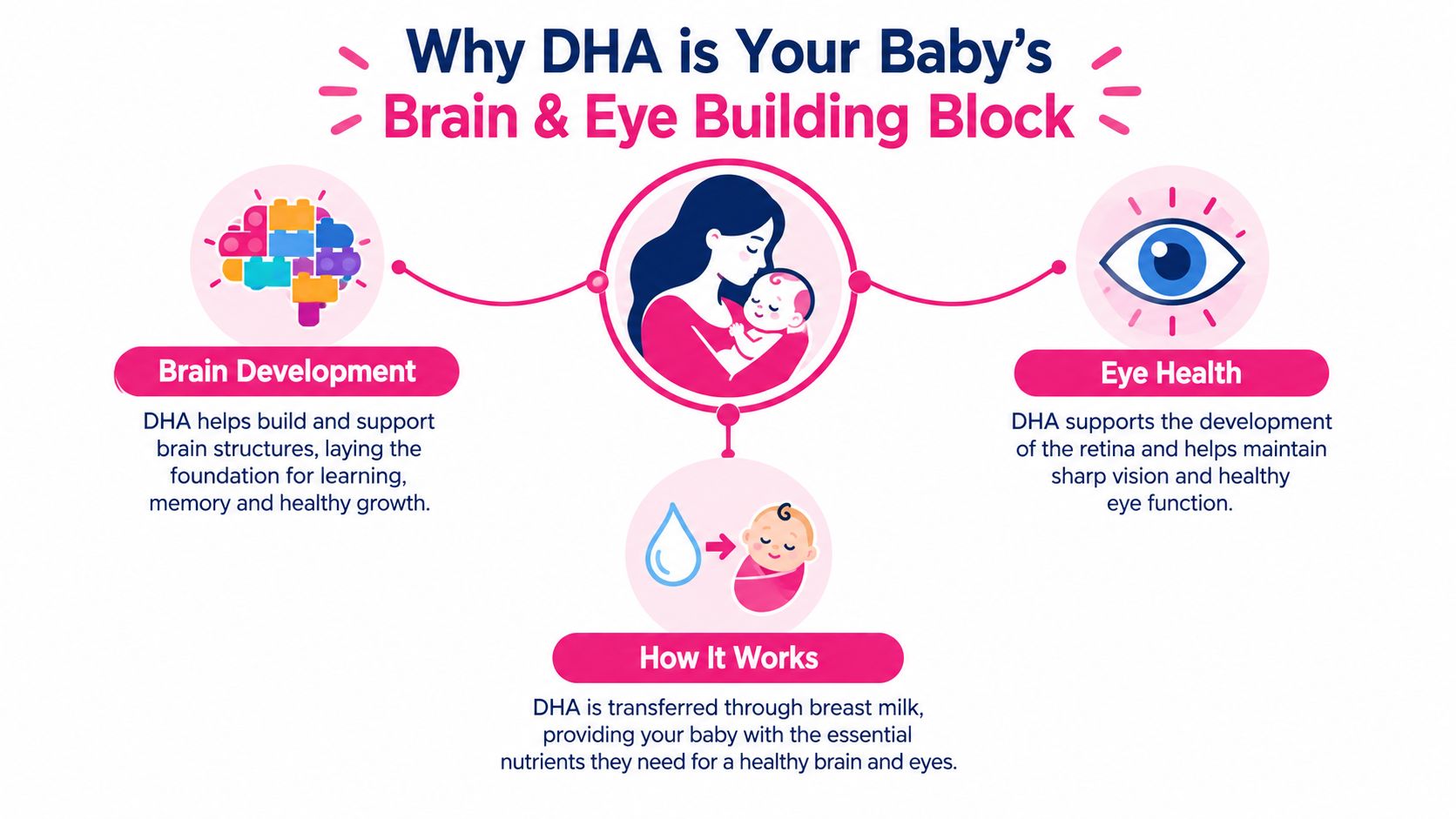
DHA, or docosahexaenoic acid, is a long-chain omega-3 fatty acid. In everyday language, it's one of the fats your body uses in tissues such as the brain and retina. A simple way to think about it is as a flexible building material. Your baby's developing nervous system and eyes need many nutrients, and DHA is one of the structural pieces involved in that larger construction project.
Breastfeeding creates a direct nutritional connection between your intake and your milk. Human milk DHA reflects maternal intake, and supplementation can modify its DHA content. That makes lactation a unique window. What you eat and supplement doesn't determine every aspect of your baby's health, but it can influence the fatty-acid composition of your milk.
The practical idea: Your DHA intake can change the DHA available in your breast milk, but higher milk DHA shouldn't be confused with a guaranteed developmental result.
A PubMed-indexed study reported as early as 2000 that DHA supplementation increased plasma and breast-milk DHA in lactating women, with higher DHA concentrations in their infants as well. More recent clinical research has continued to show that maternal supplementation changes both maternal and milk DHA concentrations. You can read more about how this nutrient functions across reproductive stages in DHA benefits during pregnancy.
Why milk composition matters
Your breast milk isn't a fixed formula with an identical nutrition label for every mother. Its composition responds to several factors, including your diet and nutrient status. For DHA specifically, maternal intake offers a route for increasing the amount present in milk.
That doesn't mean you need to chase the highest possible intake. It means you can make a thoughtful adequacy decision. If you rarely eat seafood, an appropriate supplement may help fill a predictable gap. If you regularly eat lower-mercury fatty fish and your prenatal already includes DHA, your provider may decide that adding more isn't necessary.
DHA is also only one part of breastfeeding nutrition. Adequate calories, protein, fluids, iron, iodine, choline, vitamin D, and other nutrients matter too. No single capsule can replace meals, rest, feeding support, or medical care.
The most useful framing is gentle and specific: DHA supplementation reliably raises maternal and breast-milk DHA, while research on long-term infant outcomes is more mixed. That distinction helps you make a decision without fear or inflated promises.
How Much DHA Do You Need During Lactation
You may be comparing supplement labels while holding your baby, wondering whether the prenatal DHA you took during pregnancy is still enough. There is no single dose for every breastfeeding mother. The useful target depends on whether you want ordinary nutritional adequacy, a higher milk-DHA level, or a combined DHA and EPA intake.
Common reference points include:
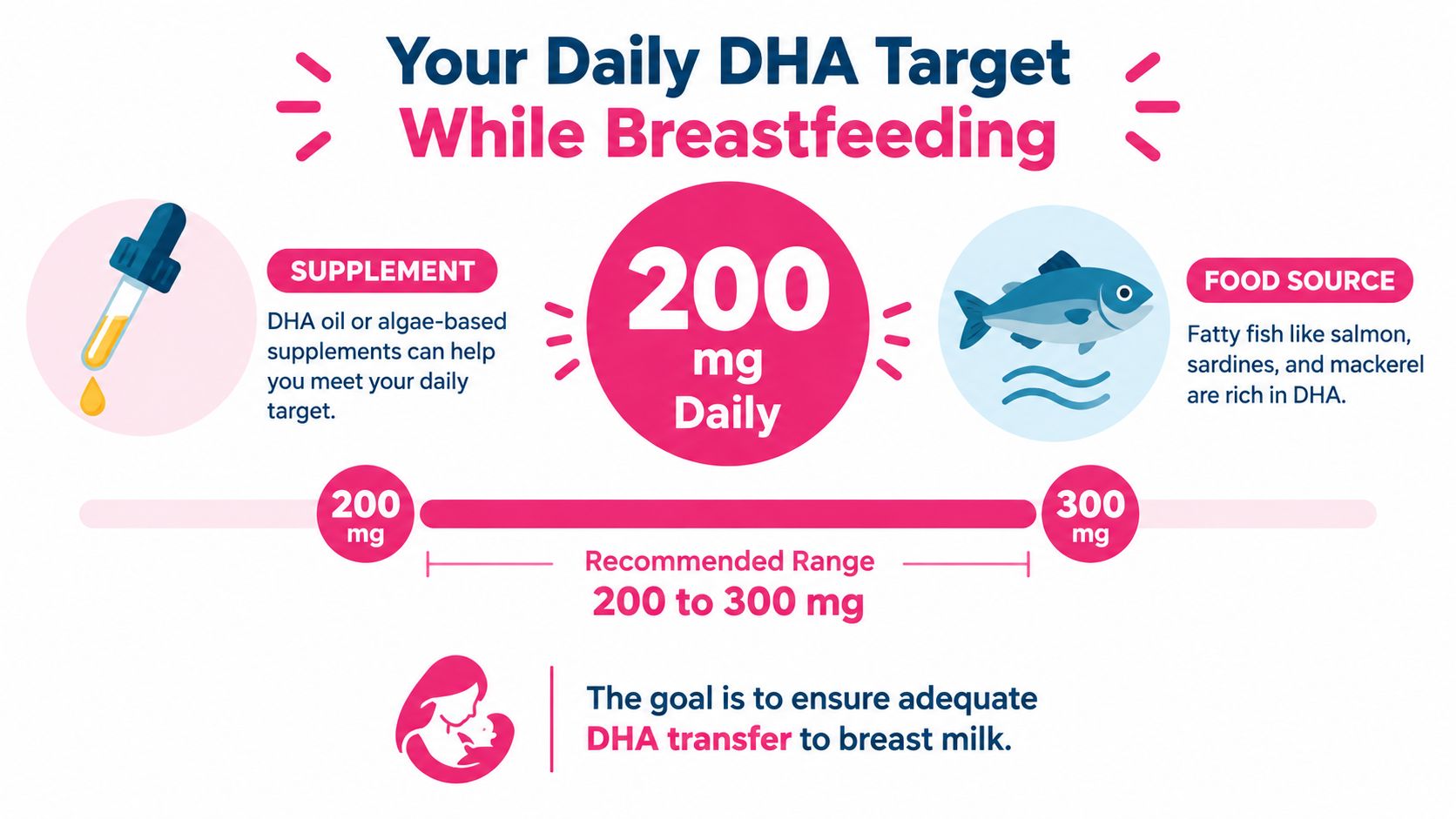
- About 200 mg of DHA daily: Global lactation guidance commonly centers on this amount for breastfeeding women, according to NIH LactMed's breastfeeding information on DHA.
- 200 to 300 mg of DHA daily: The American Academy of Pediatrics advises breastfeeding women to obtain this range, often through one to two servings of fish per week, as summarized in the NIH Omega-3 Fatty Acids fact sheet.
- 250 to 375 mg of DHA plus EPA daily: LactMed summarizes broader recommendations for nursing mothers using a combined DHA and EPA approach.
- About 1 gram of combined DHA plus EPA daily: LactMed notes that this amount may be needed to raise breast-milk DHA to roughly 1 gram per deciliter by four weeks postpartum. This is a higher, milk-targeting context, not a routine instruction for every mother.
These figures answer different questions. A daily target around 200 to 300 mg of DHA is commonly discussed for ordinary nutritional needs. A combined intake near 1 gram of DHA plus EPA aims at a different milk-composition goal and deserves guidance from your healthcare professional. If you are also reviewing your pregnancy intake, this overview of the prenatal DHA dose can help you compare the two stages.
How quickly can milk DHA respond
Maternal DHA intake can increase breast-milk DHA within hours, according to LactMed. Milk composition is responsive, like a recipe that adjusts to some of the ingredients available through your diet. A single capsule cannot correct a long-standing gap by itself, though.
A controlled-feeding study found that a standard prenatal DHA dose of 200 mg per day did not increase maternal red blood cell DHA, yet it increased breast-milk DHA over 10 weeks in lactating women, as reported in this PubMed-indexed study of prenatal DHA during lactation. Milk DHA can therefore change even when one maternal blood marker does not show the same response. Higher milk DHA does not guarantee the same infant outcome for every baby, so use your diet, preterm status, and adequacy goal to guide the decision.
Read the label carefully. Some products list total fish oil, while others list the actual DHA amount. Count the DHA line itself when comparing a product with these targets.
Can You Get Enough DHA From Food Alone
Food can be an excellent way to obtain DHA, especially if you enjoy seafood and can include it comfortably in your routine. The NIH fact sheet summarizes guidance that often uses one to two servings of fish per week to help breastfeeding women reach sufficient DHA in breast milk.
Lower-mercury fatty fish are practical choices because they provide preformed DHA directly. Salmon, sardines, anchovies, and herring are familiar examples. A meal built around juicy salmon fillets every time can also make regular fish intake feel more appealing, especially when you use a straightforward recipe such as this basil salmon preparation.
Other foods may contribute omega-3 fats, but they don't all provide DHA itself. Flaxseed, chia seeds, walnuts, and some fortified foods can fit into a nourishing diet, yet plant-based ALA isn't the same as preformed DHA. If your goal is specifically to raise DHA intake, check whether a food contains DHA rather than assuming every omega-3 source delivers the same nutrient.
| Source | Typical DHA Contribution | Considerations for Breastfeeding Mamas |
|---|---|---|
| Fatty fish | Provides preformed DHA | Useful when you enjoy fish and can choose lower-mercury options |
| DHA-fortified foods | Varies by product | Read the nutrition label because DHA amounts differ |
| Fish-oil supplement | Provides labeled DHA, often with other omega-3s | Check the actual DHA amount, freshness, and tolerability |
| Algal-oil supplement | Provides DHA from an algae-based source | A practical option for vegetarian diets |
| Flax, chia, and walnuts | Primarily provide ALA | Nutritious foods, but not a direct substitute for DHA |
When food may not feel realistic
You may be dealing with nausea, food aversions, a vegetarian or vegan diet, limited cooking time, or concern about selecting seafood. Some mothers don't like fish. None of those situations means you've failed at breastfeeding nutrition.
A supplement can be a reasonable bridge when your usual diet doesn't provide much preformed DHA. It can also make intake more predictable during the newborn stage, when planning a fish-based meal may feel harder than opening a bottle.
For practical food ideas, you can browse foods rich in DHA. If you're worried about mercury, ask your healthcare provider or consult current public-health seafood guidance rather than eliminating all fish automatically. The choice is often less about food versus supplements as competing philosophies and more about which combination helps you meet your nutritional needs consistently.
How to Choose a High Quality DHA Supplement
Shopping for a DHA supplement can feel confusing because the front of the bottle often emphasizes broad omega-3 language. Turn the bottle around and focus on the facts panel. The most important question is how much DHA you receive per serving, not just how much oil is inside the capsule.
Start with the label
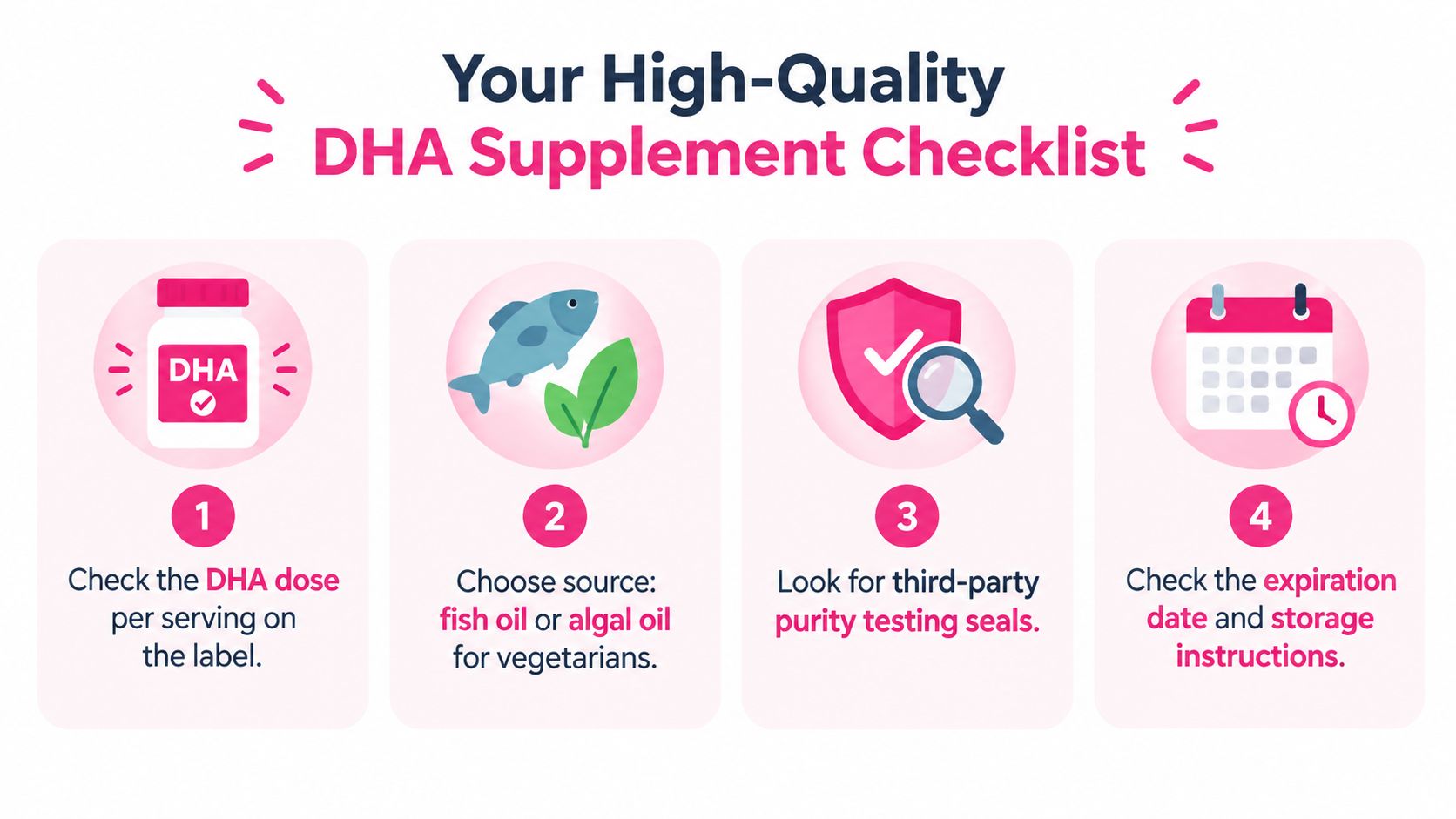
Use this checklist when comparing products:
- Check the DHA amount: Look for the specific DHA quantity per serving. Don't assume the total fish-oil amount equals the DHA amount.
- Identify the source: Fish oil provides marine DHA. Algal oil provides DHA without fish and may suit vegetarian or vegan preferences.
- Look for transparency: A clear ingredient panel should identify the oil source and serving size rather than hiding details behind a vague proprietary blend.
- Review purity testing: Third-party testing can offer additional information about identity, purity, and contaminants. A seal can be helpful, but you should still read what the organization verifies.
- Check freshness: Confirm the expiration date and follow storage instructions. Omega-3 oils can become unpleasant when they oxidize, so freshness matters for taste and confidence.
- Consider tolerability: If burping or stomach sensitivity bothers you, a delayed-release, smaller capsule, or gentle format may be easier to take.
You may also care about Non-GMO, gluten-free, soy-free, dairy-free, or artificial-color-free attributes. Those features don't automatically prove that a product is right for you, but they can help match the supplement to your dietary needs and preferences.
Make the routine doable
A supplement only helps if you can take it consistently. Try pairing it with a meal you already eat, storing it where you'll see it, and asking your provider whether it can be taken alongside your prenatal. Don't double up automatically if your prenatal already contains DHA.
You can also review what third-party testing means in this guide to third-party-tested supplements. Bring the product label to your OB, midwife, dietitian, or primary-care clinician if you're unsure how its DHA, EPA, and other ingredients fit your needs.
Vegetarian mothers often prefer algal DHA, while mothers who eat fish may choose fish oil or rely primarily on food. Neither choice is morally superior. The best option is the one that provides a transparent DHA amount, fits your dietary boundaries, and feels comfortable enough to use as part of real postpartum life.
Is DHA Safe for You and Your Breastfed Baby
For many breastfeeding mothers, DHA is well tolerated and can increase the DHA content of breast milk. The strongest, most consistent biochemical finding is straightforward: supplementation raises maternal and milk DHA, and it can improve infant biochemical DHA status, particularly when baseline intake is low, as summarized in this LactMed evidence review.
That result is meaningful, but it needs careful interpretation. Increased milk DHA doesn't guarantee that a term infant will have higher intelligence, stronger language development, better growth, or protection from a specific condition. Meta-analytic summaries in LactMed report no consistent benefit for term infants on intelligence, problem-solving, growth, language, ADHD, autism, anxiety, or depression.

A realistic way to think about benefits
The evidence is more favorable in certain contexts, including a mother whose seafood intake is low, a baby born preterm, or a situation where the practical goal is correcting a biochemical gap. For other healthy term infants, the benefit may be best understood as supporting nutritional adequacy rather than promising a measurable developmental advantage.
That's why a DHA supplement for breastfeeding mothers shouldn't be marketed as a universal brain booster. It's more accurate to describe it as a way to raise maternal and breast-milk DHA when intake is insufficient or when your healthcare team identifies a reason to consider additional support.
A calm decision rule: Improve the nutrient gap you can identify, and avoid promises the evidence can't support.
Here's a short video you can watch with your provider or support person when you're sorting through the basics:
Ask for individualized guidance if your baby was born preterm, you take medication that affects bleeding, you have a fish or algae allergy, you're preparing for a procedure, or you're considering an intake above ordinary supplemental amounts. You should also mention persistent nausea, reflux, loose stools, fishy aftertaste, or any unusual reaction. A different source, timing, or formulation may be more comfortable, but your clinician should help you decide.
Your Next Steps to Confidently Support Milk DHA
You don't need to overhaul your entire postpartum routine. Start with the information already in front of you and make one manageable decision.
- Look at your usual diet: Do you eat lower-mercury fatty fish regularly, or does seafood rarely appear on your plate?
- Read your current prenatal label: Find the actual DHA amount per serving, not just the total omega-3 or fish-oil amount.
- Choose a practical format: Fish oil may suit you, while algal oil can fit vegetarian preferences. Delayed-release capsules, peppermint, or ginger may help if taste and nausea interfere with consistency.
- Ask your provider: Your OB, midwife, dietitian, or your baby's pediatrician can help you consider your diet, health history, medications, and whether your baby's preterm status changes the conversation.
- Keep expectations grounded: A supplement can reliably improve maternal and milk DHA, but it can't guarantee a particular IQ, behavior, or developmental outcome.
One option to discuss is Feed Mom & Me Complete Prenatal Vitamin Plus DHA. It's a vegetarian, free-from, delayed-release capsule containing DHA, choline, selenium, and methylfolate, with peppermint and organic ginger included for tolerability. Feed Mom & Me is women-owned and built by moms for moms, with nutrition support intended to continue from preconception through pregnancy and postpartum, including subscription options for maintaining your supply.
Your needs may change after birth, and that's normal. The aim isn't to make every choice perfectly. It's to understand your intake, fill a likely gap when appropriate, and choose support that fits the mother and baby you're caring for today.
Feed Mom & Me offers the Complete Prenatal Vitamin Plus DHA, a vegetarian delayed-release prenatal with DHA, choline, selenium, methylfolate, peppermint, and organic ginger. Visit Feed Mom & Me to explore the product and postpartum nutrition resources, then review your choice with your healthcare provider.