
How Much Vitamin a Should a Pregnant Woman Take?
Published:Updated:
Pregnant women aged 19–50 need 770 mcg RAE of vitamin A daily, and pregnant teens aged 14–18 need 750 mcg RAE, counting food and supplements together. The daily upper limit for preformed vitamin A is 3,000 mcg RAE for adults and 2,800 mcg RAE for teens.
But if your prenatal lists vitamin A, does that tell you everything you need to know? Not quite. The form matters just as much as the amount, and understanding that difference can help you avoid unnecessary supplements without worrying about the carrots on your dinner plate.
You don't need to become a nutrition scientist, mama. You need a clear target, a way to read the label, and a provider who can help match your prenatal routine to your diet and health history.
Table of Contents
- What Is the Daily Vitamin A Target in Pregnancy?
- What Is the Difference Between Preformed Vitamin A and Beta-Carotene?
- How Do You Read a Prenatal Vitamin Label?
- Which Foods Help You Meet the Target Safely?
- When Does Your Vitamin A Need a Closer Look?
- What Should You Do If You Took Too Much Vitamin A?
- How Should You Choose a Prenatal and Talk With Your Provider?
What Is the Daily Vitamin A Target in Pregnancy?
Your daily vitamin A target is a total-intake goal, not a supplement prescription. The NIH Office of Dietary Supplements pregnancy guidance sets the recommended dietary allowance at 770 mcg RAE for pregnant women aged 19–50 and 750 mcg RAE for pregnant teens aged 14–18, with preformed vitamin A upper limits of 3,000 mcg RAE and 2,800 mcg RAE, respectively.
That total includes what you eat, what's added to fortified foods, and what you swallow in supplements. A prenatal doesn't automatically need to supply your entire requirement on top of your meals.
What do the target and upper limit mean?
The recommended dietary allowance, or RDA, is the amount intended to meet nutritional needs. The tolerable upper intake level, or UL, is a safety boundary, not an amount to aim for.
According to the NCBI Bookshelf vitamin A reference, nonpregnant adult women need 700 mcg RAE daily, compared with 770 mcg RAE during pregnancy, while the adult upper limit is 3,000 mcg RAE of preformed vitamin A. Pregnancy raises the requirement modestly, so eating for two doesn't mean doubling this nutrient.
Pregnancy vitamin A targets and upper limits
| Group or form | Daily vitamin A target | Upper limit for preformed vitamin A | What it means |
|---|---|---|---|
| Pregnant, ages 14–18 | 750 mcg RAE | 2,800 mcg RAE | Count food, fortified foods, and supplements together |
| Pregnant, ages 19–50 | 770 mcg RAE | 3,000 mcg RAE | Aim for adequacy, not the maximum |
| Nonpregnant adult women | 700 mcg RAE | 3,000 mcg RAE | A reference point, not a postpartum dosing plan |
| Beta-carotene from food | No separate RDA; contributes to total vitamin A | No established upper limit | Plant carotenoids aren't counted against the preformed limit |
| Supplemental beta-carotene | Contributes to total vitamin A | No established upper limit | An absent upper limit isn't a reason to take high doses |
The pregnancy rows and carotenoid distinctions follow the NIH guidance linked above; the nonpregnant comparison follows the NCBI reference.
What does RAE actually mean?
RAE stands for retinol activity equivalents. Think of it as a common measuring cup for vitamin A from different sources. Your body can use some forms directly and must convert others, so the same weight of each form doesn't provide the same vitamin A activity.
Vitamin A helps guide normal growth and development. A useful analogy is a foreman on a construction site: instructions help cells take on the right roles, but sending more instructions isn't automatically better. Excess preformed vitamin A can interfere with fetal development, which is why concentrated retinol deserves particular attention.
Your everyday approach can stay simple:
- Count the whole routine. Include meals, fortified foods, and every supplement.
- Separate need from safety. Meeting your requirement is the goal; approaching the upper limit isn't.
- Avoid automatic add-ons. Don't add a separate retinol supplement unless your clinician identifies a reason.
- Review the full prenatal dose. Our guide to prenatal vitamin dosing can help you organize questions about your daily routine.
Practical rule: Treat your prenatal as part of your nutrition plan, not an extra allowance to stack on top of other multivitamins.
If you're postpartum or breastfeeding, ask for a fresh review rather than carrying your pregnancy target forward unchanged. Your provider can consider your current diet, feeding plans, and medical history.
What Is the Difference Between Preformed Vitamin A and Beta-Carotene?
Vitamin A is a family, not one substance. The distinction that matters most is between ready-to-use preformed vitamin A and plant compounds your body converts into vitamin A.
The NIH vitamin A fact sheet identifies retinol, retinyl palmitate, and retinyl acetate as preformed vitamin A, and explains that the adult pregnancy upper limit of 3,000 mcg RAE, equivalent to 10,000 IU of preformed vitamin A, doesn't apply to beta-carotene in the same way.
This visual makes the label terms easier to recognize.
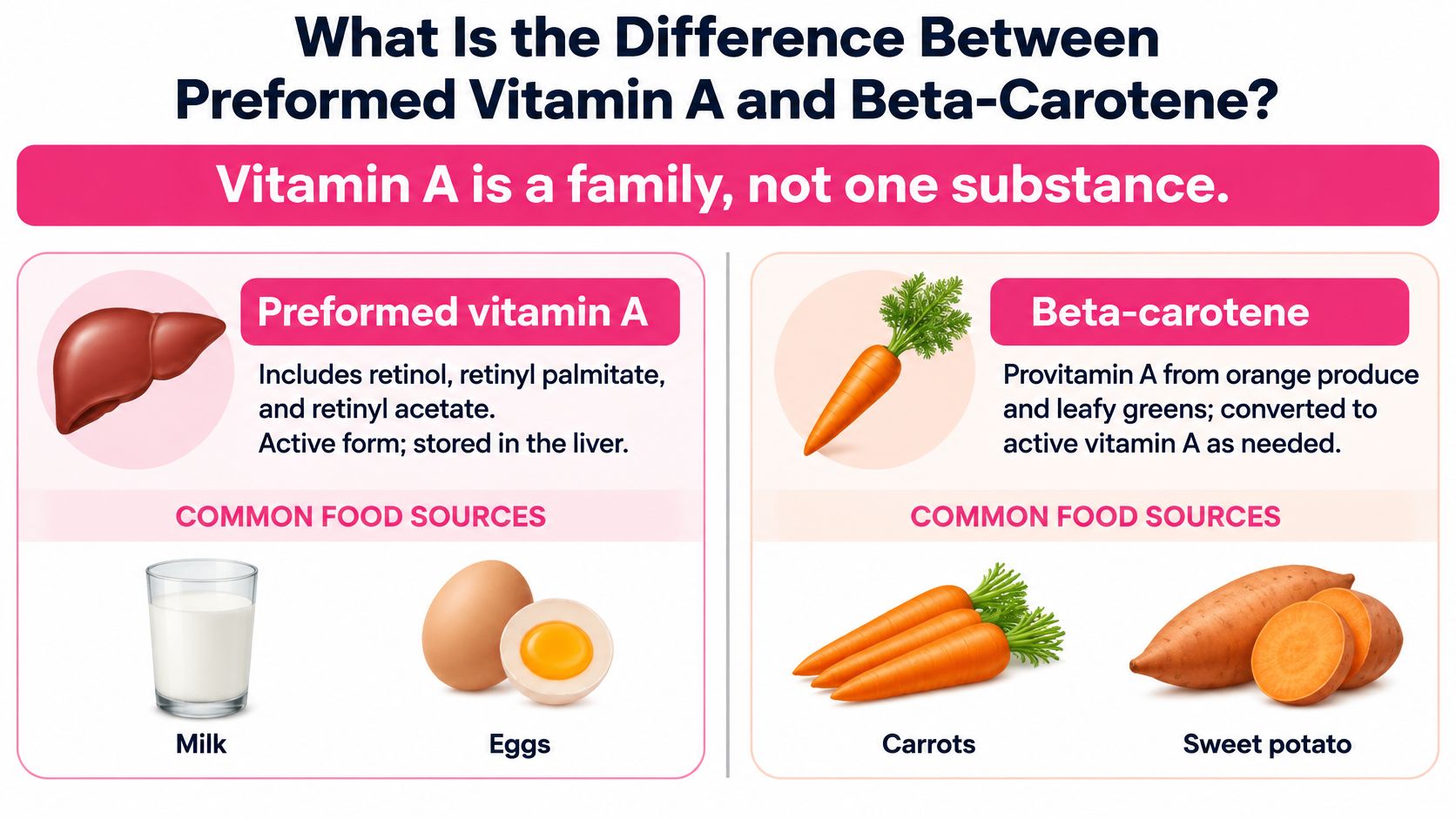
Preformed vitamin A compared with beta-carotene
| Form | Common sources | How your body handles it | Pregnancy safety frame |
|---|---|---|---|
| Preformed vitamin A, including retinol, retinyl palmitate, and retinyl acetate | Liver, eggs, dairy, fortified foods, cod liver oil, some supplements | Used directly and stored in the body | Counts toward the preformed upper limit |
| Provitamin A carotenoids, including beta-carotene, alpha-carotene, and beta-cryptoxanthin | Carrots, sweet potatoes, pumpkin, squash, spinach, kale, cantaloupe, apricots | Must be converted into active vitamin A | Food sources don't have an established upper limit |
| Supplemental beta-carotene | Isolated capsules and some prenatal formulations | Converted into vitamin A; supplemental and food forms have different activity | Don't assume high-dose supplements are necessary |
| Prescription retinoids, including isotretinoin and acitretin | Medications for certain skin conditions | Potent drugs, not ordinary nutrient doses | Require specific pregnancy precautions and prescriber oversight |
Why equal weights don't mean equal activity
Using the conversion factors in NIH guidance, 1 mcg RAE equals 1 mcg of preformed retinol, 2 mcg of supplemental beta-carotene, or 12 mcg of dietary beta-carotene. That's why the RAE amount on a modern label is more useful than comparing ingredient weights alone.
Your body handles a carrot differently from a concentrated retinol capsule. NIH notes that beta-carotene isn't known to cause the fetal-development toxicity associated with excessive preformed vitamin A. That doesn't make every isolated beta-carotene supplement necessary, but it does mean colorful vegetables shouldn't be treated as the problem.
The broader distinction between fat-soluble and water-soluble vitamins also helps explain why overlapping supplements deserve a careful review.
More retinol isn't better, and colorful produce isn't the villain. The useful question is which form you're getting, from which products, and whether you need it.
How Do You Read a Prenatal Vitamin Label?
A prenatal label works like a map. The front of the bottle gives you the headline, while the Supplement Facts panel shows the route. Start there, especially when a product marketed for immunity, beauty, or general wellness may overlap with your prenatal even if the packaging looks unrelated.
A peer-reviewed review of vitamin A in pregnancy explains why concentrated preformed vitamin A needs attention: it can accumulate in the body, so routine high-dose intake should be reviewed with a clinician. That is different from fearing carrots or other colorful vegetables. The label question is which form you are getting, how much you are getting, and whether it stacks with other sources.
Keep this checklist beside the bottles while you review them.
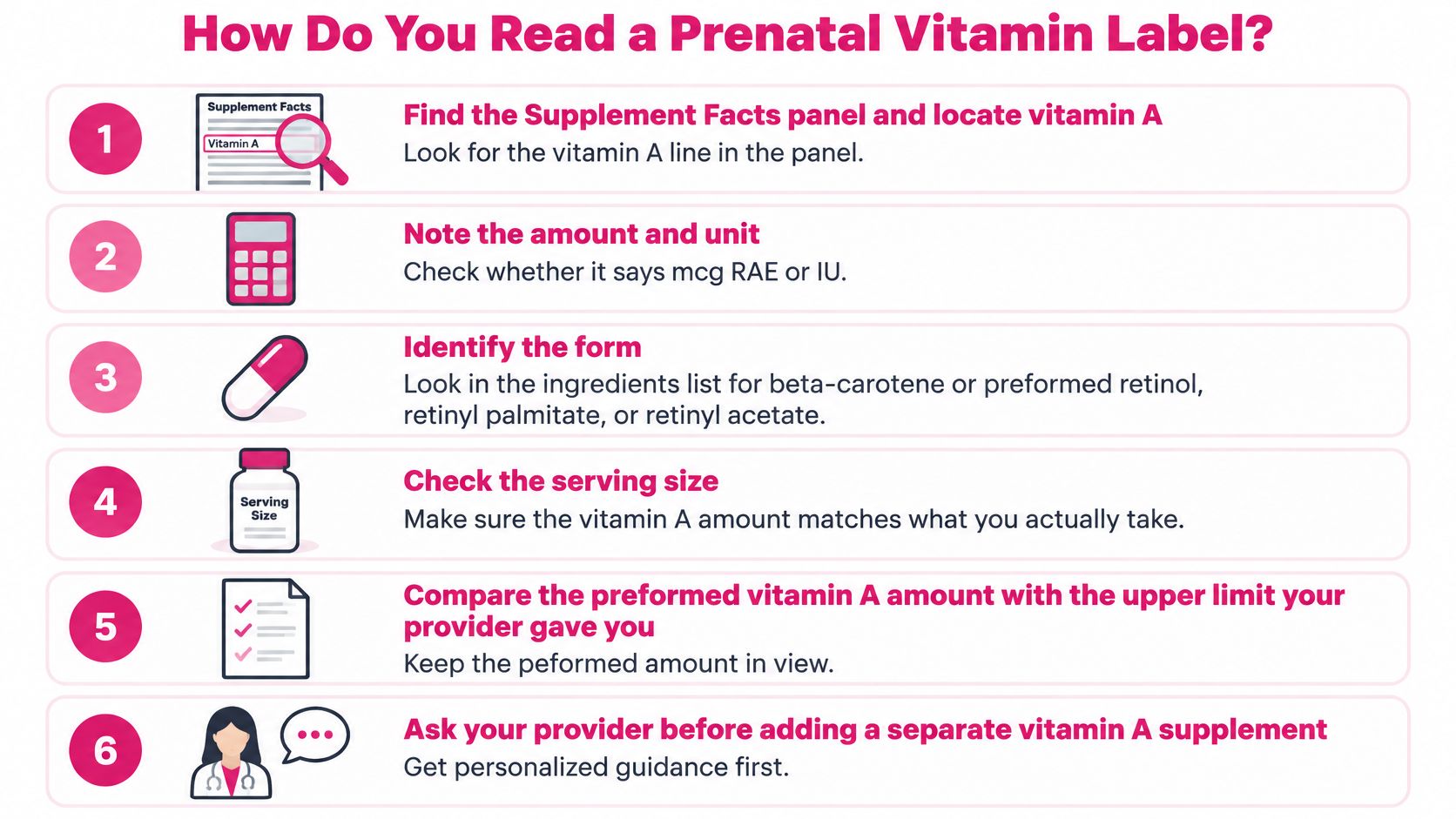
Use a label-reading checklist
- Find vitamin A. Locate its line on the Supplement Facts panel.
- Check the amount and unit. Write down the listed RAE amount, or flag an older IU listing for conversion.
- Identify the form. Look for beta-carotene, retinol, retinyl palmitate, or retinyl acetate. A mixed-source product may list more than one.
- Confirm the serving size. Match the label's serving with what you take. Don't assume the amount is per capsule.
- Make a complete inventory. Include your prenatal, multivitamin, liver oil, and beauty or immune supplements. Note regular liver meals and fortified foods separately.
- Review the total with your provider. Keep total vitamin A and the preformed portion in separate columns, mama.
Prenatal label terms and how to compare them
| What you see | What it means | How to use it |
|---|---|---|
| mcg RAE | Vitamin A activity is already expressed in comparable units | Compare total activity with your age-specific target; isolate the preformed portion for safety review |
| IU of retinol or a retinyl ester | An older unit for preformed vitamin A | Use a form-specific conversion; ask a pharmacist if the label is unclear |
| mcg or mg of beta-carotene | The weight of a provitamin A ingredient | Don't mistake ingredient weight for RAE |
| Retinyl palmitate or retinyl acetate | Preformed vitamin A | Include it in your preformed total |
| Cod liver oil | A possible source of both vitamin A and omega-3 fats | Check vitamin A separately rather than counting it only as a fish-oil product |
| % Daily Value | A reference percentage | Use the actual amount and form, not the percentage alone |
Add the preformed amounts, not just the product names
Consider a hypothetical label calculation: a prenatal supplies 400 mcg RAE as retinyl acetate, while a cod liver oil supplies 1,000 mcg RAE as retinyl palmitate. Together, that's 1,400 mcg RAE of preformed vitamin A, before food.
That example isn't a recommended combination. It shows why being below a safety ceiling doesn't prove that an add-on is useful, especially when your prenatal and meals may already cover your needs. It also shows why “natural” blends deserve the same scrutiny as obviously concentrated products.
If the label doesn't disclose how much comes from each form, don't guess. Ask the manufacturer for the breakdown and bring it to your clinician.
For a broader comparison of formulations, use our guide on how to choose a prenatal vitamin.
If a video format helps you review the label, you can watch this alongside your own bottle.
Which Foods Help You Meet the Target Safely?
A practical food plan doesn't need to revolve around a vitamin chart. Say breakfast is yogurt and fruit, lunch includes leafy greens, and dinner has a roasted orange vegetable. You've created several opportunities to get vitamin A without making concentrated supplements the center of your day.
Plant foods provide carotenoids, while eggs, dairy, and some fortified foods provide preformed vitamin A. Including both types can fit a balanced pregnancy diet, with portions and overall intake suited to your needs.
Build meals you'll actually enjoy
- Breakfast that's easy to assemble. Pair yogurt with cantaloupe, or make an egg-and-cheese wrap.
- A flexible lunch. Add spinach to a sandwich, grain bowl, or salad with olive oil and nuts.
- A comforting dinner. Try pumpkin soup or roasted sweet potato cubes alongside your usual protein.
- A simple vegetable side. If carrots sound appealing, Just Cook It's honey carrot guide offers a preparation idea you can adapt to your tastes.
A little fat alongside vegetables helps with carotenoid absorption. You don't need a special supplement for that purpose; familiar ingredients such as olive oil, yogurt, or nuts can fit naturally into the meal.
Cooking can also make some vegetable carotenoids easier to access. Choose preparations you tolerate and enjoy rather than treating raw vegetables as automatically superior.
Treat liver differently from vegetables
Liver is a concentrated source of preformed vitamin A, so it deserves a different conversation from carrots or spinach. Don't use liver meals, liver capsules, or liver oil as a self-directed way to improve prenatal nutrition.
If you eat liver regularly, tell your clinician the type, portion, and frequency. They can evaluate it alongside your supplements rather than trying to judge the meal in isolation.
You don't need to fear sweet potatoes. Put your attention on concentrated retinol and overlapping products.
For more everyday meal options, explore our guide to foods to eat when you're pregnant. The most useful food plan is one you can manage through changing appetite, nausea, and busy days.
When Does Your Vitamin A Need a Closer Look?
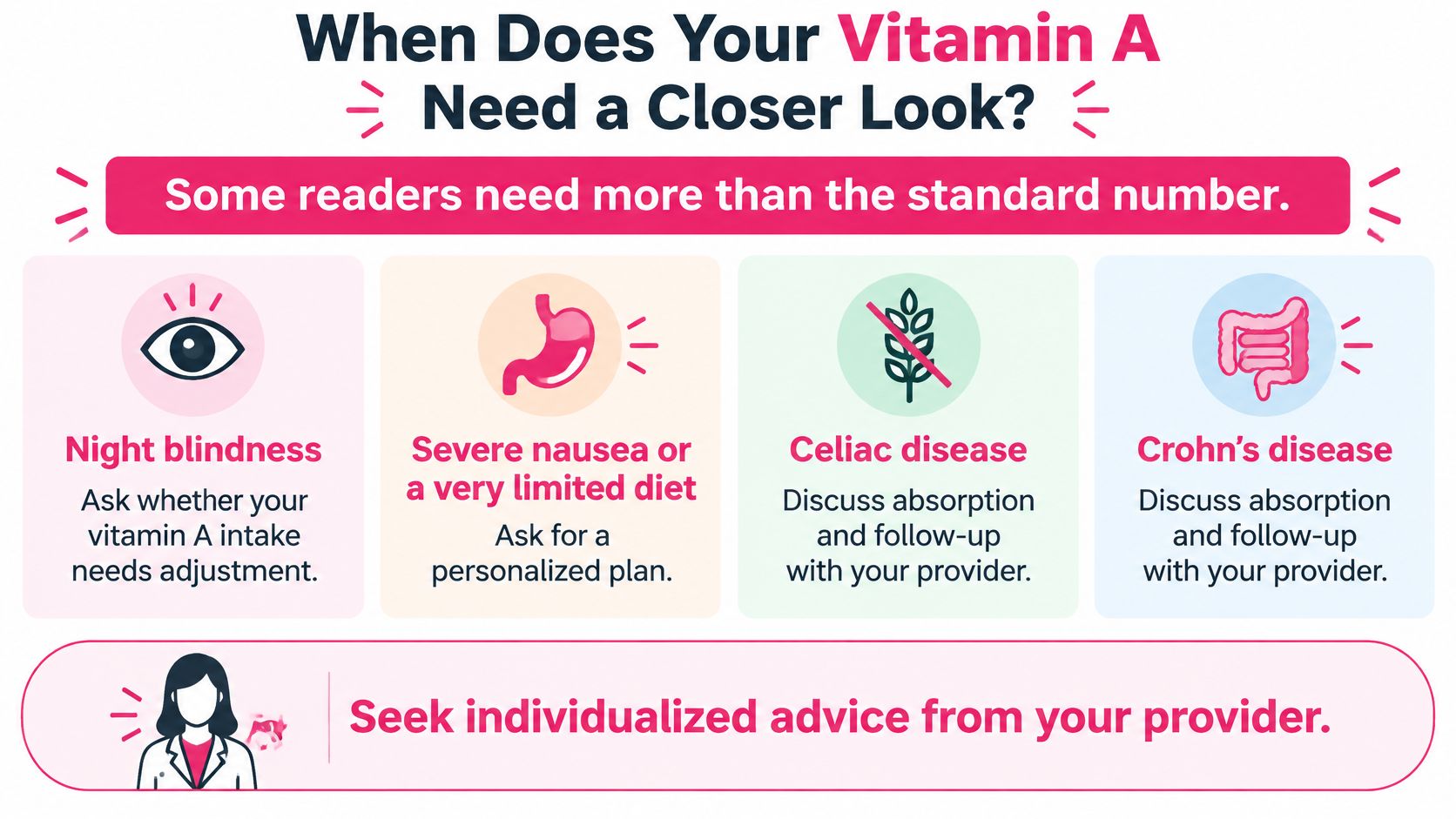
Some circumstances call for more than a standard nutrition target. If eating or absorbing nutrients is difficult, your provider may need to assess the reason before recommending a supplement.
Bring these concerns up rather than trying to correct them with extra retinol:
- Night-vision changes. Trouble seeing in dim light deserves assessment, not a self-diagnosis of deficiency.
- Severe nausea or a very limited diet. Tell your clinician what you're managing to eat and drink.
- Conditions affecting absorption. Mention celiac disease, Crohn's disease, cystic fibrosis, previous bariatric surgery, or a history of malabsorption.
- Liver disease. Your clinician needs to consider your health history before recommending additional vitamin A.
These situations are reasons for a closer look, not proof that you need a higher dose.
Why global guidance can sound different
The World Health Organization pregnancy supplementation guideline defines severe population-level deficiency as either at least 5% of women reporting night blindness during their most recent pregnancy in the previous 3–5 years, or at least 20% of pregnant women having serum retinol below 0.70 micromoles per liter.
In qualifying settings, that guidance allows up to 10,000 IU daily or 25,000 IU weekly under public-health or clinical supervision, specifically to help prevent maternal night blindness. Those are population-program rules, not your personal dosing instructions.
WHO doesn't recommend routine vitamin A supplementation to prevent maternal or infant illness and death where deficiency isn't a severe public-health problem. That distinction explains why a deficiency-prevention program and an ordinary prenatal appointment may lead to different recommendations.
Make the appointment useful
Bring your supplement bottles or clear photographs of the labels, a description of your usual meals, any relevant laboratory results, and a list of symptoms. Include products you take only occasionally, because they're easy to forget.
If you're considering a liver-oil product, our discussion of organic cod liver oil can help you prepare questions. Your clinician should make the decision based on the product's actual contents and your needs, not whether it sounds natural.
You deserve an individualized plan, mama, especially when nausea or a medical condition makes standard advice difficult to follow.
What Should You Do If You Took Too Much Vitamin A?
Finding an overlapping ingredient doesn't automatically mean you or your baby have been harmed. Normal vegetable intake isn't the same situation as taking a concentrated retinol product, and a prenatal taken as directed isn't a reason to assume toxicity.
Still, a large accidental dose needs prompt advice. The WHO safety guidance on vitamin A in pregnancy discourages a single dose above 25,000 IU, particularly between days 15 and 60 after conception, and notes uncertainty about safety above that amount later in pregnancy.
Don't use symptoms to rule out a problem
Possible signs of excessive preformed vitamin A include:
- After a large exposure. Headache, dizziness, nausea, vomiting, or blurred vision.
- With prolonged excessive intake. Dry or cracked lips, dry skin, hair loss, or bone and joint discomfort.
- Without obvious symptoms. Feeling well doesn't establish whether a pregnancy exposure is safe.
These symptoms have many possible causes, including ordinary pregnancy-related conditions. They can't confirm vitamin A toxicity on their own.
Take these practical steps
- Set aside nonprescribed retinol add-ons. Don't take more while you're getting individualized advice.
- Gather the details. Record the product, ingredient form, amount taken, timing, and whether the exposure happened repeatedly.
- Contact your obstetric clinician or a poison-information service promptly. Don't wait for symptoms after a large dose.
- Ask about your next prenatal dose. Don't double up, and don't abandon your prescribed prenatal plan without discussing what happened.
Seek urgent medical care for severe symptoms such as persistent vomiting, a severe headache, confusion, or major vision changes.
Prescription retinoids require special urgency. If you're pregnant and taking isotretinoin or acitretin, stop taking the medication and contact the prescriber immediately. These drugs aren't ordinary vitamin supplements, and the prescriber needs to arrange prompt pregnancy-specific advice.
How Should You Choose a Prenatal and Talk With Your Provider?
Your prenatal label is a starting point for a conversation. Choose by its actual label and fit with your diet, and bring your clinician a list of supplements, medications, fortified foods, and regular liver meals.
Use these questions to connect the label with your needs:
- Is my preformed vitamin A intake appropriate? Review food and supplements together so overlapping sources aren't missed.
- Which form does my prenatal use? Identify beta-carotene, retinyl esters, or a mixture. Keep those forms distinct when reviewing your total.
- Do I need anything extra? Ask your clinician to weigh your diet, symptoms, and medical history before adding another supplement.
Feed Mom & Me Complete Prenatal Vitamin Plus DHA is one option to discuss. Formulated by an OBGYN and a Registered Dietitian, it provides 50mg of DHA per serving, includes choline, and uses L-Methylfolate Calcium instead of synthetic folic acid. Directions are to take 3 vitamins daily. Compare that full serving's vitamin A amount and form with your nutrition plan, rather than reading the amount as though it represents one capsule.
Keep celebration planning separate from nutrition decisions: EventUploader baby shower use cases covers photo collection.
Visit Feed Mom & Me for prenatal details and nutrition education. Bring the current Supplement Facts panel to your next appointment, and agree on a daily plan without unnecessary vitamin A add-ons.