
Calcium Supplement Organic: What Matters in Pregnancy
Published:Updated:
If a calcium supplement says organic on the bottle, does that tell you how much calcium you'll absorb, or whether it's the right choice during pregnancy? Not necessarily. That reassuring word can describe an ingredient's agricultural certification, a chemical form, or the way a product is marketed.
If you've searched for calcium supplement organic, you're probably looking for something trustworthy for you and your baby. You don't need to become a chemist, mama. You just need to know which label details answer the questions that matter: how much calcium you're getting, what form it's in, how it's tested, and where it fits into your daily routine.
Table of Contents
- Which Calcium Forms Are Organic and How They Differ
- Is Organic Calcium Safer or Better Absorbed?
- How Much Calcium Do You Need Each Day in Pregnancy?
- How Calcium Form Changes Absorption and Dosing
- Which Nutrients Change How Calcium Works?
- Calcium Before Conception and After Birth
- Build Your Calcium Routine With Your Provider
Which Calcium Forms Are Organic and How They Differ
Organic doesn't identify a single kind of calcium. Agricultural certification describes how eligible ingredients are produced. In chemistry, organic calcium salts include forms such as citrate, lactate, and gluconate. Neither meaning tells you the dose without another look at the label.
The useful distinction is between elemental calcium, the calcium itself, and the compound carrying it. Think of a calcium compound as a delivery package. The package includes calcium plus another component, such as carbonate or citrate, but the entire package isn't calcium.
Common calcium forms compared
| Form | Elemental calcium | Take with food? | What to know |
|---|---|---|---|
| Calcium carbonate | Use the calcium amount in Supplement Facts, not the compound's weight | Yes, with a meal | A concentrated form; check the listed source and serving size |
| Calcium citrate | Read the elemental amount per serving | No meal requirement | Less dependent on stomach acid; worth discussing if carbonate bothers your stomach |
| Calcium lactate | Check the calcium line and number of tablets per serving | Follow the product's directions | Don't assume a larger compound amount supplies more calcium |
| Calcium gluconate | Compare elemental calcium, not tablet size | Follow the product's directions | Check how many tablets are needed for the labeled serving |
| Algae-derived calcium | Use the product's declared elemental calcium | Follow the identified salt form's directions | Algae describes the source, not a standardized calcium dose |
The front label might emphasize algae, marine minerals, or food-derived ingredients. Those descriptions don't replace the chemical name. For an algae-derived product, look for the actual calcium compound in the ingredient list rather than assuming the source determines how to take it.
Shell-derived products deserve the same careful reading. If the calcium is carbonate, its meal instructions still matter. A source story and a dosing instruction answer different questions.
Read the calcium line before the marketing language
Start with Supplement Facts, then check serving size. The calcium amount may apply to several capsules rather than the single capsule you're holding.
Next, look for wording such as calcium as calcium citrate. The first part tells you the nutrient; the second identifies its form. Don't multiply that declared calcium amount by an elemental-calcium percentage again, because the nutrient line already reports the calcium contribution.
Label-reading shortcut: Compare products using elemental calcium per serving, then check how many pills make up that serving.
Finally, match the product to your actual day. A supplement you can comfortably take at the right time is more useful than one chosen only because its front label sounds appealing.
Is Organic Calcium Safer or Better Absorbed?
The assumption to challenge is simple: organic automatically means safer or better absorbed. It doesn't. The NIH calcium consumer guide explains practical differences between calcium forms, including their relationship to stomach acid and meals, rather than establishing an absorption advantage from organic labeling.
Sorting the meanings makes a bottle much easier to evaluate.
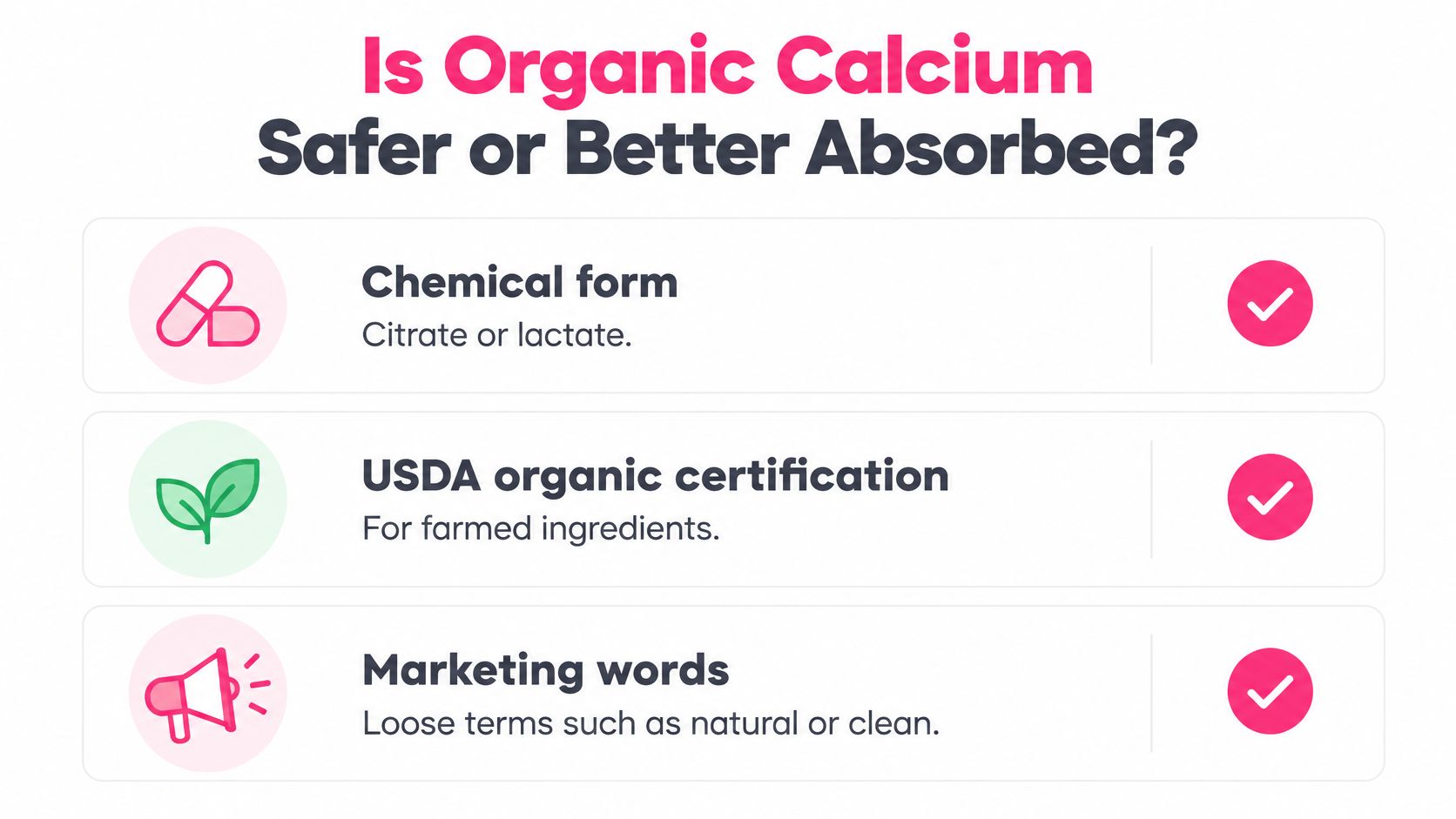
What does organic actually describe?
- Chemical form: Citrate and lactate belong to a chemical category. That doesn't mean their ingredients were organically farmed.
- Agricultural certification: USDA organic certification concerns eligible agricultural ingredients and production requirements. Check whether a certification applies to the finished supplement or only particular ingredients.
- Marketing language: Natural and clean don't tell you the elemental dose, identify contaminants, or document absorption.
Similarly, a product described as made with organic ingredients shouldn't be assumed to carry the same certification claim as a finished product bearing an organic seal. Read the exact wording rather than treating all organic references as interchangeable.
Our guide to whole-food-based vitamins offers another useful way to think about ingredient descriptions without confusing them with proof of performance.
Testing answers a different safety question
A review of animal studies on calcium forms and metal bioavailability found that several organic calcium salts, including citrate, lactate, gluconate, and aspartate, were associated with higher relative oral bioavailability of lead and cadmium than some inorganic minerals under experimental conditions. That doesn't establish that ordinary calcium supplements are unsafe for humans. It does show why a chemical category can't substitute for testing the finished product.
Use this checklist when comparing options:
- Certification scope: Identify what's certified and which organization issued the certification.
- Batch documentation: Look for a certificate of analysis that matches the lot number on your bottle.
- Contaminant testing: Ask whether an independent laboratory checks heavy metals and microbes, and whether the report includes acceptance limits.
- Verification marks: If a product displays USP Verified or NSF Certified, verify the exact product and certification scope.
- Elemental calcium: Make sure the nutrient amount and serving size are clear.
You don't need a frightening list of possible contaminants. You need transparent answers. Natural isn't a toxicology test, and a pretty label isn't a laboratory report.
How Much Calcium Do You Need Each Day in Pregnancy?
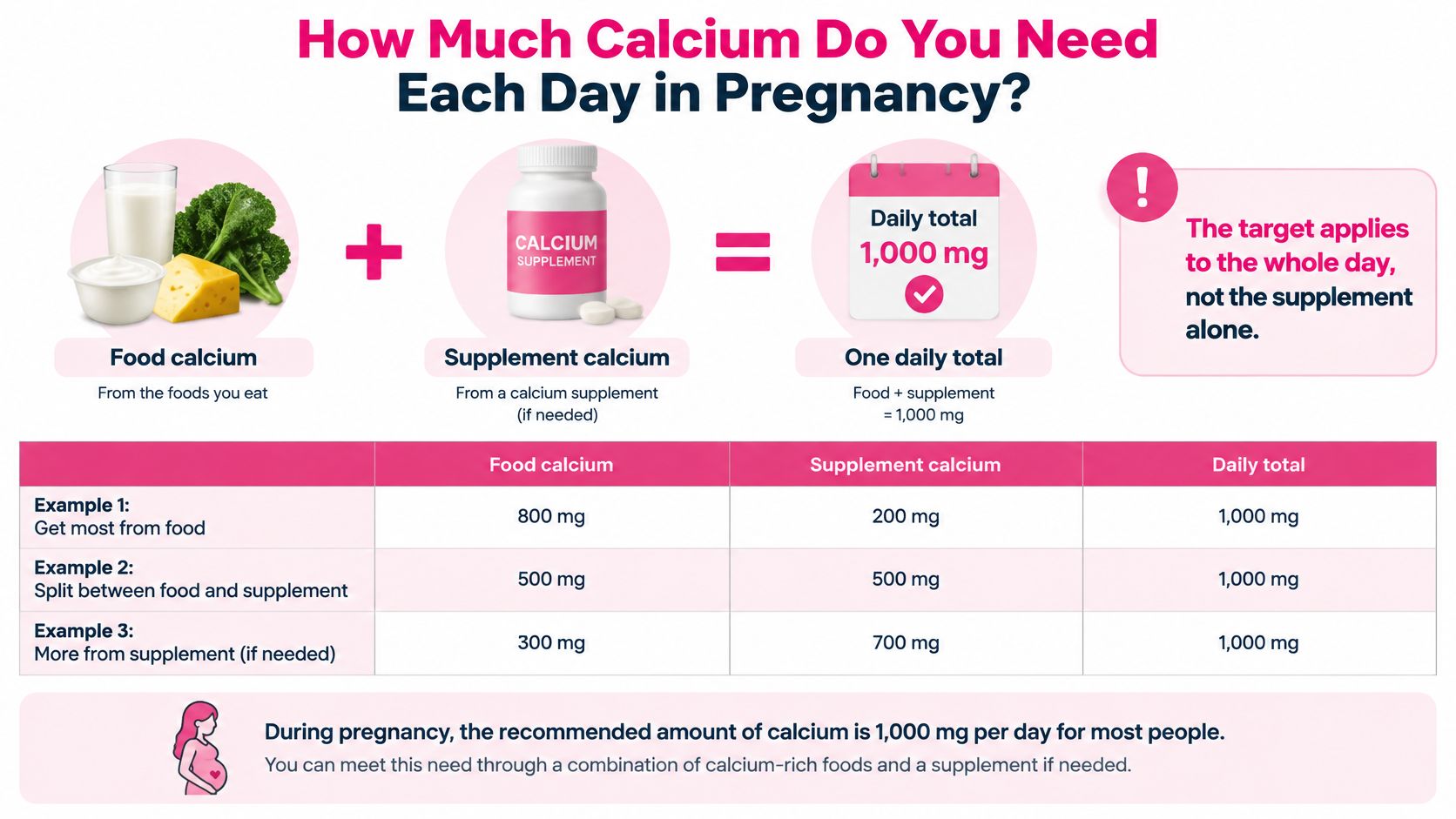
Your calcium target applies to food plus supplements, not to the supplement alone. The NIH Office of Dietary Supplements calcium fact sheet gives the following total-intake recommendations and upper limits for pregnancy and breastfeeding.
Total daily calcium targets in pregnancy and breastfeeding
| Group | Recommended total daily calcium | Upper limit, total daily |
|---|---|---|
| Pregnant or breastfeeding adults, ages 19–50 | 1,000 mg | 2,500 mg |
| Pregnant or breastfeeding teens | 1,300 mg | 3,000 mg |
Think of your intake as a calcium bank account. Food deposits calcium, your prenatal may deposit some, and a separate supplement adds another deposit. You're checking the balance of the whole account, not trying to reach the target with every individual product.
Upper limits are ceilings, not goals. Taking more than you need doesn't create extra protection. Before adding anything, count what's already coming from your meals, fortified drinks, prenatal, separate minerals, and calcium-containing antacids.
Start with foods you already enjoy
You don't have to build an entirely new menu. Look for familiar foods you can eat consistently:
- Dairy foods: Milk, yogurt, and cheese can contribute to your daily intake.
- Fortified plant milks: Check the actual carton for added calcium rather than assuming every plant-based drink contains it.
- Fish with edible bones: Canned salmon and sardines can contribute calcium when you eat the soft bones.
- Calcium-set tofu: Check the ingredient list and nutrition panel because tofu products aren't nutritionally identical.
- Cooked greens: Collards and bok choy offer options beyond dairy.
Our guide to minerals during pregnancy can help you consider calcium alongside the rest of your nutrition plan.
Add your own amounts, not generic serving guesses
For a hypothetical label-reading example, say your milk and yogurt labels add up to 500 mg, and your supplement lists 200 mg of elemental calcium. That would give you 700 mg before counting your other meals. Those are example label amounts, not standard values for every glass of milk or serving of yogurt.
Ask yourself: How often do you eat dairy or calcium-fortified foods on a typical day? Then check the portions you use. A splash of plant milk in coffee isn't the same serving as a full glass.
Keep a short food log across several typical days and bring it to your next appointment. Include brands, approximate portions, and supplement labels. Your provider can use that information, together with your medicines and health history, to decide whether you need an additional supplement.
How Calcium Form Changes Absorption and Dosing
Calcium absorption findings aren't as simple as a ranking from best to worst. The evidence summarized alongside a PubMed-indexed meta-analysis comparing calcium citrate and carbonate includes an earlier experiment in eight healthy fasting adults given a 500 mg dose, with the mean net absorption results below; the differences weren't statistically significant.
Net calcium absorption by salt in a 500 mg fasting dose
| Calcium salt | Mean net absorption |
|---|---|
| Calcium carbonate | 39% |
| Calcium lactate | 32% |
| Calcium acetate | 32% |
| Calcium citrate | 30% |
| Calcium gluconate | 27% |
The meta-analysis, however, summarized a relative absorption advantage of approximately 22%–27% for citrate over carbonate. That's a relative comparison between forms, not the percentage of an entire tablet that everyone will absorb.
Carbonate's higher numerical result in the small experiment doesn't cancel the broader finding. Nor does the meta-analysis guarantee that citrate will work better for every pregnant person.
Why the results can look different
Researchers can change the outcome by changing the dose, meal conditions, formulation, or participants. Stomach acidity also matters. A fasting experiment in healthy adults doesn't automatically predict what will happen when you take a prenatal, breakfast, and other medicines together.
There's another important distinction: absorption efficiency isn't the same thing as the amount printed on the label. A supplement can contain a substantial amount of calcium without your body absorbing all of it. That's why swallowing a larger dose isn't always the most useful solution.
A study helps explain how a form behaves. Your diet, tolerance, medicines, and prescribed dose determine how to use it.
Make the dose manageable
Larger supplemental totals are generally better divided rather than taken in one large sitting. Ask your provider how to split the specific amount you need after accounting for food.
For a hypothetical prescribed supplemental total of 1,000 mg, dividing it into 500 mg at breakfast and 500 mg at dinner illustrates the idea. It isn't an instruction to add that amount on top of an adequate diet, and the breakfast timing would need adjustment if that's when you take iron.
If you use acid-reducing medication or get stomach upset with carbonate, ask whether citrate would suit you better. Bring the actual bottle, because formulation and serving size matter as much as the form's name.
Which Nutrients Change How Calcium Works?
Iron deserves the first timing check. Calcium can interfere with iron absorption, so an iron-containing prenatal and a separate calcium supplement usually belong at different parts of the day.
A simple written schedule can make that easier than trying to remember several bottle instructions.

Nutrient interactions and timing with calcium
| Nutrient | Effect with calcium | Practical timing |
|---|---|---|
| Iron, including ferrous fumarate in many prenatals | Calcium can reduce iron absorption | Separate supplements by several hours; breakfast iron and later calcium may work |
| Vitamin D | Supports calcium absorption in the gut | Maintain your recommended intake; no special separation is needed |
| Magnesium | High supplemental amounts warrant a review of the overall mineral plan | Check combined amounts and ask whether divided doses would help |
| Food calcium | Contributes to total intake and can also matter when planning iron treatment | Count it toward your total; follow your clinician's meal instructions for iron |
Vitamin D helps your gut absorb calcium, but that doesn't mean you should automatically buy a higher-dose combination product. Check what your prenatal already provides before adding another bottle.
Magnesium also deserves a place on your supplement list. Rather than assuming ordinary recommended amounts will compete in a clinically important way, have your provider review high-dose combinations and your reason for taking them. Our explanation of magnesium in prenatal vitamins can help you prepare that conversation.
Build a day you can actually follow
A possible routine is an iron-containing prenatal with breakfast, then prescribed calcium later with lunch or dinner. Whether that works depends on meal spacing, the calcium form, and any instructions for other medicines.
Say a mama takes her calcium and prescribed iron together each morning, then learns her iron results haven't improved as expected. Separating the doses may help, but it isn't a guaranteed fix. Her clinician should also review the iron dose, tolerance, adherence, and other reasons for the result.
Food doesn't need to become a source of anxiety. Still, don't assume calcium in a meal can never affect iron absorption, especially when you're being treated for iron deficiency.
Use this video as an additional prompt for discussing your supplement routine.
Write every supplement's name, dose, and usual time on a single page. Include powders, gummies, antacids, and occasional products, not just your prenatal. That small habit gives your provider a much clearer picture than a list of nutrient names alone.
Calcium Before Conception and After Birth
Calcium planning doesn't begin with a positive pregnancy test or end at delivery. What changes is your routine: nausea may alter your meals, recovery can make cooking difficult, and breastfeeding can make regular eating harder to organize.
Before conception, focus on establishing reliable food sources rather than buying a high-dose calcium supplement for pregnancy prevention benefits. The WHO recommendations table on calcium supplementation recommends preconception calcium supplementation for preventing pre-eclampsia only in the context of rigorous research.
Adjust your plan to your stage
- Before pregnancy: Build meals around foods you'll realistically keep eating. Our guide to nutrition prior to pregnancy can help you organize that foundation.
- After birth: Recheck any pregnancy-specific prescription rather than automatically continuing it.
- While breastfeeding: Use the total-intake target appropriate for your age, and review supplements if your diet has changed.
- During weaning: Revisit your food pattern, not just whether you're still nursing.
A higher-dose pregnancy regimen may have been prescribed for a particular clinical or population context. That doesn't make it a permanent postpartum requirement. Ask for a clear continuation or stop plan before you leave it on autopilot.
Postpartum reminder: A supplement schedule should support your recovery, not become another test you feel you have to pass.
Recovery also includes comfort and personal care. For a separate, practical resource, Momotaro Apotheca's guide to gentle vulvar care after birth may help you prepare questions about that part of postpartum care.
At your postpartum visit, mention appetite changes, restricted foods, and any trouble tolerating your supplements. You don't have to wait until your meals feel perfectly organized to ask for help.
Build Your Calcium Routine With Your Provider
The best calcium plan is one your provider can review and you can follow. It should account for your food, your prenatal, any separate calcium product, and the practical realities of your day.
These starting points keep the conversation focused.
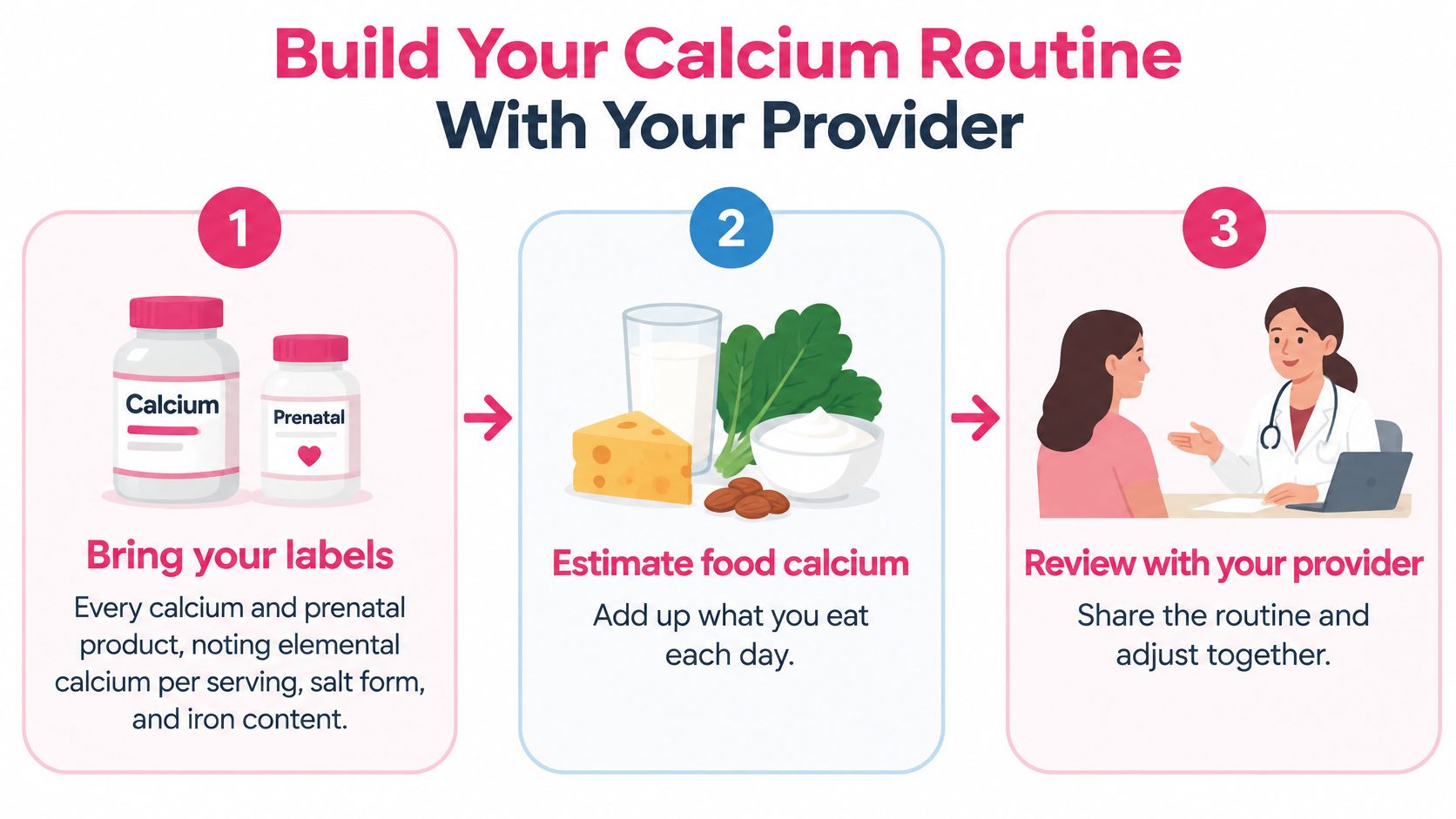
Bring a short, specific checklist
- Bring your labels. Photograph Supplement Facts and ingredient panels. Include the serving size, elemental calcium, salt form, iron content, and any other medicines.
- Estimate your food contribution. Bring your food log so your provider can distinguish an intake gap from uncertainty about portions.
- Ask which recommendation applies to you. The WHO calcium supplementation guideline recommends 1,500–2,000 mg of supplemental elemental calcium daily, divided into three doses, preferably with meals, for pregnant women in populations with low dietary calcium intake to reduce pre-eclampsia risk. This isn't a universal pregnancy dose.
- Agree on the amount and schedule. Have your provider write down the supplemental total and how to divide it. Don't reshape a prescribed regimen just to fit a general example.
- Check compatibility. Confirm the spacing from iron and any other medicines with your clinician or pharmacist.
- Set a review point. Reassess when your diet, prescriptions, pregnancy stage, or postpartum needs change.
The WHO pregnancy calcium guidance places supplementation in the context of dietary intake and pregnancy care. If you already meet your needs, a more natural-sounding product isn't a reason to add more.
Keep your prenatal and calcium decisions connected
Our guide to how to choose a prenatal vitamin can help you compare your broader nutrient needs. The useful question isn't whether one bottle sounds complete, but whether your whole routine supplies what you need without unnecessary overlap.
As a women-owned brand built by moms, for moms, we recommend discussing Feed Mom & Me Complete Prenatal Vitamin Plus DHA with your provider as one prenatal option. Our formula provides folate as L-methylfolate calcium, DHA, choline, and 18 mg of iron; a third-party lab tests each batch twice for heavy metals, microbes, allergens, and other contaminants. It doesn't replace calcium planning.
Bring your labels and food log to your next appointment, mama. Ask your healthcare provider to confirm your total, your timing, and whether a separate calcium supplement belongs in your plan.
Feed Mom & Me offers prenatal nutrition support and approachable education to help you make sense of supplement labels. Visit Feed Mom & Me to explore our prenatal and resources, then share your choices with your healthcare provider so your calcium and iron routine fits your needs.