
How to Get DHA During Pregnancy
Published:Updated:
You're standing in the grocery store, phone in one hand, prenatal bottle in the other, trying to figure out if you need fish, a capsule, or both. You're not alone in that moment, mama. Learning how to get DHA during pregnancy gets much simpler once you estimate what you're already eating, then fill the gap in a way that fits your stomach, your budget, and your life.
Table of Contents
- Why DHA Matters During Pregnancy
- How Much DHA Do Pregnant Women Need
- Best Low-Mercury Fish for DHA
- Choosing a DHA Supplement That Works for You
- Smart Dosing and Reading Supplement Labels
- Tolerability Tips When DHA Makes You Queasy
- Putting Your Weekly DHA Plan Together
Why DHA Matters During Pregnancy
That supplement aisle moment is familiar for a reason. Every label claims to matter, and it's hard to tell what's essential building material and what's just nice to have. DHA, or docosahexaenoic acid, is building material. It's an omega-3 fat your baby uses to build the brain, eyes, and nervous system, and your baby gets it from you.
Your body transfers DHA to your baby, much like handing over bricks from your own house. The need increases especially when brain and eye development speeds up later in pregnancy. If you do not replace what you give away through food or a supplement, your own stores run lower. That is not a reason to panic. It is a reason to have a steady source you can stick with.
What the Preterm Birth Evidence Shows
The strongest signal isn't about making a smarter baby. It's about timing. In a Cochrane review analyzed for preterm birth, omega-3 supplementation was associated with 119 cases per 1,000 participants compared with 134 per 1,000 without omega-3, and for early preterm birth the estimates were 27 per 1,000 compared with 46 per 1,000, as summarized in the NIH pregnancy fact sheet on omega-3 trial results.
Those are group results, not a promise for any one pregnancy. Benefits can depend on where you start, what dose you take, and who was studied. The same NIH summary notes that evidence on supplements and infant development remains mixed.
DHA isn't magic, and more isn't automatically better. It's a nutrient to get consistently, in an amount that matches your diet.
That's the lens for everything below. You'll get a clear daily target, a grocery list of fish that are low in mercury, a plain-English guide to supplement types, and tricks for the queasy days. If you want more food ideas that support development, our guide to nine foods to boost your baby's brain development while pregnant pairs well with the plan you'll build here. Start with what you eat now, then decide what, if anything, needs to top it up.
How Much DHA Do Pregnant Women Need
You don't need to memorize five different guidelines. You need one baseline, one pregnancy bump, and an honest look at your plate.
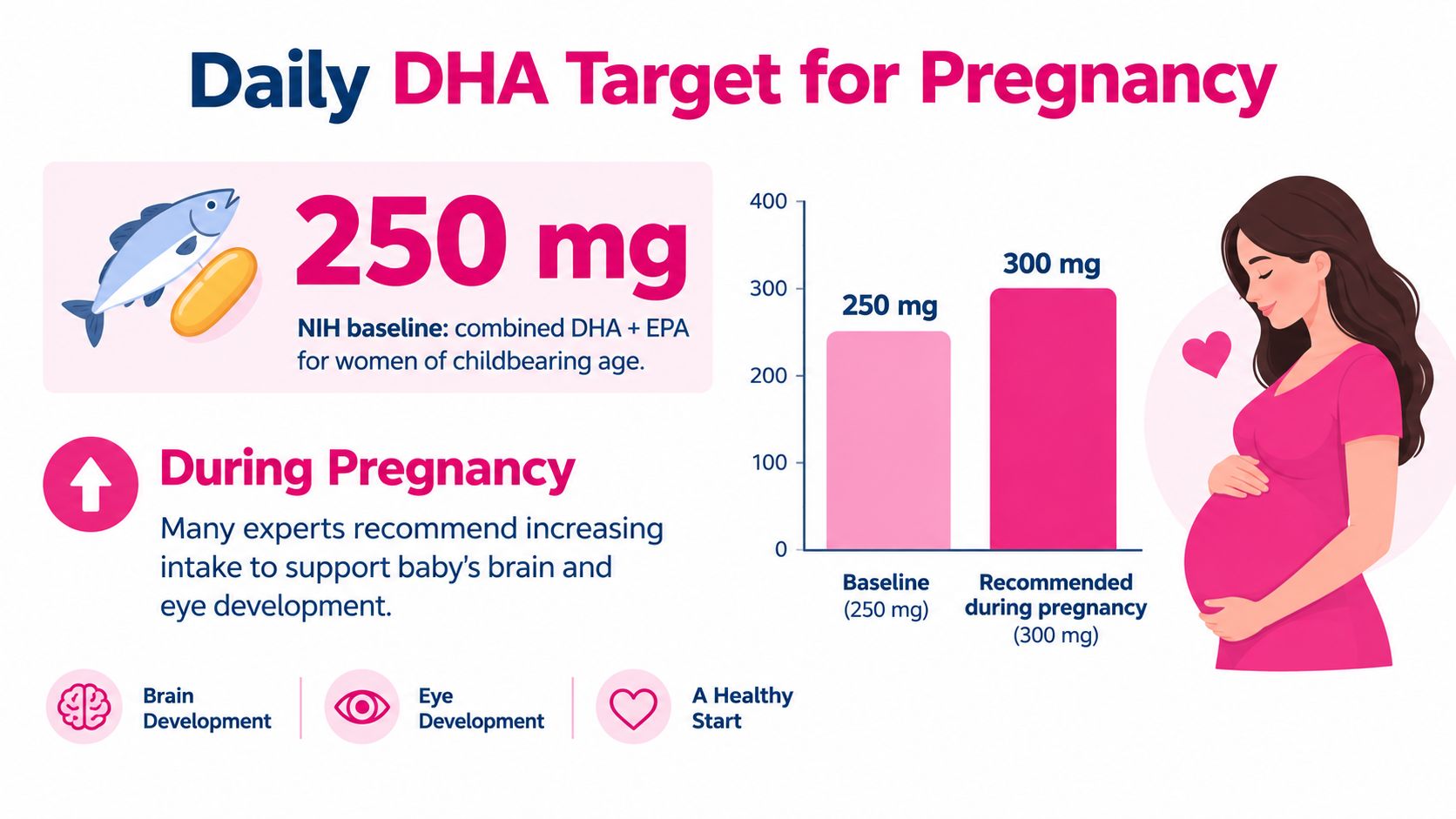
Guidance summarized by the NIH describes at least 250 mg per day of combined DHA and EPA for women of childbearing age, plus an additional 100 to 200 mg of DHA per day during pregnancy, while FAO guidance described in that summary calls for at least 300 mg of DHA plus EPA daily, including 200 mg DHA, according to the NIH omega-3 fact sheet for health professionals.
Different authorities phrase it differently, but they point in the same direction. Pregnancy raises the target, and food counts toward it.
Why Your Starting Point Changes the Math
Consider two mamas. One eats salmon most weeks and likes sardines on toast. She's already covering part of her target at the table, so a supplement, if she uses one, is gap insurance for busy weeks. The other is vegetarian, can't stand fish right now, or hasn't eaten seafood in months because the smell sends her running. Her gap is bigger, so her supplement conversation with her provider will look different.
Neither approach is more virtuous. They're just different starting lines.
- You eat seafood regularly: Track your typical week, not your best week, and see how close food alone gets you.
- You eat seafood rarely: A supplement does more of the heavy lifting, so the actual DHA amount on the label matters more.
- Your intake runs very low: Ask your OB or midwife directly whether a higher-dose approach fits your history, rather than choosing one on your own.
That last point matters. Some clinical guidance discusses higher amounts for people with low intake, started earlier in pregnancy, but that's a provider-led decision, not a self-prescribed upgrade. You'll see those specifics in the dosing section below, framed the way to bring them up at a prenatal visit.
Write down your honest answer to one question before you shop. In a normal week, how often do you eat fish? That answer drives every smart choice that follows.
Best Low-Mercury Fish for DHA
Food first doesn't mean fish at every meal. It means a small, repeatable weekly habit you don't have to negotiate with yourself each Monday.
The FDA and EPA advise 8 to 12 ounces, about 227 to 340 grams, of varied cooked seafood weekly from the Best Choices lower-mercury category, spread over 2 to 3 servings, with a standard serving of 4 ounces before cooking, per the FDA and EPA advice on eating fish during pregnancy.
That amount helps, but it doesn't land in exactly the same place for everyone. A review in the NIH archive reports that two servings of seafood per week may provide about 100 to 250 mg per day of total omega-3 fats, including about 50 to 100 mg per day of DHA, as described in this review of seafood intake and omega-3 amounts. Species, portion, and consistency all move the number. That's why many mamas pair food with a supplement instead of treating it as either-or.
Your Grocery Shortlist
| Fish | Why it works | Servings per week | Mercury status |
|---|---|---|---|
| Salmon | Rich source of DHA and EPA, easy to cook | Part of your weekly Best Choices total | Lower mercury |
| Sardines | Small fish, strong DHA source, budget friendly | Part of your weekly Best Choices total | Lower mercury |
| Trout | Mild flavor that suits sensitive taste buds | Part of your weekly Best Choices total | Lower mercury |
| Herring | Oily fish with DHA and EPA | Part of your weekly Best Choices total | Lower mercury |
| Canned light tuna | Pantry staple for busy days | Part of your weekly Best Choices total | Lower mercury |
| Shrimp and pollock | Mild, widely available, easy portions | Part of your weekly Best Choices total | Lower mercury |
Rotate what you buy. Variety spreads nutrients and keeps you from leaning on one species week after week.
Fish to Skip and Rules That Trip People Up
The EPA and FDA list shark, swordfish, king mackerel, tilefish from the Gulf of Mexico, marlin, orange roughy, and bigeye tuna as choices to avoid, and for locally caught fish with no advisory, their guidance is one serving that week and no other fish, according to the EPA and FDA advice about eating fish and shellfish.
- Don't treat all tuna the same: Albacore or white tuna is limited to one serving weekly in FDA guidance, while canned light tuna sits on the Best Choices list.
- Cook it thoroughly: This isn't the season for raw seafood experiments, and our overview of foods to avoid during pregnancy covers the broader list.
- Check local advisories: Self-caught fish follows local rules, not the grocery store chart.
The FDA also notes moderate evidence that eating fish during pregnancy can support fetal cognitive development. You don't need to fear seafood, mama. You need the right species, cooked well, in a rhythm you can repeat.
Choosing a DHA Supplement That Works for You
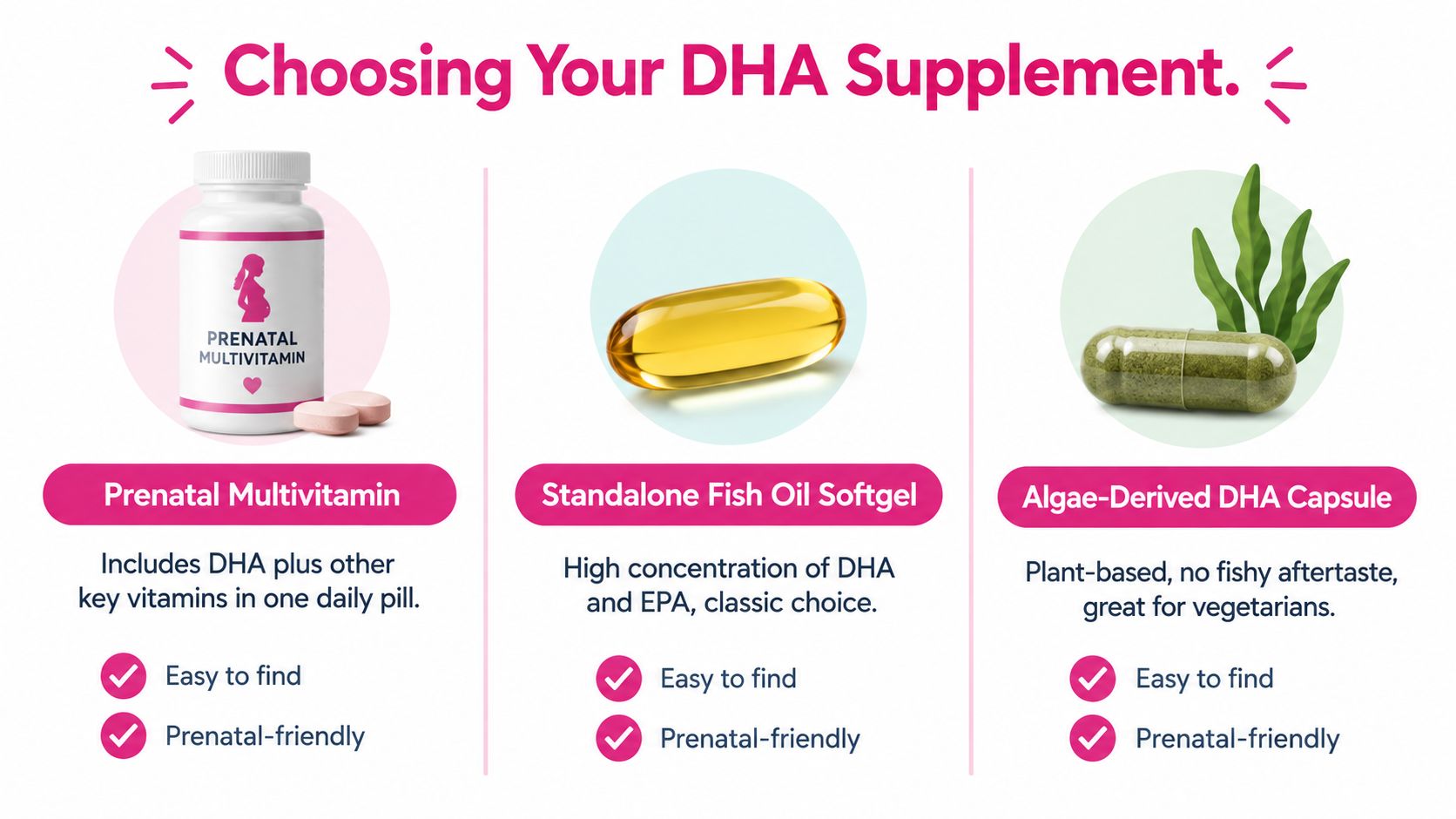
Supplements aren't a test of how serious you are about pregnancy. They're a tool for the gap between your target and your actual week. Three formats cover almost everyone.
The Three Real Options
A prenatal multivitamin that includes DHA suits the mama who wants one bottle and one habit. You get DHA alongside other prenatal nutrients, which makes consistency easier when you're tired and your routine is already full. The tradeoff is dose. A combined product may provide a modest amount of DHA, so check whether that amount, plus your food, reaches the target you discussed with your provider.
A standalone fish oil softgel suits someone whose provider wants a specific amount of DHA, EPA, or both. Fish oil products may supply DHA with or without EPA, and the dose is easier to adjust. The tradeoff is tolerability for some people, plus one more capsule to remember.
An algae-derived DHA capsule suits vegetarians, people with fish allergies, and anyone who avoids fish for personal or cultural reasons. Algae is where fish ultimately get DHA, so you're going closer to the source. If that route appeals to you, our explainer on the algae-based DHA supplement option walks through how it differs from fish oil.
Match the format to your life: The best option for you is the one you'll take on a random Tuesday, not the one that looks most impressive in the cart.
A Quick Self-Check Before You Buy
- Diet first: How much DHA does your normal week already provide?
- Restrictions: Do you avoid fish, have an allergy, or follow a vegetarian pattern?
- Tolerances: Do capsules, tastes, or certain ingredients bother your stomach?
- Provider input: Has your OB, midwife, or dietitian suggested a particular amount because of your history?
Answer those four and the shelf gets quieter. You're not choosing the universally correct product. You're choosing the format that closes your personal gap without creating a new daily struggle. Bring your shortlist, or a photo of the labels, to your next prenatal visit and confirm the fit together.
Smart Dosing and Reading Supplement Labels
The front of the bottle is marketing. The Supplement Facts panel is math. Learn to read the math and you won't be misled again.
Start with one rule. Total fish oil is not DHA. A capsule can list a large amount of fish oil while providing far less DHA, because the oil contains other fats too. The numbers that count toward your target are the separate lines for DHA and EPA in milligrams. If a label only says omega-3 without breaking out DHA, you can't tell how much DHA you're getting.
Read the Label in This Order
- Find DHA milligrams: Look past the oil total and locate the DHA line first.
- Find EPA milligrams: Note it separately, since some targets count DHA plus EPA together.
- Check serving size: Confirm whether the amounts listed require one capsule or two.
- Scan added ingredients: Note flavors, coatings, and anything you personally avoid.
- Look for testing information: Our article on what 3rd party tested means explains the language brands use on labels and product pages.
Then do your personal subtraction. If food covers part of your week, your supplement only needs to cover the rest. If you eat little to no seafood, the supplement carries more weight. That's the whole decision framework, and it's why your friend's dose may not be your dose.
When a Higher Dose Enters the Conversation
For pregnant people with DHA intake below 150 mg per day, some clinical guidance summarized by the NIH has recommended 600 to 1,000 mg per day of DHA plus EPA, or DHA alone, beginning in the second trimester and no later than 20 weeks, per the NIH summary of guidance for low DHA intake.
Read that carefully, mama. It's targeted guidance for low intake, not a universal prescription, and it belongs in a conversation with your obstetric clinician. Higher isn't automatically better, and trial results don't support the idea that extra DHA improves every outcome for every person. Your history, including any prior preterm birth, shapes whether this applies to you.
Bring the actual bottle to your appointment. Point to the DHA line and ask, does this amount plus my diet make sense for me? That one question turns label reading into personalized care. Consistency with the right amount beats perfection with a guessed amount every time.
Tolerability Tips When DHA Makes You Queasy
Let's talk about the fishy burp, because it's the reason many perfectly good capsules sit unopened in a cabinet. If a supplement makes you gag, you won't take it, and a plan you can't keep down isn't serving you or your baby.

Meet the most common scenario. You take your capsule first thing, on an empty stomach, with your other vitamins. Twenty minutes later you're queasy and tasting fish. Before you quit DHA entirely, change the conditions around the capsule.
Small Changes That Often Help
- Take it with dinner: Food in your stomach, especially your largest meal, can make a capsule easier to tolerate than a morning dose.
- Try nighttime: Some mamas sleep through the window when repeat taste would bother them.
- Refrigerate the bottle: A cold capsule can reduce fishy repeat for some people.
- Split the dose: If your product uses more than one capsule, ask your provider about dividing it across meals.
- Switch the format: Enteric-coated, delayed-release, or algae-derived options may sit better if standard fish oil doesn't.
Our dedicated guide to the fish oil burp problem goes deeper on why repeat happens and what to adjust first.
Some prenatals are built with this exact struggle in mind, using delayed-release capsules and ingredients like peppermint and organic ginger to support palatability for sensitive stomachs. Tolerability isn't a luxury feature during pregnancy. It's the difference between a habit that lasts forty weeks and one that lasts four days.
This short video walks through practical ways to make daily supplements easier during queasy stretches.
One boundary matters here. If nausea is severe, persistent, or keeping you from eating and drinking enough, don't troubleshoot capsules on your own. Call your provider. Tolerability tips are for ordinary queasiness, not for suffering you should endure. You deserve support, not a pep talk, when pregnancy feels rough.
Putting Your Weekly DHA Plan Together
Here's your plan on one screen, built two ways so you can copy the version that looks like your life.
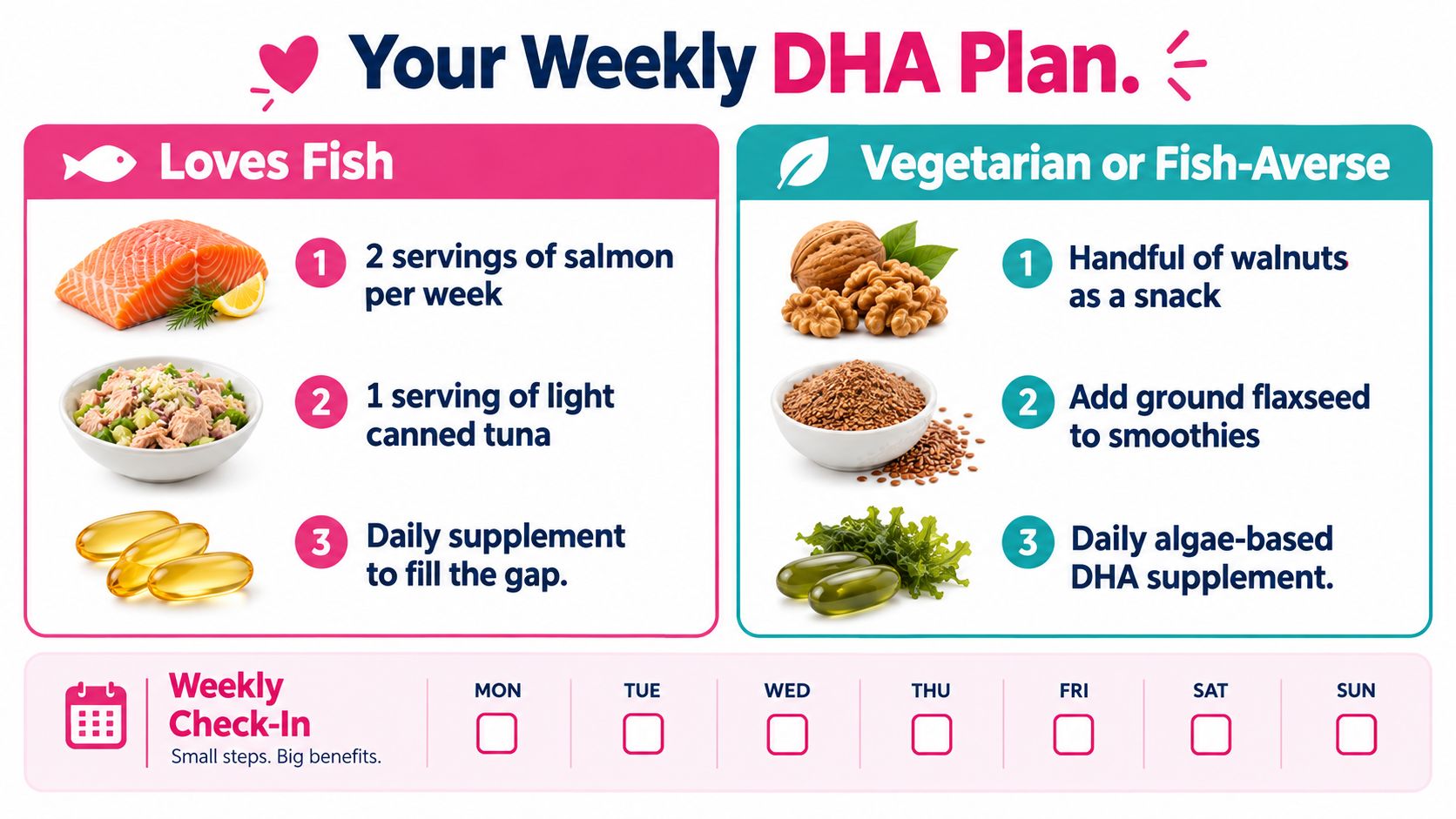
If you love fish, anchor your week with salmon one night, sardines or trout another day, and canned light tuna for an easy lunch. Rotate species, keep portions within the Best Choices framework from earlier, and use a supplement only to cover weeks when meals fall apart.
If you're vegetarian or fish-averse, build around a daily algae-derived DHA capsule at the amount you confirm with your provider. Walnuts and ground flaxseed are nutritious snacks, but don't count on them to replace DHA itself. Your capsule does that job.
Both plans share the same safety pillars. Choose lower-mercury species, avoid the high-mercury list, cook seafood thoroughly, and read every label for actual DHA milligrams. Because NIH summaries describe mixed evidence on supplements and developmental outcomes, food first with supplement support is the most reassuring path for most mamas.
If you want one daily product to help close the gap, Feed Mom & Me Complete Prenatal Vitamin Plus DHA includes DHA alongside nutrients such as choline, selenium, and methylfolate, in a vegetarian, soy-free, gluten-free, and dairy-free formula. We're women-founded and built by moms, for moms, and we still want you to confirm dose and fit with your OB or midwife.
You've got this, mama. Estimate, choose, and stay consistent.
If you're looking for a once-daily way to support your DHA plan alongside a food-first routine, visit Feed Mom & Me to explore our Complete Prenatal Vitamin Plus DHA, bundles, and mama-friendly nutrition education. Choose the option that fits your diet and stomach, then bring your plan to your next prenatal visit so you and your provider can confirm it together.