
Whole Food Prenatals Explained
Published:Updated:
You're standing in the vitamin aisle, holding one prenatal labeled “whole food,” another promising advanced forms, and a third with a beautifully simple ingredient list. Your stomach already feels unsettled, the online reviews disagree, and every label seems to use a different language. If you're pregnant, trying to conceive, or newly postpartum, that confusion is completely understandable.
Whole food prenatals can be a thoughtful way to support your nutrition, but the words on the front of the bottle don't tell the whole story. The most useful questions are: Which nutrients are included? In what forms and amounts? How is the product tested? And can you tolerate it consistently?
Table of Contents
- What Are Whole Food Prenatals and Why Do They Matter?
- What Are the Pros and Cons of Food-Based Prenatal Vitamins?
- Which Key Nutrients Should You Look For on the Label?
- How Can You Evaluate Safety and Quality Certifications?
- How Do You Manage Nausea and Choose a Tolerable Supplement?
- What Are the Most Common Questions About Prenatal Vitamins?
What Are Whole Food Prenatals and Why Do They Matter?
The phrase whole food prenatal usually describes a supplement made with concentrated ingredients derived from foods such as fruits, vegetables, and herbs. Some products combine these ingredients with isolated vitamins and minerals. Others emphasize food-derived sources more heavily. Because “whole food” isn't a universal regulatory category, the label can describe a formulation style rather than a guaranteed nutritional standard.
The difference between eating a strawberry and taking a vitamin C tablet. A strawberry arrives with water, fiber, and naturally occurring plant compounds. A tablet delivers a specific nutrient in a concentrated form. Both can have a place, but they aren't interchangeable experiences, and one label alone can't prove that a nutrient will be absorbed better or feel gentler for every person.
Many mamas choose food-based products because they like the idea of a supplement that feels closer to familiar foods. Some also find certain formulations easier on a sensitive stomach. Those experiences can be meaningful, but tolerability is personal, and “natural” doesn't automatically mean safer, more complete, or more appropriate during pregnancy.
A helpful way to think about it: Your prenatal is a safety net, not the entire meal.
A varied diet still supplies protein, carbohydrates, fats, fiber, and many vitamins and minerals in combinations a capsule can't reproduce. Prenatal supplementation is best understood as a way to help close specific nutrient gaps, not as a replacement for food-based nutrition. The benefits of prenatal vitamins make the most sense when considered alongside regular meals, snacks, hydration, and individualized medical care.
The World Health Organization recommends daily iron and folic acid during pregnancy, beginning as early as possible after conception. Its standard recommendation is 30–60 mg of elemental iron plus 400 micrograms, or 0.4 mg, of folic acid daily throughout pregnancy, an intervention linked with reduced maternal anemia and iron deficiency and lower risks of low birth weight and other adverse outcomes. You can also explore AloeCure's nutrient support guide for a broader explanation of how food-based nutrient support is commonly approached.
That history gives whole food prenatals an important context. They may complement your meals and help you meet key nutrient needs, but the product still needs a transparent label, suitable doses, and quality controls. Your OB-GYN, midwife, or registered dietitian can help determine whether a particular formula fits your health history.
What Are the Pros and Cons of Food-Based Prenatal Vitamins?
A food-based prenatal can feel appealing when pregnancy has made your usual routine unfamiliar. Perhaps the smell of a standard tablet turns your stomach, or you prefer vegetarian ingredients and a shorter list of additives. Those preferences matter because the best supplement is one you can take consistently and safely.
The trade-off is that a food-based formula may not provide every pregnancy-relevant nutrient in the amount you need. Concentrated synthetic nutrients can make it easier for a manufacturer to deliver precise quantities in a smaller serving. Food-derived blends may require more capsules, and some products cost more because of their sourcing or processing.
| Feature | Whole Food Prenatals | Standard Synthetic Prenatals |
|---|---|---|
| Ingredient approach | Often uses concentrated food-derived ingredients, sometimes alongside isolated nutrients | Uses isolated vitamins and minerals in defined chemical forms |
| Dose precision | May vary by ingredient and blend, so read the Supplement Facts panel closely | Usually lists precise amounts for each named nutrient |
| Stomach experience | Some people find certain formulas gentler, though experiences differ | Some formulas may feel harder to tolerate, especially on an empty stomach |
| Pill count | May require several capsules to provide a broad nutrient profile | Can sometimes deliver concentrated nutrients in fewer pills |
| Cost | May carry a higher price depending on sourcing and testing | Often offers more budget-oriented options |
| Label clarity | Quality depends on whether individual nutrients and amounts are disclosed | Individual nutrient amounts are commonly listed, but transparency still varies |
When a food-based option may feel practical
A whole food formula may suit you if you value food-derived ingredients, need a vegetarian option, or have found a specific capsule easier to tolerate. It can also fit a routine built around simple, minimally processed choices. None of those qualities replaces the need to inspect the label.
Look for:
- Named nutrients: The bottle should identify folate, iron, choline, DHA, and other nutrients instead of relying only on a proprietary blend.
- Serving information: Confirm how many capsules provide the listed amounts.
- Dietary fit: Check for ingredients that conflict with your allergies, ethical choices, or medical guidance.
- Testing details: Look for meaningful information about identity, purity, and contaminants.
When a standard formula may be more useful
A conventional prenatal may make sense when your clinician wants a clearly defined dose, when you're watching your budget, or when you need a particular nutrient delivered efficiently. The word “synthetic” also doesn't automatically mean “poor quality.” In nutrition, the form, dose, purity, and suitability matter more than a simple natural-versus-synthetic label.
If a product causes persistent vomiting, constipation, or other uncomfortable symptoms, don't stop taking it without discussing alternatives. Your provider may suggest a different serving schedule, nutrient form, or product.
Which Key Nutrients Should You Look For on the Label?
The front of a prenatal bottle is marketing. The Supplement Facts panel is where you make your decision. Start with the actual amount and form of each nutrient, then consider how the formula fits your diet and your clinician's recommendations.
Folate comes first
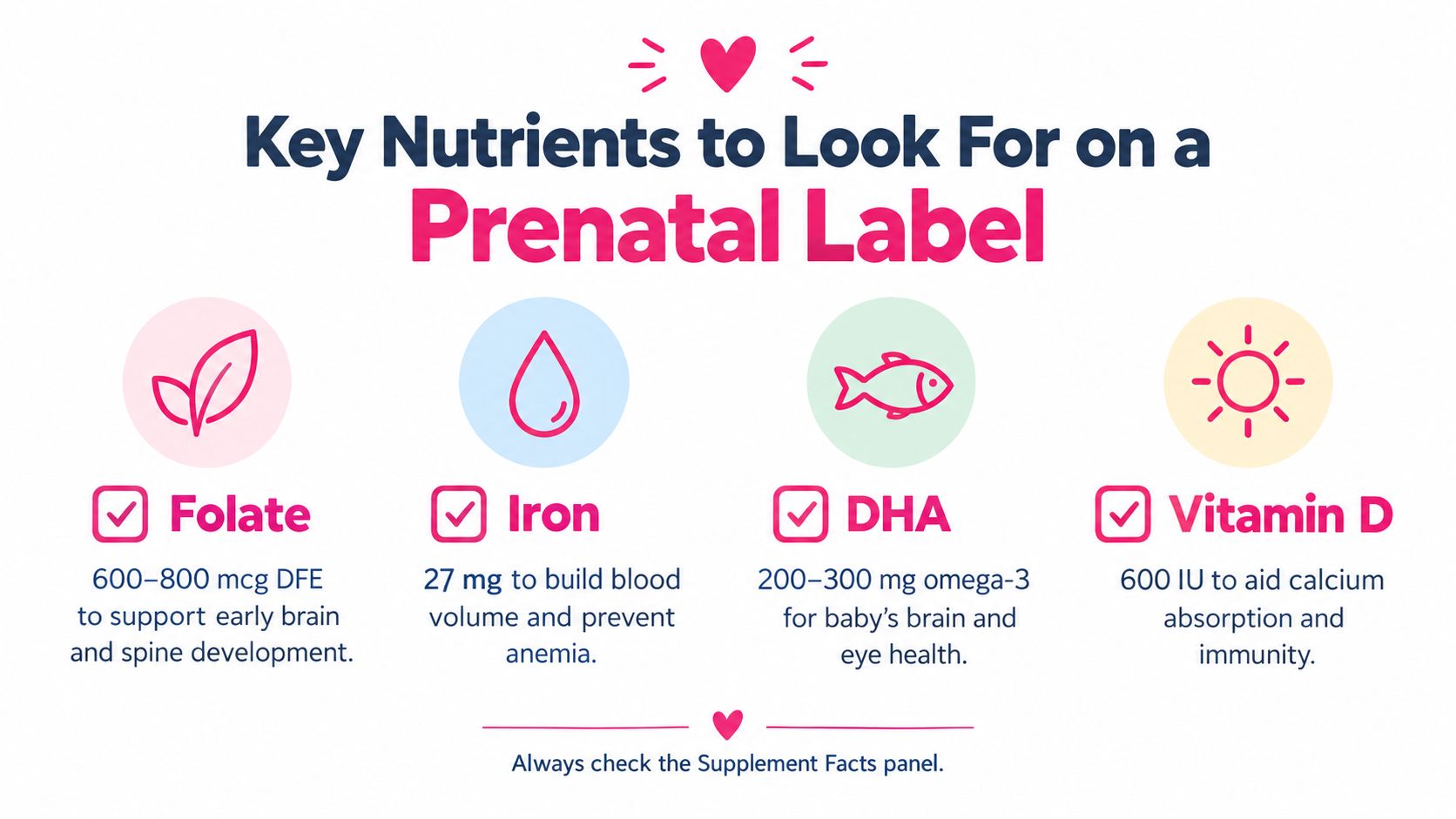
Folate supports early development of the neural tube, which becomes the baby's brain and spinal cord. The NIH Office of Dietary Supplements reports a pregnancy recommended dietary allowance of 600 micrograms of dietary folate equivalents, while people capable of becoming pregnant are advised to obtain 400–800 micrograms of folic acid daily from supplements and/or fortified foods. Folic acid taken before and during the first 28 days after conception reduces neural-tube-defect risk, according to NIH pregnancy nutrition guidance.
You may see folic acid, methylfolate, or L-5-MTHF on a label. Methylfolate is a form of folate used directly in the body, while folic acid is the form used in many supplements and fortified foods. A common discussion point is the MTHFR gene variation, but your personal history and clinical needs should guide the choice. For a clearer comparison, read methylfolate versus folic acid.
Choline supports development
Choline often receives less attention than folate or iron, even though pregnancy raises the adequate intake to 450 mg per day. It supports fetal growth and central nervous-system development. Eggs, meat, fish, dairy, beans, and some vegetables can contribute choline, but the amount in a prenatal varies widely, so check the panel rather than assuming it's included.
DHA provides building material
DHA is an omega-3 fatty acid involved in fetal brain and eye development. There isn't a formal pregnancy RDA for DHA and EPA, but expert guidance cited by NIH recommends at least 250 mg per day of combined DHA plus EPA for women of childbearing age, with an additional 100–200 mg of DHA per day during pregnancy. Look for the actual DHA amount, not just “contains omega-3s.”
Iron needs both adequacy and tolerance
WHO recommends 30–60 mg of elemental iron daily during pregnancy, while the NIH reference table lists a pregnancy iron RDA of 27 mg per day. These figures aren't a reason to adjust your dose independently. They show why the label and your bloodwork matter, particularly if you have anemia, constipation, nausea, or a history of low iron.
Check that the label states elemental iron, and ask your provider which form and amount are appropriate. A supplement that contains iron but makes you vomit every time isn't supporting your routine effectively. Food sources such as meat, beans, lentils, fortified grains, and leafy greens can contribute too, but your clinician may recommend supplementation based on your needs.
How Can You Evaluate Safety and Quality Certifications?
A “whole food” label tells you about positioning and ingredients. It doesn't prove that every batch is free from contaminants, contains the stated amount, or has been evaluated for pregnancy use.
In the United States, the FDA does not approve dietary supplements for safety or effectiveness before marketing. Manufacturers must follow current good manufacturing practices, but that oversight isn't the same as premarket approval. The FDA explains the regulatory distinction in its questions and answers about dietary supplements.
Ask what the testing actually covers
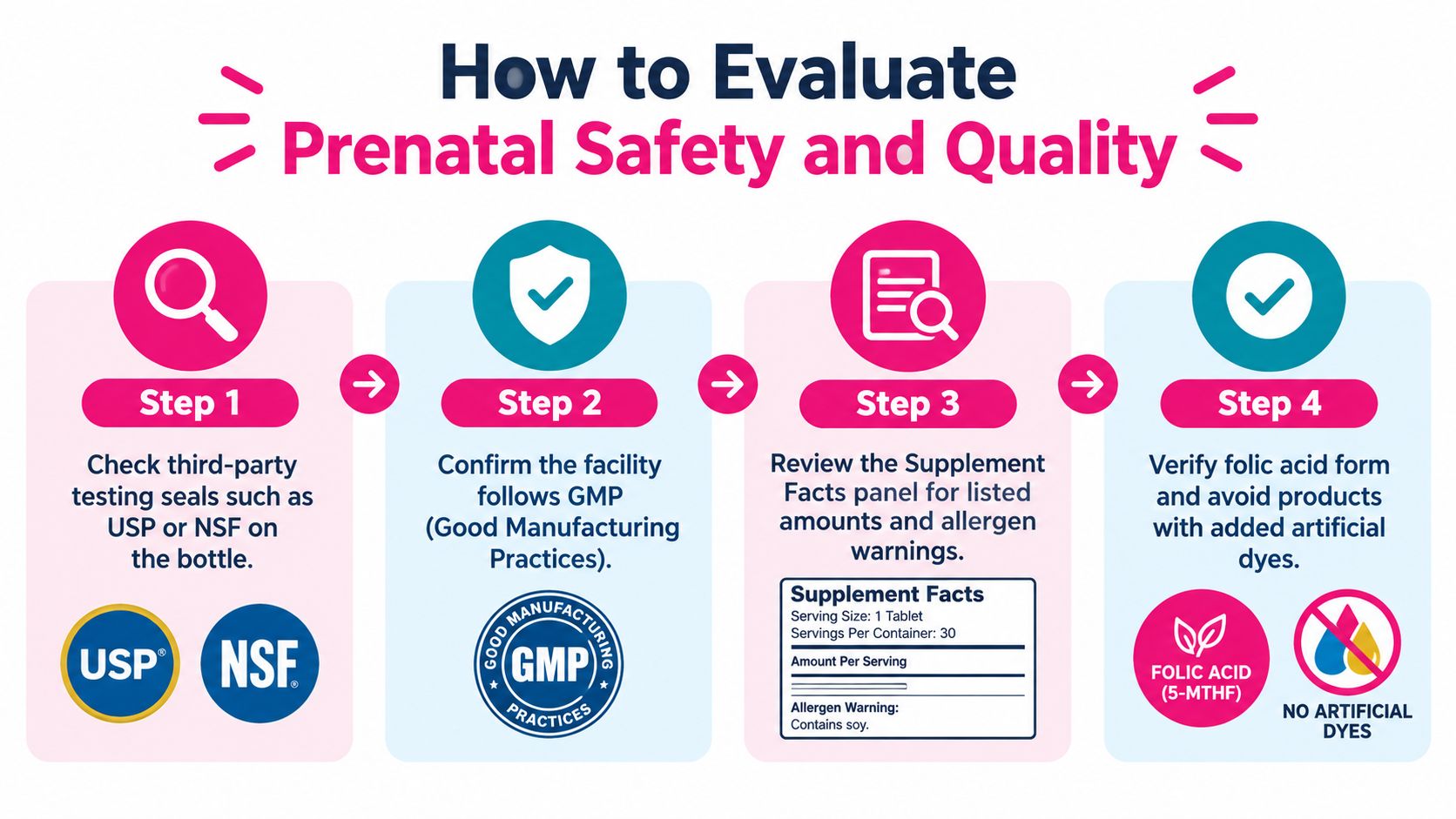
Third-party testing can help verify that a product contains the intended ingredients and meets defined purity standards. It should be more specific than a badge on the front of the bottle.
Look for:
- Identity testing: Does the batch contain the ingredients listed on the label?
- Purity testing: Are unwanted substances below the company's stated limits?
- Heavy-metal screening: Has the batch been checked for contaminants such as lead, arsenic, cadmium, or mercury?
- Microbial testing: Has the manufacturer evaluated the product for bacteria, yeast, and mold?
- Serving-size verification: Does the finished product match the listed serving and nutrient amounts?
A Certificate of Analysis, or COA, can provide batch-level information. Ask whether the company will share a current COA, whether an independent laboratory performed the analysis, and whether the document identifies the same product and batch you're considering.
Read beyond the seal
USP, NSF, and similar marks may indicate a certification or testing program, but you should understand what the mark covers. Some programs focus on manufacturing, while others evaluate identity, purity, potency, or a combination of standards.
Also inspect the form of vitamin A. NIH identifies vitamin A, iron, and iodine as nutrients that require attention to both adequacy and upper limits. Preformed vitamin A and provitamin A carotenoids aren't the same, so ask your provider how a product fits with your food intake and other supplements.
The most reassuring label is a transparent one. You should be able to find the nutrient forms, amounts, allergens, serving size, manufacturer information, and testing explanation without having to guess.
For a practical look at how testing claims can be assessed, review Feed Mom & Me's guide to third-party tested supplements. If a brand won't explain its testing or sourcing, choose a different conversation rather than relying on attractive packaging.
How Do You Manage Nausea and Choose a Tolerable Supplement?
Pregnancy nausea can turn a previously simple routine into a daily negotiation. You may tolerate a capsule at night but not in the morning, or manage a few bites of toast while the smell of vitamins feels impossible. That doesn't mean you're failing. It means your plan needs to respect what your body can handle today.

Try changing the conditions around the supplement rather than forcing the same routine:
- Take it with food: A small meal or snack may feel better than an empty stomach.
- Choose a calmer time: Some people tolerate a prenatal better later in the day.
- Ask about delayed release: A delayed-release capsule may move the supplement farther along the digestive tract before it opens.
- Separate problem nutrients only with guidance: If iron is the main source of discomfort, ask your provider whether a different form or schedule is appropriate.
- Keep fluids nearby: Small, regular sips may be easier than drinking a large amount at once.
Ginger and peppermint can make a formula more pleasant for some people, but they aren't a substitute for medical advice. If you can't keep fluids or supplements down, contact your healthcare provider promptly. Severe or persistent vomiting deserves care, not self-blame.
The best prenatal vitamin choices for nausea usually balance nutritional coverage with a routine you can realistically maintain. Look for a label that identifies key nutrients such as folate, choline, DHA, and iron, then consider capsule size, release design, flavor, and dietary restrictions.
For additional comfort ideas beyond supplements, the Sunflower Motherhood Morning Sickness Box offers a curated set of items intended for morning-sickness support. It shouldn't replace care from your OB-GYN or midwife, but a thoughtful comfort kit can make difficult days feel a little more manageable.
Feed Mom & Me Complete Prenatal Vitamin Plus DHA is one option for mamas who want a vegetarian, soy-free, gluten-free, delayed-release capsule. The formula is described as containing methylfolate, choline, DHA, iron, vitamin D3, calcium, zinc, magnesium, selenium, and other nutrients, with peppermint and organic ginger included for palatability. Feed Mom & Me is women-owned and built by moms, for moms, so its approach pairs the product with accessible pregnancy nutrition education.
What Are the Most Common Questions About Prenatal Vitamins?
Are gummies as good as capsules?
Gummies can be easier to chew, especially when capsules trigger nausea. Their limitation is space. A gummy format may not include every nutrient or the same amount of iron, choline, or DHA as a capsule, so compare the Supplement Facts panels carefully. A sweet coating also doesn't make a product nutritionally complete.
Capsules often allow a broader nutrient profile, but comfort still matters. If you can't swallow or keep down a capsule, a theoretically complete formula isn't useful in practice. Ask your provider how to cover nutrients that a gummy leaves out.
When should you start?
Ideally, start before conception because neural-tube development happens very early, sometimes before you know you're pregnant. WHO recommends beginning folic acid before conception or as soon as possible afterward. If you're already pregnant and haven't started, don't panic. Begin a suitable conversation with your healthcare provider and choose a product that clearly lists its forms and amounts.
Should you continue after delivery?
Your nutrient needs and priorities continue to change during postpartum recovery and breastfeeding. Some people continue a prenatal during this period, while others move to a different supplement based on iron status, diet, lactation, medications, and medical history. Ask your clinician before continuing, changing, or combining products.
How do you choose among all the options?
Use the guide to choosing a prenatal vitamin as a starting point, then make your own checklist:
- Nutrient coverage: Are folate, iron, choline, and DHA clearly listed?
- Form and dose: Can you identify the nutrient forms and serving size?
- Tolerance: Can you take it with your actual nausea and digestion patterns?
- Quality: Does the manufacturer explain testing, sourcing, and manufacturing?
- Personal fit: Has your OB-GYN, midwife, or dietitian reviewed it when needed?
You don't need to find a perfect bottle on the first try, mama. You need a transparent, tolerable option that fits your health needs and can be used consistently with professional guidance.
Feed Mom & Me offers the Complete Prenatal Vitamin Plus DHA in a mom-built formula featuring nutrients such as methylfolate, choline, DHA, and iron, with vegetarian, soy-free, and gluten-free delayed-release capsules. Visit Feed Mom & Me to review the product details, nutrition resources, and options for supporting your journey from preconception through postpartum.