
Best Choline for Pregnancy How to Choose Wisely
Published:Updated:
About 90% to 95% of pregnant women consume less choline than the pregnancy benchmark, according to an NIH fact sheet, and a 2025 meta-analysis found that only 11.24% met recommended intake levels (NIH review, 2025 meta-analysis). So if you're wondering about the best choline for pregnancy, you're asking a very practical question, not chasing a trendy add-on.
Maybe you're comparing prenatal labels while dealing with nausea, food aversions, or the daily mental load of pregnancy. One bottle lists choline bitartrate, another contains phosphatidylcholine, and a third barely explains the form at all. You don't need a perfect nutrition routine, mama. You need a clear way to judge dose, form, tolerability, and fit.
This guide will help you understand why choline matters, whether food may cover your needs, how the main supplement forms differ, what the safety limits mean, and how to match an option to your real life. Your healthcare provider should remain part of that decision, especially if you're pregnant, breastfeeding, taking medications, or managing a health condition.
Table of Contents
- Why Is Choline Important During Pregnancy
- Are You Getting Enough Choline From Food Alone
- Which Form of Choline Is Best for Pregnancy and Why
- How Much Choline Do You Need and What Is Safe
- Which Choline Option Fits Your Needs Best
- How to Choose a Quality Prenatal With Choline You Can Stick With
Why Is Choline Important During Pregnancy
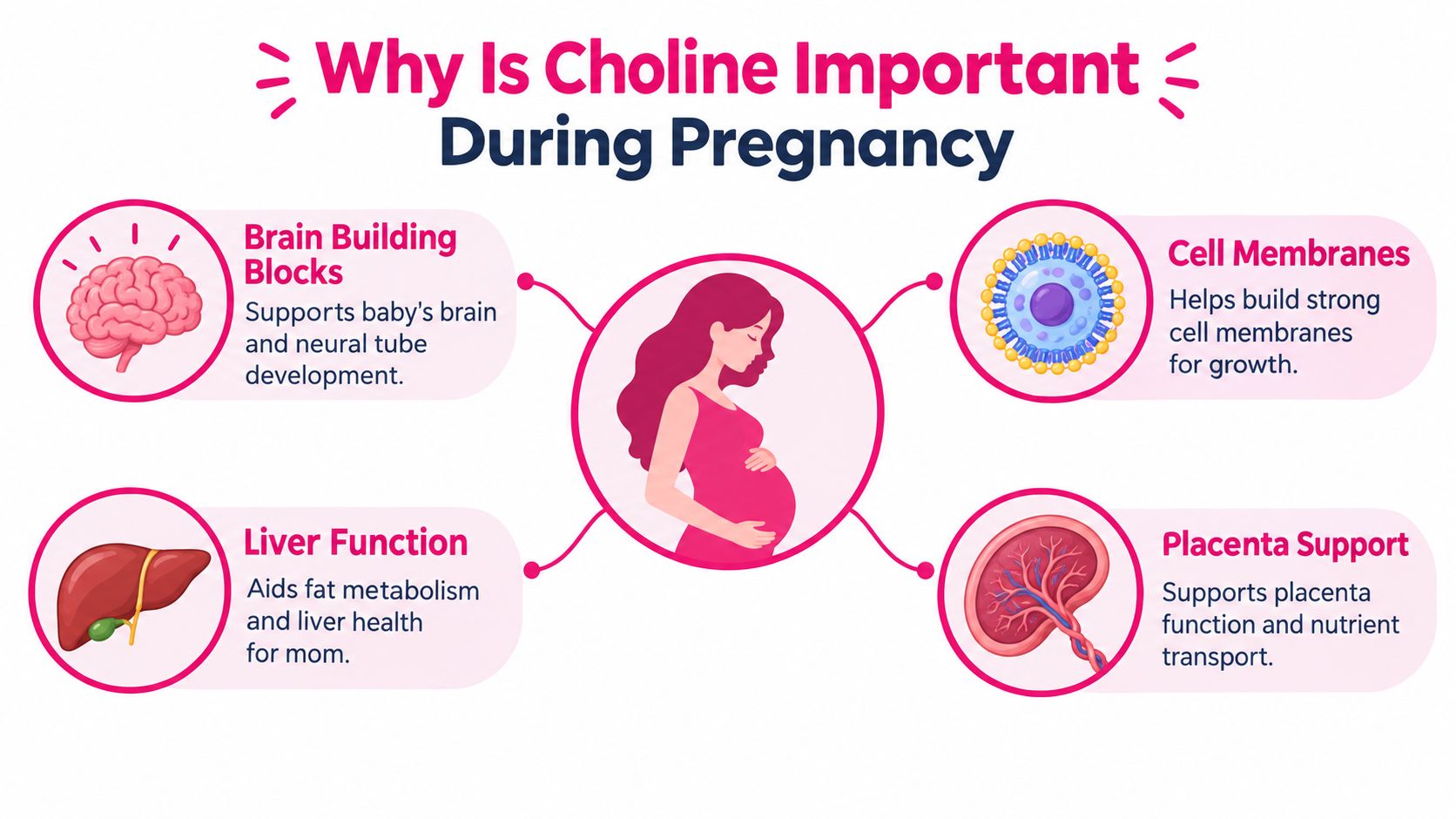
Choline supports several systems that pregnancy depends on. It works like raw material for cell membranes, brain development, and nervous-system signaling. Your baby needs choline-related compounds as tissues grow, while your body uses choline in processes such as fat transport and liver function.
The building-block role
Choline contributes to phosphatidylcholine, a major part of cell membranes. Every growing tissue needs these membranes, including the fetal brain and placenta. Choline also helps produce acetylcholine, a neurotransmitter involved in memory and learning, and joins one-carbon metabolism with nutrients such as folate and vitamin B12.
Nutrient synergy makes this role easier to understand. Folate supports DNA-related processes and cell division. Choline can become betaine, which supports methyl-group metabolism. DHA supplies an omega-3 fatty acid for developing tissues, while choline's role in phospholipid metabolism may assist fatty-acid transport. In a randomized trial, healthy pregnant participants who received 550 mg/day of supplemental choline from gestational weeks 12 to 16 until delivery had improved maternal DHA biomarkers (randomized trial summary).
What it does for you and baby
Choline's pregnancy roles include:
- Brain and neural development: It supplies materials involved in fetal brain growth and nervous-system signaling.
- Cell membranes: Phosphatidylcholine helps form membranes needed for growth.
- Placental function: Choline-related phospholipids support the placenta's structure and nutrient transport.
- Maternal liver support: Choline helps with fat metabolism and the movement of fats through the liver.
The U.S. National Institutes of Health lists the Adequate Intake at 450 mg per day during pregnancy and 550 mg per day during lactation (NIH pregnancy guidance). These figures are population reference points, not personal prescriptions. Use them as a practical destination, then review your diet, prenatal label, health history, and tolerance with your clinician.
For a pregnancy-focused explanation of these roles, read how choline supports pregnancy.
Are You Getting Enough Choline From Food Alone
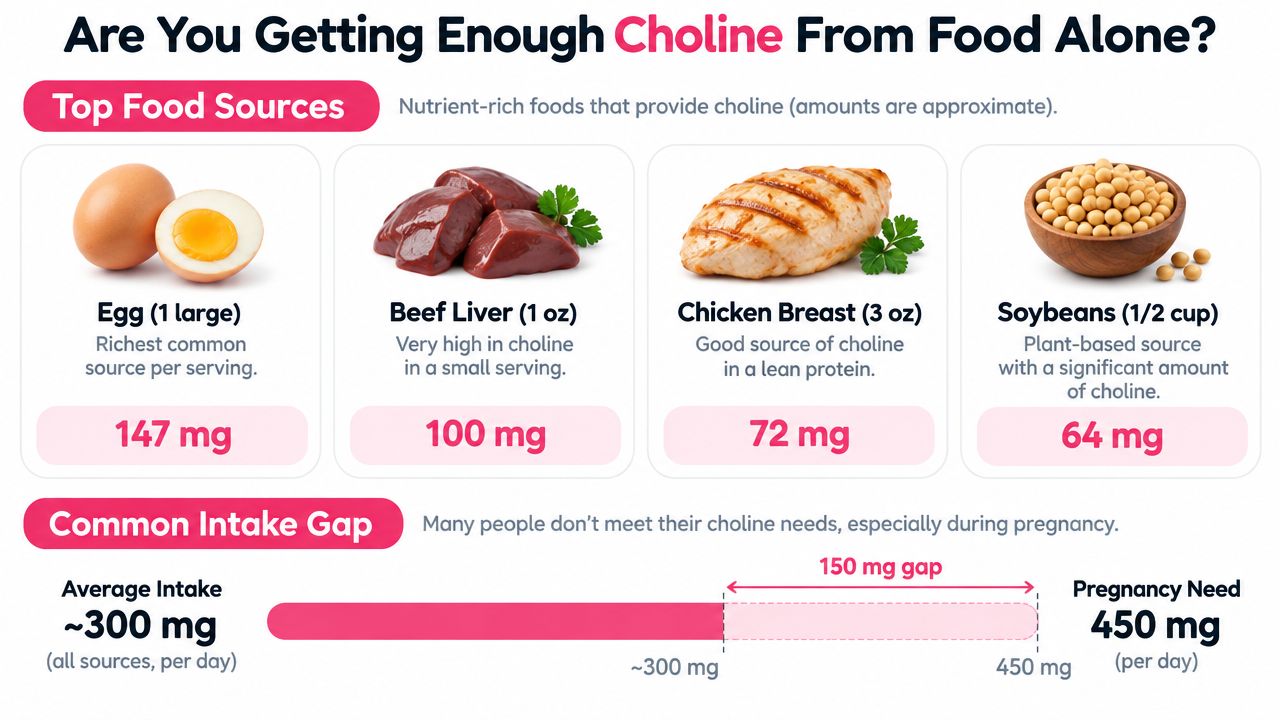
Food may contribute a large share of your choline, yet many pregnant women still do not reach the pregnancy target. A review found that women aged 20 to 39 consumed an average of 285 mg of choline per day, while one large egg contains about 300 mg (peer-reviewed review of choline intake). Eggs can therefore make a noticeable difference, although nausea, food aversions, dietary choices, and appetite changes may alter what you can eat consistently.
Practical food sources
Choline comes from animal foods, soy foods, and some vegetables. The supplied infographic lists these examples:
- Egg: One large egg, 147 mg
- Beef liver: One ounce, 100 mg
- Chicken breast: Three ounces, 72 mg
- Soybeans: One-half cup, 64 mg
These amounts come from the educational visual. Liver needs extra care during pregnancy because it can contain substantial preformed vitamin A. Ask your prenatal care provider before using liver as a regular choline strategy.
For broader meal ideas, browse this micronutrient food guide for women and adjust suggestions to your appetite, eating pattern, and pregnancy-safety guidance.
Why the gap happens
Research from different countries shows that low intake can occur across varied cuisines and eating patterns. In a German study of 283 pregnant women, median intake was 260.4 mg per day, and 7% reached adequate intake. An Australian cohort found that 23% met the 440 mg per day benchmark, while 2.6% took a choline-containing prenatal supplement daily. A Bangladesh study reported mean intake of 189.5 mg per day, or 42.72% of the 450 mg per day reference value (country-level pregnancy studies).
Vegetarian and vegan mamas may need more deliberate planning because familiar choline-rich foods may appear less often in those diets. NIH guidance recommends that vegetarian and vegan pregnant women discuss supplementation with a clinician, since food-based intake is often lower (NIH choline guidance).
Use this quick check before that conversation:
- Review a typical day: Note eggs, soy foods, poultry, fish, dairy, and other choline sources.
- Read your prenatal label: Check whether it lists choline and record the amount per serving.
- Consider barriers: Nausea, aversions, limited food access, and restrictive diets can make regular intake harder.
- Avoid self-diagnosing: Symptoms cannot determine choline status on their own.
For additional meal inspiration, explore these nine foods that may support your baby's brain development during pregnancy.
Which Form of Choline Is Best for Pregnancy and Why
The form on the label affects how much choline the product delivers, how it fits with phospholipid nutrition, and how comfortable it feels in your stomach. There isn't one universally superior option for every pregnancy.
The most useful form is the one that provides a meaningful amount, fits your dietary needs, and remains comfortable enough to take consistently.
The main forms at a glance
| Form | Choline Content and Absorption | Tolerability and Best Fit |
|---|---|---|
| Choline bitartrate | A water-soluble choline salt commonly used for dose-efficient supplementation. The amount of elemental choline depends on the product label. | Practical when you need a concentrated, clearly measured addition to food intake. Some people prefer divided doses if larger servings feel uncomfortable. |
| Choline chloride | Another water-soluble salt. Product labels should state the actual choline amount rather than relying only on the compound's total weight. | Useful when clearly labeled and tolerated, though taste and formulation details can matter for powders or liquids. |
| Phosphatidylcholine | A phospholipid form that places choline within a fat-based structure. It aligns naturally with membrane and phospholipid biology, but the label's choline yield matters. | A reasonable fit if you want a food-like phospholipid form or are pairing choline with DHA-focused nutrition. |
| Alpha-GPC | A concentrated choline-containing compound with a different chemical structure from choline salts. Pregnancy-specific evidence and product labeling should guide use. | Consider only with clinician input, especially because pregnancy data may be less extensive than for commonly used prenatal forms. |
| CDP-choline | Also called citicoline, it supplies choline within a compound involved in phospholipid metabolism. Check the declared choline contribution. | May appeal to people seeking a specialized form, but pregnancy-specific formulation evidence and tolerability deserve careful review. |
Bioavailability isn't the only question. A form can be absorbed well in theory, but a product still misses the mark if its serving supplies little choline, requires too many capsules, or causes nausea. Pregnancy changes what “practical” means. A supplement that works beautifully on paper but stays in the cupboard isn't helping you close the gap.
Phosphatidylcholine can be especially interesting when you're thinking about membrane structure and DHA transport. For a neutral explanation of this form and how supplement listings describe it, you can consult The Patients Guide supplement library. Choline salts may be simpler when your main goal is to add a measurable amount to daily intake.
One more label detail matters: look for elemental choline, not just the weight of the entire chemical compound. Two products can list different compound weights while contributing similar or very different amounts of choline. If the label is unclear, bring a photo to your pharmacist, midwife, OB/GYN, or dietitian.
You can also read about the broader role of methyl-donor supplements, especially when considering how choline fits beside folate and vitamin B12.
How Much Choline Do You Need and What Is Safe
Start with the pregnancy benchmark: 450 mg of total choline per day, rising to 550 mg per day during lactation. “Total” includes food and supplements. The Adequate Intake is a planning reference, not an instruction to put the entire amount into a capsule. The values are also summarized in this prenatal vitamin dose guide.
Understanding the numbers
A controlled feeding study compared 480 mg per day with 930 mg per day in healthy women during the third trimester for 12 weeks. The higher intake only partly restored pregnancy-related changes in phosphatidylcholine metabolism, while 480 mg was close to the AI used in the study. These findings show why research doses and population targets can differ. They do not mean every pregnant woman should take 930 mg.
A separate randomized trial used 2 g per day in pregnant women with heavy alcohol exposure. Choline levels rose by four weeks and stayed higher than placebo through 12 weeks. Nausea and dyspepsia increased only slightly in that study, with no reported signal for several other symptoms. The participants and dose were specific, so apply the result with clinical guidance rather than treating it as a general recommendation.
Keep these reference points together:
- Pregnancy AI: 450 mg per day total
- Lactation AI: 550 mg per day total
- Experimental late-pregnancy intake: 930 mg per day in a controlled feeding study
- Trial dose in a specific high-risk population: 2 g per day
- Adult UL, including pregnancy and lactation: 3,500 mg per day (NIH choline safety guidance)
The UL is a ceiling, not a goal. Larger supplemental amounts may cause side effects, and combining several choline products can push your total higher than expected. A pharmacist, midwife, OB/GYN, or dietitian can help you weigh dose, tolerability, and your personal diet.
Reading your prenatal label
Use this quick check:
- Find the choline line. See whether it lists choline itself or the weight of the complete compound.
- Check the serving size. A two-capsule serving provides the stated amount only when you take both capsules.
- Estimate food intake. Use your usual pattern, not an unusually perfect day.
- Look for duplicates. Choline may appear in a prenatal, standalone supplement, drink mix, or fortified food.
- Ask before changing the dose. Your clinician can consider trimester, nausea, medications, medical conditions, and the amount you already get from meals.
The safest choice is the amount that closes your likely gap without creating a supplement routine your stomach or schedule cannot tolerate.
Which Choline Option Fits Your Needs Best
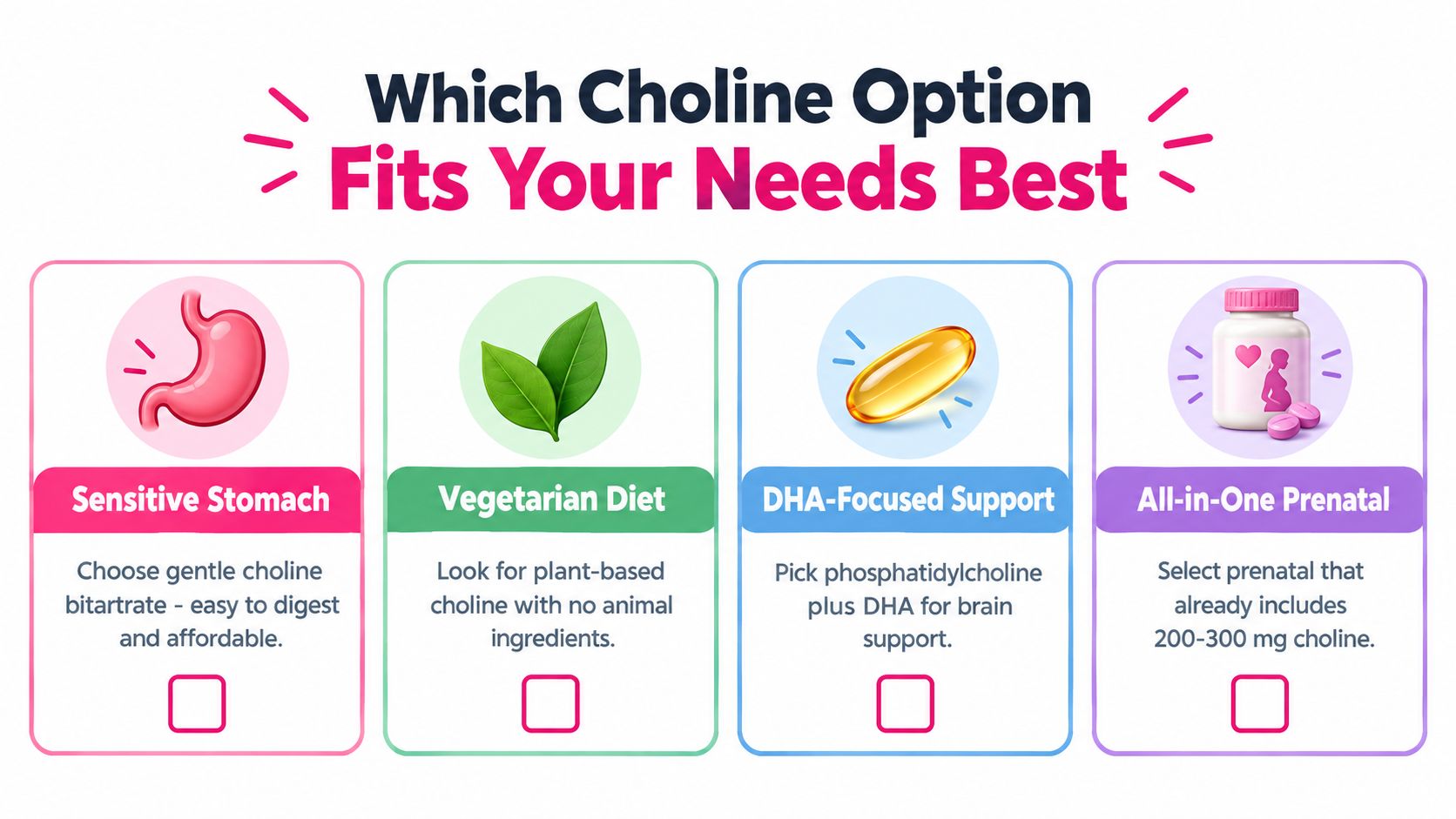
The best choline for pregnancy is a personal fit decision. Your food pattern, stomach, capsule tolerance, and need for companion nutrients can matter more than a form's marketing language.
A real-life decision matrix
| Your situation | What to prioritize | Form direction to discuss |
|---|---|---|
| Sensitive stomach or strong nausea | Smaller servings, taking supplements with food, and a formula designed for tolerability | A well-labeled choline bitartrate product may be practical, but start only with provider guidance |
| Vegetarian or vegan diet | Plant-compatible ingredients and a clear plan for total daily intake | Check whether the product is free from animal-derived ingredients and ask your clinician about supplementation |
| DHA-focused nutrition plan | Choline plus a phospholipid-oriented formula or a prenatal that includes DHA | Phosphatidylcholine may fit the strategy, but verify the actual choline contribution |
| Large dietary shortfall | A meaningful supplemental amount rather than a token listing | A dose-efficient form may be easier to use, with the final amount chosen alongside your provider |
| Already taking a prenatal | The existing choline amount, form, and duplicate ingredients | Add another product only after calculating your total intake |
The matrix isn't a prescription. It's a way to name the problem you're solving. If your stomach is the limiting factor, a theoretically elegant formula won't help if you can't keep taking it. If your diet is very low in choline-rich foods, a tiny amount may not meaningfully change your total.
Your label checklist
Before buying, look for:
- A named choline form: Bitartrate, chloride, phosphatidylcholine, Alpha-GPC, or CDP-choline.
- A declared choline amount: You should be able to identify how much choline the serving contributes.
- Companion nutrients: DHA, methylfolate, and other prenatal nutrients may simplify your routine.
- Dietary compatibility: Check vegetarian, soy-free, dairy-free, gluten-free, and allergen details when relevant.
- A tolerable routine: Consider capsule size, serving frequency, delayed-release design, and whether taking it with food is realistic.
You're not trying to win a supplement comparison contest. You're choosing the option you can understand, tolerate, and use consistently.
How to Choose a Quality Prenatal With Choline You Can Stick With
A quality prenatal should make the label easy to interpret. Look for transparent amounts, a clearly named choline form, companion nutrients that suit your plan, and ingredients that match your dietary needs. If nausea is a concern, delayed-release capsules and additions such as ginger or peppermint may make the routine more manageable, though individual responses vary.
A prenatal can also reduce decision fatigue when it includes several nutrients you already planned to take. Still, check the actual choline amount rather than assuming every prenatal supplies enough. The guide to choosing a prenatal vitamin can help you review the rest of the label.
Feed Mom & Me Complete Prenatal Vitamin Plus DHA is one option to discuss with your healthcare provider. The brand describes it as a vegetarian, soy-free, gluten-free, dairy-free, Non-GMO formula with choline, DHA, methylfolate, and selenium, plus delayed-release vegetable capsules, peppermint, and organic ginger. Feed Mom & Me is women-owned and built by moms, for moms, with educational resources intended to support conversations with healthcare professionals.
Before you commit, use this short checklist:
- Confirm the choline amount per serving.
- Add food and supplement sources together.
- Choose a form and schedule your stomach can handle.
- Ask your provider whether the plan fits your pregnancy or postpartum needs.
- Set up continuity so you don't run out during a busy week.
Feed Mom & Me offers a Complete Prenatal Vitamin Plus DHA that includes choline alongside methylfolate and selenium in a delayed-release formula designed with pregnancy tolerability in mind. Visit Feed Mom & Me to review the prenatal, educational resources, and routine options, then bring the label to your healthcare provider for personalized guidance.