
Can Pregnant Women Drink Protein Shakes? What to Know
Published:Updated:
Most pregnant women can drink a protein shake in moderation. It's optional rather than required, and its protein should be counted within your daily total.
Why do answers to can pregnant women drink protein shakes stop at a doctor's yes and never ask whether breakfast already did the job? A shake is a bridge, cash from the same daily budget, not a bonus account. Eggs, dairy, beans, lentils, fish, poultry, tofu, nuts, and seeds cover a lot of mamas without any powder. The glass helps when nausea, a lost appetite, or a tight diet makes a plate unrealistic. You'll see how an ordinary day adds up, then what to check on a label if a gap is real. Your own provider still has the final say.
Table of Contents
- Is a Protein Shake Safe During Pregnancy?
- How Much Protein You Need Each Trimester
- Getting Enough Protein From Food First
- Can Too Much Protein Hurt My Baby?
- How to Read a Shake Label and Spot Risky Ingredients
- Timing Your Shake Around Your Prenatal and Talking to Your Provider
Is a Protein Shake Safe During Pregnancy?
A shake can belong in a pregnancy eating plan. It isn't something you owe your baby, and it isn't a requirement of being pregnant. The European Commission knowledge gateway on protein in pregnancy explains that the extra you need depends on trimester, body size, calories, and health. It describes added protein of 1 gram a day in the first trimester, 9 grams in the second, and 28 grams (European Food Safety Authority) or 31 grams (World Health Organization and FAO/UNU) in the third, alongside a commonly cited U.S. target of about 71 grams a day versus 46 grams for nonpregnant women. Those are food targets. Plenty of people meet them with eggs, dairy, beans, lentils, fish, poultry, tofu, nuts, and seeds.
Reach for a shake when food is the hard part. Don't pour one because a label says "pregnancy." Appetite loss and nausea are common reasons a sip goes down easier than a plate. A vegetarian or dairy-free pattern with a real gap can be another. Gestational diabetes, kidney disease, food allergies, hyperemesis, slow weight gain, and a multiple pregnancy belong in a conversation with your provider before a powder becomes routine.
Whatever you drink, fold those grams into the day. Look at grams per serving and how many servings still fit inside your total, then ask your provider how many servings are right before a shake turns into a daily habit.
| Situation | Shake usually reasonable? | Why |
|---|---|---|
| Meeting protein targets easily from meals | Not needed | Food already covers it; count any shake inside your total |
| Nausea or food aversions limiting meals | Often helpful as a bridge | Easy to sip and fits within your daily target |
| Vegetarian or dairy-free diet with gaps | May help | Choose a short-label product and check the protein per serving |
| Gestational diabetes | Discuss first | Added sugar and carbohydrate load matter |
| Kidney disease | Discuss first | Extra protein load may need to be limited |
| Hyperemesis or poor weight gain | Discuss with your provider | Your medical plan may call for a specific product or amount |
| Multiple pregnancy | Discuss first | Protein needs and weight gain targets differ |
Practical rule: Count it in your day, read the label, and tell your provider before daily use.
A clinician can also spot excess sugar, stimulants, herbs, or vitamins that don't suit your plan. If you'd rather start with food you can sip, a chocolate protein strawberry smoothie shows how fruit and everyday ingredients can carry protein without a long fortified formula.
How Much Protein You Need Each Trimester
The targets below are averages, mama, not a personal prescription. Read the columns as two different bookmarks in one budget.
| Trimester | Extra protein per day (EFSA or WHO/FAO) | Total daily target (U.S. guidance) |
|---|---|---|
| First trimester | +1 g (EFSA and WHO/FAO) | 46 g |
| Second trimester | +9 g (EFSA and WHO/FAO) | 71 g |
| Third trimester | +28 g (EFSA) or +31 g (WHO/FAO) | 71 g |
| Nonpregnant adult woman (reference) | 0 g | 46 g |
Why the bookmarks don't fight each other
A review of protein intake in pregnancy reports an RDA of 46 grams per day in the first trimester and 71 grams per day during the second and third trimesters, about 1.1 grams per kilogram of body weight per day in those later trimesters. The same review estimates the average requirement rises by 21 grams per day in the second and third trimesters, while the estimated average requirement is 59 grams per day then. An RDA is set high enough to cover the needs of the large majority of a population. An estimated average requirement sits lower, around the middle of the population. The "extra grams" column is the add-on above a nonpregnant baseline. None of these is an order to dump a huge scoop into a blender.
Body size, twins or multiples, activity, a vegetarian pattern, illness, and how you were eating before pregnancy all shift where you land. Your clinician is the person who can weigh those pieces. You don't have to spend the whole budget in one drink.
Think of protein like a daily grocery budget you spread across meals, not one large bill you must pay at breakfast.
Check one ordinary day before you buy powder
Write down breakfast, lunch, dinner, and snacks for a single day. Add the grams from the package or a reliable food listing. Compare that sum with your trimester column. If you're close, you probably don't need a supplement at all. If you're short on nauseated days only, a shake can fill that hole on those days.
Busy schedules make logging sloppy. A short guide on how to improve your daily protein logging walks through mistakes that throw the total off when life is full. For a closer look at how pregnancy targets are built, see these pregnancy protein requirements and bring your one-day tally to your next visit.
Getting Enough Protein From Food First
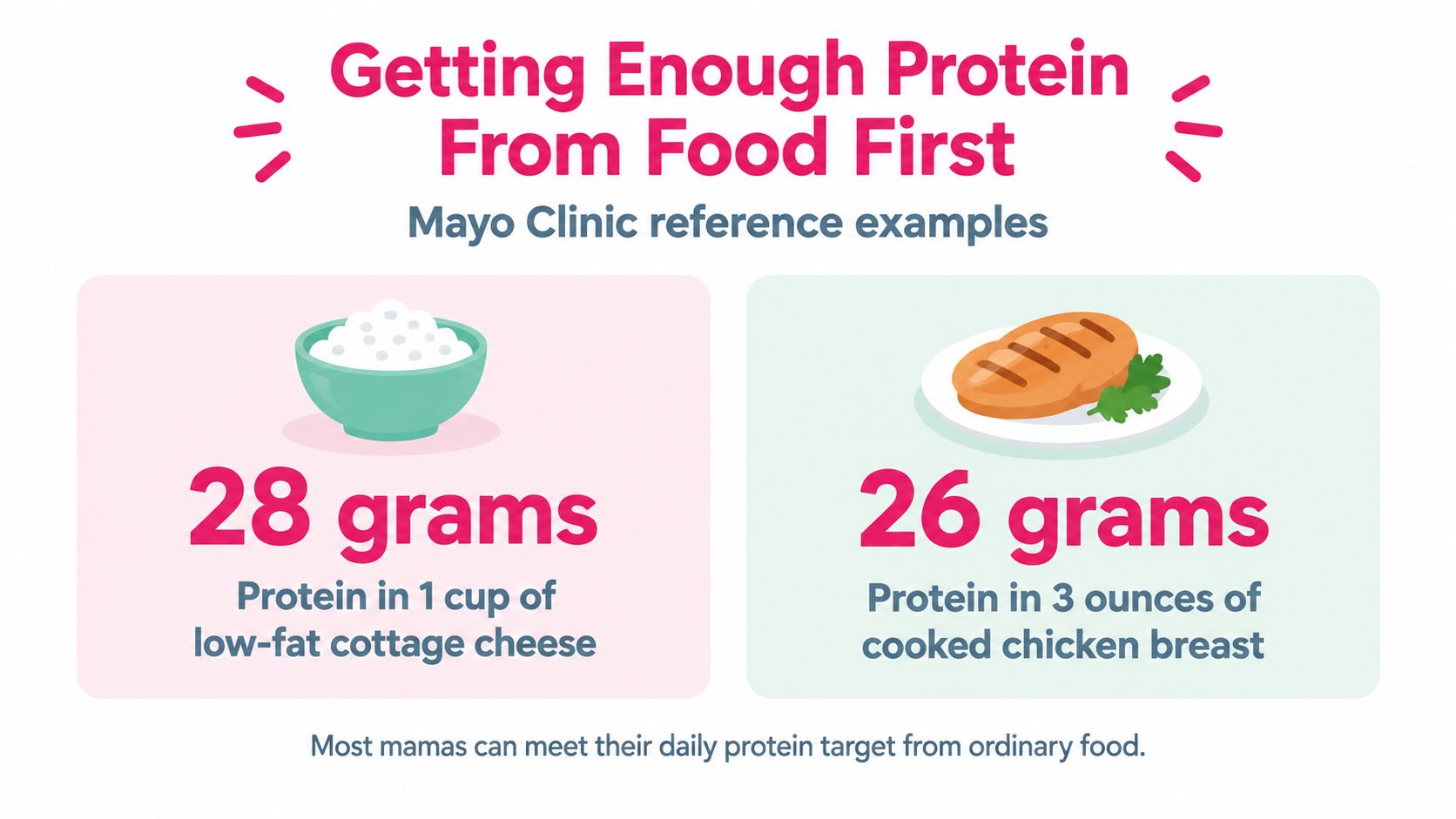
Protein supports your baby's growth, and ordinary portions stack faster than a supplement aisle suggests. The Mayo Clinic pregnancy nutrition guide lists practical amounts you can use as a reference card: 28 grams in 1 cup of low-fat cottage cheese, 26 grams in 3 ounces of grilled chicken, 17 grams in 3 ounces of canned salmon, 9 grams in 1/2 cup of cooked lentils, and 8 grams in 1 cup of skim milk.
| Food | Protein per serving |
|---|---|
| 1 cup low-fat cottage cheese | 28 g |
| 3 oz grilled chicken | 26 g |
| 3 oz canned salmon | 17 g |
| 1/2 cup cooked lentils | 9 g |
| 1 cup skim milk | 8 g |
A day that adds up without a tub
Say breakfast is that cup of cottage cheese (28 grams). Lunch is half a cup of lentils in soup (9 grams). Dinner is 3 ounces of canned salmon (17 grams), and you pour a cup of skim milk with a snack (8 grams). That's 62 grams before you count bread, vegetables, or a second helping. Swap the salmon for 3 ounces of grilled chicken on another night and the plate jumps again. Variety matters here: meat, poultry, seafood, eggs, beans, peas, soy foods, nuts, and seeds each bring a different mix of nutrients. A guide to complete protein sources can help if you don't eat animal foods and want pairs that cover the amino acids.
Whole foods also carry iron, choline, and iodine. A shake that replaces lunch can crowd those out even when the protein number looks fine.
The swap test
Use the shake when a plate of chicken is impossible, or when appetite has disappeared and you need something cold you can sip. Skip it when the plate is already full. Then it's calories stacked on a day that didn't have a gap. A shake is a bridge on a rough afternoon, not the foundation of how you eat.
This short video shows simple food combinations you can keep in rotation on weeks when cooking feels like too much.
Five-minute check: pick yesterday, list four protein foods, write the grams beside each, and add them. If the sum already lands near your trimester target, you have your answer.
Can Too Much Protein Hurt My Baby?
More protein is not automatically better. What the supplement is for, and how much of the calories come from protein, changes the picture.
In a World Health Organization review of antenatal energy and protein supplementation, balanced protein-and-energy supplements (protein supplying less than 25% of total calories) reduced stillbirth risk by 40% in five trials involving 3,408 women (relative risk 0.60, 95% confidence interval 0.39 to 0.94). High-protein supplementation didn't show a clear benefit. In one analysis it was linked with a 58% higher risk of a small-for-gestational-age infant (relative risk 1.58, 95% confidence interval 1.03 to 2.41). WHO points balanced energy-and-protein supplements toward undernourished pregnant women, not routine high-protein dosing for everyone.
What that means at your kitchen counter
Those findings come from supplement trials, not from eggs and lentils on a normal plate. Eating enough protein for your trimester is still the goal. The caution is about concentrated, high-protein products used as if more must be safer.
A shake is a measured top-up, not a second dinner. If one serving already closes the gap you found on your food tally, a second scoop doesn't buy extra safety. It can push calories and protein past what your day needed.
Targets and serving size are the safety tools. Your provider can help you find the balance that fits your weight, your labs, and how this pregnancy is growing.
How to Read a Shake Label and Spot Risky Ingredients
Protein itself isn't the usual problem. The formula around it is. A pregnancy-focused review of protein powders notes that some powders have contained heavy metals, may carry a lot of added sugar or artificial sweeteners, and aren't tested by the FDA before marketing the way medicines are. Safety responsibility sits with the manufacturer. That review also says whey protein is generally considered compatible with pregnancy if you don't have a milk allergy. Product choice and medical advice still matter.
MotherToBaby adds that not every protein supplement has been well studied in pregnancy, while adequate protein intake itself isn't expected to raise pregnancy or breastfeeding risks. Screen for proprietary herbal blends, caffeine, excess sugar, and vitamins that duplicate your prenatal. Preformed vitamin A deserves a hard look, because stacking fortified products can push intake too high.
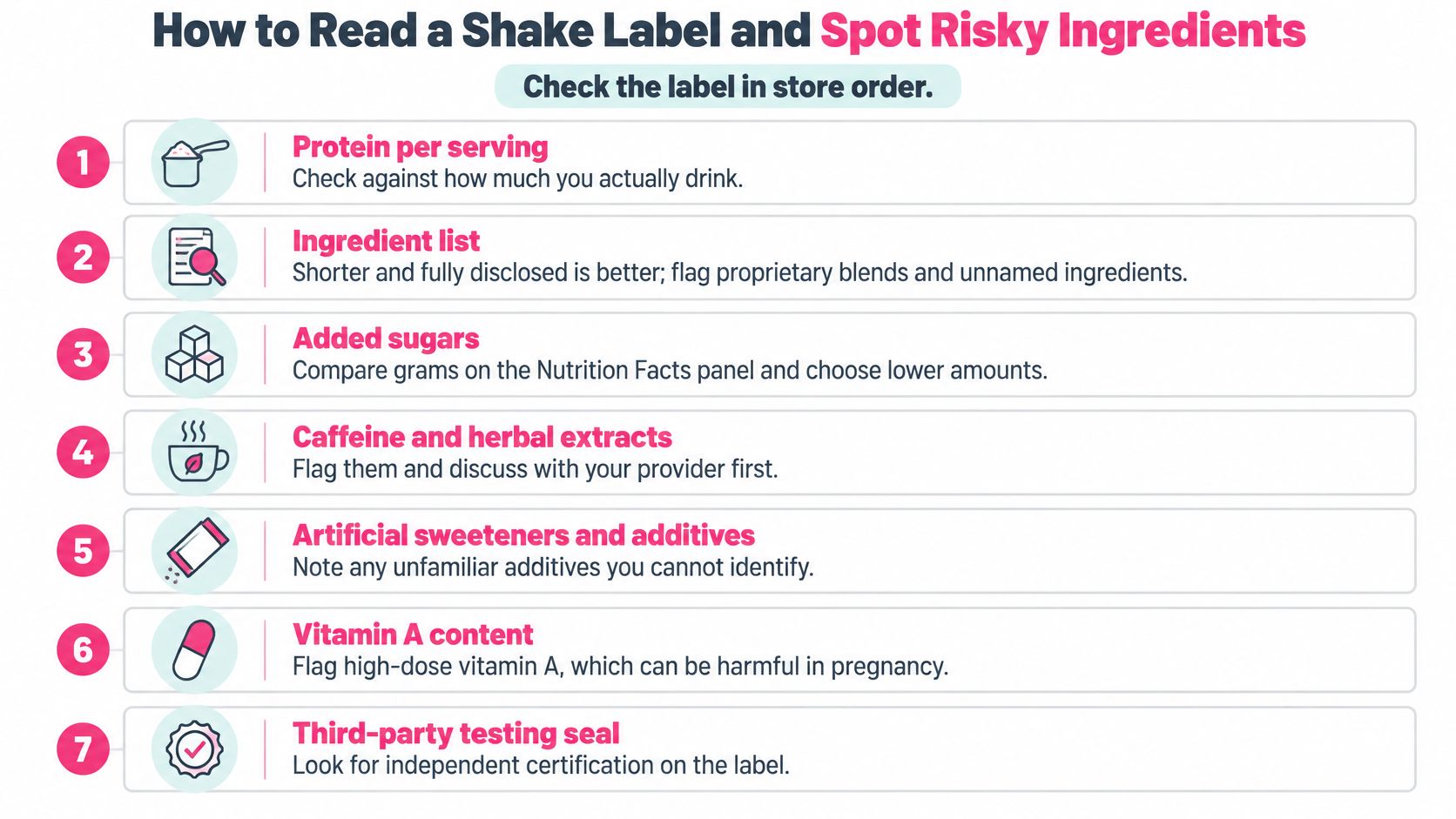
Seven checks in the order you meet them
- Protein per serving. Read the grams, then the serving size. If you drink half a scoop, count half. If the tub lists two scoops as one serving and you use both, count the full amount against the gap you really have.
- Ingredient list. Shorter and fully disclosed is easier to trust. A proprietary blend hides how much of each item you're getting, so you can't add it to your day.
- Added sugar. Find grams of added sugar on the Nutrition Facts panel. In pregnancy, that sugar is part of your blood-sugar picture, especially if gestational diabetes is on the table. Artificial sweeteners often have thin pregnancy data, so an unsweetened or lightly sweetened tub is the calmer pick.
- Protein source. Whey is a familiar option without a milk allergy. Pea or soy blends fit many dairy-free kitchens. Soy is a common allergen, so match the source to what you already tolerate.
- Allergen and free-from lines. Gluten, soy, dairy, and nuts should match your needs, not the brand's marketing. "Natural" doesn't mean allergen-free.
- Third-party testing. A seal from an independent tester doesn't make a product medical care. It does mean someone outside the company checked for contaminants such as heavy metals. Prefer it when you can find it.
- Stimulants, herbs, and extra vitamins. Caffeine, guarana, and botanical blends don't belong in a prenatal snack unless your provider has already approved that specific ingredient. Added vitamin A, iron, zinc, or calcium can double what your prenatal already gives you.
Pregnancy-safe wording on a tub is marketing. It isn't FDA approval. Ginger in a meal is not the same thing as a concentrated green-tea or raspberry-leaf extract in a scoop.
| Ingredient | Why it needs caution | What to do |
|---|---|---|
| Herbal or botanical blends (raspberry leaf, maca, green tea extract) | Little pregnancy research; some are not advised in pregnancy | Skip unless your provider approves |
| Caffeine and stimulants (green tea extract, guarana) | Can disrupt sleep, heart rate and nausea | Choose a stimulant-free shake |
| Preformed vitamin A (retinol) | Stacking with a prenatal can exceed safe intake | Check the amount and review total intake with your provider |
| High-dose iron, zinc or calcium | Doubles up with your prenatal; calcium can reduce iron absorption | Add the totals together with your prenatal |
| Artificial sweeteners | Limited pregnancy data | Prefer unsweetened or lightly sweetened options |
| Proprietary blends | Hidden amounts make intake impossible to track | Choose a label that discloses every amount |
If a bar is easier than a blender on workdays, you can compare healthier protein bar options with the same label habits: protein grams, sugar, and a short ingredient list. For powder-specific filters, this look at raw organic protein is a useful companion while you shop. Bring the actual label to your visit, not just the brand name. Your OB/GYN, midwife, or dietitian can match it to kidney disease, gestational diabetes, allergies, hyperemesis, or a prescribed high-protein plan.
Timing Your Shake Around Your Prenatal and Talking to Your Provider
ACOG's guidance on healthy eating in pregnancy recommends a variety of protein foods each day, including meat, poultry, seafood, beans, peas, eggs, processed soy, nuts, and seeds, rather than leaning on one product. A modest shake can be the convenient piece when smells turn your stomach or you need a snack you can hold in one hand. Pair it with fruit, vegetables, whole grains, and dairy or a fortified alternative so the drink doesn't become the whole menu.
Keep calcium away from your iron
Calcium in a milk-based shake can reduce iron absorption. Keep that shake about two hours away from an iron-containing prenatal. Many mamas take a prenatal with food because food often settles the stomach. Delayed-release capsules are built for that kind of tolerability, not for chasing a shake.
| Time of day | What to do | Why it helps |
|---|---|---|
| Breakfast | Take your prenatal with food if nausea allows | Food often eases nausea |
| Mid-morning or afternoon | Sip a shake as a snack | Spreads protein across the day |
| At least 2 hours from your prenatal | Keep milk-based shakes apart from an iron-containing prenatal | Calcium can reduce iron absorption |
| Evening | Avoid stimulant-containing shakes | Caffeine can affect sleep |
One sample rhythm: prenatal with breakfast if you can keep it down, a shake mid-morning only if breakfast was light, a protein-rich lunch, an afternoon snack if you're still short, and dinner from ordinary food. No milk-based shake next to the iron dose. No stimulant shake after dinner, when sleep is already fragile.
If mornings are the rough patch, move the prenatal to a later snack you eat with food, and save the shake for mid-afternoon when the nausea has eased. Don't change your prenatal dose on your own. If you take other supplements, confirm the spacing with your provider so minerals aren't competing.
Three questions for the appointment
- How much protein do I need at my stage? Bring your one-day food tally so the answer is about you, not a generic range.
- Does this shake fit without overshooting? Hand over the label, including sugar, herbs, and vitamin A.
- Does my prenatal already cover what's in the shake? Iron, calcium, zinc, and vitamin A are the usual overlaps.
Conditions that change the answer include gestational diabetes, kidney disease, allergies, hyperemesis, poor weight gain, and twins. Ask before a tub becomes a habit. If you're comparing prenatals, a plain explainer of prenatal vitamin dose can help you list what you already take. One option some mamas discuss with their clinician is Feed Mom & Me Complete Prenatal Vitamin Plus DHA, made by a women-founded team of moms. It uses delayed-release vegetable capsules, is vegetarian, and is free of soy, gluten, and dairy, with DHA, choline, selenium, and methylfolate (L-5-MTHF). Whether it fits is a question for your provider, not a decision a blog can make for you.
Feed Mom & Me is a women-owned, mom-built shop for prenatal nutrition, including Complete Prenatal Vitamin Plus DHA with DHA, choline, selenium, and methylfolate, plus practical guides on eating well when a protein shake is only a bridge. If you're sorting meals, labels, and prenatals in one place, visit Feed Mom & Me and bring what you find to your next prenatal visit.