
Do Prenatals Have Iron: What You Need to Know
Published:Updated:
Most prenatal vitamins contain iron because pregnancy raises the daily requirement to 27 mg, but the exact amount varies by brand and some formulas, especially gummies, intentionally omit it. The right question isn't only whether your prenatal has iron, but whether its amount matches your body, your diet, and your clinical needs.
Have you ever opened a prenatal bottle, seen “iron” listed among a long row of nutrients, and wondered whether the number is enough? You're not alone, mama. Prenatal labels can make a simple question feel surprisingly complicated, especially when one product contains iron and another, often a gummy, contains little or none.
Most standard nonchewable prenatal vitamins provide about 27 mg of elemental iron, which matches the U.S. pregnancy recommendation. Yet that doesn't mean every pregnant person needs the same supplement plan. Iron needs can differ according to your existing iron stores, eating pattern, whether you're carrying multiples, prior blood loss, and whether testing shows anemia.
You'll also see iron listed in forms such as ferrous fumarate or ferrous sulfate. The number that matters is the amount of elemental iron, not the total weight of the compound. Once you know where to find that information, the label becomes much easier to understand.
If you're comparing formats, a guide to prenatal gummies for expectant mothers can help you think through convenience and formulation differences, but you'll still need to check the iron line on the specific label. You can also learn how prenatal vitamins help fill nutritional gaps in this overview of the benefits of prenatal vitamins.
Table of Contents
- Do Prenatals Have Iron and Why That Matters
- Why Does Your Body Need More Iron During Pregnancy
- How to Read Iron on Your Prenatal Label
- When Iron-Free or Low-Iron Prenatals Make Sense
- What Bloodwork Reveals About Your Iron Needs
- How to Choose and Use a Prenatal Vitamin With Confidence
Do Prenatals Have Iron and Why That Matters
The short answer is yes, most prenatal vitamins have iron. Pregnancy increases your iron requirement from 18 mg per day for nonpregnant women aged 19–50 to 27 mg per day, a 50% increase, according to the NIH Office of Dietary Supplements pregnancy guidance.
Think of iron as part of your pregnancy delivery system. Your body uses it to help expand maternal blood volume, move oxygen through the bloodstream, support the placenta, and contribute to your baby's development. A prenatal with iron can help cover nutritional gaps, especially on days when nausea, food aversions, or a busy schedule make eating difficult.
But “most” doesn't mean “all.” Some gummies and formulas created for people who struggle with nausea, constipation, or swallowing may contain little or no iron. That choice can make a product easier to tolerate, but it also means you must check the label rather than assume the word “prenatal” guarantees an iron dose.
The label matters more than the bottle shape
Two products can both be called prenatal vitamins while offering different amounts of iron. A capsule may contain a standard iron dose, while a gummy may leave it out because iron can affect taste and digestion. Neither format is automatically right or wrong.
The useful questions are:
- What is the daily serving? One serving may mean one capsule, several capsules, or multiple gummies.
- How much elemental iron is listed? This is the amount to compare.
- Does your clinician know what you're taking? Your supplement should fit your health history and lab results.
- Are you combining products? A separate iron pill can change your total intake.
A prenatal containing iron can support routine nutrition, but it doesn't automatically treat diagnosed iron-deficiency anemia. Treatment often involves a different dose and monitoring. That distinction protects you from both underestimating a real deficiency and assuming that more iron is always better.
Why Does Your Body Need More Iron During Pregnancy
Pregnancy raises your blood volume by roughly 50 percent, and each new red blood cell needs hemoglobin, which depends on iron. The placenta and developing baby also use iron as they grow. This helps explain why iron needs rise during pregnancy, rather than reflecting an arbitrary supplement target.
Iron absorption also changes over time. The body can absorb more iron as pregnancy progresses, but food intake may become harder during nausea, food aversions, or fatigue. The recommended amount therefore serves as a population-level guide, while bloodwork and medical history help show whether your individual needs differ. The NIH iron guidance for consumers explains the pregnancy recommendation and the role of iron in health.
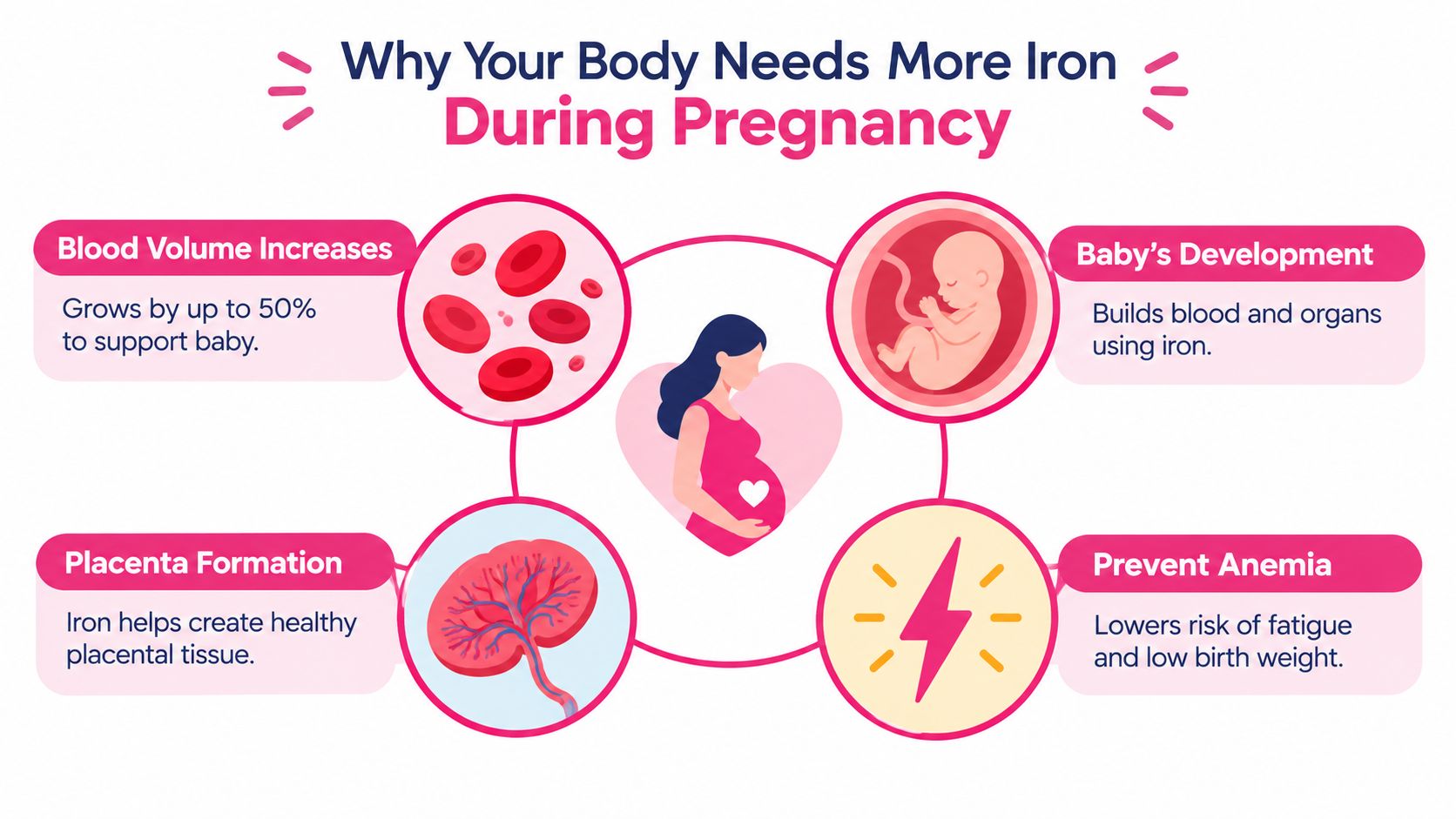
Four jobs iron helps support
- Blood volume: Iron supports the red blood cell production associated with pregnancy.
- Oxygen transport: Hemoglobin uses iron to carry oxygen to your tissues, placenta, and baby.
- Placental function: The placenta needs oxygen and nutrients to support your baby.
- Fetal development: Your baby uses iron while building blood and developing tissues and organs.
Iron is therefore more than another line on a Supplement Facts panel. It acts like raw material used in several construction projects at once. A prenatal may help fill dietary gaps, but its iron amount should match your situation rather than follow a “more is better” assumption.
Food can supply iron through meat, seafood, beans, lentils, fortified foods, and leafy greens. Plant-based eating patterns can provide iron too, although a clinician or dietitian may help coordinate meals and supplements with your overall intake. Resources on managing anaemia through Indian diets may provide culturally familiar ideas, while iron during pregnancy offers further nutrition education.
How to Read Iron on Your Prenatal Label
Could two prenatal labels list different compound weights yet provide a similar amount of usable iron? Yes. The key is separating elemental iron from the total weight of the compound that carries it. Ingredients such as ferrous fumarate and ferrous sulfate contain iron along with other components, so the compound's weight does not tell you how much iron you receive.
Find the amount that counts
Start with the Supplement Facts panel. Find the nutrient line labeled Iron and note the milligram amount beside it. A smaller ingredient list may identify the source, such as ferrous fumarate or ferrous sulfate, but that name alone is not the amount to use when comparing products.
For example, a label might name ferrous fumarate as the iron source and separately state the elemental iron supplied per serving. Compare the elemental iron amounts, not the full weight of each compound. The distinction is like a suitcase and its contents: the suitcase carries the clothes, but the clothes are what you need to weigh for your practical decision.
A calm label-reading checklist
- Confirm the serving size: Check how many capsules, tablets, or gummies provide one daily serving.
- Locate “Iron”: Use the milligram amount beside the nutrient, not only the ingredient name.
- Check elemental iron: Ask a pharmacist or clinician if the label does not make the distinction clear.
- Review the form: Ferrous fumarate and ferrous sulfate describe compounds, not replacements for the elemental iron amount.
- Compare your full routine: Include separate iron, multivitamin, and mineral products so you can account for total intake.
- Match the product to your circumstances: A routine prenatal and an anemia treatment plan serve different purposes.
A standard prenatal may provide approximately 27 mg of elemental iron, although products vary. The U.S. recommended dietary allowance describes average daily needs, while treatment decisions depend on bloodwork and medical judgment. WHO public-health guidance recommends antenatal supplementation containing 30–60 mg of elemental iron plus 400 micrograms of folic acid (WHO antenatal care guidance). These recommendations address population-level care and should not be treated as a universal personal instruction.
Check the prenatal vitamin dose by considering serving size and the other supplements in your routine. A provider can then interpret that total alongside your health history and laboratory results.
When Iron-Free or Low-Iron Prenatals Make Sense
Could an iron-free or low-iron prenatal be the right fit for you? Sometimes. It may make sense when iron causes difficult side effects, your iron stores are adequate, or a clinician has a specific reason to limit extra supplementation. Some gummies contain little or no iron because iron can worsen nausea, constipation, abdominal discomfort, or dark stools.
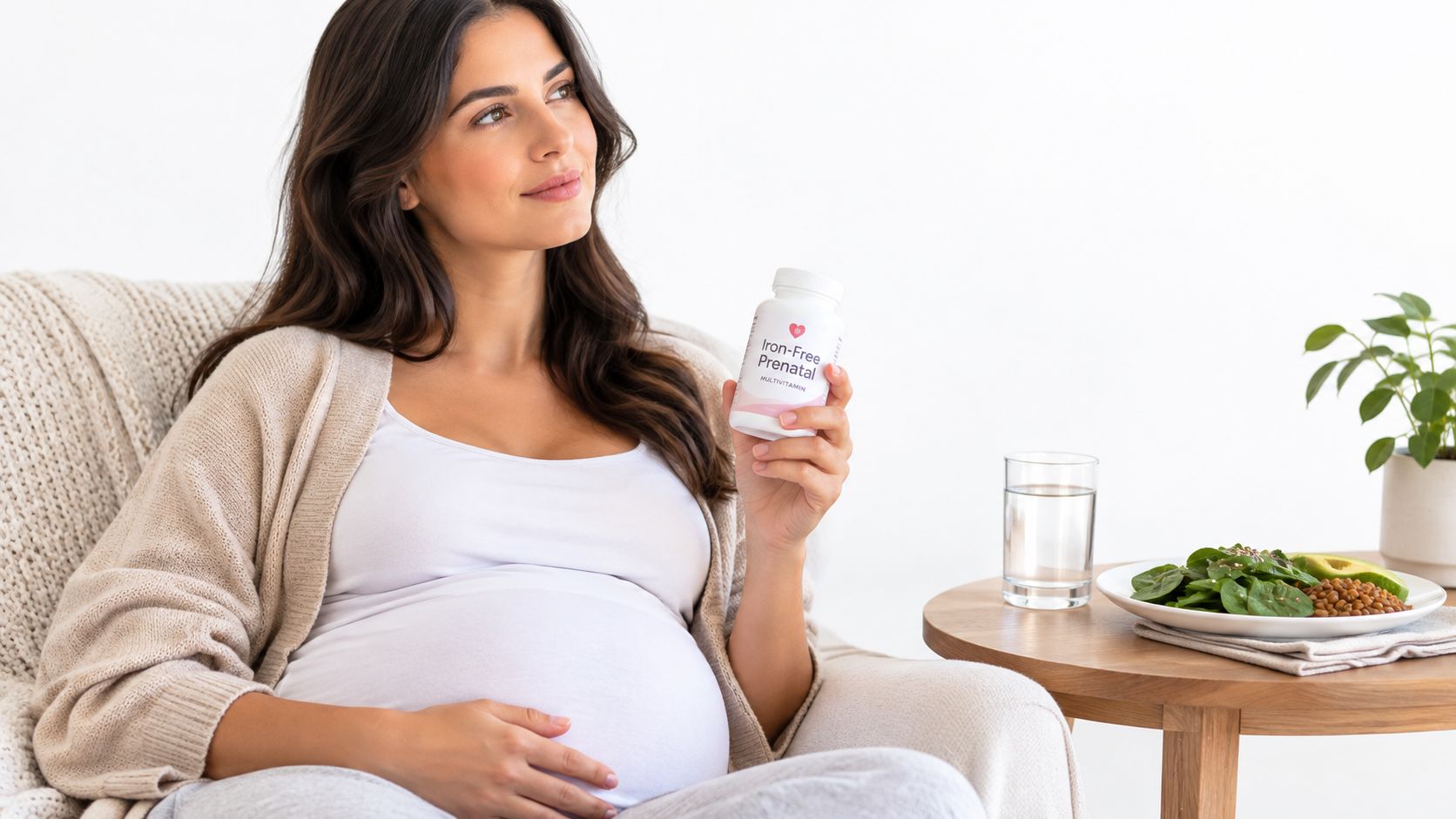
The tradeoff is straightforward. A product that is easier on your stomach may be easier to take consistently, but it does not supply iron. If testing shows iron deficiency or anemia, an iron-free prenatal alone may not address the problem. In that situation, the choice of prenatal and any separate iron treatment should follow clinical advice.
Choose for fit, not simply for more iron
Your best option can depend on:
- Baseline iron stores: Ferritin and related results help show whether extra iron is needed.
- Dietary pattern: People who eat little or no animal food may need help reviewing their iron intake.
- Pregnancy circumstances: A multiple pregnancy or previous blood loss can affect the plan.
- Digestive tolerance: Nausea or constipation may determine which product you can take regularly.
- Diagnosed anemia: Treatment usually requires a clinician-directed dose rather than guesswork.
According to the NIH Office of Dietary Supplements iron fact sheet, evidence about routine iron supplementation during iron-replete pregnancy remains uncertain. That uncertainty does not mean a standard prenatal is unsafe or that you should fear iron. It does show why more is not automatically better, especially when your clinical needs have not been established.
Do not double your prenatal or add an iron tablet just because you feel tired. Pregnancy fatigue has many possible causes, and symptoms alone cannot confirm iron deficiency. If your prenatal causes discomfort, ask a clinician or pharmacist about a different formulation, timing, or dose. A product you can take consistently may serve you better than one that looks stronger on the label but leaves you feeling unwell.
What Bloodwork Reveals About Your Iron Needs
Could fatigue, breathlessness, or headaches mean you need more iron? They can occur during pregnancy for many reasons, so symptoms alone cannot confirm iron deficiency. Bloodwork gives clinicians a clearer starting point.
ACOG recommends a complete blood count during the first trimester and again at 24 0/7–28 6/7 weeks of pregnancy, as described in its anemia in pregnancy guidance. The same guidance describes anemia as hemoglobin below 11 g/dL in the first or third trimester and below 10.5 g/dL in the second trimester.
How clinicians sort out the picture
- Complete blood count: Hemoglobin and hematocrit show whether anemia may be present.
- Iron-store testing: Ferritin helps assess stored iron and is more specific for depleted stores than hemoglobin alone. Ferritin below 30 can be consistent with iron deficiency.
- Clinical context: Your clinician considers diet, previous anemia, bleeding history, symptoms, pregnancy details, and other possible causes.
- Follow-up: If treatment starts, repeat testing may show whether your levels are responding, rather than relying only on how you feel.
Anemia and iron deficiency overlap, but they are not identical. Hemoglobin can identify anemia without proving that low iron caused it. Ferritin adds another piece of the picture by showing whether stored iron is low.
Practical rule: Let your results guide the dose, not the number of tablets in someone else's routine.
A prenatal may contain iron while your results still point to anemia or low ferritin. Your clinician might recommend a separate treatment dose, investigate another cause, or schedule follow-up testing. As covered in the label section, an anemia diagnosis changes the recommended dose, and that decision belongs to your clinician.
Bring the prenatal bottle, or a clear photo of its Supplement Facts panel, to your appointment. Reviewing how to increase iron intake during pregnancy can help you prepare food-related questions. Food and supplements can support care, but they do not replace medical assessment.
How to Choose and Use a Prenatal Vitamin With Confidence
Choosing a prenatal doesn't require finding one perfect bottle. It means matching the formulation to your tolerance, dietary pattern, label details, and clinical information.
Start with the basics:
- Read the daily serving: Know how many pills or gummies provide the listed nutrients.
- Check elemental iron: Compare the iron nutrient line, not the compound's total weight.
- Review the rest of the formula: Look for nutrients relevant to pregnancy, such as folate, iodine, choline, vitamin D, and DHA, while recognizing that products differ.
- Consider tolerability: A product you can take consistently may be more practical than one that repeatedly worsens nausea or constipation.
- Ask before adding anything: This includes separate iron, multivitamins, and mineral products.
A broader best prenatal vitamins UK guide can help you compare common formulation considerations, though local guidance and your own clinician should remain central. Your nutritional needs may also continue during postpartum and breastfeeding, so ask how long your provider recommends continuing a prenatal.
How to choose a prenatal vitamin can help you create a personal checklist. One option is Feed Mom & Me Complete Prenatal Vitamin Plus DHA, a women-owned formula built by moms for moms. Its product information describes a vegetarian, soy-free, gluten-free, and dairy-free formula with 18 mg of iron as ferrous fumarate, plus DHA, choline, selenium, and methylfolate. It also uses delayed-release vegetable capsules and includes peppermint and organic ginger for palatability.
That 18 mg amount is a product fact, not a universal recommendation. If your provider wants you to reach a different iron intake because of laboratory results, dietary needs, or anemia, follow that personalized plan rather than adding capsules yourself.
You're allowed to ask detailed questions, request an explanation of your labs, and choose a prenatal that fits your body. Understanding the label turns a confusing decision into a conversation you can enter with confidence.
Feed Mom & Me offers prenatal nutrition support through its Complete Prenatal Vitamin Plus DHA, educational resources, recipes, and options for maintaining your supply through pregnancy and early parenthood. Review the formula and bring its iron information to your next prenatal appointment, then visit Feed Mom & Me to explore the product and maternal wellness resources.