
How Do Delayed Release Capsules Work for Pregnancy
Published:Updated:
Delayed-release capsules use a pH-sensitive coating to protect ingredients from stomach acid and release them in the intestine. In laboratory testing, they're commonly exposed to an acidic medium around pH 1.2 for 2 hours, then moved to an intestinal medium around pH 6.8, a design that may help reduce stomach discomfort during pregnancy.
You're holding your prenatal in one hand and bracing your stomach with the other. You want to support your growing baby, but you also know that nausea, reflux, or a sensitive stomach can make even a small capsule feel like a challenge. If that sounds familiar, you're not being difficult, mama. Finding a supplement you can take consistently is part of caring for yourself.

Delayed-release technology may offer a gentler experience for some people, but its name is often surrounded by marketing language that makes it sound more powerful than it is. Understanding the difference between delayed release, extended release, stomach comfort, and actual nutrient absorption can help you choose more confidently and have a clearer conversation with your OB/GYN, midwife, or pharmacist.
If you're also sorting through beverages and food choices during pregnancy, a practical resource such as this matcha in pregnancy guide can help you think through another everyday nutrition question. For nausea support, you can also review morning sickness during pregnancy and bring any persistent symptoms to your care team.
Table of Contents
- The Morning Sickness Dilemma Many Mamas Face
- What Delayed-Release Capsules Are Designed to Do
- How Enteric Coatings Protect Ingredients in the Stomach
- Why Delayed Release Is Different From Extended Release
- What the Quality Testing Measures
- Can Delayed-Release Capsules Really Help With Nausea
- Practical Tips for Using Delayed-Release Prenatal Capsules
- Frequently Asked Questions About Delayed-Release Prenatals
The Morning Sickness Dilemma Many Mamas Face
A prenatal may be easy to swallow on one day and feel impossible the next. You might take it after breakfast, notice your stomach turning, and wonder whether the vitamin caused the reaction or just arrived during an already difficult wave of pregnancy nausea. Then comes the worry that skipping it means you're not doing enough.
That emotional tug-of-war can be exhausting. You're trying to meet your nutrient needs while managing hormonal changes, reflux, smell sensitivity, appetite changes, and the ordinary unpredictability of pregnancy. A capsule's design can matter, especially when stomach comfort affects whether you can take it regularly, but no coating can remove every possible cause of nausea.
A helpful mindset: delayed release may improve tolerability for some people, but it isn't a guarantee of nausea prevention.
The phrase “delayed release” refers to the capsule's physical behavior inside your digestive tract. It doesn't automatically promise all-day nutrient delivery, faster absorption, or a nausea-free experience. Once you understand what the coating is designed to do, you can judge product claims more calmly and identify questions worth asking your healthcare provider.
What Delayed-Release Capsules Are Designed to Do
A regular capsule may begin dissolving soon after it reaches the stomach. A delayed-release capsule is designed to postpone ingredient release, usually by using an enteric coating that remains intact in the acidic stomach and dissolves later in the less-acidic small intestine. The FDA defines delayed release as release that occurs at a time other than immediately after oral administration and identifies enteric-coated products as formulations intended to delay release until they've passed through the stomach (FDA guidance).
Think of the capsule as a tiny delivery package:
- You swallow it with water.
- The coating resists the stomach's acidic environment.
- The coating dissolves after the capsule reaches an intestinal environment, allowing the contents to become available.
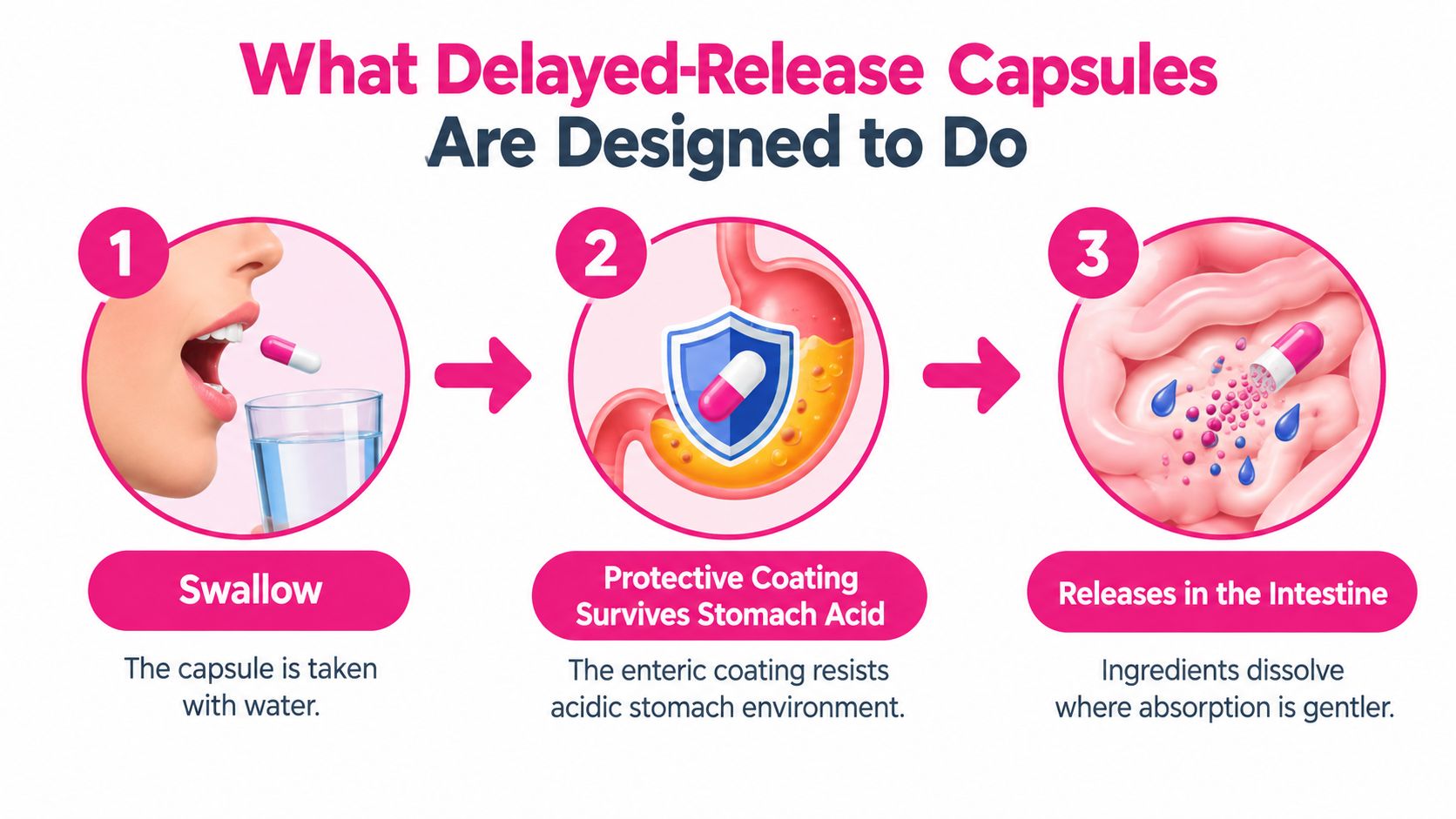
This location-based design may reduce direct exposure of some ingredients to the stomach during the acidic phase. That's why a delayed-release prenatal may be marketed as a more comfortable option for people who feel queasy after standard vitamins. The formulation may use an enteric-coated capsule shell, or it may contain coated pellets or granules inside the capsule.
The most important distinction is what “delayed” means. It primarily describes when or where release begins. It doesn't necessarily mean the ingredients release slowly for many hours. An extended-release product has a different purpose, spreading release over a longer duration.
The coating also doesn't guarantee that every nutrient will be absorbed better. Release and absorption depend on the nutrient, the full formulation, digestive conditions, and your individual response. A delayed-release capsule may be a useful tolerability feature, but it shouldn't be treated as proof that the product is superior in every respect.
How Enteric Coatings Protect Ingredients in the Stomach
The protective layer is usually made with a pH-sensitive polymer. In the stomach's low-pH environment, the polymer stays relatively insoluble and keeps the capsule, pellets, or granules enclosed. Once the dosage form reaches a higher-pH environment in the small intestine, the polymer becomes ionized, takes up water, and dissolves, exposing the contents.
The exact release point depends on the material used. Enteric polymers can be engineered to open at different thresholds, including around pH 5.0, pH 5.5, pH 6.0, and pH 6.5 (review of enteric polymers). A coating that dissolves around pH 5.5 is commonly intended to begin releasing contents near the duodenum, the first part of the small intestine.
What the chemistry means for you
You don't need to memorize polymer names to understand the practical idea. The capsule responds to its surroundings:
- Acidic stomach conditions: the coating stays intact.
- Less-acidic intestinal conditions: the coating begins to dissolve.
- After the coating opens: the ingredients can move into the surrounding intestinal fluid and become available for digestion and absorption.
Laboratory tests often model this journey by exposing the dosage form to 0.1 N hydrochloric acid for about 2 hours, followed by a buffer around pH 6.8 (FDA modified-release guidance). Another technical review describes the stomach stage around pH 1.2 for 2 hours, followed by an intestinal medium commonly around pH 6.8 (delayed-release dosage-form review).
That design can protect sensitive contents during the gastric phase, but comfort still depends on the complete product and your own physiology. The same principle applies when you're evaluating other supplements, including questions about whether probiotics have to be refrigerated. Storage, formulation, and handling can all affect how a product performs.
Why Delayed Release Is Different From Extended Release
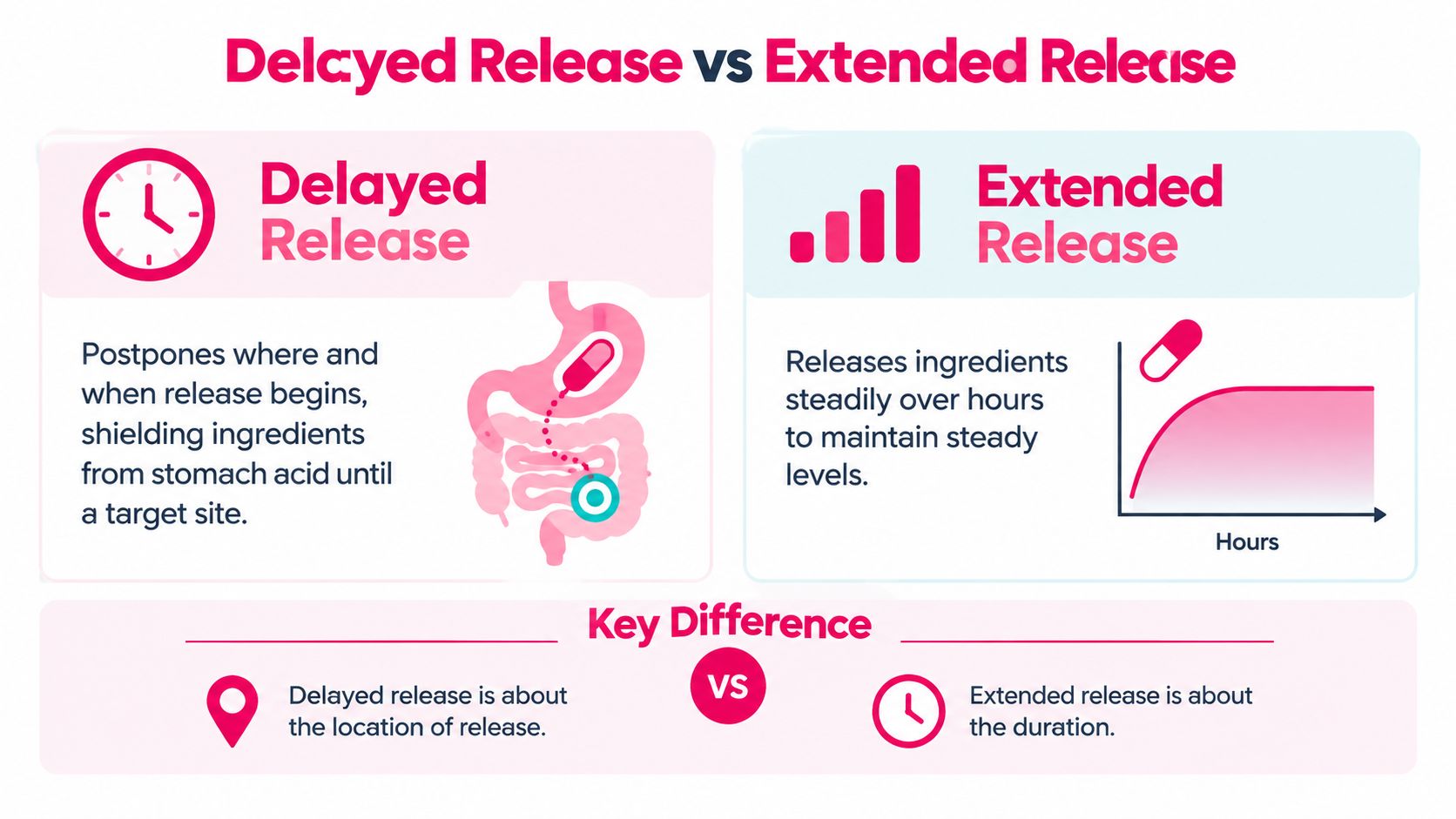
Delayed release answers the question, “Where or when does release begin?” Extended release answers a different question, “How long is release spread out?”
A delayed-release capsule is like a package that stays sealed while it travels through a building and opens when it reaches a particular room. An extended-release capsule is more like a package that opens gradually over a longer period. The first design controls the starting location or timing. The second controls the duration of delivery.
| Feature | Delayed release | Extended release |
|---|---|---|
| Main purpose | Postpones the beginning of release | Spreads release over a longer duration |
| Common design goal | Protects contents from stomach acid until the intestine | Releases contents gradually |
| What the label does not automatically promise | All-day delivery or nausea prevention | Better absorption or improved tolerability for everyone |
The distinction matters during pregnancy because “modified release” can sound like one broad promise. It isn't. A delayed-release prenatal may release its ingredients after passing through the stomach, then release them according to the formulation's design. That doesn't mean the nutrients will continue entering your body steadily throughout the day.
You may find discussions of slow-release iron useful when comparing labels, but a slow-release format shouldn't be assumed to work like an enteric delayed-release capsule. This slow-release iron in pregnancy guide can help you frame questions about iron tolerance and timing with your clinician.
What the Quality Testing Measures
A delayed-release label is meaningful only when the product's release behavior has been tested. In the laboratory, the capsule moves through two dissolution stages. It first enters an acidic medium, then an intestinal buffer, allowing testers to examine whether the coating resists acid and opens after the pH changes.
The framework commonly includes:
- Acid stage: exposure to 0.1 N hydrochloric acid for about 2 hours, representing stomach conditions.
- Buffer stage: transfer to a phosphate buffer commonly around pH 6.8, often for about 45 minutes. The exact pH and duration depend on the product.
- Measurements: tracking how much of the contents becomes available during each stage.
USP guidance sets separate acceptance criteria for the acid and buffer stages. The USP dissolution guidance also helps explain why testing conditions can differ between products.
One cited USP standard for enteric-coated articles requires less than 10% release after 2 hours in 0.1 N hydrochloric acid. A delayed-release aspirin monograph, for example, requires more than 75% dissolution within 45 minutes during the buffer stage (technical review of dissolution standards). These limits describe quality-control testing. They do not promise identical timing inside every person's body.
The lab test checks coating performance. It doesn't measure your personal nausea response.
Food, stomach emptying, intestinal movement, formulation details, and individual physiology can affect what happens after swallowing. Third-party testing can provide another quality check, but third-party tested products still deserve review alongside the actual formulation and advice from your healthcare provider. A passing dissolution result shows how the capsule behaved under set conditions, not whether it will feel comfortable for you.
Can Delayed-Release Capsules Really Help With Nausea
They may help some people, but delayed release doesn't eliminate the many causes of pregnancy nausea. The coating can reduce the time certain ingredients spend exposed directly to stomach acid. That may feel gentler for you, especially if a standard prenatal causes discomfort soon after swallowing it.
Pregnancy nausea can also involve:
- Hormonal changes that affect digestion and appetite.
- Nutrient dose or form, particularly when a formula feels heavy.
- Taking a supplement without food, when the label and your clinician allow food.
- Reflux or digestive sensitivity, which may continue even after the capsule moves onward.
- Smell and taste triggers, including the capsule itself or nearby foods.
- Individual intolerance, which varies widely from one mama to another.
The most useful way to evaluate a delayed-release prenatal is to separate three experiences:
- Physical release behavior: whether the coating resists stomach conditions and opens later.
- Stomach comfort: whether you personally feel less irritation or queasiness.
- Adherence: whether the product is comfortable enough for you to take consistently.

A product can perform well in dissolution testing and still not suit your stomach. Conversely, a formula that feels comfortable for you may help you maintain a routine even though its coating isn't a treatment for morning sickness. You can read more about the broader question of whether prenatal vitamins help with nausea, but persistent or severe vomiting deserves medical guidance rather than repeated supplement experiments.
If you can't keep fluids down, are losing weight, or continue vomiting after taking your prenatal, contact your OB/GYN or another qualified clinician. They can help you decide whether the issue relates to the vitamin, pregnancy nausea, dehydration risk, or another condition.
Practical Tips for Using Delayed-Release Prenatal Capsules
Treat an enteric-coated capsule as a complete delivery system, not an ordinary shell. Don't open, crush, or chew it unless the manufacturer or your healthcare professional specifically says that's safe. Damaging the coating can expose the ingredients to stomach acid too early.
Use the product according to its label and your clinician's advice. If the instructions allow flexibility, ask whether taking it with food or at a different time of day might suit your symptoms. Don't change the dose or substitute another prenatal without checking first, especially if you're pregnant, breastfeeding, taking medication, or managing an iron-related concern.
Keep a simple note of what happens after dosing:
- Comfort: Did you notice nausea, reflux, cramping, or no discomfort?
- Timing: Did symptoms occur immediately or later?
- Consistency: Could you take the capsule as directed?
- Vomiting: Did you vomit soon after taking it?
If vomiting happens soon after a dose, don't guess whether you absorbed enough or automatically take another capsule. Contact your clinician or pharmacist for product-specific advice. They may need to consider the formulation, timing, your pregnancy stage, and your overall nutrient intake.
Pregnancy brands and products also change over time, so consumer resources such as what happened to Mama Mio can be useful when you're trying to understand a brand's history, but your own care team should guide decisions about replacing or changing a prenatal. Feed Mom & Me offers Complete Prenatal Vitamin Plus DHA in delayed-release vegetable capsules, with DHA, choline, selenium, and methylfolate listed as part of its formulation. It's one option to discuss with your healthcare provider.
Frequently Asked Questions About Delayed-Release Prenatals
Does delayed release mean the vitamin lasts all day
No. Delayed release usually describes when or where release begins, often after the dosage form passes through the stomach. It doesn't automatically mean the ingredients are released gradually throughout the day. That longer delivery pattern is associated with extended-release design.
What should I do if I vomit shortly after taking it
Don't automatically repeat the dose. Contact your OB/GYN, midwife, or pharmacist and tell them the product name, when you took it, and when vomiting occurred. They can advise you based on the capsule's formulation and your health needs.
Does taking it with food change comfort or release
Food may affect how comfortable a supplement feels and can influence gastrointestinal conditions, but the effect depends on the product. Follow the label and ask your healthcare provider whether food is appropriate for that specific prenatal. Never assume food will prevent nausea or change the release pattern in a predictable way.
Feed Mom & Me provides prenatal nutrition support, including Complete Prenatal Vitamin Plus DHA, delayed-release vegetable capsules, and education for pregnancy and early parenthood. Visit Feed Mom & Me to explore the formula and resources, then bring your questions about tolerability, nausea, and nutrient needs to your healthcare provider.