
How Much DHA During Pregnancy: A Complete Guide
Published:Updated:
Most pregnant women do well aiming for at least 200 mg of DHA per day, layered onto a broader baseline of at least 250 mg a day of DHA plus EPA, with some guidance suggesting an extra 100 to 200 mg of DHA during pregnancy. In everyday terms, that puts many mamas in a practical target range of about 350 to 450 mg total omega-3 intake during pregnancy when that pregnancy-specific DHA add-on is included.
You've probably had that moment already. You're standing in the supplement aisle, or squinting at a prenatal label on your phone, trying to figure out whether the tiny DHA number matters and whether you need more. One bottle says DHA. Another says omega-3s. A third says fish oil. Suddenly a simple question feels weirdly complicated.
The good news is that how much DHA during pregnancy usually isn't a mystery once you separate two things: the baseline amount most women are trying to meet and the higher range sometimes used in more specific situations. That's where a lot of the confusion comes from. Some articles talk only about a minimum. Others jump straight to high-dose studies and make it sound like everyone needs the same thing.
You don't need to decode this alone, mama. A steady, research-based baseline is realistic for everyday life, and if you happen to be in a group that may benefit from more, there's a clear way to think that through with your provider.
Table of Contents
- How Much DHA Do You Really Need While Pregnant
- What DHA Is and Why Your Baby Needs It
- What the Guidelines Actually Recommend
- Algal DHA vs Fish Oil Which Is the Better Choice
- DHA Food Sources You Can Add to Your Week
- Is More DHA Ever Too Much Safety and Upper Limits
- Bringing It All Together Your Daily DHA Routine
How Much DHA Do You Really Need While Pregnant
You pick up a prenatal, turn the bottle around, and find the DHA line in tiny print. Maybe it says 200 mg. Maybe less. Maybe none at all. Then you open another tab online and see a totally different number. That's usually the moment the question stops feeling simple.
A helpful place to start is this: a peer-reviewed review in Omega-3 Fatty Acids and Pregnancy reports that consensus guidelines have recommended at least 200 mg of DHA per day during pregnancy (review on pregnancy DHA guidance). That's the number many moms recognize because it shows up again and again on prenatal labels.
Your everyday baseline
Think of 200 mg of DHA as the common pregnancy floor for DHA itself. Then zoom out one step further. The U.S. NIH summarizes newer guidance saying women of childbearing age should get at least 250 mg per day of DHA plus EPA, and pregnant women should add another 100 to 200 mg per day of DHA (NIH pregnancy guidance summary).
That's why the numbers can look different without disagreeing.
Here's the plain-English version:
- Common DHA minimum: 200 mg DHA daily
- Broader omega-3 floor: 250 mg DHA plus EPA daily
- Pregnancy add-on in newer guidance: an extra 100 to 200 mg DHA daily
So if you're wondering what to shoot for in real life, many women think in terms of a baseline prenatal-level DHA amount, then look at food and the rest of their omega-3 intake around it.
Practical rule: If your prenatal gives you some DHA, that's useful. If it gives you none, you'll usually want to think more intentionally about fish, algae oil, or a separate omega-3 supplement.
When the number may be higher
There's also a second lane. Some clinicians steer women with low fish intake, low omega-3 status, or a history of preterm birth toward a higher intake range. That's not because everyone needs a mega-dose. It's because your starting point matters.
If you've ever felt lost comparing labels, this guide on prenatal vitamin dose can help you think through the rest of your prenatal routine too.
What DHA Is and Why Your Baby Needs It
DHA stands for docosahexaenoic acid, which is one of the long-chain omega-3 fats. That sounds science-y, but the job itself is pretty easy to picture.
Think of DHA like a very specific kind of building brick. Not every part of the body needs the same brick, but the brain and retina really do. DHA gets built into the membranes around cells, especially in places where quick signaling and visual development matter most.
Why DHA matters in pregnancy
Your baby isn't just “using” DHA in a general wellness sort of way. DHA helps form actual structure. It becomes part of the tissue itself.
That matters during pregnancy because your baby depends on you as the supply line. DHA moves across the placenta, and your body is the source it pulls from. Later, during breastfeeding, your intake still matters because DHA continues to reach your baby through milk.
Here's the simple version:
- Brain support: DHA helps build the structure of brain cell membranes.
- Eye support: DHA is also important in the retina.
- Supply line: Your baby gets DHA from your stores and your intake.
- Postpartum matters too: DHA doesn't suddenly stop mattering after birth.
Where EPA fits in
You'll often see DHA and EPA listed together. They're both omega-3s, but they don't play the same role.
DHA is the structural star in pregnancy. EPA is more involved in inflammation balance and is often included alongside DHA in fish oil products. That's one reason supplement labels can look so different from each other.
Your baby doesn't need you to become a nutrition expert overnight. You just need to know which nutrient is doing the heavy lifting.
If you're also thinking ahead to toddler nutrition, this family-friendly guide to omega-3 fatty acids for kids helps connect the dots after pregnancy too.
What the Guidelines Actually Recommend
You read one article that says 200 mg. Then a supplement label mentions DHA plus EPA. Then another source talks about eating fish twice a week. No wonder this gets muddy fast.
Here's the clearer way to sort it out. Pregnancy DHA guidance usually falls into two buckets: a baseline amount that fits most pregnant women, and a higher target that makes sense if your diet is low in omega-3s or you have a reason to be more intentional.
The simple baseline
A practical floor you'll see again and again is about 200 mg of DHA per day during pregnancy. That number shows up in guidance from groups focused specifically on pregnancy and early development, including a joint expert recommendation published in the Journal of Perinatal Medicine that advises pregnant and lactating women to aim for at least 200 mg of DHA daily (perinatal DHA consensus statement).
For many moms, this is the easiest number to use because it answers the plain question first: “What do I want to make sure I'm getting every day?”
Why some guidance sounds higher
Other organizations frame omega-3 needs more broadly. The European Food Safety Authority, for example, recommends 250 mg per day of EPA plus DHA for adults, with an extra 100 to 200 mg of DHA during pregnancy (EFSA scientific opinion on dietary reference values for fats).
That sounds different, but the ideas overlap.
One guideline is counting DHA by itself. Another starts with total marine omega-3s and then adds extra DHA for pregnancy. It's a little like comparing a grocery list that says “buy fruit” with one that says “buy apples specifically.” They are not arguing. They're measuring from different starting points.
DHA and Omega-3 Recommendations During Pregnancy
| Authority | Recommended Daily Intake | Notes |
|---|---|---|
| Pregnancy-focused expert consensus | At least 200 mg/day DHA | A practical baseline many clinicians and prenatal brands still use. |
| European Food Safety Authority | 250 mg/day EPA plus DHA for adults, plus an extra 100 to 200 mg/day DHA in pregnancy | Broader omega-3 framework with a pregnancy add-on. |
| Food and Agriculture Organization of the United Nations | Around 300 mg/day EPA plus DHA, including 200 mg DHA | Another version of the same general baseline. |
How to use this in real life
If you eat little or no low-mercury fatty fish, starting with a supplement that gives at least 200 mg DHA daily is a reasonable baseline.
If your prenatal or omega-3 supplement is built around combined DHA plus EPA, the total may look higher on the label. That does not automatically mean it is “too much.” It usually means the formula is counting both omega-3s, not just DHA.
This is the part many moms need most. There isn't one magic number that fits every situation. There is a universal baseline you want covered consistently, and there is a higher range that may fit better if your food intake is low or your provider wants you aiming higher.
If you're comparing labels and trying to figure out what belongs in a prenatal too, this guide on how to choose a prenatal vitamin can help you read them without the guesswork.
Algal DHA vs Fish Oil Which Is the Better Choice
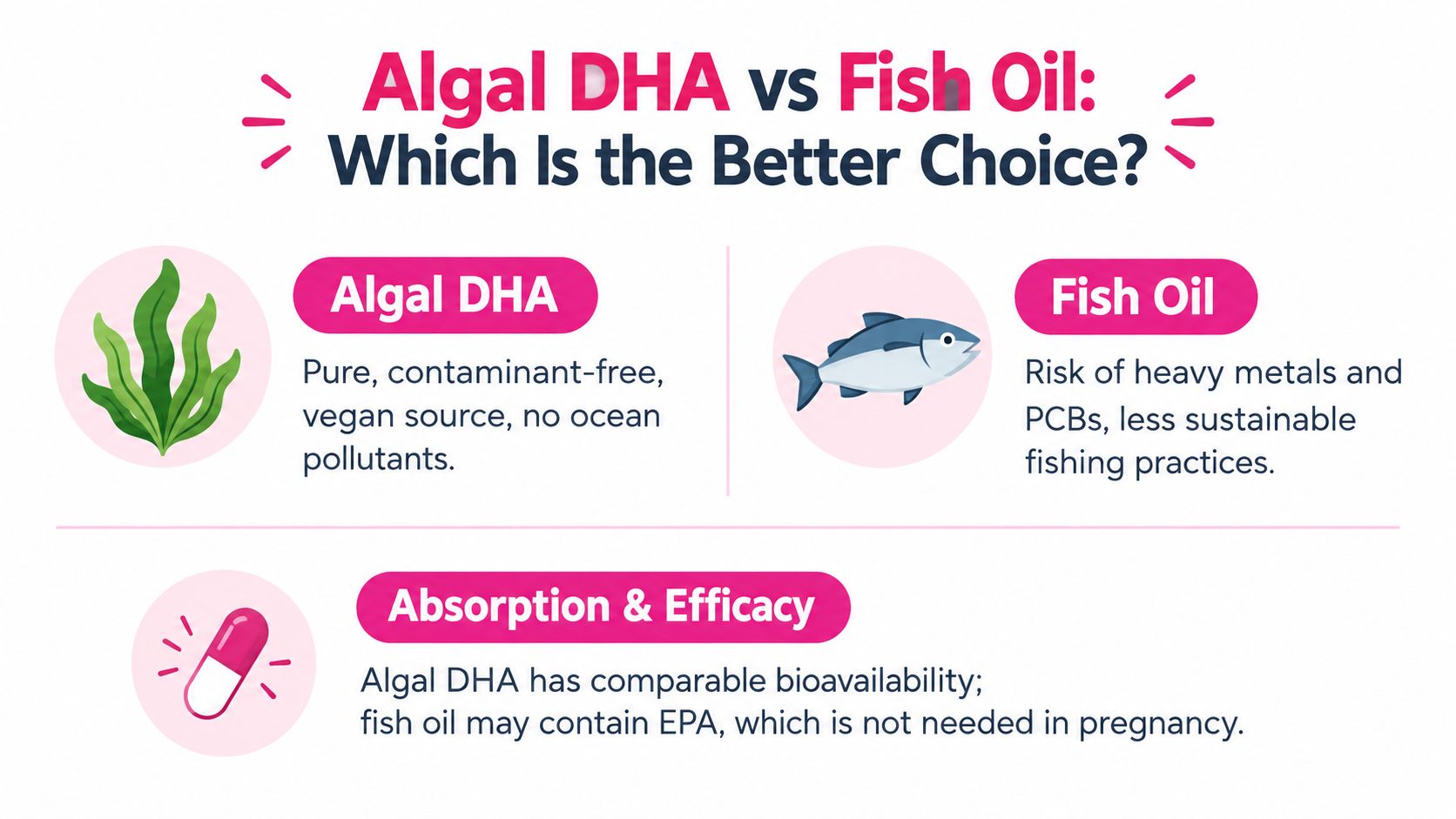
This choice gets framed like there's one right answer for everyone. There isn't. Both algal DHA and fish oil can be sensible options in pregnancy. The better pick is usually the one you'll tolerate, trust, and take consistently.
Purity and sourcing
Algal DHA comes from microalgae. That matters because microalgae are the original source of DHA in the marine food chain. Fish get DHA from algae. So when you take algal DHA, you're going straight to the source.
Many moms like algal oil because it feels simpler and cleaner on paper. It's also the practical non-fish option if you're vegan, vegetarian, or just can't deal with fish.
Fish oil gives you DHA plus EPA from marine sources. That can be useful if you want both omega-3s in one supplement, but product quality can vary by brand and processing.
Tolerance during pregnancy
This one matters more than people admit. A supplement can look perfect on the label and still be a terrible fit if it gives you fishy burps or turns your stomach.
A few things many women notice:
- Algal DHA: Often milder in taste and easier if fish smells are suddenly unbearable.
- Fish oil: May be easier on the budget and may offer both DHA and EPA in one capsule.
- Sensitive stomachs: The “best” supplement is the one you can keep taking without dreading it.
Some pregnancies make fish smell like a personal attack. That alone can make algae oil the more realistic option.
So which should you choose
Use the most ordinary decision filter possible.
Choose algal DHA if:
- You avoid fish: Vegan and vegetarian moms usually need a direct DHA source that isn't marine animal-based.
- You want a straightforward label: Algal products are often the cleanest emotional fit for people worried about contaminants.
- You hate fishy reflux: A lot of women tolerate algae better.
Choose fish oil if:
- You want EPA plus DHA together
- You tolerate fish oil well
- You're trying to keep costs lower
If you want a deeper look at plant-based options, this guide to algae-based DHA supplements is worth a read.
DHA Food Sources You Can Add to Your Week
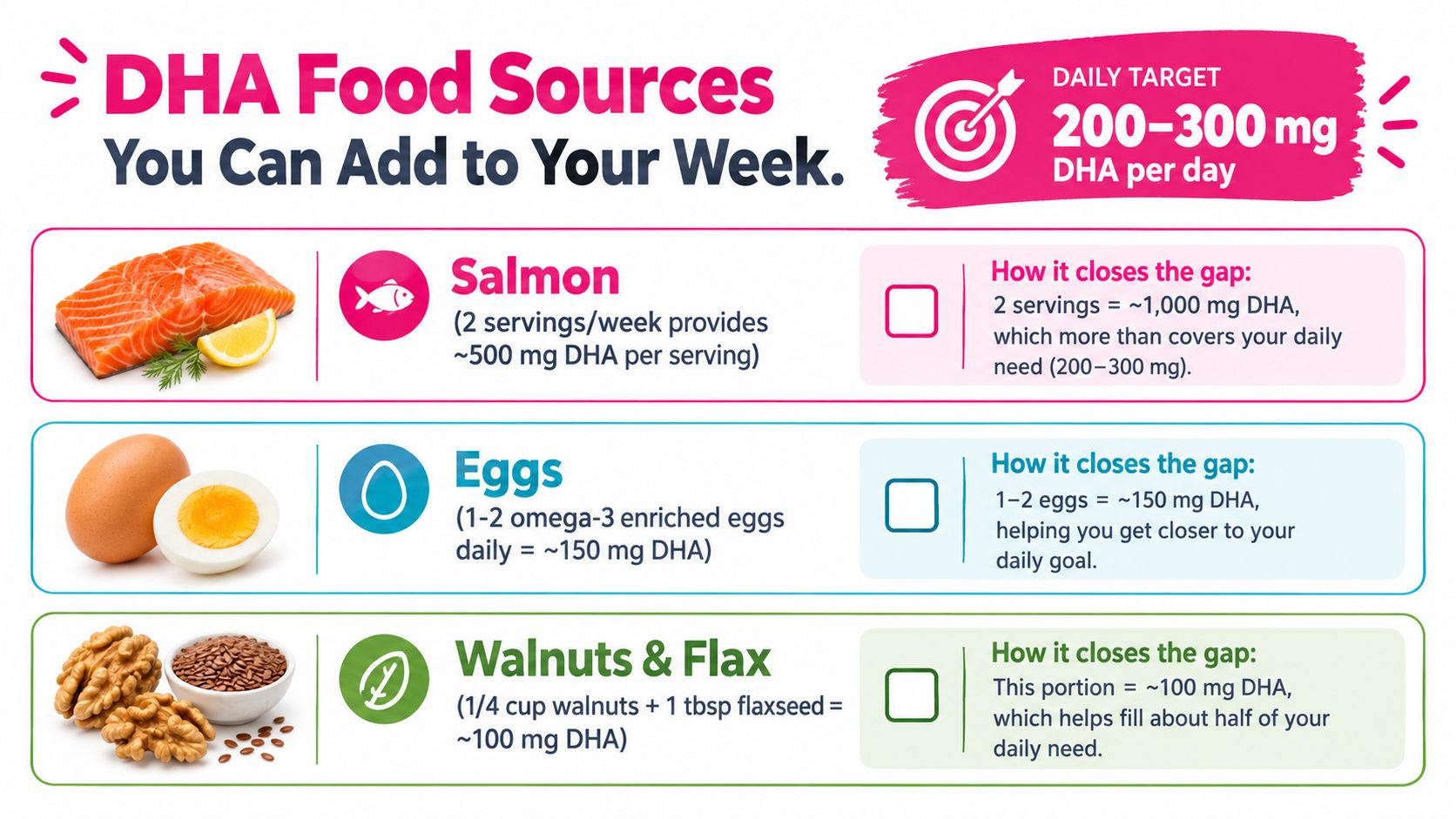
If your prenatal covers only part of your DHA target, food can close a lot of the gap without turning your life into a meal plan spreadsheet.
The easiest place to start is low-mercury fatty fish. These are the foods that naturally bring in the kind of omega-3s your body can use directly, especially DHA. In pregnancy, that's often simpler than trying to build everything around plant sources alone.
The foods that do the most work
A practical weekly rotation can include:
- Salmon: A staple choice for many pregnant women because it's familiar and easy to cook.
- Sardines: Not glamorous, but very efficient if you like them.
- Trout, herring, and anchovies: Also direct marine sources of DHA.
- DHA-enriched eggs: Helpful as a small daily boost.
- Fortified foods: Some dairy products or other packaged foods add DHA, though amounts vary.
Plant foods like chia, flax, and walnuts still deserve a place at the table. They provide ALA, another omega-3 fat. The issue is that ALA doesn't replace DHA very well, because your body converts only a small amount of it into DHA.
A simple weekly pattern
You do not need a perfect menu. You need a repeatable one.
A low-stress pattern might look like this:
- One or two fish meals during the week
- Eggs on a few mornings
- Walnuts or chia added where they already fit
- A prenatal or separate DHA supplement if food alone isn't covering your needs
That's often enough to make the numbers on paper feel much more manageable in real life.
Easy win: Build around meals you already like. Salmon tacos, trout with roasted potatoes, a sandwich with sardines if you enjoy them, or eggs you'd eat anyway.
If you want more meal ideas, this roundup of foods rich in DHA can make weekly planning feel much less fussy.
Is More DHA Ever Too Much Safety and Upper Limits
You buy a prenatal, then notice a second bottle of DHA in your cart and pause. If more supports baby's brain and eyes, should you add it. Or is there a point where more stops being helpful?
That question makes sense. Pregnancy has a way of turning even simple supplement decisions into second-guessing.
The clearest way to sort it out is to separate two different ideas. One is the baseline amount many pregnant women use for steady daily support. The other is a higher range that may be used on purpose in women with low seafood intake or a higher chance of preterm birth. Those are not the same situation, and they should not be treated like they are.
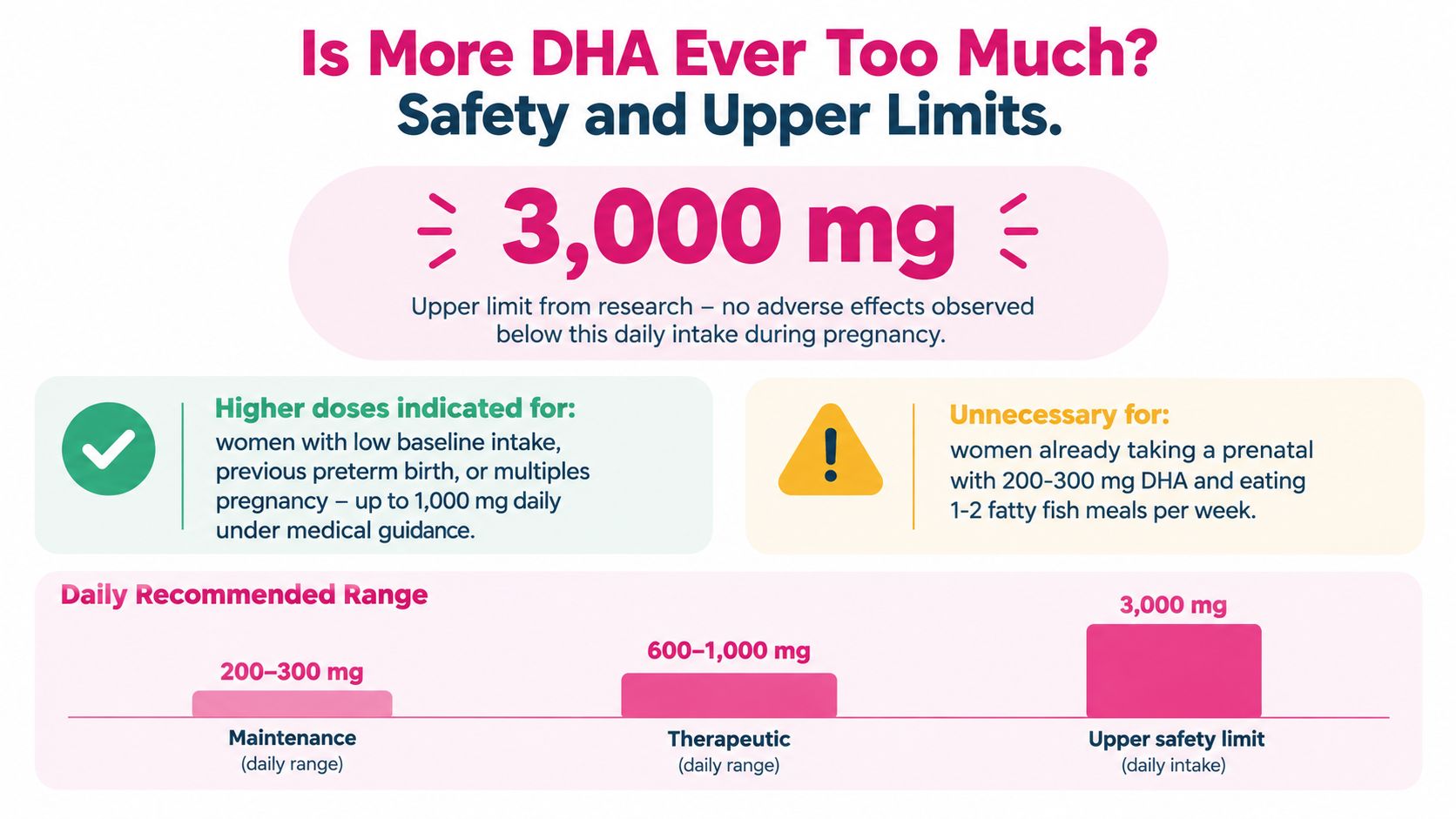
A recent European Food Safety Authority review found that studies support the safety of supplemental DHA alone up to 1 gram per day for pregnancy-related outcomes (EFSA review on DHA safety in pregnancy).
When higher doses come up
Higher-dose DHA has been studied most often for preterm-birth prevention. That is why you will sometimes see numbers that sound much higher than the usual daily baseline.
One NIH-supported trial summary reported that pregnant women taking 1,000 mg per day of DHA had lower rates of preterm birth than women taking 200 mg per day (NICHD clinical trial news on DHA dose and preterm birth).
A review in Frontiers in Pediatrics describes a similar practical range. It notes that women with low DHA intake or low DHA status may benefit from 600 to 1000 mg per day, especially when preterm birth prevention is part of the conversation (review of omega-3 use in pregnancy).
That does not mean every pregnant mama needs the high range. It means dose should match the reason you are taking it.
What “too much” usually looks like in real life
For most women, the first limit they notice is not danger. It is practicality.
A higher dose may make sense if you avoid fish, eat very little seafood, follow a vegan or vegetarian diet, have had a prior preterm birth, or your clinician is concerned that your omega-3 intake is low. In those cases, the goal is usually to move from a basic baseline into a more targeted range for a clear reason.
If you already eat fish regularly and your prenatal includes DHA, piling on extra capsules may not change much. More is not automatically better, the same way adding extra cups of flour does not always improve a recipe. The useful amount depends on what is already in the bowl.
Here's a helpful explainer if you want to listen while folding baby laundry or driving to an appointment.
Bringing It All Together Your Daily DHA Routine
The easiest routine is the one that doesn't ask you to think too hard every day.
For many women, a practical setup looks like this: use a prenatal that includes some DHA, eat low-mercury fish when you can, and only layer on extra DHA if your diet or risk profile makes that sensible. That keeps you anchored to a real routine instead of chasing numbers from one article to the next.
A sample day that feels normal
Here's what this can look like without becoming a whole project:
- Breakfast: Eggs and toast, with walnuts or chia added somewhere if you like them.
- Lunch: Leftover salmon on a salad, or another meal built around fish when it fits the week.
- Dinner: Your regular dinner, plus your prenatal with food if that helps your stomach.
- Optional add-on: An algal DHA capsule at dinner if you avoid seafood or your clinician wants you in a higher range.
That's it. No nutrition perfection required.
Matching the dose to your situation
A useful way to think about it is in two lanes.
Lane one is baseline support. This is the lane most pregnant women live in. The focus is steady intake, usually through a prenatal, food, or both.
Lane two is therapeutic dosing. Higher amounts may come into play for women with low seafood intake, low DHA status, or a history that makes preterm-birth prevention more relevant to discuss.
One straightforward option in the baseline lane is Feed Mom & Me Complete Prenatal Vitamin Plus DHA, which includes DHA as part of a broader prenatal formula. If you like routines that feel simple and all-in-one, products in that category can make daily consistency easier.
The right DHA plan should feel supportive, not like another thing on your mental load list.
You don't have to get this perfect, mama. You just need a plan that matches your actual life, your actual meals, and your actual pregnancy.
If you want a simpler way to cover your prenatal basics, Feed Mom & Me offers a women-owned, mom-built approach to pregnancy nutrition, including Complete Prenatal Vitamin Plus DHA and practical education for everyday questions like this one. You can explore their prenatal support, recipes, and pregnancy resources at Feed Mom & Me, then bring any supplement questions to your healthcare provider so your routine fits you.