
Magnesium Bisglycinate Benefits for Pregnancy and Sleep
Published:Updated:
You're lying in bed, finally still, and then your calf tightens. Or your mind starts doing that annoying little lap around tomorrow's to-do list. Or your prenatal sits on your nightstand because your stomach has already had enough for one day. If that sounds familiar, mama, you're not doing anything wrong. A lot of women start looking into magnesium because they want support that feels a little gentler and a little more doable.
That's where magnesium bisglycinate usually enters the conversation. It gets talked about as the calm, easy-on-your-stomach form of magnesium. Sometimes it's described like a miracle for sleep, cramps, stress, and pregnancy discomfort all at once. That's the part where things can get confusing. Some of the interest around this form is well grounded. Some of it is more hopeful than proven.
I like to approach magnesium bisglycinate benefits the same way I'd talk to a friend over tea. Let's separate what seems useful from what's still uncertain. That way, you can make a steady, informed choice instead of chasing big promises.
You'll see a few themes come up again and again in this guide:
- Why this form is different from other magnesium types
- Which benefits have the strongest support
- Why stomach tolerance matters so much in real life
- What pregnancy safety guidance says
- How low magnesium can show up during pregnancy
- How to think practically about food, supplements, and daily routines
Feed Mom & Me is a women-owned brand built by moms, for moms, and that matters to me because maternal wellness advice should feel both warm and medically careful. You deserve information that respects your real life, your symptoms, and your questions. Still, any supplement decision during pregnancy or postpartum belongs in conversation with your OB, midwife, or another trusted clinician who knows your health history.
Table of Contents
- Introduction What You Will Learn About Magnesium Bisglycinate
- What Is Magnesium Bisglycinate and Why Is It Different
- What Are the Proposed Benefits of Magnesium Bisglycinate
- How Does Magnesium Bisglycinate Compare to Other Magnesium Forms
- Is Magnesium Bisglycinate Safe During Pregnancy and How Much Do You Need
- What Happens If You Get Too Little Magnesium During Pregnancy
- Final Takeaways and How to Support Your Magnesium Needs Daily
Introduction What You Will Learn About Magnesium Bisglycinate
A lot of late-night supplement searching starts the same way. You wake up uncomfortable, your legs feel twitchy, your sleep has turned feather-light, and the thought of taking one more thing that might upset your stomach feels exhausting. So you type in “magnesium bisglycinate benefits” and hope for a simple answer.
The simple answer is that this form may be helpful mainly because it's often better absorbed and gentler on digestion than some other forms. That matters more than it sounds. A supplement only helps if you can take it consistently.
For pregnant and postpartum women, that practical piece is huge. You may already be dealing with nausea, food aversions, constipation, or a very selective stomach. A form of magnesium that feels easier to stick with can be meaningful, even if it doesn't promise dramatic results.
Big picture: Magnesium bisglycinate is often chosen less for flashy claims and more for daily comfort, steadier use, and fewer digestive complaints.
Sleep is another reason many mamas look at this form. That interest makes sense, but the strongest direct sleep study we have showed a small benefit, not a dramatic one. That doesn't mean it's useless. It means it's better to think of it as one possible helper in a bigger sleep-support plan, not a magic switch.
Pregnancy adds another layer. Magnesium status matters in maternal health, but that is not the same thing as saying every pregnant woman needs a magnesium supplement. The more careful question is whether a specific form, dose, and routine make sense for you.
A gentle guide matters here because it's easy to end up in one of two extremes. Either you read that magnesium fixes everything, or you get so buried in caveats that you give up. Neither helps.
What Is Magnesium Bisglycinate and Why Is It Different
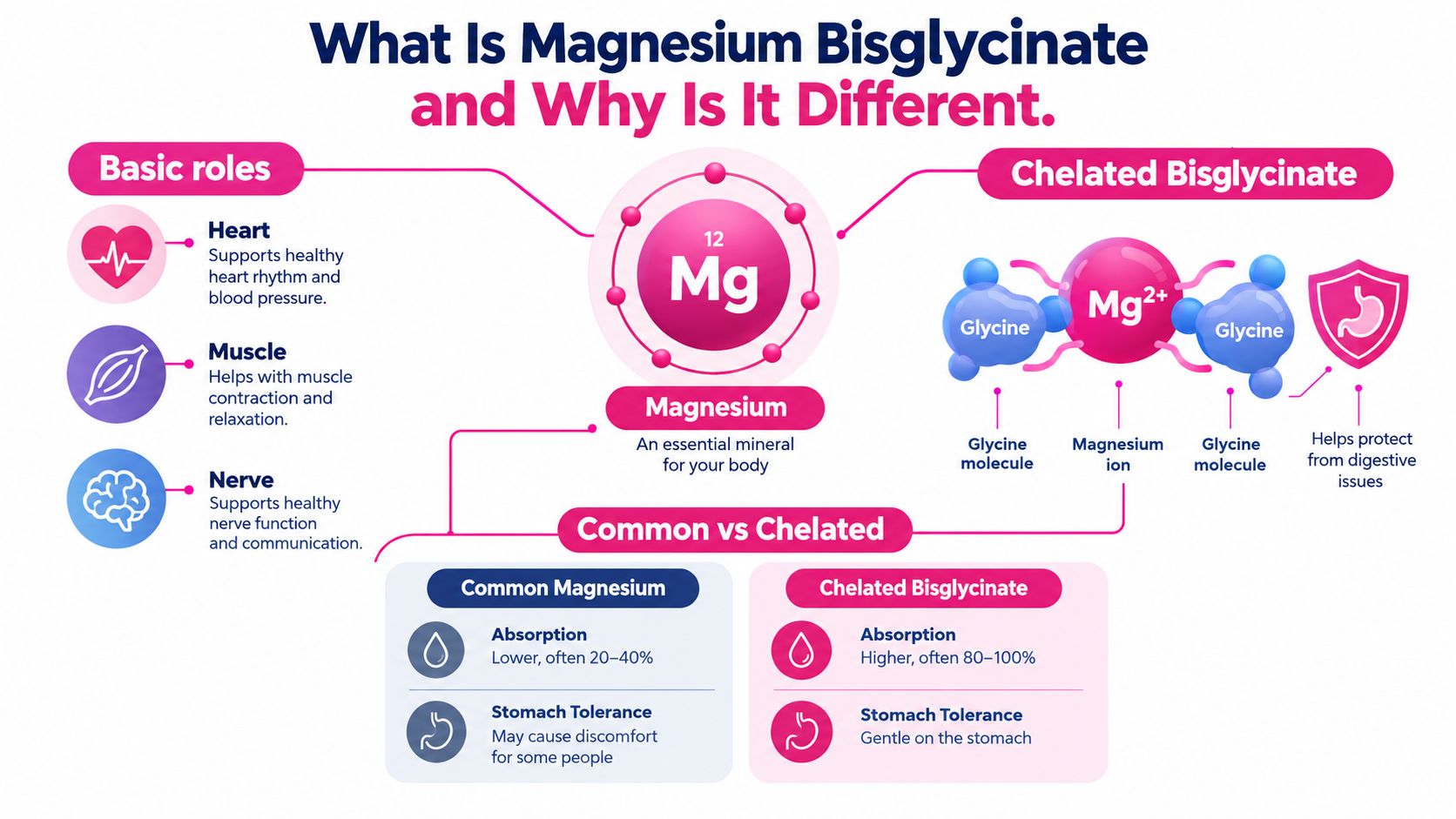
Magnesium itself is an essential mineral your body uses in everyday jobs like supporting muscle function, nerve signaling, and a steady rhythm in basic body processes. The part that trips people up is this: magnesium doesn't come in just one supplement form.
Magnesium bisglycinate is magnesium attached to two glycine molecules. That pairing is called a chelate.
What does chelated mean in plain language
Think of magnesium as a small passenger trying to get through digestion without getting bumped off course too early. In bisglycinate, glycine acts a little like a protective wrap around the magnesium. That chelated structure may help it move through the digestive tract with fewer losses.
Magnesium bisglycinate is basically magnesium “hugged” by glycine. That's the simple reason people associate it with gentler absorption.
A 2025 in vitro evaluation of magnesium compounds described magnesium bisglycinate as a highly bioavailable chelated form and found overall bioavailability around 66.66%, with peaks up to 73.73% depending on formulation conditions. In that same evaluation, it performed at a level similar to magnesium chloride and higher than most other organic salts.
Why form matters more than many labels suggest
When you read a supplement label, you may see a compound name and an amount of magnesium. What often gets missed is that the form affects how the supplement behaves in the body. One form may be more likely to loosen stools. Another may be chosen because it seems easier to absorb.
That doesn't mean one form is universally “best.” It means the best fit depends on the problem you're trying to solve. If your main issue is daily stomach sensitivity, a gentler form may matter more than anything else.
Elemental magnesium versus the full compound
This is another common point of confusion. The amount listed as elemental magnesium refers to the actual magnesium portion, not the total weight of the whole bisglycinate compound. So two bottles can look similar at first glance but deliver different practical experiences depending on form and dose.
Here's the helpful takeaway:
- Chelated form means magnesium is bound to another molecule, here glycine
- Bisglycinate often gets chosen for stomach comfort and absorption
- Elemental magnesium tells you how much magnesium you're getting
- Tolerability matters because consistency matters
What Are the Proposed Benefits of Magnesium Bisglycinate
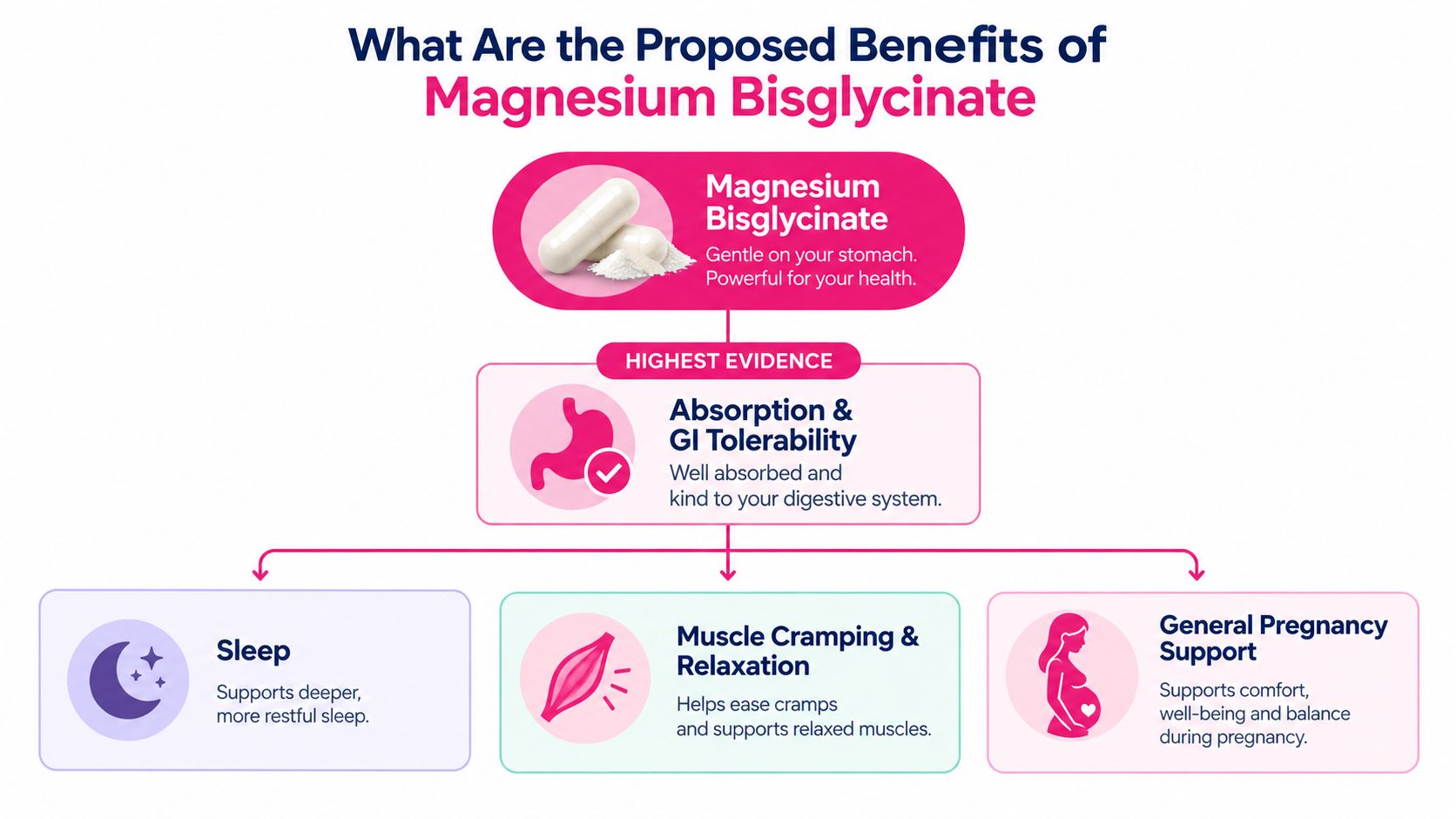
When people talk about magnesium bisglycinate benefits, they usually mean four things: better absorption, fewer digestive problems, better sleep, and help with muscle tension or cramping. Those ideas aren't all supported equally.
Absorption and stomach tolerance are the strongest practical benefits
This is the area where magnesium bisglycinate has the clearest real-world appeal. In an older randomized absorption study comparing magnesium diglycinate, another name used for this chelated form, with magnesium oxide, participants with the most impaired absorption had 23.5% absorption for magnesium diglycinate versus 11.8% for magnesium oxide, and the chelated form was reported as better tolerated in that study's findings from PubMed.
That doesn't just sound technical. It matters for actual daily use. If a supplement is easier on your gut, you're more likely to keep taking it.
A randomized crossover tolerability study in healthy adults also found magnesium bisglycinate was well tolerated, with no study-product-related adverse events reported, and some bowel habit improvement versus placebo or magnesium oxide in certain conditions according to the study PDF.
Sleep support seems real, but modest
Online hype tends to outrun the data. A randomized trial in 155 adults with self-reported poor sleep tested 250 mg elemental magnesium as bisglycinate daily for four weeks and found insomnia severity improved slightly more than placebo, but both groups improved and scores stayed in the subthreshold insomnia range, as reported in this peer-reviewed trial summary.
So yes, there may be a sleep benefit. But no, the strongest direct trial does not support a dramatic makeover in sleep.
Practical takeaway: If you try magnesium bisglycinate for sleep, think “gentle nudge,” not “overnight fix.”
If your nights are rough, it often helps to pair supplement questions with habits like caffeine timing, iron evaluation when appropriate, and a calming routine. You might also want to browse natural sleep solutions for ideas that work alongside, not instead of, medical care.
For more pregnancy-focused context on nighttime support, Feed Mom & Me also has an article on sleep aid supplement options for moms.
Muscle comfort and general pregnancy support are more nuanced
Many women use magnesium because they hope for fewer cramps, a more relaxed body, or a little less physical tension. Those reasons are understandable. Magnesium plays a role in muscle and nerve function, so the idea is biologically plausible.
Still, pregnancy-specific outcomes are far less supported by evidence than the internet often suggests. An older peer-reviewed review on magnesium supplementation in pregnancy concluded there was no evidence supporting supplementation for improving maternal or neonatal outcomes overall, as discussed in this evidence review summary.
That's why I think the most honest framing is this:
- Most supported benefit: Better tolerability and a reasonable absorption profile
- Plausible but modest: Sleep support
- Possible but less settled: Muscle comfort and symptom-specific pregnancy use
- Not supported as a blanket claim: Broad improvement in pregnancy outcomes for everyone
How Does Magnesium Bisglycinate Compare to Other Magnesium Forms
Standing in front of a supplement shelf can feel weirdly complicated. The bottle says magnesium, but then you notice oxide, citrate, chloride, L-threonate, and bisglycinate. Same mineral, different delivery styles.
The simplest way to think about it is that each form has a personality. Some are chosen because they're common and inexpensive. Some are picked for bowel effects. Some are popular for nervous-system or brain-health marketing, even when direct pregnancy relevance is less clear.
Magnesium forms compared for absorption and tolerability
| Form | Absorption and Tolerability | Best Fit |
|---|---|---|
| Bisglycinate | Often chosen for good absorption and gentler stomach tolerance | Daily use when you want continuity and fewer GI issues |
| Citrate | Commonly considered fairly well absorbed, but some people find it more laxative | Someone who doesn't mind bowel effects or may even welcome them |
| Oxide | Common and widely available, but often discussed as less well absorbed and more likely to loosen stools | Short-term bowel-focused use or when this is the form already included in a prenatal |
| Chloride | Performed similarly to bisglycinate in the in vitro evaluation linked earlier | A practical alternative when tolerated well |
| L-threonate | Marketed for brain-focused use, but not usually the first form discussed for pregnancy comfort | Niche goals discussed with a clinician |
Why oxide gets mixed reviews
Magnesium oxide shows up in many products because it's familiar and easy to find. But if you're sensitive to digestive side effects, it may not be your favorite. For a mama who already feels a little queasy or unpredictable in the bathroom department, that can be reason enough to consider another form with her provider.
Why bisglycinate stands out for routine use
Bisglycinate tends to make the most sense when your goal is simple consistency. You want to take magnesium regularly without feeling like your supplement is picking a fight with your stomach.
That's also why some moms look not just at the magnesium form itself, but at the overall prenatal experience, including capsule design and nausea-friendly ingredients. Feed Mom & Me has a related read on anti-stress supplements for moms if you're thinking about magnesium as one piece of a bigger support plan.
No magnesium form is perfect for everyone. The right one is the one that fits your body, your symptoms, and your provider's guidance.
Is Magnesium Bisglycinate Safe During Pregnancy and How Much Do You Need
Pregnancy supplement questions usually sound simple at first. Then you start reading and realize there's a difference between magnesium from food, magnesium from supplements, and what's broadly recommended versus what's individualized.
That's why safety deserves a calm, practical look.

What official guidance says
The NIH Office of Dietary Supplements states that during pregnancy, the upper limit for magnesium from supplements is 350 mg/day, while magnesium from food has no upper limit. It also notes that there are no specific recommendations from major professional or public health groups for magnesium supplementation during pregnancy in the broad, blanket sense, according to the NIH pregnancy fact sheet.
That means “magnesium matters” and “every pregnant woman should supplement magnesium” are not the same statement.
During pregnancy, magnesium-rich food is the foundation. Supplements are the individualized layer.
Food first is a steady approach
Here are magnesium-rich foods many women can work into real life, depending on appetite and tolerance:
- Leafy greens like spinach
- Seeds such as pumpkin seeds
- Beans including black beans
- Nuts and whole grains if they sit well with you
- Mixed meals like grain bowls, soups, or smoothies that include magnesium-rich ingredients
If food sounds better than pills on a given day, that still counts as support.
Practical supplement questions to ask your provider
A thoughtful conversation might include:
- How much supplemental magnesium am I already getting from my prenatal?
- Would a separate magnesium supplement duplicate anything in my routine?
- Is my goal sleep, bowel comfort, muscle symptoms, or deficiency correction?
- Should I take it with food if I'm nausea-prone?
- Could it interact with any medicines or other supplements I use?
For moms comparing prenatals, Feed Mom & Me has a helpful explainer on magnesium in prenatal vitamins.
Simple use tips
- Start with your current plan before layering on extras
- Take supplements with food if your stomach is sensitive
- Use consistency over intensity. A tolerable routine beats an ambitious one you abandon
- Call your clinician if you have kidney concerns, medication questions, or ongoing symptoms that need proper evaluation
What Happens If You Get Too Little Magnesium During Pregnancy
Low magnesium doesn't always announce itself in a dramatic way. Sometimes it shows up as symptoms that are easy to brush off because pregnancy itself can feel similar.
A peer-reviewed pregnancy review notes that early magnesium deficiency can include loss of appetite, nausea, vomiting, fatigue, and weakness, and more severe deficiency can progress to tetany, cardiac arrhythmia, bone instability, and kidney stone formation, according to this Nutrition Reviews article.

Why magnesium status matters in maternal care
Another peer-reviewed review in the NIH/PMC literature notes that magnesium deficiency in pregnancy is linked with restricted fetal growth, intrauterine growth restriction, gestational diabetes, preterm labor, and pre-eclampsia, which is why magnesium status deserves attention in maternal care, as described in this PMC review on pregnancy and magnesium deficiency.
That can sound scary, but the goal isn't fear. The goal is awareness. If you're struggling with food intake, repeated vomiting, or symptoms that seem more intense than expected, that deserves a conversation with your provider.
What to do with that information
The helpful middle ground looks like this:
- Notice patterns in appetite, energy, nausea, and weakness
- Keep food as your base when possible
- Take your prenatal consistently if it works for your stomach
- Ask whether your symptoms need evaluation rather than assuming they're just normal pregnancy discomforts
If you want a broader maternal nutrition overview, Feed Mom & Me shares more on the benefits of magnesium during pregnancy.
One important reminder. A form like bisglycinate may improve tolerability and make routine use easier. It does not guarantee meaningful pregnancy outcome changes on its own.
Final Takeaways and How to Support Your Magnesium Needs Daily
If you've been trying to make sense of magnesium bisglycinate benefits, the most grounded answer is refreshingly practical. This form stands out mainly because it's often easy to tolerate and well positioned for absorption, which can make daily use more realistic.
That may not sound flashy, but for a tired pregnant or postpartum woman, realistic matters.
A simple daily checklist
- Eat magnesium-rich foods when you can and keep it flexible
- Check your prenatal label before adding a separate magnesium supplement
- Take supplements with food if your stomach is touchy
- Support sleep from multiple angles, not just one capsule
- Bring symptom questions to your provider, especially if nausea, weakness, or poor intake are lingering
Keep your expectations kind and honest
The sleep evidence for magnesium bisglycinate is promising but modest. The pregnancy-outcome evidence does not support a blanket promise for every mama. The comfort-and-adherence story is where this form often shines most.
That's also why your overall prenatal routine matters more than any one nutrient headline. Some women do well with a prenatal that keeps the ingredient list simple and supports tolerability in other ways too. One option to discuss with your clinician is Feed Mom & Me Complete Prenatal Vitamin Plus DHA, a women-owned, mom-built formula that includes DHA, choline, selenium, and methylfolate, with delayed-release capsules plus peppermint and organic ginger designed with tolerability in mind. If you're exploring broader sleep-support questions too, their article on melatonin and L-theanine can help you think through the bigger picture.
You don't need a perfect routine. You need one you can live with.
If you want maternal wellness support that respects both real life and medical nuance, Feed Mom & Me offers prenatal nutrition education and a Complete Prenatal Vitamin Plus DHA designed for pregnancy through postpartum. Their women-owned, mom-built approach is especially relevant if you care about tolerability, nutrient coverage, and having resources you can bring into a thoughtful conversation with your provider.