
Prenatal Vitamins Gluten Free: A Complete Guide
Published:Updated:
You're standing in the supplement aisle, one hand on your belly and the other rotating two prenatal bottles toward the light. One says “gluten-free” in small print. The other lists a long collection of vitamins but says nothing about wheat, barley, shared equipment, or testing. You want to choose quickly, but you also want confidence that the formula is safe, complete, and gentle enough to take every day.
That hesitation makes sense, especially if you have celiac disease, non-celiac gluten sensitivity, or a restricted diet that already limits fortified breads and cereals. Prenatal vitamins gluten free should mean more than a reassuring phrase on the front of a bottle. You need to understand the claim, check the manufacturing controls, and make sure the formula still covers important pregnancy nutrients.
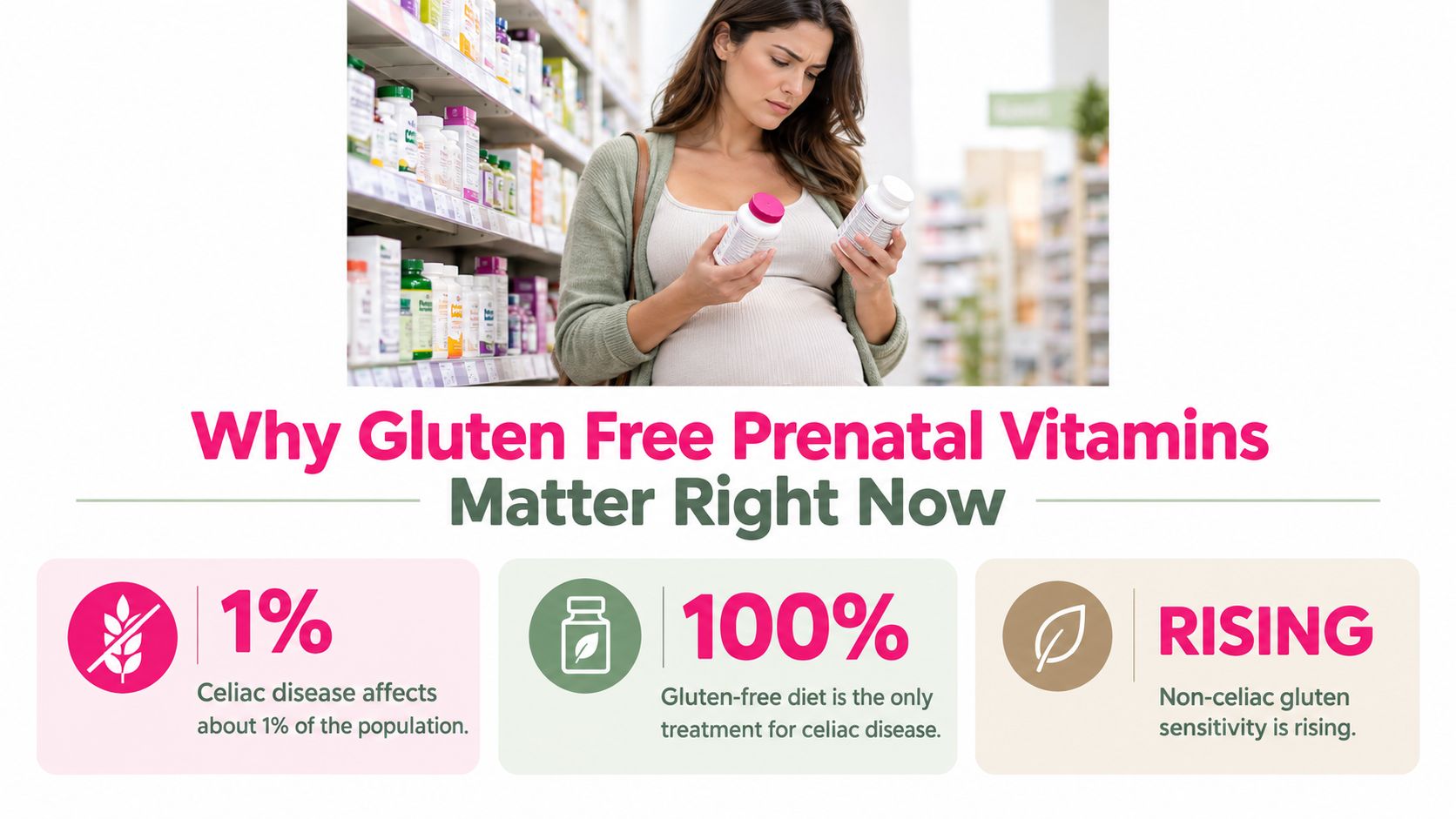
Table of Contents
- Why Gluten Free Prenatal Vitamins Matter Right Now
- What Gluten Free Actually Means on a Label
- Where Hidden Gluten Sneaks Into Prenatals
- Does Going Gluten Free Change Pregnancy Outcomes
- How to Read a Prenatal Vitamin Label Like a Pro
- Comparing Prenatal Forms for Sensitive Mamas
- Your Simple Checklist for Choosing a Safe Gluten Free Prenatal
Why Gluten Free Prenatal Vitamins Matter Right Now
A gluten-free prenatal can serve different purposes for different mamas. For someone with diagnosed celiac disease, avoiding gluten is a medical necessity. For someone with non-celiac sensitivity or a digestive condition, it may reduce worry and help the daily routine feel more manageable. For another person, it may be a preference.
A 2026 prospective cohort study of 2,359 pregnant participants found that 108 people, or 4.6%, reported following a gluten-free diet during pregnancy. Of those 108 participants, 68, or 63.0%, did not have celiac disease, showing that gluten avoidance during pregnancy extends beyond diagnosed celiac disease (2026 pregnancy cohort study).
The same study found that the gluten-free group was more likely to take prenatal vitamin B supplements. It found no significant differences in obstetrical outcomes between gluten-free and non-gluten-free participants, including analyses that excluded participants with celiac disease. That doesn't mean every gluten-free diet is nutritionally complete, but it does offer useful reassurance that gluten-free eating itself isn't automatically linked to poor pregnancy outcomes when managed appropriately.
A gluten-free label matters most when it reflects both the recipe and the manufacturing process.
If you're sorting through symptoms, dietary restrictions, and supplement choices at the same time, a plain-language guide to gluten-free pregnancy can help you think about food and supplements together. Your clinician can also help you decide whether you need testing, extra nutrient monitoring, or a particular prenatal formulation.
What Gluten Free Actually Means on a Label
A gluten-free claim describes the finished prenatal, not only its vitamin ingredients. Under the FDA gluten-free food labeling rule, the product must contain less than 20 parts per million, or ppm, of gluten. The threshold is small, yet it matters because gluten can come from inactive ingredients, coatings, or processing conditions.
The rule also covers wheat, rye, barley, and their crossbred grains. A product using “gluten-free,” “no gluten,” “free of gluten,” or “without gluten” cannot contain those grains unless processing removes the gluten and the finished product stays below the FDA threshold.
Three label patterns to recognize
| Label Pattern | What It Promises | Limitations |
|---|---|---|
| Gluten-free wording | The finished product meets the FDA requirement of less than 20 ppm gluten. | The bottle may not explain testing frequency, supplier checks, or whether production areas are separated. |
| Third-party seal, such as GFCO or NSF | An independent certification program has reviewed the product under its own standards. | Programs can differ in testing, audits, and facility requirements, so check what the seal covers. |
| Shared-facility disclaimer | The manufacturer says wheat or other allergens are handled at the facility. | This wording does not prove that the prenatal contains gluten. It does signal that cross-contact controls deserve a closer look. |
These labels answer different questions. The FDA wording addresses the gluten level in the finished product. A certification seal adds outside review, while a shared-facility statement describes a possible manufacturing risk. For someone with celiac disease, that distinction can matter as much as the ingredient list.
Organic, natural, and clean label describe other product features. They do not confirm gluten-free status, so look for an explicit claim or clear allergen-control information.
For broader dietary restrictions, sinlac flour for gluten-free diets shows why clear “without gluten” wording helps. Apply the same careful reading to prenatal supplements.
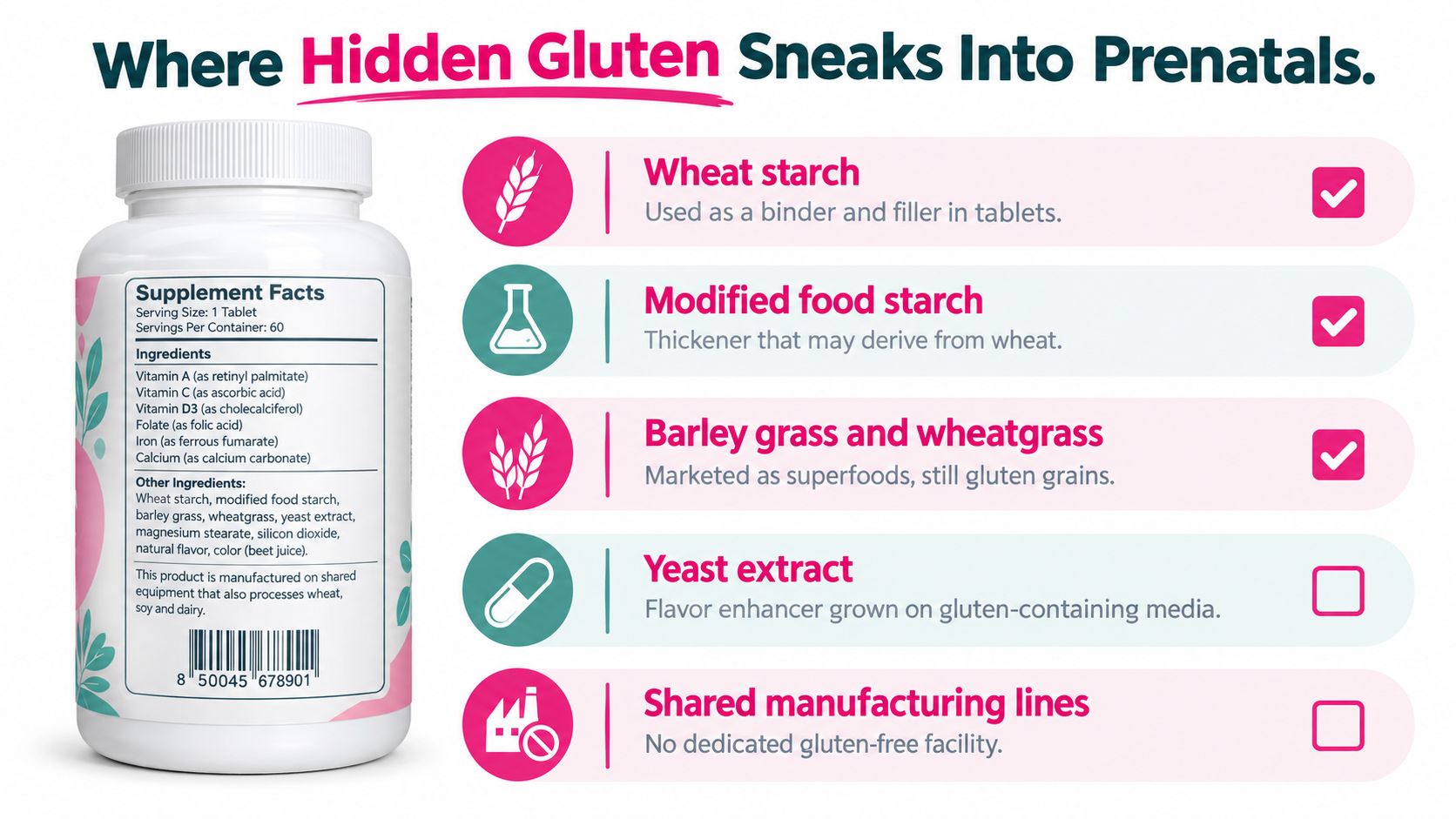
Where Hidden Gluten Sneaks Into Prenatals
The front of a prenatal bottle usually highlights folate, iron, DHA, or a “free-from” claim. The back tells you how the product is built. Gluten may enter through an excipient, coating, flavoring, carrier, or shared manufacturing line rather than through the vitamin itself.
Start with the ingredient list and look for terms that deserve clarification:
- Wheat starch: It may function as a binder or filler in tablets.
- Modified food starch: The source can vary, so ask whether it comes from wheat or another plant.
- Malt and malt flavoring: Barley-derived ingredients can create concern.
- Dextrin and maltodextrin: These may come from different sources, so the source matters.
- Brewer's yeast and yeast extract: Ask how the ingredient was grown and processed.
- Natural flavors and caramel color: These broad terms may need manufacturer confirmation.
- Hydrolyzed ingredients: The source and processing method should be clear.
- Capsule materials: Pullulan and hypromellose are commonly used vegetarian capsule materials, but the full formulation still needs review.
Ingredient safety and cross-contact aren't the same thing
A formula can exclude obvious wheat-derived ingredients and still require questions about production. Shared equipment, bulk ingredient handling, and contract manufacturing lines can create cross-contact concerns. If you have celiac disease, look for a finished-product gluten-free claim that meets the FDA threshold, plus information about validated testing and contamination controls. Guidance used by celiac organizations also emphasizes a finished product below 20 ppm gluten, along with careful sourcing and production controls (National Celiac Association supplement guidance).
Use this quick label-reading move:
- Search the Supplement Facts and other ingredients for starch, malt, dextrin, and hydrolyzed.
- Find the separate allergen statement.
- Look for shared-facility or shared-equipment language.
- Contact the manufacturer if an ingredient source isn't clear.
- Prefer a focused formula with fewer unnecessary coatings, flavors, and fillers.
A clear label can't answer every question, but it gives you a practical starting point. For a related look at ingredient transparency, you can read about raw-code prenatal vitamins.
Does Going Gluten Free Change Pregnancy Outcomes
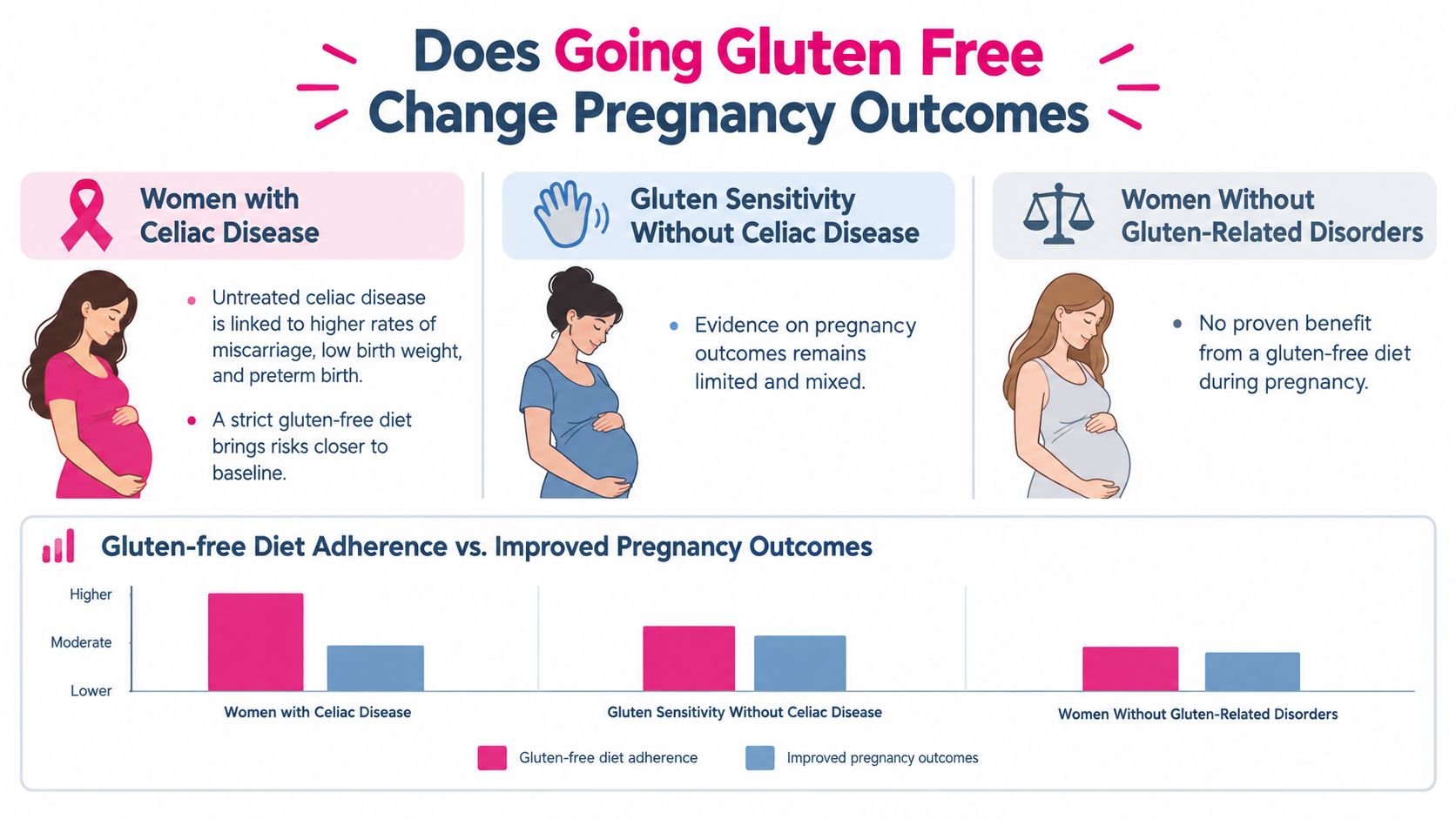
Choosing a gluten-free prenatal can reduce a specific exposure. It does not show that removing gluten will improve pregnancy for everyone.
The health context matters. People with diagnosed celiac disease need strict gluten avoidance because exposure can damage the intestine and interfere with nutrient absorption. People with non-celiac gluten sensitivity may avoid gluten to manage symptoms, although pregnancy-specific evidence remains limited. For people without a gluten-related disorder, removing gluten has no proven pregnancy benefit.
A large retrospective cohort of pregnant women without celiac disease found no association between a gluten-free diet and adverse maternal or neonatal outcomes. Median birth weight was 3,533 g in the gluten-free group versus 3,440 g in controls, and pregnancy complications were comparable between groups (retrospective pregnancy cohort study). Induction of labor occurred more often in the gluten-free group, with an adjusted OR of 1.52, and labor lasted longer, with an adjusted OR of 1.56. Cesarean rates did not differ. These findings describe an association, not proof that the diet caused either outcome.
The practical issue is what replaces fortified grains. Removing them can narrow food sources of folate, iron, and B vitamins unless you choose fortified gluten-free foods, naturally rich foods, or a suitable supplement. A gluten-free claim only addresses ingredient exclusion unless the manufacturer also explains cross-contact controls or provides third-party certification. Judge the prenatal by nutrient adequacy and manufacturing safety, not by the claim alone.
With celiac disease, your healthcare provider may monitor nutrient status and digestion more closely. Guidance for pregnancy and lactation advises a gluten-free multivitamin that includes folic acid (celiac and pregnancy supplement guidance).
How to Read a Prenatal Vitamin Label Like a Pro
A prenatal label can look like a crowded spreadsheet, especially when nausea makes every decision harder. Read it like a nutrition audit: first confirm the nutrients pregnancy guidance emphasizes, then check whether the product's ingredients, quality controls, and format make it realistic for you to take regularly.
Start with the nutrients that carry the most weight
Health authority guidance lists useful formulation targets, including 400 to 800 mcg of folic acid or equivalent methylfolate, at least 200 mg of DHA daily, and 450 mg of choline per day during pregnancy (Alberta Health Services pregnancy nutrition guidance). A peer-reviewed review also discusses around 400 mcg of folic acid before conception, with pregnancy references commonly noting 600 to 800 mcg daily during pregnancy (peer-reviewed prenatal supplementation review).
Use these figures as conversation points with your clinician, not instructions to stack several supplements on your own. The nutrient's form matters too. A label that says only “folate” gives less useful information than one naming folic acid or methylfolate, such as L-5-MTHF.
A gluten-free claim answers one question: whether the product excludes gluten ingredients under the manufacturer's labeling practice. It does not automatically explain cross-contact controls or independent testing. Look for statements about shared equipment, facility practices, batch testing, or recognized third-party certification. This distinction matters more when fortified wheat products are no longer part of your diet, because your prenatal may need to fit into a wider plan for folate, iron, and B vitamins.
Work through the rest of the panel
- DHA: Find the actual DHA amount, not only “omega-3 blend.” Some products place DHA in a separate softgel.
- Iron: Check both the amount and chemical form. Your provider may tailor iron advice to bloodwork, diet, and side effects.
- Iodine: A prenatal may list 150 mcg, a commonly used formulation target, though individual needs can differ.
- Choline: Look for a stated quantity. Guidance identifies 450 mg daily during pregnancy, and many prenatals provide only part of that total.
- Cross-contact language: “Made in a facility that also processes wheat” deserves a question about testing and controls.
- Certification: NSF, GFCO, and BSCG are examples of third-party programs. A self-declared claim offers less independent verification.
- Tolerability: Delayed-release capsules, gentler iron forms, or directions to take the product with food may help if nausea or constipation affects consistency.
| Label Checkpoint | What to Accept | What to Flag |
|---|---|---|
| Folate | A named form and a dose within your clinician's recommended range | A vague “folate blend” with no clear amount |
| DHA | DHA listed separately with its quantity | “Omega-3s” without the DHA amount |
| Choline | A stated quantity that helps you plan food or add-ons | No choline information |
| Allergen control | Gluten-free claim plus clear testing or facility information | Ambiguous wheat, malt, starch, or shared-line language |
| Testing | A recognizable third-party certification or transparent batch testing | A quality promise with no verification details |
| Tolerance | A form you can swallow and keep down | A large, strongly flavored serving that worsens nausea |
For practical label questions, see this guide on how to choose a prenatal vitamin. Magnesium deserves a separate discussion. NIH notes that professional societies, government agencies, and public health organizations do not have specific routine recommendations for magnesium supplementation during pregnancy (NIH pregnancy dietary supplements fact sheet).
Comparing Prenatal Forms for Sensitive Mamas
The best format is the one that meets your nutrient needs without becoming the supplement you avoid. Gluten-free status still matters, but your nausea, swallowing comfort, and ability to take the product consistently matter too.
| Format | Gluten-Free Risk | Tolerability | Typical Nutrient Coverage |
|---|---|---|---|
| Capsules | Often easier to formulate without starch-based coatings, but the ingredient list and manufacturing controls still matter | May feel heavy during nausea | Often supports a broader vitamin and mineral profile |
| Softgels | The shell and coating need review, especially for carriers and processing aids | Useful for DHA, but may cause fishy burps | Often strong for DHA, with variable vitamin and mineral coverage |
| Gummies | May use starches or other binders that require source verification | Easy to chew, though sweeteners may not suit every stomach | Often less complete, particularly for iron and DHA |
Capsules often offer the most room for a complete nutrient profile, but a queasy stomach may prefer a smaller serving or delayed-release design. Softgels are a practical way to deliver DHA, although fish-based oils can cause burps for some people. Algae-derived DHA is another option to discuss if fish oil doesn't agree with you.
Gummies can be easier to swallow, especially during the first trimester. Their tradeoffs deserve attention, though. Many gummy prenatals don't contain iron or DHA, and sugar alcohols may aggravate digestive symptoms for some people. If you're considering a gummy, read the full panel rather than assuming it replaces a complete prenatal.
Match the format to your current reality
- If nausea is intense: Ask your provider whether splitting the serving, taking it with food, or using a delayed-release capsule makes sense.
- If swallowing is difficult: A gummy or powder may be easier, but confirm which nutrients you'll need elsewhere.
- If gluten exposure feels medically risky: Prioritize documented controls and certification over flavor or convenience.
- If DHA causes discomfort: Consider a separate softgel or a different DHA source after discussing it with your clinician.
A split system, such as a capsule plus a separate DHA softgel, can work well for sensitive mamas who want a focused formulation. More ideas about gummy formats are available in this guide to vegan prenatal vitamins and gummies.
Your Simple Checklist for Choosing a Safe Gluten Free Prenatal
Choosing a prenatal is easier when you use the same checks each time. The goal is to protect gluten safety while still covering nutrients that may be harder to get when fortified grains are off the menu.
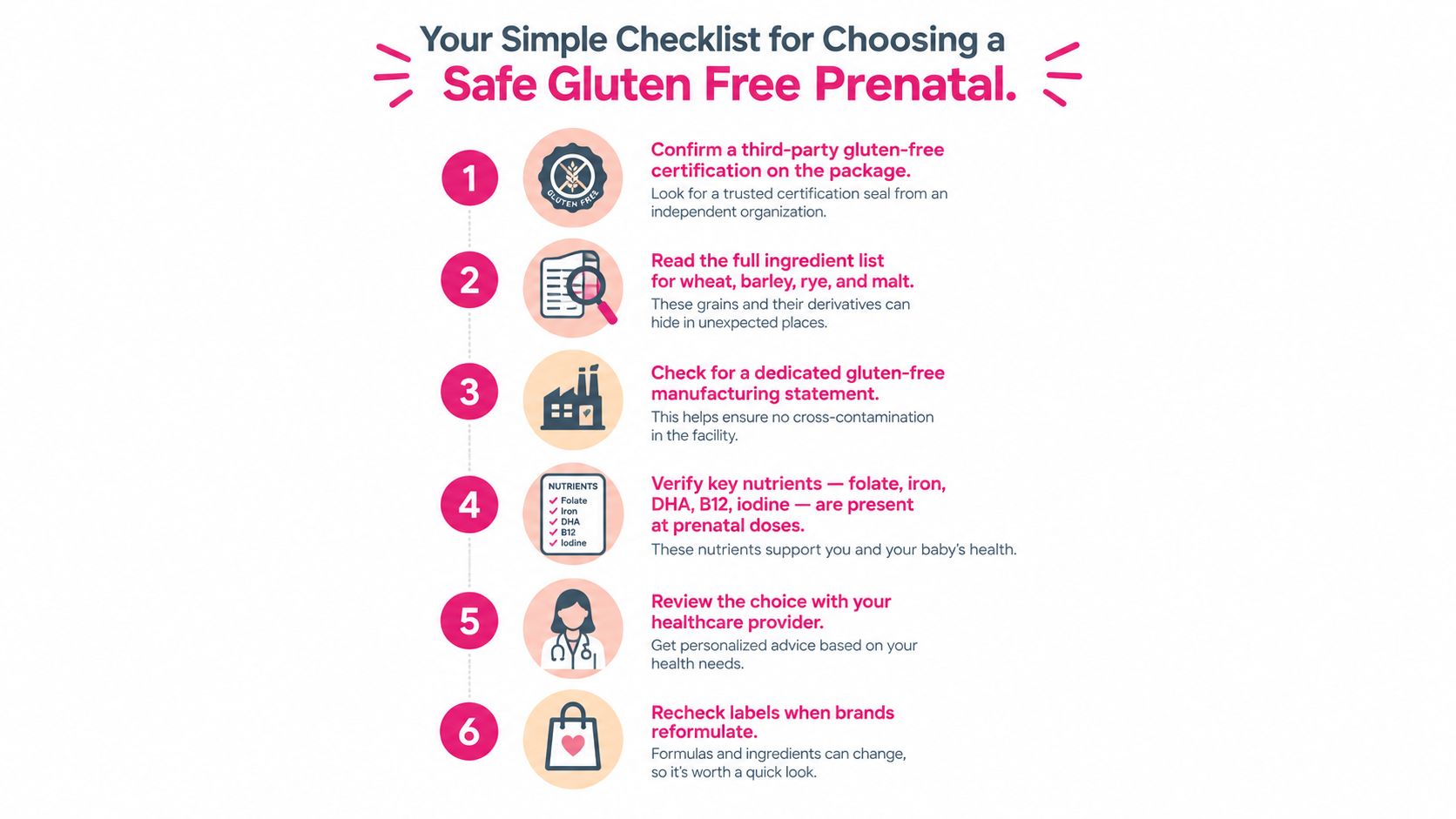
Six checks before you buy
- Confirm the gluten-free claim. Look for an explicit claim meeting the FDA's less-than-20-ppm standard. A third-party seal may provide added review, but it does not replace reading the product details.
- Read every ingredient. Check for wheat, barley, rye, malt, brewer's yeast, wheat starch, modified starch, and unclear dextrins.
- Ask about the factory. Shared equipment can raise cross-contact questions. Contact the manufacturer and ask what controls and finished-product testing they use.
- Verify prenatal nutrients. Compare folate, iron, DHA, iodine, choline, and any nutrients your healthcare provider recommended. Folate guidance commonly falls around 400 to 800 mcg. Pregnancy guidance also identifies at least 200 mg DHA daily and 450 mg choline daily as useful targets. Check the full nutrition panel rather than assuming a gluten-free product covers everything.
- Check tolerability. Consider capsule size, delayed release, iron form, flavor, and whether the serving fits your routine. The right formula is one you can take consistently.
- Recheck after reformulation. Suppliers, excipients, certifications, and serving sizes can change, so review the current label instead of relying on an older package.
For help comparing independent verification, explore third-party-tested prenatal vitamins. A general resource to find teeth whitening supplements may support broader self-care research, but pregnancy-specific choices should be reviewed with your prenatal care team.
Feed Mom & Me Complete Prenatal Vitamin Plus DHA is one formula to compare. Its gluten-free vegetarian formulation includes DHA, choline, selenium, and methylfolate, with delayed-release vegetable capsules plus ginger and peppermint. Review the current label with your healthcare provider to confirm it suits your needs.
Visit Feed Mom & Me to review the product, subscription options, and nutrition resources. Bring the label to your OB-GYN, midwife, or dietitian and make the final choice together.