
Non GMO Vitamin: What Pregnant Moms Should Know
Published:Updated:
Pick the bottle with the biggest non-GMO badge and you're done. That popular advice sounds reassuring, but it skips the question that matters most in pregnancy.
A non-GMO vitamin label tells you about ingredient provenance, where ingredients came from and how they were produced. It doesn't tell you whether the dose on the label is in the capsule, or whether heavy metals and microbes were controlled. You can care about sourcing, mama, and still ask those separate questions. Think of non-GMO as the origin story, and nutrient dose and testing as the job the vitamin has to do every day.
Table of Contents
- What Does a Non GMO Vitamin Label Actually Mean
- Why Can a Non GMO Vitamin Matter in Pregnancy?
- Which Prenatal Ingredients Need a Closer Non GMO Look?
- How Do You Verify a Non GMO Vitamin Before You Buy?
- Which Non GMO Vitamin Myths Should You Set Aside
- How Do You Choose a Prenatal You Can Trust?
What Does a Non GMO Vitamin Label Actually Mean
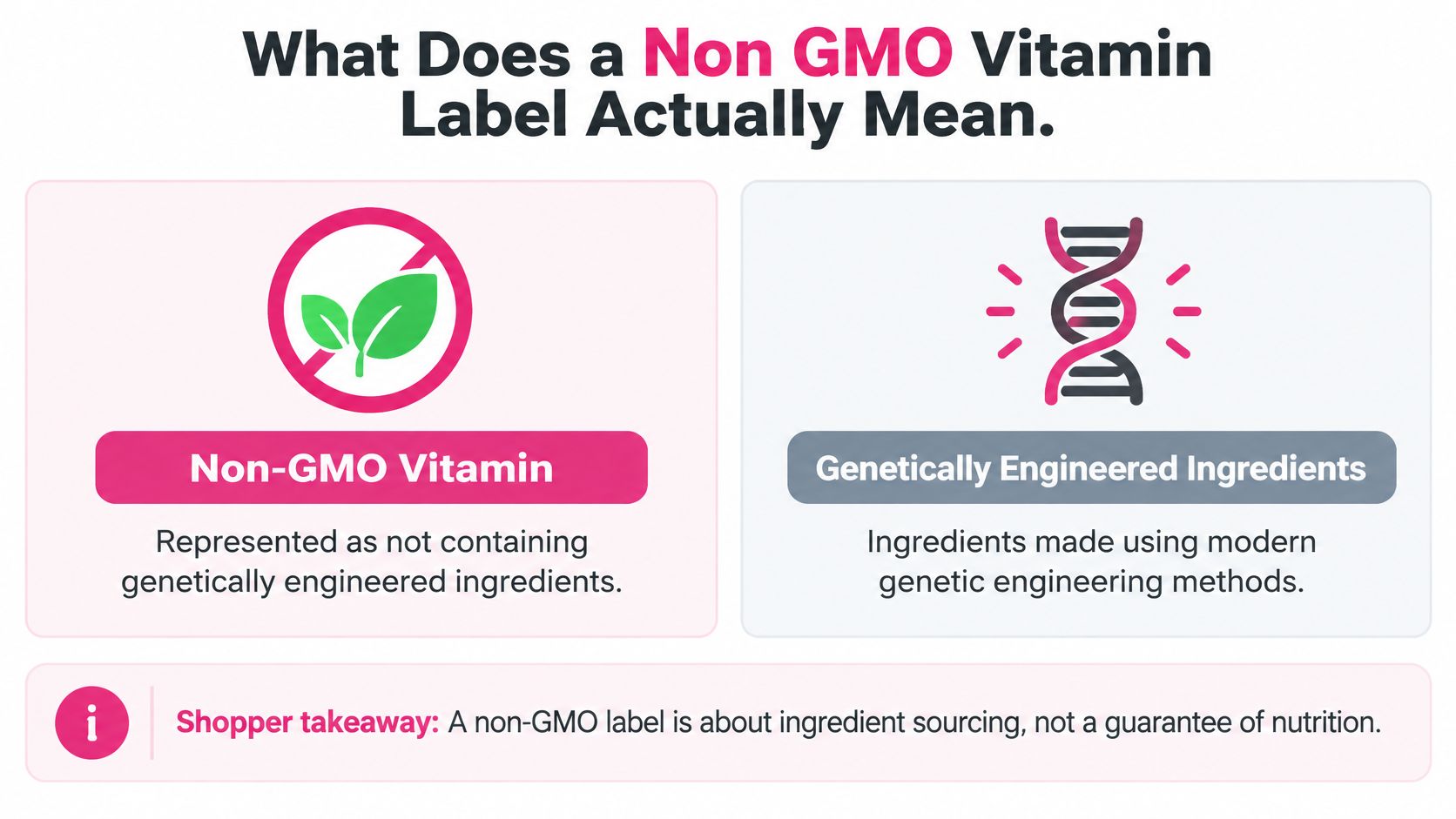
A non-GMO vitamin label describes ingredient sourcing: the product is represented as not containing genetically engineered ingredients. It does not tell you how much of each nutrient is in the capsule or how the product was tested. Those are separate questions to check when choosing a prenatal.
The FDA voluntary labeling guidance on foods derived from genetically engineered plants describes genetic engineering as using modern biotechnology, including in-vitro recombinant DNA techniques, to alter genetic material in ways that go beyond conventional breeding or natural processes. For a vitamin, the claim may relate to ingredients such as botanicals, microbial inputs, carriers, processing aids, or capsule materials. Nutrients such as folate, iodine, iron, and vitamin D are identified by their chemistry, even if plant-derived inputs are used elsewhere in the formula.
How the Federal Timeline Fits In
Voluntary non-GMO claims and the federal bioengineered food disclosure system are different. Congress passed a law in 2016 directing the U.S. Department of Agriculture to create the National Bioengineered Food Disclosure Standard. Implementation began January 1, 2020, small food manufacturers had until January 1, 2021, and full mandatory compliance began January 1, 2022.
The standard applies to covered foods containing detectable genetic material modified through specified laboratory techniques that could not be produced through conventional breeding or found naturally. A covered product can disclose this through package text, an approved symbol, or an electronic or digital link. For a plain-language introduction to the sourcing term, see non-GMO ingredients explained.
A missing bioengineered mark does not certify that every ingredient was identity-preserved from farm to capsule.
Reading Four Labels Side by Side
What common vitamin labels do and do not mean
| Label | What it tells you | What it does not tell you | Who sets the rule |
|---|---|---|---|
| Non-GMO claim | The product is represented as not containing genetically engineered ingredients | Dose accuracy, heavy metals, microbes, or pregnancy suitability | Voluntary brand language or a third-party seal such as Non-GMO Project Verified |
| Bioengineered disclosure | A covered food contains detectable genetic material modified by specified lab techniques that conventional breeding or nature could not produce | That another product is non-GMO, or that nutrients match the label | USDA National Bioengineered Food Disclosure Standard, with full compliance beginning January 1, 2022 |
| USDA Organic | Agricultural ingredients follow organic production rules that also prohibit genetic engineering | That every isolated vitamin is organic, or that the labeled dose is accurate | USDA National Organic Program |
| Natural | Only the processing or origin story the brand chooses to imply | Non-GMO status, organic status, potency, or contaminant control | No single federal definition equates natural with non-GMO |
Read across each row to see what the label covers. A non-GMO claim is voluntary brand language or a third-party seal, so check who supports it. A bioengineered disclosure is a federal requirement for qualifying foods. Its presence or absence does not certify a separate vitamin as non-GMO.
USDA Organic covers genetic engineering along with other production practices, so it is broader than a non-GMO claim. Natural has no federal standard that makes it equivalent to non-GMO. If food-based sourcing is part of your question, this guide to whole food based vitamins and what that phrase means explains how an ingredient's source differs from the amount of a nutrient in a serving.
Use the table to interpret the front of the bottle, then read the Supplement Facts panel separately. The sourcing label answers where ingredients come from; the panel lists nutrient amounts. Neither label, by itself, answers every question about a prenatal's quality.
Why Can a Non GMO Vitamin Matter in Pregnancy?
Caring where ingredients come from is a reasonable preference, mama. That preference sits beside, not above, the nutrients that do specific jobs while your baby is growing.
Here's a calm way to picture your prenatal on your kitchen counter before we get into amounts.
Non-GMO is the story of an ingredient's origin. Folate is a job. It supports cell division and the building of genetic material during embryonic and fetal development, which is why timing matters so early.
Folate Amounts Worth Knowing
The NIH Office of Dietary Supplements pregnancy fact sheet sets recommended intake at 600 micrograms of dietary folate equivalents (mcg DFE) per day during pregnancy. ACOG advises a prenatal containing at least 400 mcg of folic acid daily, beginning at least 1 month before conception and continuing through the first 12 weeks of pregnancy, because neural tube development occurs very early, sometimes before you know you're pregnant.
Folate intake targets during pregnancy
| Situation | Amount | Timing |
|---|---|---|
| Recommended intake during pregnancy | 600 mcg DFE per day | Throughout pregnancy |
| Prenatal vitamin minimum | At least 400 mcg folic acid per day | Start at least 1 month before conception, continue through 12 weeks |
| Prior pregnancy affected by neural-tube defect | 4 mg per day under medical supervision | Start at least 3 months before pregnancy, continue through first 3 months |
That 4 milligrams daily regimen for a prior neural tube defect pregnancy isn't a do it yourself upgrade. It belongs under medical supervision, not extra bottles chosen at home.
If a short video helps you sort label words from nutrient jobs, watch this explainer and then come back to your own bottle.
Don't stop at folate when you scan the panel. Look at iron, iodine, DHA, and choline on the same label, then ask your OB, midwife, or dietitian whether food plus supplement matches your needs.
Choline needs a little extra care in that conversation. The ACOG guide to healthy eating during pregnancy is a good discussion starter, and pregnancy raises the adequate intake to 450 milligrams per day. Needing enough choline doesn't automatically mean you need a separate choline supplement, since there's no specific recommendation for routine choline supplementation during pregnancy. Check your diet first, confirm iodine on the panel, and let your clinician weigh your total intake. A sourcing seal doesn't pick the dose for you.
Which Prenatal Ingredients Need a Closer Non GMO Look?
Think of a capsule like a finished loaf of bread. The non-GMO question doesn't start with the loaf. It starts with the flour, the yeast, and the oil on the pan.
That analogy helps because different parts of a prenatal have very different histories. The FDA overview of how GMOs are regulated in the United States uses a threshold based on detectable genetic material modified through specified laboratory techniques that couldn't be achieved through conventional breeding or found in nature. Extensive purification, refining, hydrolysis, or fermentation can remove or degrade DNA and proteins, so testing the finished capsule alone can't reliably prove ingredient origin.
Where a prenatal non-GMO check should focus
| Ingredient type | Prenatal example | Best evidence to ask for | DNA test limit |
|---|---|---|---|
| Botanical | Ginger or peppermint | Identity-preserved crop source and supplier declaration | DNA may remain, but a negative test is still not the whole proof |
| Fermentation or microbial input | Some vitamin or DHA production inputs | Source organism, growth medium, and whether the microbe was genetically engineered | Processing can degrade DNA and proteins |
| Highly purified nutrient | Folate, iron, iodine, or vitamin D | Whether the claim covers the input and its carriers, not only the finished capsule | Refining, hydrolysis, or fermentation can remove detectable DNA |
| Carrier, excipient, or capsule | Vegetable capsule or plant-derived processing aid | A separate specification for capsule material and excipients | The active nutrient may be pure while the carrier comes from a commodity crop |
Where to Look First on Your Bottle
- Botanicals like ginger and peppermint: These have an agricultural history, so supplier declarations and identity preserved or segregated sourcing matter most.
- Fermentation or microbial inputs: Ask for the source organism, its growth medium, and whether that organism was genetically engineered.
- Highly purified nutrients: Folate forms, iron salts, iodine, and vitamin D may have little or no DNA left after processing, so paperwork carries the proof.
- Carriers, excipients, and the capsule: These can come from commodity crops even when the active nutrient is simple chemistry, so they need their own specification line.
A defensible file links each lot to a supplier and country of origin. It also requires written notice before a source, manufacturing process, or formula changes, with certificates kept for every claimed ingredient.
Practical rule: Ask about flavor botanicals, oils or carriers, and the capsule first, then ask how purified nutrients were sourced.
That paperwork still doesn't replace potency, heavy metal, microbial, allergen, or DHA oxidation testing. If DHA is on your list of questions, our overview of prenatal vitamins and DHA and how they work together explains why that ingredient deserves its own quality check. Sourcing records and contaminant testing answer different questions, and you deserve both answers.
How Do You Verify a Non GMO Vitamin Before You Buy?
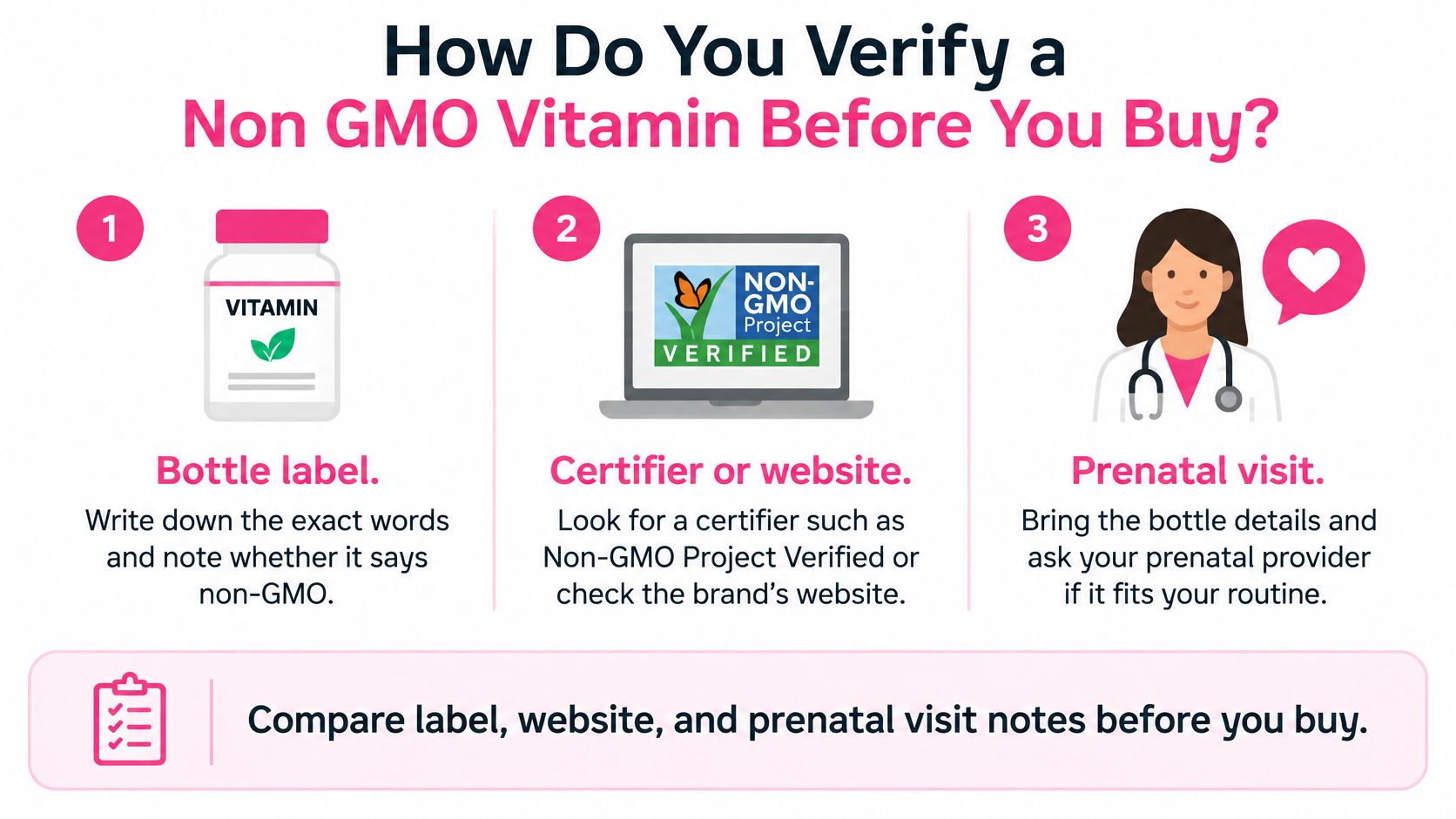
A non-GMO claim answers one question about ingredient sourcing. It does not prove the labeled dose is present or that contaminants were controlled. You can check those questions separately, without a lab coat: start with the bottle, then the brand's information, and bring any questions to your prenatal provider.
Your Eight Step Check
- Write down the exact words: Note whether the bottle says non-GMO, names a certifier such as Non-GMO Project Verified, or uses bioengineered disclosure language. The wording shows what kind of claim the brand is making.
- Ask what the seal covers: Does it apply to every ingredient, including excipients and the capsule, or only selected inputs? Check for exclusions. A claim covering some ingredients does not automatically cover the whole bottle.
- Request lot-level records: Ask for documents showing identity, purity, strength, and composition for your lot, rather than a general marketing sheet. These records connect the information to the batch you'll take.
- Ask about contaminant screening separately: Look for information about heavy-metal and microbial screening. A sourcing claim does not show whether either was tested.
- Check dose accuracy on its own: A U.S. Government Accountability Office test of 12 prenatal supplements found that 11 had at least one tested nutrient, including folic acid, iodine, iron, or vitamins A, C, and E, outside acceptable deviations from the label value. A non-GMO badge cannot replace evidence about potency.
- Know who is responsible: FDA dietary supplement rules place safety and labeling responsibility largely on manufacturers and do not require drug-style premarket approval. That makes it reasonable to ask the brand what testing and records support its claims.
- Review the nutrient panel with your clinician: Look at folic acid or methylfolate, iron, iodine, DHA, and choline alongside your provider's plan. A sourcing seal does not establish that the formula fits your needs.
- Save the lot number: Photograph it before opening the bottle. If a question comes up later, you can point to the exact batch.
For an example of what independent testing information can look like, read about third-party tested prenatal vitamins. Use the page to shape questions for any brand, then bring your bottle, notes, and lot photo to your prenatal appointment. A focused conversation can help you sort sourcing, dose, and testing without treating one label claim as the whole answer.
The same habit of checking what a product is for and how it should be handled appears in a home cook's guide to peroxide. For prenatal vitamins, keep the questions specific to the label, the batch, and the nutrients your provider recommends.
Which Non GMO Vitamin Myths Should You Set Aside
Some label myths stick around because they sound protective. You can set them aside gently without giving up the values underneath them.
Four Mix Ups to Retire
Myth 1: Non-GMO means safer in pregnancy. Foods from genetically engineered plants are regulated under the same safety standards as other foods. A non-GMO claim tells you about sourcing, so it isn't evidence that one prenatal is safer than another.
Myth 2: A non-GMO seal confirms the dose. It doesn't. A product can meet a sourcing claim and still contain a labeled nutrient in an amount that differs from the label, which is why potency documents matter separately.
Myth 3: No bioengineered mark means a fully traced supply chain. Purification can remove detectable DNA, so the absence of a disclosure mark isn't the same as traced, identity preserved sourcing. Supplier records tell that story more completely than a single finished capsule test.
Myth 4: This one claim should decide the whole bottle. Choosing only for non-GMO status can make you miss allergen fit, stability, and whether the capsule is gentle enough on a nauseous morning. A vitamin you can't take consistently isn't helping, no matter how good the front label looks.
Your values aren't the problem, mama. A single badge just can't carry every question you're asking.
Reframe the decision as a stack you can check one layer at a time.
- Sourcing preference: Does the claim match what you care about, and who verifies it?
- Independent quality documents: Do lot records support potency and contaminant control?
- Allergen and comfort fit: Can you take it daily without dread or stomach trouble?
- Clinician agreement: Does your provider say the panel fits your labs, diet, and history?
If natural language is still muddying the choice, our guide to natural prenatal vitamins and what natural really signals can help you sort marketing words from measurable ones. Keep the values that matter to you, and let your healthcare provider weigh the medical pieces with you. A clearer label is a tool, not a verdict about your parenting.
How Do You Choose a Prenatal You Can Trust?
A Non-GMO claim tells you about ingredient sourcing. It does not, by itself, show whether the labeled dose is present or whether contaminants were controlled. Look for those quality details separately, then discuss the formula with your healthcare provider.
Feed Mom & Me Complete Prenatal Vitamin Plus DHA is a Non-GMO option for preconception, pregnancy, and postpartum. The brand was founded by co-founders Maria and Amanda. Each nutrient is third-party certified for purity and potency, and a third-party lab tests each batch twice for heavy metals, microbes, allergens, and other contaminants. These checks address questions about potency and purity that a sourcing claim cannot answer.
What to Confirm Before You Switch
- Nutrients on the panel: The formula includes DHA, choline, and L-Methylfolate Calcium, a form of folate found naturally in food. Review these alongside the iron and the rest of the Supplement Facts panel, rather than assuming one sourcing claim tells you whether the nutrient mix fits your needs.
- Capsule and comfort: The delayed-release vegetable capsule is designed for tolerability. One customer described the vitamins as gentle on her stomach, though individual experiences can differ. Choose a form you can take consistently, and ask your provider if you have concerns.
- Your clinician's guidance: Before switching, review the folate form, iron, DHA, and full nutrient panel with your OB, midwife, or dietitian, especially if you take other supplements or medications. Your provider can help weigh the formula against your diet, health history, and individual needs.
For a step-by-step way to compare nutrient panels, read how to choose a prenatal vitamin for your stage. Bring your questions and the Supplement Facts panel to your provider.
You don't need the loudest badge in the aisle, mama. Choose a bottle whose ingredients and quality checks you understand, and make the personal fit decision with your clinician.
Feed Mom & Me offers its Complete Prenatal Vitamin Plus DHA as a Non-GMO prenatal with DHA, choline, and L-Methylfolate Calcium in a delayed-release vegetable capsule. Each batch is tested twice by a third-party lab for heavy metals, microbes, allergens, and other contaminants. Review the full Supplement Facts panel and testing details, then ask your OB, midwife, or dietitian whether it fits your routine.