
Omega 3 Fish Oil EPA DHA Benefits: What Mamas Need to Know
Published:Updated:
If your prenatal says 1,000 mg of fish oil on the front, do you know how much EPA and how much DHA you're getting? Most mamas don't, and that's not your fault. Bottles love to lump omega 3 fish oil EPA DHA benefits into one vague promise, when EPA and DHA do different jobs, fish and capsules aren't interchangeable, and the key skill is adding up the separate milligrams across everything you take.
Table of Contents
- What Are EPA and DHA and Why Does DHA Matter for Your Baby?
- What Does Research Show About Omega-3 Benefits in Pregnancy?
- How Do You Get EPA and DHA From Seafood Safely?
- How Much EPA and DHA Should You Aim For During Pregnancy?
- What Safety Limits and Side Effects Should You Know About?
- What Should You Bring to Your Provider to Confirm Your Plan?
What Are EPA and DHA and Why Does DHA Matter for Your Baby?
EPA and DHA are long-chain omega-3 fats your body can't make in large amounts, so food or supplements have to supply them. That's the short answer, mama. The longer answer matters because these two fats aren't twins, and treating them as one ingredient is where label confusion begins.
EPA versus DHA at a glance
| Feature | EPA | DHA |
|---|---|---|
| Full name | Eicosapentaenoic acid | Docosahexaenoic acid |
| Chain length | 20 carbon atoms | 22 carbon atoms |
| Main role | Inflammation signaling and blood fat support | Structural building block of brain and retina cell membranes |
| Common food sources | Fatty fish, fish oil, algae-based blends | Fatty fish, fish oil, algae oil, fortified eggs |
| Pregnancy emphasis | Often part of mixed marine oils | Most emphasized in prenatal products and trials |
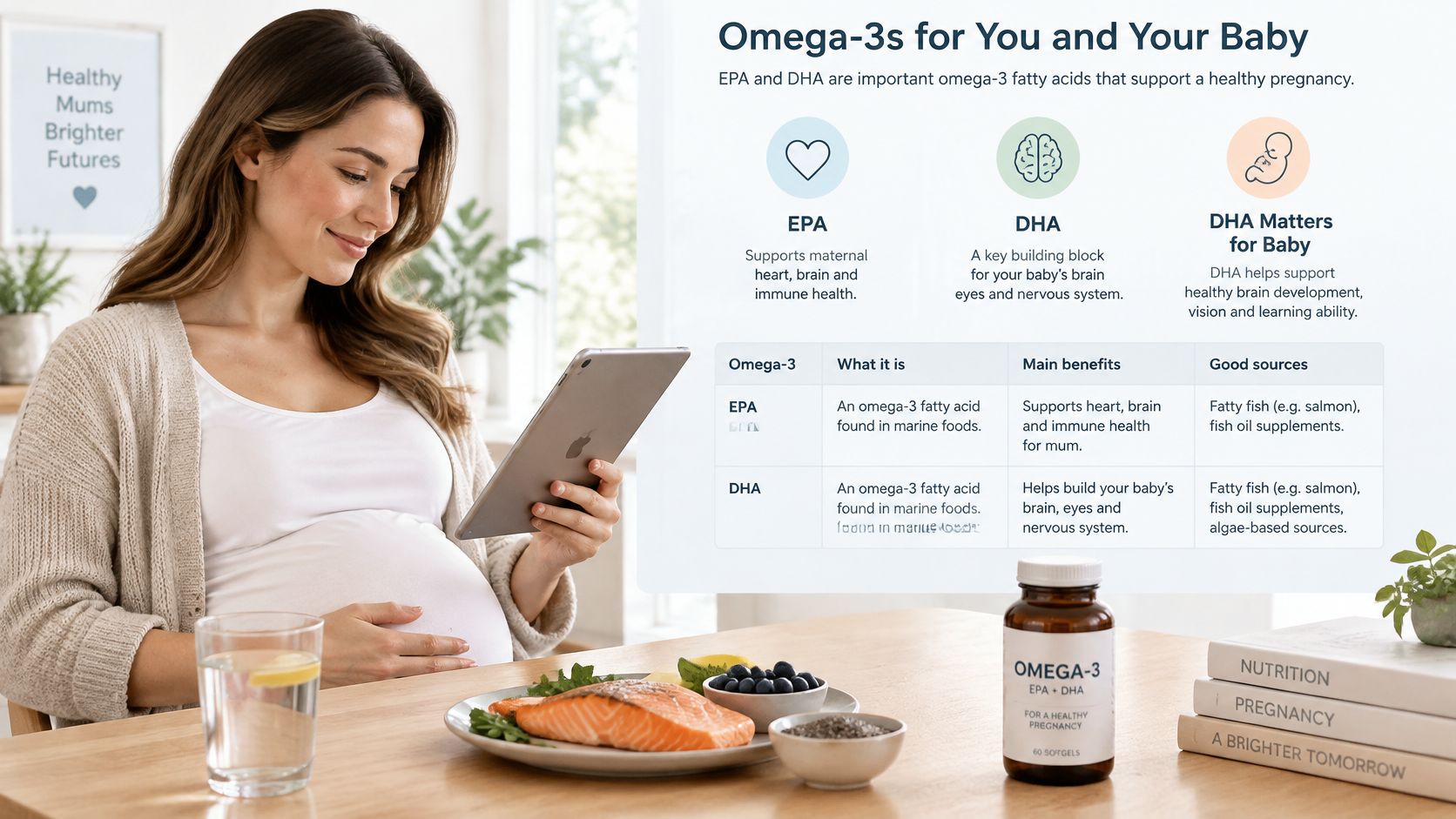
The photo below shows the everyday version of this decision, a meal, a screen full of advice, and a bottle that needs decoding.
Think of EPA and DHA as Cousins With Different Jobs
EPA and DHA are cousins from the same family, but they show up to different work sites. EPA works mainly as a messenger. It helps your body manage inflammation signaling and supports healthy blood fats, much like a calm traffic coordinator who keeps signals from piling up.
DHA is more like a building material. Your baby uses it as a structural piece in brain and retina cell membranes, the flexible walls around nerve and eye cells. If EPA sends and softens messages, DHA helps build the rooms where those messages travel.
The NIH Office of Dietary Supplements fact sheet on omega-3 fatty acids explains that DHA is highly concentrated in neural and retinal membranes, where its long, flexible structure influences membrane fluidity, photoreceptor function, synaptic signaling, and production of specialized inflammation-resolving mediators. In plain language, that flexibility helps light-sensing cells respond and helps nerve cells pass signals smoothly. A stiff membrane is like a door that sticks. A flexible one opens and closes as it should.
Why DHA Gets So Much Attention Late in Pregnancy
Your baby's brain doesn't grow at one steady speed. Growth speeds up in the third trimester, and that's when DHA demand gets the most attention. New brain and eye tissue needs membrane material, and DHA is a preferred building block for that tissue.
DHA is essential in the development of the baby's brain, eyes, and nervous system, and it also helps support the mom's immune system and mood. That dual role explains why prenatal products often highlight DHA on the front label. It also explains why foods that support brain building get so much love in pregnancy, including the ideas in this guide to foods that support your baby's brain development while pregnant.
EPA still matters, even if it gets less prenatal marketing. Many mixed marine oils include EPA alongside DHA, because real fish oils naturally contain both. When a product leans heavily on DHA, it isn't saying EPA has no value. It's reflecting where pregnancy research and product design have focused.
Don't judge a capsule by its total oil weight. A large softgel can still contain modest EPA and DHA, because the oil includes other fats too.
The Honest Limit You Deserve to Hear
A strong biological reason doesn't guarantee a specific outcome for your child. DHA fits beautifully into brain and eye membranes, but findings on child development and cognition are inconsistent. Some outcomes look promising, others don't show a clear difference, and results vary by dose, timing, and what a mama already eats.
That means DHA isn't a promise of a smarter child, and you shouldn't feel pressured by anyone who sells it that way. It's better understood as nutritional support for normal building processes, similar to how calcium supports bone building without guaranteeing any one child's height. You're providing raw material, not programming a result.
Your practical takeaway is simple and powerful. Read every label for EPA in milligrams and DHA in milligrams as two separate numbers. Don't rely on one total for fish oil or algae oil, because that total can't tell you how much of each cousin you're getting.
What Does Research Show About Omega-3 Benefits in Pregnancy?
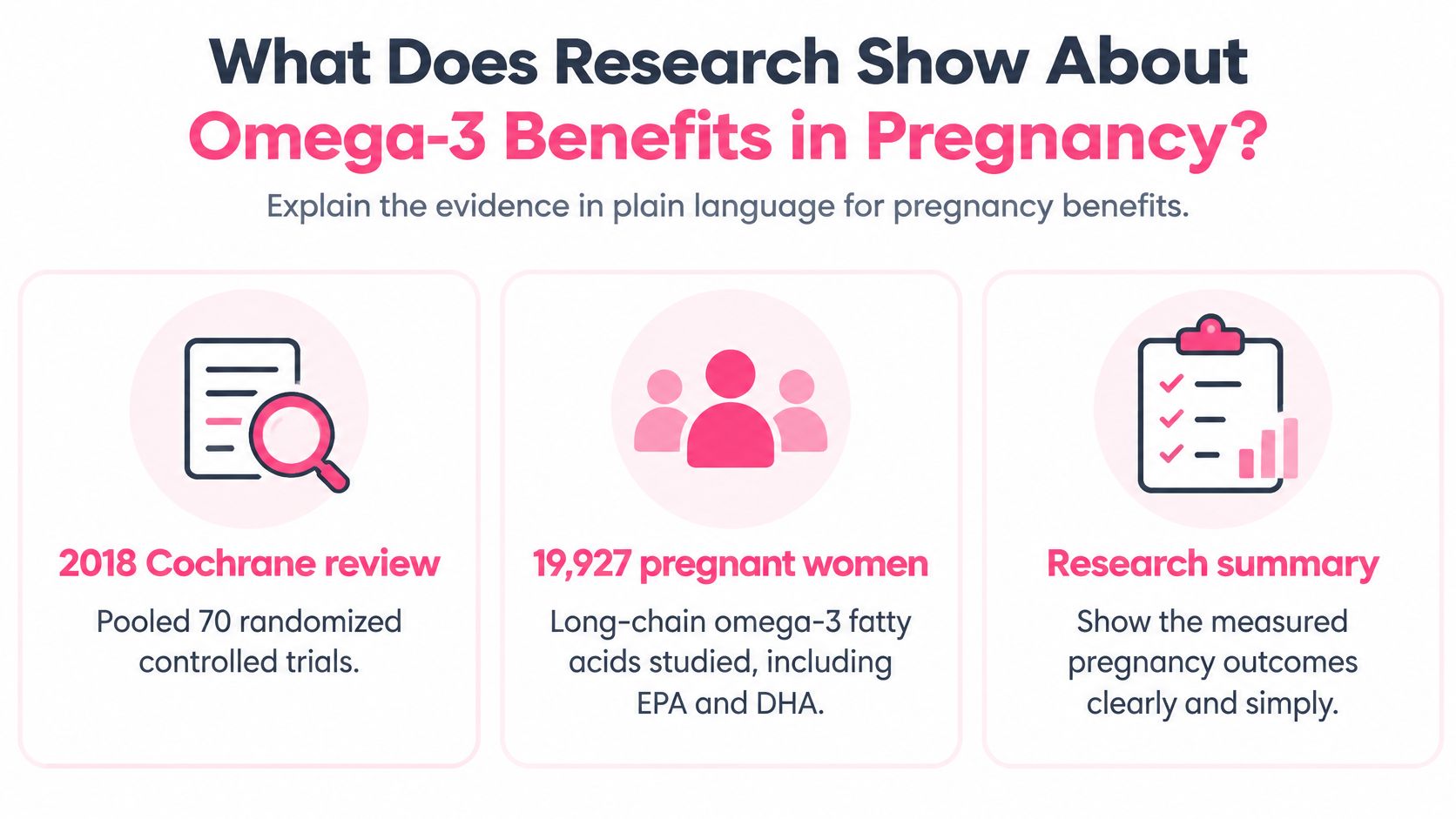
The clearest pregnancy finding isn't about IQ scores. It's about staying pregnant a little longer. The 2018 Cochrane systematic review in the Cochrane Library pooled 70 randomized controlled trials involving 19,927 pregnant women and evaluated long-chain omega-3 fatty acids, including EPA and DHA.
The visual summary below keeps that evidence milestone in one place.
Across 26 trials with 10,304 participants, birth before 37 weeks occurred in approximately 11.9% of women receiving omega-3 long-chain polyunsaturated fatty acids, compared with 13.4% in comparison groups. That corresponded to a risk ratio of 0.89, an 11% relative risk reduction, with a 95% confidence interval of 0.81 to 0.97. For early preterm birth before 34 weeks, nine trials with 5,204 participants reported 2.7% with supplementation versus 4.6% without it, a risk ratio of 0.58 and a 42% relative reduction.
Preterm birth rates with and without omega-3 supplementation
| Outcome | Without omega-3 | With omega-3 | Relative change |
|---|---|---|---|
| Birth before 37 weeks | 134 per 1,000 | 119 per 1,000 | 11% lower |
| Birth before 34 weeks | 46 per 1,000 | 27 per 1,000 | 42% lower |
What Relative and Absolute Risk Mean for You
Those percentages can sound bigger than they feel in real life, so let's use an umbrella analogy. If a forecast says your chance of getting rained on drops by a large percentage, you still want to know whether that means two fewer rainy walks or twenty. Relative risk tells you the percentage change. Absolute risk tells you how many actual cases changed.
For birth before 37 weeks, the table shows about 15 fewer cases per 1,000 pregnancies. That's modest for any one mama, but meaningful across a whole community of pregnancies. For birth before 34 weeks, the difference is about 19 fewer cases per 1,000, and earlier births tend to carry more medical complexity, which is why that finding gets attention.
If you prefer to hear the numbers walked through out loud, this short video is a helpful pause before you keep reading.
Other Findings and Honest Limits
Supplementation also modestly prolonged pregnancy and raised average birth weight in that body of trials. The findings included a lower chance of a baby weighing less than 2,500 grams, which fits with babies having a bit more time to grow. None of that means every baby will be larger or every pregnancy will go longer.
These are population averages, not promises for your pregnancy. Most trials tested long-chain omega-3 supplementation overall, not one specific brand or a DHA-only product in every case. Benefits are most relevant if your baseline fish intake is low or your preterm risk is higher, and your own history matters more than an average across thousands of women.
How Do You Get EPA and DHA From Seafood Safely?
Seafood and supplements aren't interchangeable, even though both can supply EPA and DHA. A capsule gives you selected fats. A fish meal gives you those fats plus a whole food package, and that difference should shape your plan.
The NIH fact sheet summary of seafood guidance notes that U.S. agencies recommend pregnant and breastfeeding people eat 8 to 12 ounces of lower-mercury seafood weekly, and that seafood provides EPA and DHA alongside protein, iodine, vitamin D, selenium, and other nutrients. It also states that it remains unclear whether EPA and DHA supplements during pregnancy or breastfeeding improve infant health or development, although some studies suggest small increases in birth weight and gestational length.
Two Mamas, Two Different Gaps to Fill
Say Maya eats salmon twice a week. Each serving is about 4 ounces, so she's building her week around two fish-centered meals. For Maya, a supplement conversation is mostly about filling small gaps on busy weeks when fish doesn't happen, not replacing meals that already work for her.
Say Priya avoids fish completely. She feels better skipping seafood, but now she needs a plan for what fish would have supplied. Priya's provider might discuss fortified foods or a supplement for DHA, plus other sources of iodine, vitamin D, selenium, and protein, so one capsule isn't asked to do a whole meal's job.
You can explore meal ideas in this collection of omega-3 rich foods for pregnancy, then match the list to what you enjoy eating. The best food plan is the one you'll repeat without dread.
Species Choices That Keep Mercury Low
Aim for variety from lower-mercury choices across 2 to 3 servings of cooked fish each week, rather than one very large serving.
- Salmon: A familiar, fatty option that fits many weeknight meals
- Sardines: Small fish that are naturally rich in omega-3s
- Herring: Another oily fish with a strong omega-3 profile
- Trout: A mild freshwater choice for people who dislike stronger flavors
- Shrimp: A lean, widely available lower-mercury option
- Pollock: A mild white fish used in many family-friendly dishes
Avoid these large predatory fish because they can contain more mercury.
- Shark: Skip during pregnancy and breastfeeding
- Swordfish: Skip in favor of smaller species
- King mackerel: Skip, and don't confuse it with smaller mackerel types
- Tilefish: Skip while you're pregnant, planning, or breastfeeding
Practical rule: Think in a weekly rhythm, two or three fish-centered meals, instead of trying to perfect a single perfect plate.
Can DHA let you skip fish entirely? Nutritionally, that answer is incomplete. Avoiding fish can reduce mercury exposure, but it can also remove nutrients unless you replace them elsewhere. Species and portion choices matter more than a simple fish oil versus no fish oil decision.
How Much EPA and DHA Should You Aim For During Pregnancy?
No single number fits every pregnancy, and that's reassuring, not evasive. Your seafood habits, your history, and what your prenatal already contains all change the math. The table below puts the main sourced figures side by side so you can talk through them with your provider.
Omega-3 intake guideline figures in pregnancy
| Source or guideline | Amount | What it means for you |
|---|---|---|
| Cochrane review, optimal supplement range | 500 to 1,000 mg per day long-chain omega-3, including at least 500 mg DHA | Range linked with fewer preterm births, usually starting around 12 weeks |
| NIH-funded trial, standard DHA dose | 200 mg per day DHA | Comparison dose in the trial |
| NIH-funded trial, higher DHA dose | 1,000 mg per day DHA | Early preterm birth 1.7% versus 2.4%, discuss with your clinician |
| 2024 clinical practice guideline, safe intake | Up to 1,000 mg per day DHA alone or DHA plus EPA | No safety concerns at this level, individual needs vary |
| FDA ceiling for supplements | 5 grams per day combined EPA and DHA | Upper limit, not a target |
The NIH pregnancy fact sheet cites guidance recommending at least 250 mg per day combined EPA plus DHA, plus an additional 100 to 200 mg per day DHA during pregnancy, and notes that people with low DHA intake or status may be considered for substantially higher clinician-supervised dosing, such as 600 to 1,000 mg per day of DHA or combined EPA plus DHA. That same source describes the 11% lower risk of birth before 37 weeks across 26 trials and 10,304 participants, with a risk ratio of 0.89 and a 95% confidence interval of 0.81 to 0.97.
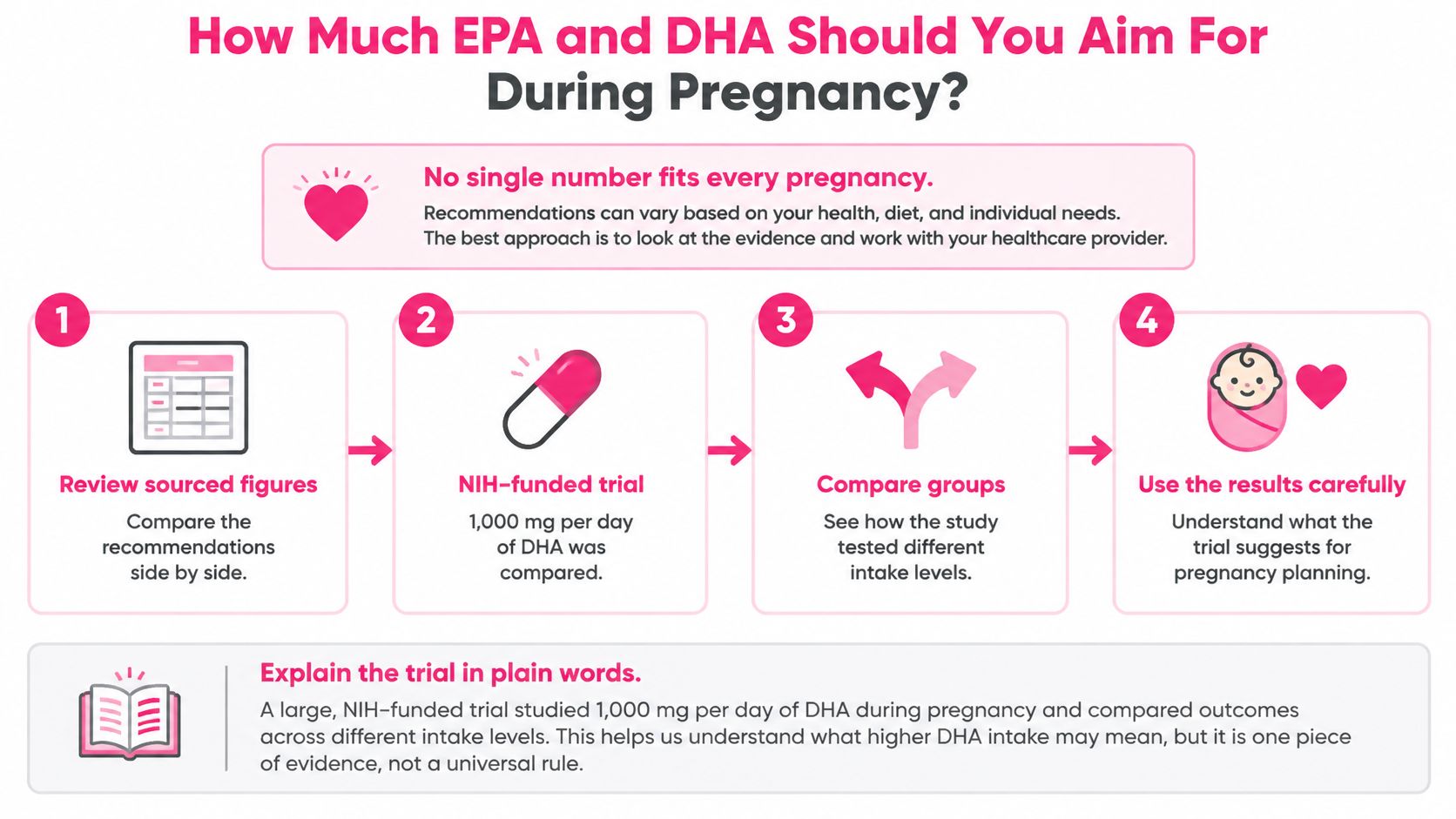
The process visual below shows how to move from those figures to a personal total without guessing.
What the Higher Dose Trial Actually Tested
One NIH-funded trial compared 1,000 mg per day of DHA with a standard 200 mg per day dose during the latter half of pregnancy. Early preterm birth occurred in 1.7% of the high-dose group versus 2.4% of the standard-dose group. That is a difference, but it's smaller in everyday terms than a headline might suggest, and it came from a supervised trial setting.
Related mechanistic analyses found that higher-dose DHA altered circulating soluble RAGE and interleukin-6, proteins involved in tissue injury and inflammatory signaling. You don't need to memorize those names, mama. The takeaway is that researchers found a plausible biological pathway involving inflammation, not just a lucky coincidence in birth timing.
Reviews remain inconsistent on overall preterm birth, child development, and other maternal outcomes. Dose, baseline DHA status, seafood intake, and gestational timing can all change results. That's why higher doses belong under obstetric supervision, even when a trial makes them look appealing.
Count Your Real Total in Five Steps
Label math is where you gain control. This guide on how to choose a prenatal vitamin pairs well with the steps below when you're comparing bottles side by side.
- Find the Supplement Facts panel: Write down EPA milligrams and DHA milligrams separately for each product.
- Ignore the front label total: Don't count total fish oil or algae oil weight as EPA plus DHA.
- Add across products: Combine DHA from your prenatal, any separate capsule, and fortified foods you use daily.
- Estimate seafood separately: Note your weekly servings, remembering EPA and DHA vary by species and preparation.
- Compare with your provider: Bring the total to your appointment and adjust together based on your history.
More isn't automatically better. A ceiling tells you where caution begins, not where benefits are guaranteed.
Use the 5 grams per day FDA ceiling for supplements as a guardrail, not a goal. Most pregnancy conversations happen far below that level, in the hundreds of milligrams to about 1,000 mg range. If your math shows you're already close to your provider's target, you may not need another capsule at all.
What Safety Limits and Side Effects Should You Know About?
Many people tolerate omega-3s well, and knowing the limits helps you use them with confidence. Safety information isn't meant to scare you. It's meant to help you spot the few situations where a quick check-in matters.
The NIH consumer fact sheet on omega-3 fatty acids reports that the FDA recommends no more than 5 grams per day of combined EPA and DHA from dietary supplements, and that a 2024 clinical practice guideline summarized by NIH states intakes up to 1,000 mg per day of DHA alone or DHA plus EPA do not raise safety concerns, while individual needs vary. That gap between a pregnancy guideline level and an overall supplement ceiling is normal. One is a practical pregnancy range, the other is a broad upper boundary.
Common Mild Side Effects
At commonly used amounts, side effects are generally mild. You might notice one of these, notice none, or notice one only on an empty stomach.
- Unpleasant taste: Often a fishy aftertaste after swallowing
- Bad breath: Sometimes paired with fishy burps
- Heartburn: More likely if you take capsules without food
- Nausea: Can overlap with normal pregnancy nausea
- Stomach discomfort: Mild cramping or unease after a dose
- Diarrhea: Looser stools, especially when starting
- Headache: Reported at commonly used amounts
- Fishy-smelling sweat: Less common, but listed among mild effects
Practical tweaks often help. Take capsules with a meal, split a dose across breakfast and dinner if your provider agrees, or ask about a delayed-release product if your stomach is sensitive. If fishy burps are your main complaint, these tips for dealing with a fish oil burp can make a daily routine feel much easier.
Medication Cautions to Raise Early
Higher doses can raise bleeding concerns, especially when combined with medicines that affect clotting. Tell your care team promptly if any of these apply to you.
- Warfarin or other anticoagulants: Blood thinners need coordinated dosing decisions
- Antiplatelet drugs: These also affect how blood clots
- Daily aspirin: Common in pregnancy for some mamas, so mention it even if it feels routine
- Upcoming surgery: Your team may want a plan for supplement timing
- History of bleeding problems: Past complications help your provider judge dose safety
Prenatal products may already contain DHA, so check totals across all products before adding a separate fish oil capsule. Tell your obstetric clinician, midwife, or pharmacist about every product you take, and call promptly for unusual bleeding or bruising. A two-minute medication review can prevent a problem that guessing might miss.
What Should You Bring to Your Provider to Confirm Your Plan?
You don't have to figure this out alone, mama. Bringing a short, organized list turns a vague worry, am I getting enough, into a focused conversation your provider can answer.
Your Appointment Checklist
- Weekly seafood servings: Note species, portion size, and how often you really eat them
- EPA and DHA milligrams: Write the separate numbers from each product you take
- Every medication: Include blood thinners, antiplatelet drugs, and daily aspirin
- Preterm birth history: Share your own history and any risk factors your team has flagged
- Fish preferences: Say clearly if you avoid fish, eat vegetarian, or dislike seafood flavors
With that list, you and your provider can decide whether food alone covers you, whether your current prenatal is enough, or whether a separate DHA source makes sense. Quality questions belong in that chat too, including what third-party tested means when you're comparing labels and brands.
One option to discuss is Feed Mom & Me Complete Prenatal Vitamin Plus DHA. It contains folic acid, DHA, choline, and 15 other key nutrients, with 50mg of DHA per serving as shown for the prenatal multivitamin with DHA, so you can add that amount confidently into your label math rather than guessing. The formula is OB, Registered Dietitian, and MOM approved, and our brand is women-owned and built by moms, for moms.
That last part matters to us because we know you're not shopping for a miracle. You're building a plan that fits your body, your baby, your appetite, and your real life. A prenatal is one piece of that plan, not a replacement for seafood you enjoy or for clinical care you trust.
Every mama deserves clear numbers, honest limits, and a provider who listens. Bring your checklist, ask your questions out loud, and leave with a target you understand. You've already done the hardest part by learning how to read past the front of the bottle.
If you're ready to put your label math into practice, explore the Complete Prenatal Vitamin Plus DHA and our mama-friendly nutrition resources, then confirm your personal EPA and DHA target with your provider. Visit Feed Mom & Me to see the full nutrient list, check the DHA per serving on the current label, and choose support built by moms who understand this season.