
Prenatal Multivitamin Side Effects: Causes and Relief
Published:Updated:
Is that queasy feeling coming from your prenatal, or are you blaming the bottle for something pregnancy itself is causing? The answer matters, because prenatal multivitamin side effects aren't all caused by the same thing, and the right next step might be a timing change, an iron-dose review, or a closer look at another ingredient.
You don't have to choose between getting nutrients and feeling comfortable, mama. Understanding the pattern behind your symptoms can help you and your healthcare provider find a routine you can keep up with, during pregnancy and after birth.
Table of Contents
- Common Side Effects and What Usually Causes Them
- Why Iron Causes Stomach Trouble and Why It Still Matters
- Vitamin A, Folate and Medications to Check
- How to Ease Symptoms Step by Step
- When Symptoms Need Urgent Care
- Confirm Any Switch With Your Provider First
Common Side Effects and What Usually Causes Them
Nausea and constipation are familiar complaints, but they tell slightly different stories. Queasiness may come from pregnancy, the supplement, or both. Constipation often makes iron dose a stronger suspect, especially when you're also drinking less or eating differently because food doesn't sound appealing.
A Canadian regulatory product review reported nausea in approximately 9.3% of standard-formula users versus 10.1% of higher-iron users, and constipation in 22.5% versus 34.8%, respectively. The nausea difference wasn't statistically significant, while the constipation difference was.
That distinction is reassuring and useful. Feeling nauseated after starting a prenatal doesn't automatically prove that you need less iron, while worsening constipation gives your clinician a particular reason to examine the iron amount.
Match the symptom to a possible cause
Common prenatal side effects, likely causes and reported frequency
| Symptom | Most likely linked to | Reported frequency |
|---|---|---|
| Nausea | Pregnancy itself and iron dose | 9.3% on standard formula; 10.1% on higher iron in the Canadian review |
| Constipation | Iron dose, low fluid and low fiber | 22.5% on standard formula; 34.8% on higher iron in the Canadian review |
| Diarrhea | Iron or a high-dose nutrient, or an unrelated stomach bug | No symptom-specific frequency available in the cited review |
| Heartburn | Iron and pregnancy-related reflux | No symptom-specific frequency available in the cited review |
| Vomiting | Iron dose or pregnancy nausea | No symptom-specific frequency available in the cited review |
| Itching, rash or hives | Possible reaction to an ingredient | No symptom-specific frequency available in the cited review |
The review also identifies diarrhea and gastric irritation among common adverse reactions. Missing frequency information doesn't mean a symptom can't happen. It means there's no reliable percentage to attach to that symptom from this review.
Pay attention to what changed around the same time. Did you start a separate iron supplement? Are you taking the prenatal before breakfast because mornings are rushed? Have nausea and food aversions made it harder to drink or eat your usual meals?
Look for patterns, not proof
A symptom that repeatedly follows a dose deserves attention, but timing alone isn't a diagnosis. Pregnancy-related symptoms can happen at predictable times too, so deliberately skipping doses isn't a good way to test the theory.
Our guide to common pregnancy discomforts and how to treat them can help you describe what you're experiencing more clearly.
Practical rule: Treat the table as a conversation starter, not a diagnosis. Write down what you feel, when it starts, and whether eating changes it.
Common doesn't mean you should suffer in silence. If discomfort is making you dread your prenatal or miss doses, that's useful information for your care team, not a failure on your part.
Why Iron Causes Stomach Trouble and Why It Still Matters
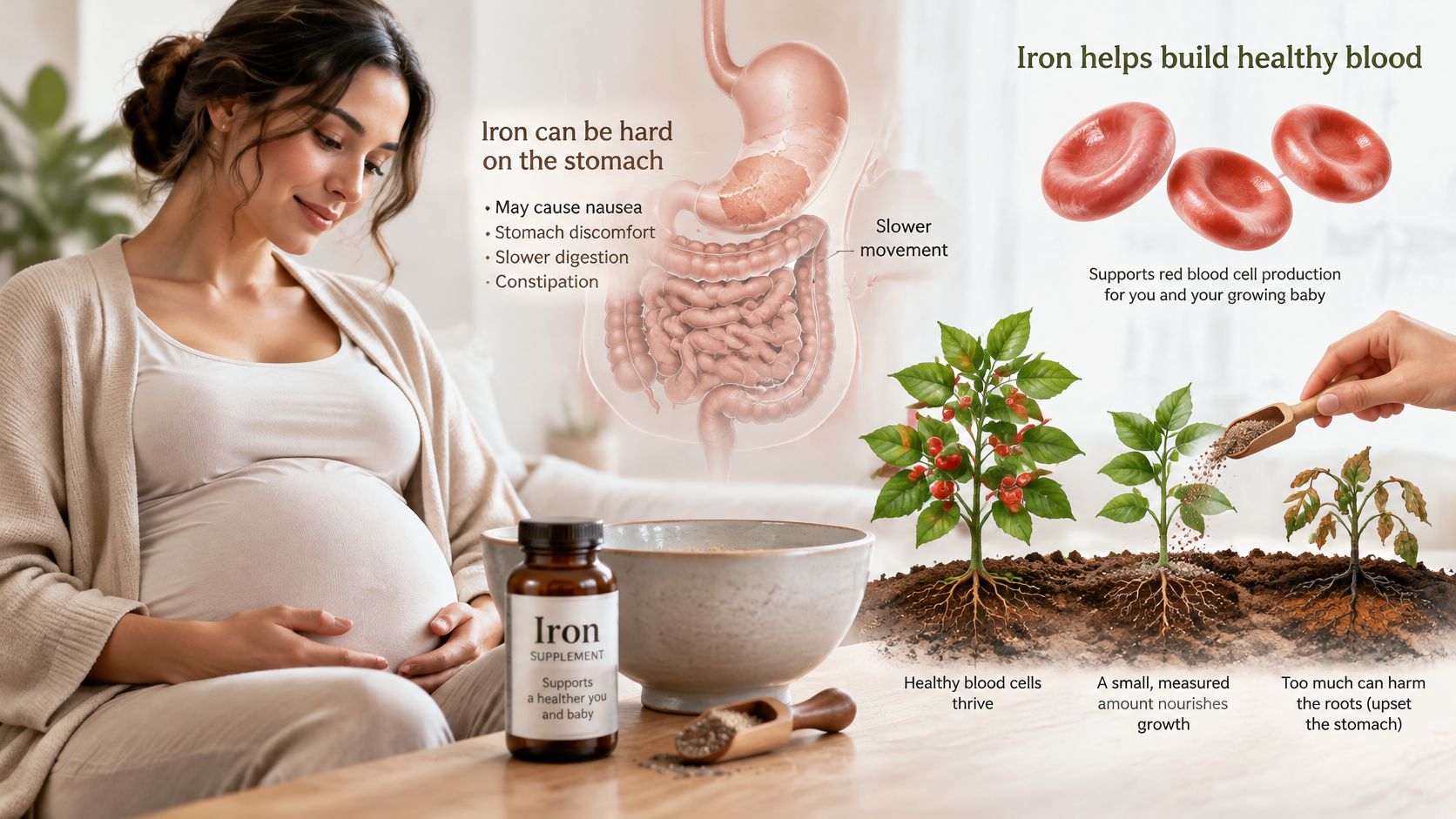
Iron is a little like fertilizer for your blood. A measured amount supports growth, but more isn't automatically better, and an amount that exceeds what you need can create problems. The analogy isn't a diagnosis of toxicity, it's a reminder that the dose and your starting iron status both matter.
Iron-containing supplements can irritate the digestive tract, and pregnancy may already make digestion feel slower and less comfortable. Your gut can therefore be sensitive to a dose that another person tolerates easily.
This illustration captures the balance between enough iron and a dose that needs review.
What a dose comparison can tell you
A 2025 randomized study involving 1,400 pregnant participants compared an iron-folic acid product containing 90 mg of iron with multiple-micronutrient supplements containing 60 mg or 30 mg; perceived adverse effects were reported by 48%, 36% and 23%, respectively.
Iron dose and perceived side effects in the study
| Product | Iron dose | Any perceived side effect | Constipation | Heartburn |
|---|---|---|---|---|
| Iron-folic acid | 90 mg | 48% | 29% | 14% |
| Multiple micronutrient | 60 mg | 36% | 15% | 5% |
| Multiple micronutrient | 30 mg | 23% | 15% | 4% |
This comparison supports a dose review when symptoms are troublesome. It doesn't prove that iron explains every difference, because the products also differed in their overall formulations.
NIH pregnancy guidance lists recommended daily iron intake as 27 mg during pregnancy, compared with 18 mg for nonpregnant women, and describes a trial in non-anemic women carrying twins in which 54 mg wasn't more effective than 27 mg at preventing iron-deficiency anemia but caused more side effects. Those findings don't determine your personal prescription, particularly if you already have iron deficiency.
Why stopping iron isn't the automatic answer
A Cochrane review covering 57 trials and 48,971 pregnant women found adverse effects in 21.6% receiving daily iron versus 18.0% receiving placebo or no iron, with a relative risk of 1.29 and a 95% confidence interval of 0.83 to 2.02. The evidence was very uncertain and didn't establish a statistically significant increase.
The same review found that iron plus folic acid probably reduced anemia at term from 25.5% to 12.1%. Its background also notes the World Health Organization estimate that more than 40% of pregnant women worldwide are anemic, with at least half of that burden presumed to result from iron deficiency.
Both messages can be true: iron can be difficult on your stomach, and it can provide an important benefit. Your clinician needs to weigh comfort alongside your blood results, diet and medical history.
Useful questions include:
- Your starting point: Do your results suggest iron deficiency, anemia, or adequate iron stores?
- Your treatment goal: Is the supplement covering routine nutritional needs or treating a diagnosed deficiency?
- Your options: Could a different iron form or clinician-directed schedule fit your needs better?
Our guide to iron during pregnancy offers more background for that discussion. The goal isn't to find the lowest number on a label. It's to find an appropriate plan you can tolerate consistently.
Vitamin A, Folate and Medications to Check
Stomach comfort isn't the only reason to review your prenatal. The chemical form of a nutrient and the total amount across products can matter even when you feel completely fine.
Vitamin A is a good example. NIH guidance on multivitamin-mineral supplements identifies pregnancy upper limits for preformed vitamin A of 3,000 mcg daily for adults and 2,800 mcg daily for adolescents, because excessive intake can increase birth-defect risk and cause liver toxicity.
Read the form before adding the total
Look for retinol, retinyl palmitate or retinyl acetate on the Supplement Facts panel. These are preformed vitamin A. Beta-carotene doesn't carry the same upper limit in the cited NIH guidance, but that doesn't make unlimited supplementation a sensible goal.
Pregnancy upper limits and watch-outs for nutrients on your label
| Nutrient | Pregnancy upper limit | Watch for |
|---|---|---|
| Preformed vitamin A | 3,000 mcg/day for adults; 2,800 mcg/day for adolescents | Duplicate beauty, immune or standalone vitamin A products |
| Beta-carotene | No pregnancy upper limit in the NIH guidance cited | Confirm the form on the Supplement Facts panel |
| Supplemental folic acid | 1,000 mcg/day for ages 19–50; 800 mcg/day for ages 14–18 | Separate folic acid products stacked on a prenatal |
| Vitamin C | Excess may cause diarrhea, nausea and stomach cramps |
The supplemental folic acid limits appear in NIH folate guidance. A blank vitamin C cell isn't a recommendation to take unlimited amounts; it's not a numerical limit supplied by the multivitamin guidance cited here.
A common mix-up is taking a prenatal alongside a beauty supplement or immune formula without noticing the overlapping ingredients. Include cod-liver oil, liver-containing foods and fortified products in your vitamin A review, and have your pharmacist reconcile amounts expressed in different units.
Our explanation of vitamin A sources and benefits during pregnancy can help you distinguish nutrient forms. If you're exploring vegetables for home cooking or gardening, you can also browse spinach plant details from Shopifarm, while leaving supplement-dose decisions to your clinician.
Bring the whole medicine list
MedlinePlus prenatal multivitamin guidance advises disclosing prescription medicines, over-the-counter products, vitamins, supplements and herbs because your clinician may need to adjust treatment or monitor adverse effects. Prenatals are not interchangeable just because their front labels look similar.
A complete list is more useful than a prenatal label alone. Include occasional products, not just the ones you take every morning.
Don't swap products or cut doses to correct a suspected overlap yourself. Ask your clinician or pharmacist to review the entire routine.
How to Ease Symptoms Step by Step
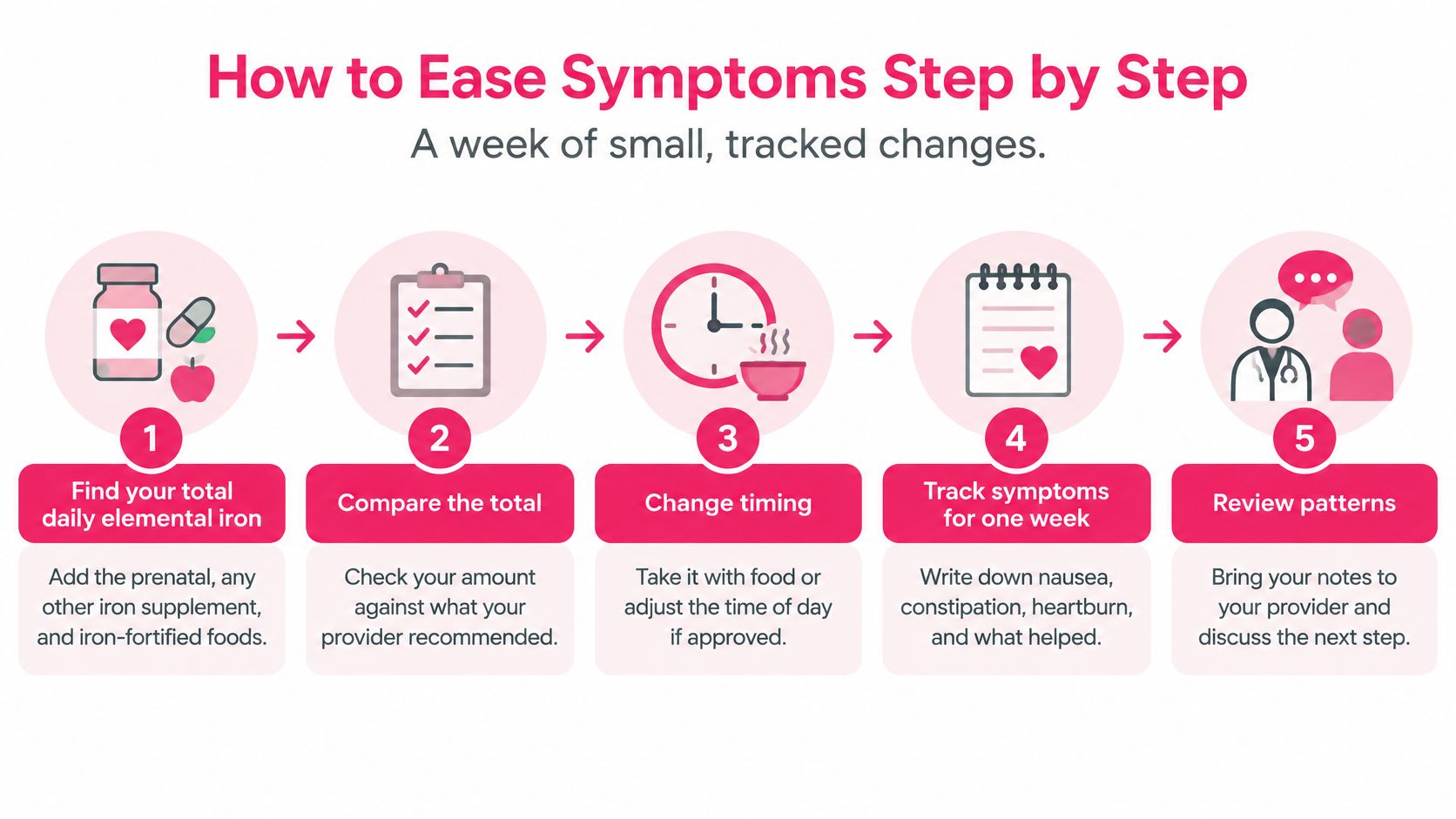
For mild symptoms, a week of small, tracked changes can be more useful than replacing everything at once. If you alter the product, meal timing and diet together, neither you nor your clinician will know which change made the difference.
A Family Practice review recommends reviewing total elemental iron, laboratory status, timing, hydration, fiber and alternative formulations; it identifies the U.S. upper intake level as 45 mg daily from all sources. This isn't a self-treatment ceiling for diagnosed anemia, because prescribed treatment may differ from routine supplementation.
Make one manageable change at a time
- Find your total daily elemental iron. Photograph the prenatal label and any separate iron products, then note iron-containing fortified foods you eat regularly. Use the elemental iron amount on the nutrition panel rather than trying to calculate it from the weight of the iron compound.
- Pair the prenatal with a small meal if your instructions allow. Food may make the dose easier on your stomach than taking it before eating. Ask your pharmacist how to space it from calcium supplements, dairy, coffee and any medicines, since food and medication timing can affect iron absorption.
- Choose a time that fits your symptom pattern. If mornings are your queasiest time, ask whether an evening meal or snack would work better. Bedtime isn't automatically best if lying down makes your heartburn worse.
- Ask before dividing the dose. Your clinician may consider a different formulation, smaller divided doses or another schedule, but that decision depends on your treatment needs. Don't cut tablets, open delayed-release capsules or change the daily amount unless the product instructions and your pharmacist permit it.
- Build fluids, fiber and gentle movement into the day. Sip drinks regularly, increase fiber gradually, and take a comfortable walk after meals if your pregnancy care team has cleared activity. These changes support bowel regularity without treating extra supplements as the first answer.
- Keep a short symptom log. Record the dose time, what you ate, nausea severity in your own words and whether bowel movements were hard, comfortable or loose. Add heartburn and any missed or vomited doses so your clinician can see what's interfering with the routine.
- Bring the log to your appointment. Ask your clinician to review hemoglobin and, when appropriate, ferritin, which helps assess stored iron. The aim is to connect your symptoms with your actual nutritional needs rather than guessing from the label alone.
This visual offers a simple way to organize those changes.
Choose foods you can comfortably tolerate
Fiber doesn't have to mean forcing down a large salad when you're nauseated. Start with familiar foods and adjust portions to your appetite.
- Breakfast options: Oatmeal, whole-grain toast or fruit can be easier starting points.
- Meal additions: Cooked vegetables, beans or lentils can add fiber when you tolerate them.
- Between meals: Keep drinks accessible rather than trying to catch up all at once.
If increasing beans or certain fruits worsens bloating, Mise's guide to navigating fermentable carbohydrates in your diet can help you identify questions for a dietitian. It isn't a reason to start a restrictive elimination diet during pregnancy on your own.
Our guide to constipation from prenatal vitamins can also support that conversation.
Keep the experiment small: Change a practical habit, document the result, and let your clinician decide whether the iron prescription itself needs changing.
This approach is for mild discomfort, not symptoms that stop you from drinking, eating or functioning normally. You don't need to finish a log before asking for help.
When Symptoms Need Urgent Care
At night, when the office is closed and you're wondering whether to call, use the symptom itself to guide you. Don't assume a severe symptom is harmless just because it happened after a vitamin.
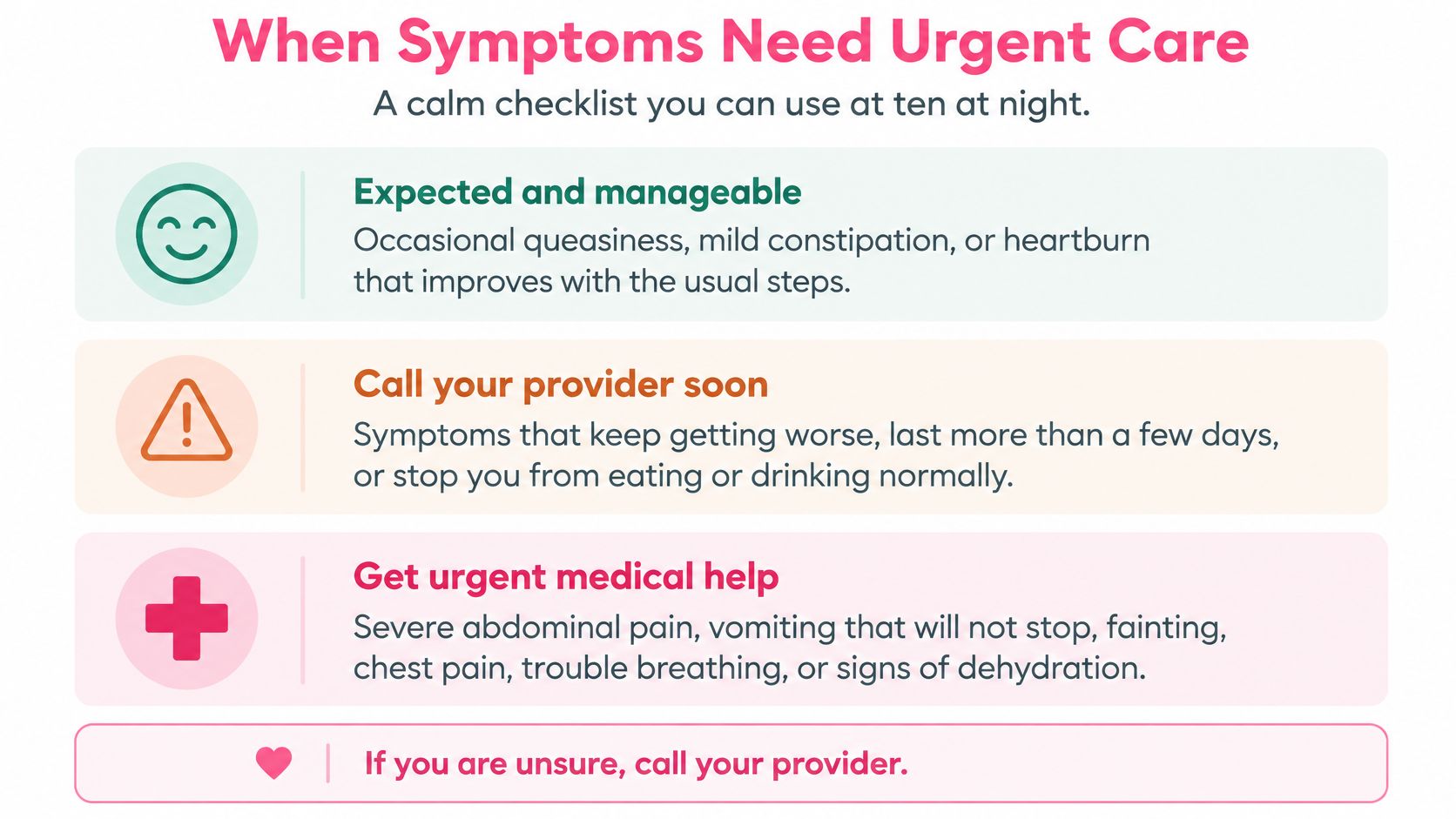
This checklist separates routine follow-up from symptoms that need faster attention.
Expected and manageable
Mention improving mild symptoms at your next visit. Occasional queasiness, mild constipation or heartburn that improves with approved adjustments can usually be discussed during routine care.
- Keep a note: Record the symptom and what helped.
- Watch the direction: Symptoms that become stronger or interfere with meals deserve an earlier call.
Call your provider the same day
Contact your obstetric team for persistent symptoms or a possible ingredient reaction. MedlinePlus lists persistent digestive symptoms and itching, rash or hives as reasons to contact a healthcare professional.
- Repeated vomiting: Especially if you can't retain doses or fluids.
- Possible dehydration: Dizziness, very dark urine or passing little urine.
- Ongoing bowel problems: Constipation or diarrhea that doesn't improve with agreed changes.
- Skin symptoms: New itching, rash or hives, even without breathing problems.
If you're becoming weak or can't keep fluids down, seek urgent assessment rather than waiting for a routine callback.
Get emergency medical help
Seek emergency care for breathing trouble, swelling of the face, lips or throat, fainting, severe abdominal pain or significant bleeding. These aren't symptoms to troubleshoot by changing the time you take your prenatal.
Severe symptoms may reflect dehydration, anemia, infection, an allergic reaction or another pregnancy complication. After birth, the same principle applies: don't dismiss concerning symptoms as a supplement problem.
Keep the bottle, ingredient panel and medication list handy when you call. Your care team expects questions like these, mama, and calling early gives them a better chance to help.
Confirm Any Switch With Your Provider First
A more comfortable prenatal routine should still meet your nutritional needs. Bring questions about the format and ingredients, not just a request for a different brand.
A consultation can help you compare options without losing sight of your treatment goals.

Questions worth bringing
- Would delayed release suit me? These capsules are designed to release later in the digestive tract, but that doesn't guarantee relief.
- Are ginger and peppermint appropriate? They're common additions for queasiness, though evidence is mixed and individual tolerance matters.
- Which folate form fits my plan? Your provider can weigh L-methylfolate against folic acid in the context of your needs.
- Should my iron plan change? A different amount, form or split schedule should be clinician-directed.
Our guide to switching prenatal vitamins during pregnancy can help you prepare.
One option we recommend discussing is our Feed Mom & Me Complete Prenatal Vitamin Plus DHA. It comes in delayed-release vegetable capsules, includes organic ginger and peppermint powders added to help relieve morning-sickness queasiness, and uses L-Methylfolate Calcium instead of synthetic folic acid. These features aren't a promise that it will resolve your symptoms.
For another resource to consider alongside your questions, you can watch the following video.
Confirm features on the current label before choosing, because formulations can change. This week, bring your label and symptom notes to your provider and agree on the next step before switching; if you suspect an allergic reaction, seek care before taking another dose.
At Feed Mom & Me, we're women-owned and built by moms, for moms, offering prenatal nutrition education and Complete Prenatal Vitamin Plus DHA with nutrients including DHA, choline and methylfolate. Visit Feed Mom & Me to review the current formula and bring its label to your healthcare provider so you can choose a plan that supports both your nutrition and your comfort.