
Switching Prenatal Vitamins During Pregnancy: A Safe Guide
Published:Updated:
You're a few months along, staring at your prenatal bottle after another queasy morning. The tablet feels enormous, your stomach isn't happy, and you're wondering whether a different vitamin might make this daily task easier.
Switching prenatal vitamins during pregnancy can be a reasonable choice, but the best approach starts before your old bottle is empty. Think of it as checking a replacement grocery order: the packaging can change, but you still want the essentials accounted for.
Table of Contents
- Is It Okay to Switch Prenatal Vitamins During Pregnancy?
- What to Compare on the New Prenatal Label
- Are You Doubling Up on Iron or Folic Acid?
- When and How to Make the Switch Smoothly
- How to Involve Your Clinician in the Decision
- Choosing a Replacement and Keeping Your Supply Steady
- Your Next Step for a Confident Switch
Is It Okay to Switch Prenatal Vitamins During Pregnancy?
You don't need to treat your first prenatal choice as a commitment you can never revisit. If taking it has become uncomfortable, bring that information to your healthcare provider rather than struggling or abandoning your routine.
The reason for changing is often tolerability, not a change in your nutritional goals. You still want appropriate nutrient coverage. You're looking for a way to maintain it that works better for your body.
What makes a change worth discussing?
Start by describing what happens when you take your current product:
- Nausea: Does taking the prenatal seem to make an already unsettled stomach feel worse?
- Constipation: Has digestive discomfort made you reluctant to take it?
- Trouble swallowing: Is the tablet's size making the routine difficult?
- Availability: Is your usual product unavailable, leaving you unsure what to buy next?
These are useful observations, not evidence that you've done anything wrong. A product can look suitable on paper and still be difficult for you to take.
Clinical review findings summarized in pregnancy nutrition guidance associate larger tablets and higher iron content with lower compliance among women experiencing nausea and vomiting. Gastrointestinal symptoms alongside pregnancy-related nausea can also lead women to discontinue multivitamins altogether. The practical lesson is to address discomfort while preserving nutritional coverage, rather than assuming you need to push through.
A useful distinction: You're changing the delivery system, not giving up on prenatal nutrition.
What shouldn't change without a review?
A smaller tablet, different capsule, or gummy isn't automatically a nutrient-equivalent replacement. The American College of Obstetricians and Gynecologists' pregnancy nutrition guidance explains why nutrient needs and formulation differences matter when choosing a prenatal.
For example, moving away from a product that bothers your stomach shouldn't remove a nutrient your clinician wants you to receive. Your replacement needs to fit both your nutritional plan and your ability to keep taking it.
You deserve a manageable routine, mama. Asking about a switch is a practical way to care for yourself, not a reason to feel guilty about the bottle you originally chose.
What to Compare on the New Prenatal Label
Put the current bottle beside the replacement, or open clear photos of both Supplement Facts panels. Compare the actual amounts and serving directions, not the front-label promises.
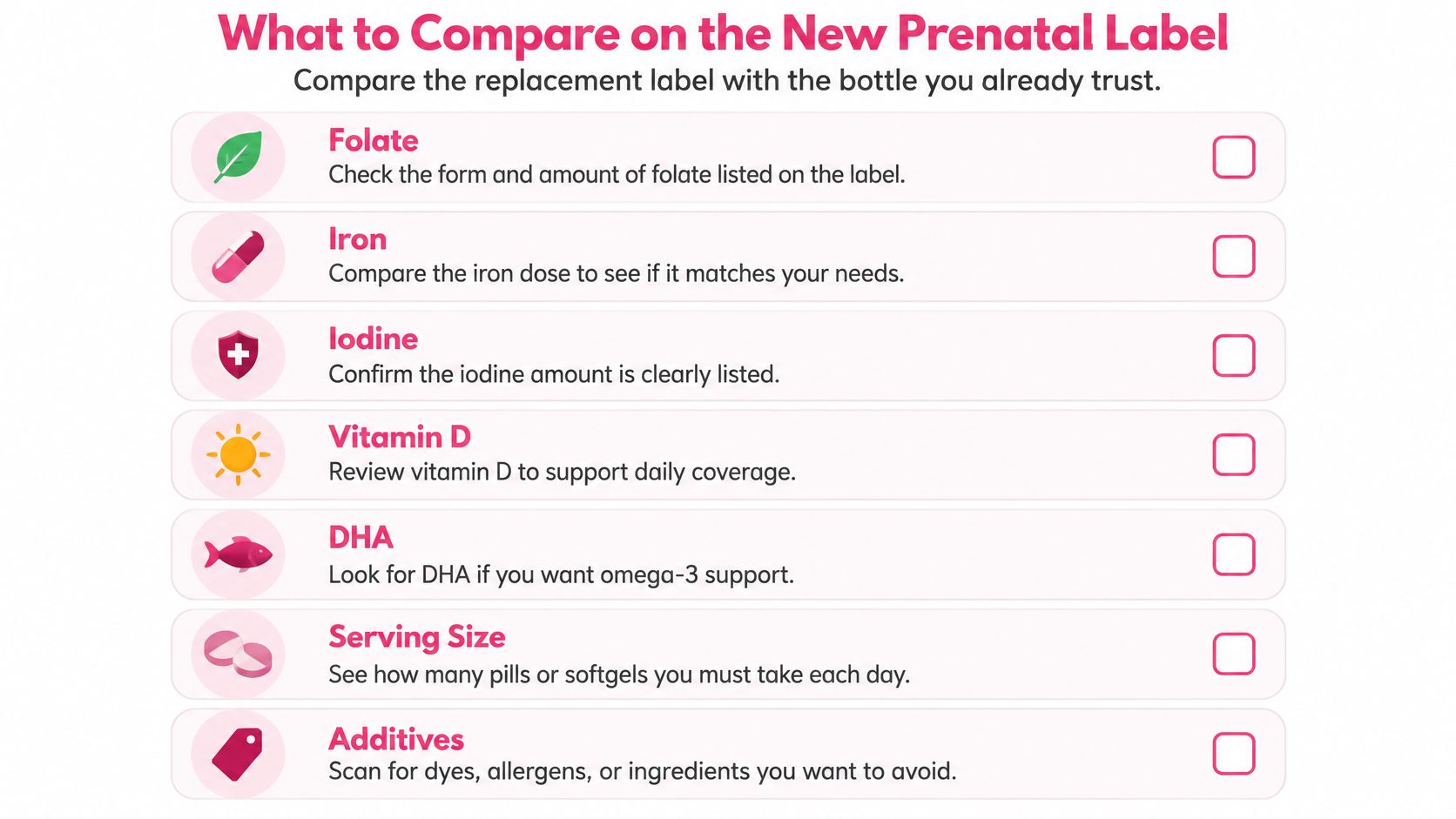
Use this checklist as a visual reminder while you review them.
Which details deserve a closer look?
- Serving size: Find out how many tablets, capsules, or softgels make up the labeled serving. Don't assume the amounts shown apply to a single pill.
- Folate form and amount: Record whether the label lists folic acid, methylfolate, or another folate form. Keep the dietary folate equivalents, abbreviated DFE, and any separately stated folic acid amount visible.
- Iron: Compare the listed elemental iron, meaning the amount of iron supplied rather than the weight of the entire iron compound.
- Iodine and vitamin D: Check whether each appears and whether the amount changes.
- Choline: Look for an actual amount rather than assuming a prenatal includes it.
- DHA: Check the amount of DHA itself. A larger oil-blend amount isn't the same thing as a clearly stated DHA amount.
- Vitamin A: Note whether the product lists preformed retinol. Flag this for review, especially if you use other supplements.
- Other ingredients: Scan for allergens, dyes, and ingredients you prefer to avoid.
How do you interpret different nutrient units?
Think of the label as a recipe written in different measuring systems. You need to know both the ingredient and the unit before deciding whether the replacement matches.
The NIH Office of Dietary Supplements' prenatal supplement information identifies a pregnancy folate recommendation of 600 mcg daily and an iodine recommendation of 220 mcg daily. It also notes that prenatal supplements can provide folic acid, iron, iodine, and vitamin D, while iodine and choline may be absent or present only in small amounts.
That's why two bottles labeled prenatal can provide different coverage. Don't interpret the folate recommendation as permission to substitute an unfamiliar form or amount without checking your plan.
For a folic-acid-specific reference, ACOG's prepregnancy guidance recommends at least 400 mcg daily, beginning at least 1 month before pregnancy and continuing through the first 12 weeks. It also advises patients prescribed 4 mg for higher-risk circumstances to use prescribed folic acid rather than extra prenatal vitamins because of vitamin A toxicity concerns.
The prenatal vitamin dose guide can help you organize label questions. Treat the comparison as a way to identify differences, not as a reason to redesign a prescribed regimen yourself.
Are You Doubling Up on Iron or Folic Acid?
The new prenatal bottle is only part of your supplement picture. Before choosing it, gather anything else you take, including an iron tablet, folic acid, gummies, another multivitamin, and fortified products you use regularly.
Total intake matters more than the amount in any single bottle. A replacement that looks reasonable alone may create an unintended increase when combined with your existing add-ons.
Iron and Folic Acid Reference Points in Pregnancy
| Nutrient | Pregnancy Requirement | Adult Upper Limit |
|---|---|---|
| Iron | 27 mg daily, as identified in Mayo Clinic's prenatal vitamin guidance | 45 mg daily from food and supplements, per the same guidance |
| Folate and folic acid | Use the pregnancy folate target and folic-acid guidance described above, keeping their different label units separate | 1,000 mcg daily of folic acid from supplements, per the same Mayo Clinic guidance |
These upper limits aren't goals to work toward. They're reference points for reviewing a routine, and they don't mean that a clinician-prescribed higher dose is automatically inappropriate.
Iron can cause constipation, nausea, abdominal discomfort, or vomiting. If your current routine is uncomfortable, increasing or decreasing iron through trial and error isn't a substitute for reviewing why you need it and how much you're receiving.
Build a complete supplement inventory
Write down the serving you take, not just the serving printed on the bottle.
- Current prenatal: Record its iron and folic acid amounts.
- Separate supplements: Include prescribed and nonprescribed iron or folic acid.
- Other multivitamins: Check products you may not think of as part of your prenatal routine.
- Fortified foods and drinks: Include relevant label information so your clinician can assess the full picture.
If you're comparing a standalone product, you can browse folate tablets from lo la beauty as a label-reading exercise. That isn't a recommendation to add folic acid to your prenatal; use the listed amounts to identify a possible duplicate before buying.
The distinction between forms also matters. This explanation of methylfolate versus folic acid can help you prepare questions without treating differently labeled quantities as interchangeable.
Don't take both complete prenatals to finish an old bottle or compensate for a missed dose.
If you've missed a serving, follow the product directions or ask your pharmacist what to do. Keep any prescribed extra iron or folic acid in place until your clinician confirms how the replacement fits that individualized plan.
When and How to Make the Switch Smoothly
Plan the change while you still have your current bottle available for comparison. You don't need to wait until it's empty to ask questions, order a replacement, or check delivery timing.
A written schedule can make the handoff easier to remember.

What does adherence research actually tell you?
A Jordanian cohort summarized in the NIH pregnancy supplement review reported 82.9% folic acid use, 71.9% iron use, and 63.8% overall adherence, defining adherence as at least 80%. The same summary reported the highest compliance in month 4, corresponding to weeks 13–16, declines in months 5 and 6, and a rebound to 93% in month 9, corresponding to weeks 33–36.
Those findings describe a particular cohort, not every pregnant woman. They don't prove that changing brands improves pregnancy outcomes or identify a universally best week to switch.
They do provide useful context: maintaining a supplement routine throughout pregnancy can be challenging. Your plan needs to account for discomfort, changing schedules, and whether the next bottle will arrive when you need it.
What does a practical transition look like?
Suppose you're in your first trimester, your prenatal repeatedly leaves you queasy, and you still have some left. Rather than stopping without a replacement plan, send your clinician photos of the current label and the product you're considering.
Then organize the transition:
- Before purchasing: Finish the label comparison and resolve any missing nutrients or prescribed add-ons.
- Before the old supply runs out: Confirm that the replacement is available and that you understand its serving directions.
- On the agreed start date: Start the replacement and stop the old prenatal unless your obstetric clinician specifically directs overlap.
- After the change: Record the start date and any differences in nausea, swallowing, or digestive comfort.
- At your next review: Keep both labels with your supplement inventory so your care team can see what changed.
Having both bottles at home for a planned handoff is different from taking both products. The purpose of ordering early is to avoid a supply gap, not to create overlapping doses.
For a visual break while you organize your plan, you can also watch the video below.
What if discomfort continues?
Use your notes to describe the problem rather than assuming the replacement has failed or changing again immediately. Record what you took, the serving, and what you noticed afterward.
If constipation is your main concern, this guide to constipation from prenatal vitamins can help you prepare a more specific conversation. Ask your clinician or pharmacist how to proceed if symptoms make taking your prenatal difficult.
How to Involve Your Clinician in the Decision
Your clinician can help you answer a more useful question than whether a different brand is acceptable: Does this replacement fit your needs, your diet, and your existing care plan?
Bring your OB/GYN or midwife both labels, your supplement inventory, and a short explanation of why you want to change. That turns a broad question into a decision they can review efficiently.
Make the conversation specific
You might explain that the current tablet is hard to swallow, that constipation is interfering with your routine, or that your usual product is unavailable. These details help your care team distinguish a formulation problem from a nutrient question.
Useful questions include:
- Folate: Does this form and amount fit the plan you've recommended for me?
- Iron: Does the new prenatal work with my laboratory results and any prescribed iron?
- Iodine: Does my thyroid history change what I should choose?
- Vitamin D and choline: Do the amounts fit my diet, or does something need further review?
- Separate supplements: Which should continue, and which might duplicate the replacement?
The label differences identified earlier become more meaningful when your clinician considers your personal history. A nutrient that's missing from the replacement may matter especially if it was deliberately included in your treatment plan.
Don't use a brand change to treat a deficiency
Pregnancy anemia needs assessment with blood testing, not a guess based on how you feel or which bottle looks more complete. If anemia has been diagnosed, your clinician may recommend additional iron rather than relying on a prenatal switch alone.
The same principle applies to other prescribed nutrients. Don't replace or discontinue a specific supplement because a new prenatal advertises a similar ingredient.
Bring the evidence from your own routine: Clear label photos, your actual serving sizes, and a description of what's bothering you are more useful than a general request for the best prenatal.
A pharmacist or registered dietitian can also help review labels and identify questions for your obstetric team. This can be especially useful when multiple supplements, dietary restrictions, or a thyroid history make the comparison less straightforward.
If genetic testing is part of your concern, use this discussion of prenatal vitamins and MTHFR mutations to prepare questions rather than choosing a high-dose product on your own.
And if you're reading this after delivery, bring your current feeding plans and postpartum care instructions into the conversation. Pregnancy recommendations shouldn't automatically become your ongoing personal prescription.
Choosing a Replacement and Keeping Your Supply Steady
Choose a product by how it fits your reviewed nutrient plan, swallowing preferences, ingredient needs, and refill routine. A familiar store-bought tablet, a capsule, and a gummy can each look convenient for different reasons.
The important question isn't which format sounds best in general. It's which option you can use consistently without losing the coverage your clinician wants.
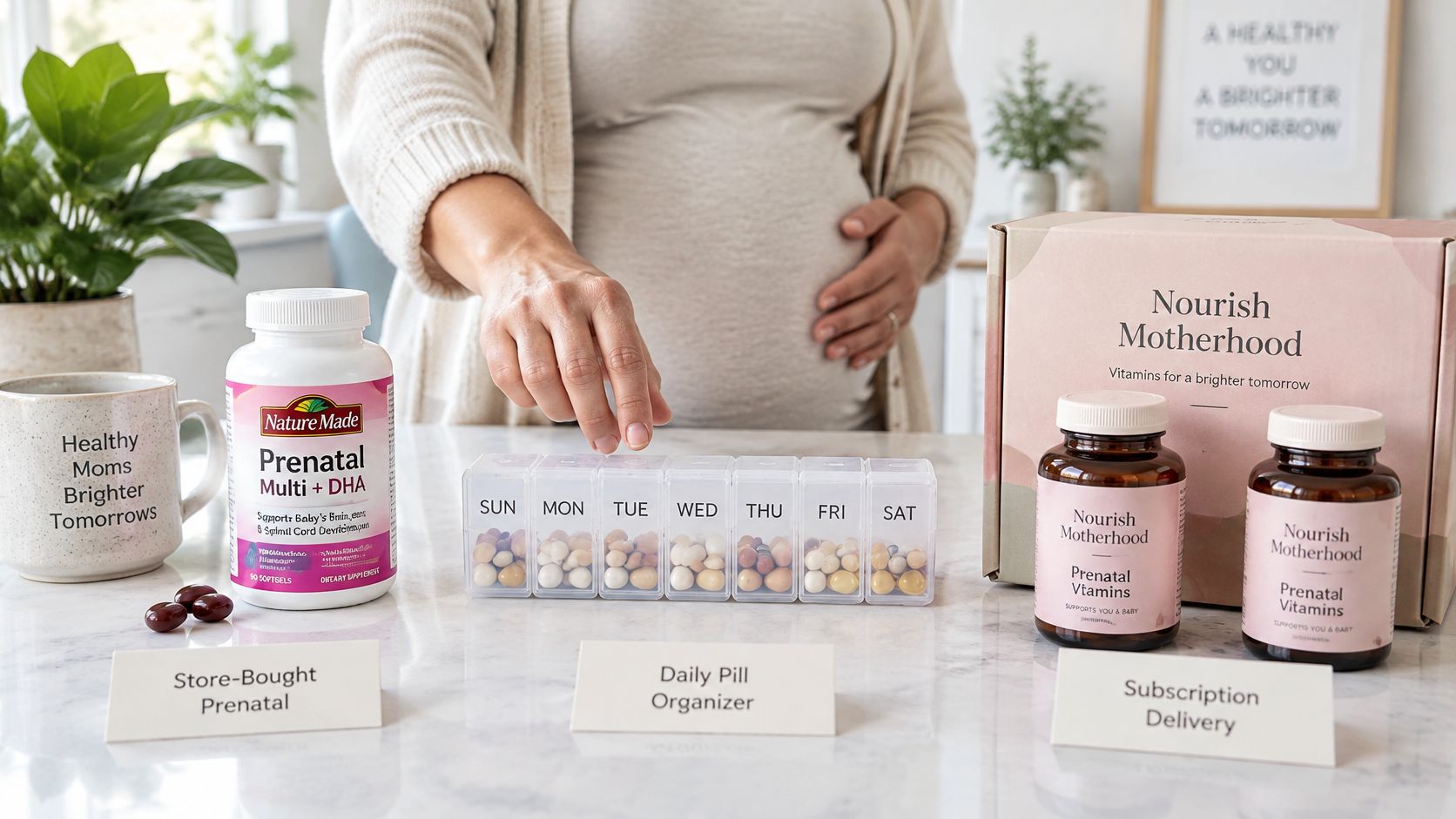
Organizing the replacement alongside your routine can help you see what needs to be restocked.
How do the formats compare?
| Option | What to consider | What to verify |
|---|---|---|
| Different store-bought prenatal | Whether local availability makes replacement easier | The actual formula, not just the prenatal wording |
| Gummy | Whether a chewable format suits your preferences | Iron coverage and any clinician-directed add-on |
| Capsule | Whether its size and serving fit your routine | Nutrient amounts, capsule ingredients, and swallowing comfort |
| Delayed-release capsule | Whether a tolerability-focused design is worth discussing | Don't assume it guarantees relief from nausea |
| Multi-month or subscription supply | Whether planned replenishment fits your schedule | Delivery timing, remaining supply, and whether the formula is still suitable |
ACOG's gummy guidance, noted earlier, is particularly relevant here: gummies may require additional iron because they can't contain the same amount found in regular prenatal vitamins. Don't assume the convenience of the format means it matches your previous product.
Delayed-release capsules are designed with tolerability in mind and may be an option for a sensitive stomach. Still, a design feature isn't proof that you personally will feel better, and added flavoring ingredients shouldn't be treated as a replacement for care when nausea persists.
How can you avoid running out?
Make replenishment part of the choice rather than an afterthought.
- Check remaining servings: Count according to the labeled daily serving, not the number of capsules.
- Allow for delivery: Order before the last serving, especially when changing retailers.
- Review subscriptions: Confirm that the next shipment still matches your current plan.
- Keep a reminder: Put the reorder date somewhere you already check, such as your phone calendar.
Quality questions belong in the decision too. This explanation of third-party testing for prenatal supplements can help you identify what to ask a manufacturer.
A larger supply is useful only after you're comfortable with the choice. Don't let an unfinished bottle or recurring order pressure you into continuing something your clinician wants you to change.
Your Next Step for a Confident Switch
A confident switch starts with a clear reason and ends with a routine you can maintain. You don't need the most impressive-looking bottle. You need a replacement that has been checked against your needs.
Use the information you've gathered to make a short decision path:
- Name the problem: Identify whether discomfort, swallowing, availability, or another concern prompted the change.
- Review the replacement: Finish your label comparison and total-intake inventory.
- Get personalized input: Send both labels and your questions to your clinician.
- Plan the handoff: Choose the start date and organize your refill reminder.
Make room for the rest of pregnancy
Not every pregnancy task needs to stay in your head. Keeping supplement details in a note or calendar leaves less to remember while you manage appointments, meals, work, and preparations for your baby.
The same practical approach can help with happier logistics, too. If loved ones are planning a celebration, EventUploader's guide to sharing baby shower photos made simple is a resource you can pass along rather than taking on another organizing job yourself.
You're allowed to adjust a routine when it isn't working. The careful part is checking what changes, not proving you can tolerate the original choice.
Changing prenatal vitamins isn't a judgment on your earlier decision. You made a choice with the information you had, and you can make another with better information about your own experience.
Today, take photos of the labels and write down your main concern. That gives you something concrete to share with your healthcare provider and a manageable next step, mama.
Feed Mom & Me is a women-owned brand built by moms, for moms, offering Complete Prenatal Vitamin Plus DHA with DHA, choline, selenium, and methylfolate, in vegetarian, soy-free, gluten-free, dairy-free, non-GMO delayed-release vegetable capsules with peppermint and organic ginger for palatability. Visit Feed Mom & Me to review the label and single-bottle, 3-month, and subscription options, then discuss it with your healthcare provider as a possible replacement that fits your nutrient plan and refill routine.