
Why Are Prenatal Vitamins Important in Pregnancy
Published:Updated:
You're in the weeks before a positive test, or you've just seen one and are trying to work out what you should already be doing. Maybe you're comparing bottles at the pharmacy, wondering whether food is enough, or wishing someone would explain the label without making you worry. Prenatal vitamins matter because some nutritional needs begin before pregnancy is obvious, and timing can be as important as the nutrients themselves.
If you've been thinking about a multivitamin while planning a pregnancy, this guide to pre-pregnancy multivitamins can help you prepare questions for your healthcare provider. You don't need to make every decision alone, mama. A steady starting point and personalized advice can go hand in hand.
Table of Contents
- Why Are Prenatal Vitamins Important Before You Know
- What Do Prenatal Vitamins Actually Do in Your Body
- Which Nutrients Matter Most From Preconception to Postpartum
- What Evidence Links Prenatal Vitamins to Healthier Outcomes
- Does a Prenatal Cover Every Nutrient You Need
- How Do You Choose a Prenatal You Can Take Every Day
- What Should You Do Next With Your Provider
Why Are Prenatal Vitamins Important Before You Know
The earliest weeks of pregnancy can pass before you know they're happening. During that time, the neural tube, the embryonic structure that develops into the brain and spinal cord, forms and closes. That's why folic acid is a key reason to start a prenatal before conception rather than waiting for a first appointment.
The American College of Obstetricians and Gynecologists recommends at least 400 micrograms (mcg) of supplemental folic acid daily, beginning at least 1 month before pregnancy and continuing through the first 12 weeks. The overall pregnancy target is 600 mcg of dietary folate equivalents per day. Food remains important, but it can be difficult to rely on meals alone to provide a consistent amount during weeks when pregnancy may not yet be recognized. (ACOG's guidance on health before pregnancy explains this early timing.)
For someone who has had a pregnancy affected by a neural-tube defect, the recommended amount is different: 4 milligrams (mg) daily, as a separate supplement beginning at least 3 months before pregnancy and continuing through the first 3 months, under medical supervision. This is a specific, clinician-directed dose, not an amount to choose on your own. Your provider can also account for your health history and medications when recommending a product or dose.
A steady baseline, not a substitute for food
Think of a prenatal as a reliable baseline alongside meals, not as a replacement for them. Leafy greens, beans, citrus, and fortified grains can contribute folate, while a supplement helps make daily intake more dependable. If you're already pregnant and haven't been taking one, reach out to your clinician about starting now rather than worrying about what you didn't know earlier.
The next questions are practical ones: what these nutrients do in your body, how needs change across preconception and postpartum, what the evidence says, and how to check whether a prenatal leaves any gaps.
What Do Prenatal Vitamins Actually Do in Your Body
Your body uses nutrients as building materials and helpers. Folate, for example, supports one-carbon metabolism, a process that supplies methyl groups used in DNA synthesis and cell division. In other words, these are part of the body's "building-block" work as the neural tube closes and maternal and fetal tissues grow.
Pregnancy changes both how much of certain nutrients you need and when you need them. A standard adult multivitamin may not match those changing needs, and food alone may not consistently meet the folate target while a pregnancy is still unrecognized. That's why professional guidance calls for supplemental folic acid before conception, rather than treating it as something to begin only after a positive test.
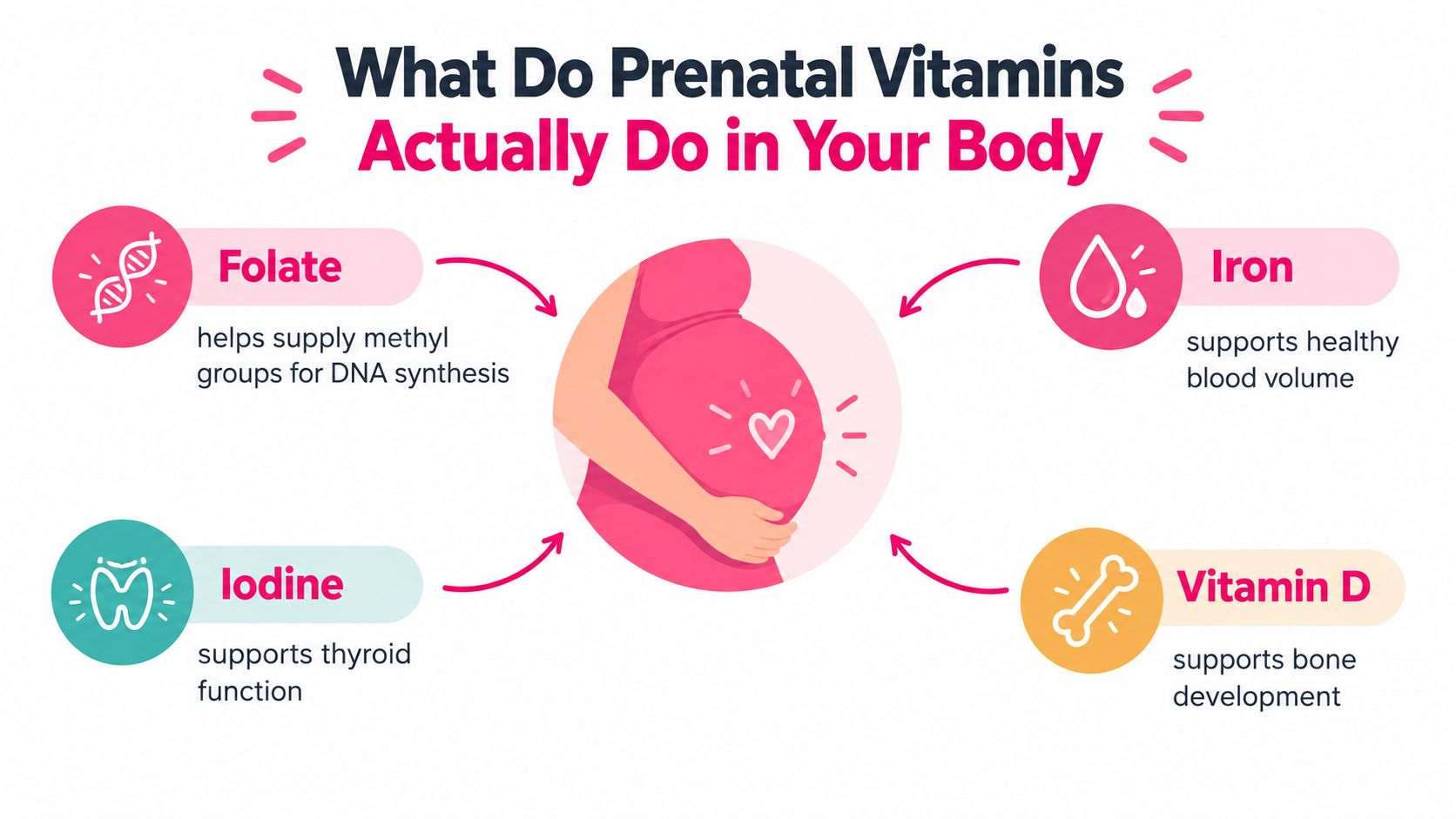
A prenatal supports nutrition; it isn't a magic shield or a replacement for medical care. The right formulation depends on the person taking it, and products aren't interchangeable just because they share the same label category.
Why the label and your history matter
If you've had a pregnancy affected by a neural-tube defect, have malabsorption, or take medicine that interferes with folate metabolism, ask your clinician whether you need a specific dose or formulation. Don't assume a standard prenatal is enough for a health situation that calls for individualized guidance.
Also check the form and amount of vitamin A. Excessive preformed vitamin A is a reason to review a product rather than assume that more is better. Your clinician or pharmacist can help interpret the Supplement Facts panel, especially if you take other supplements or prescription medicines.
A helpful mental model: a prenatal is timed nutritional support that can help fill predictable gaps. It doesn't guarantee an outcome or make food, follow-up, and personalized care unnecessary.
Which Nutrients Matter Most From Preconception to Postpartum
Nutritional needs shift as you move through planning, pregnancy, and recovery. For pregnancy in particular, blood volume expands to support the placenta and fetus, which helps explain why iron is often paired with folic acid in supplementation guidance.
- Preconception: Talk with your clinician about folic acid and any personal factors that could change your dose. The key is choosing a plan before you need to rely on a prenatal appointment to get started.
- Pregnancy: The World Health Organization recommends a daily supplement containing 30–60 milligrams of elemental iron and 400 micrograms of folic acid, begun as early as possible after conception. WHO identifies reducing maternal anemia and iron deficiency, and lowering risks associated with low birth weight, as goals. Its antenatal-care guidance also links the regimen with prevention of preterm birth and puerperal sepsis. (WHO's antenatal iron supplementation guidance describes these recommendations.)
- When anemia is especially common: In settings where anemia affects at least 40% of pregnant women, WHO prefers the higher 60-milligram iron dose. If daily supplementation isn't acceptable because of side effects, WHO describes an intermittent option of 120 milligrams of elemental iron plus 2,800 micrograms of folic acid once weekly in populations where anemia prevalence is below 20%. These options are context-specific, so discuss them with a healthcare professional rather than changing your regimen on your own.
- Postpartum and breastfeeding: Ask whether continuing a dependable nutritional baseline fits your diet, recovery, and feeding plans. Your needs and circumstances are personal, and a provider can help you decide what to continue.
DHA and choline are also worth discussing for their role in supporting the developing brain. If you're curious about choline in particular, this overview of choline during pregnancy can help you make a focused list of questions. Iodine may also deserve attention, especially if you have dietary restrictions.
A supplement can provide support, but it can't replace evaluation or treatment for diagnosed anemia. Bring up fatigue or other health concerns with your clinician rather than trying to treat them by adding iron yourself.
What Evidence Links Prenatal Vitamins to Healthier Outcomes
The clearest evidence behind prenatal folic acid is about neural-tube defects, not a promise that a vitamin prevents every pregnancy complication. The U.S. Preventive Services Task Force recommends that people planning pregnancy or capable of becoming pregnant take 400–800 micrograms of folic acid daily during the periconceptional period. Its evidence review found lower neural-tube-defect risk when supplementation was taken before pregnancy, during pregnancy, or both before and during pregnancy. (The Task Force's folic-acid evidence summary provides the findings.)
The adjusted relative risks were 0.54 for supplementation before pregnancy, 0.62 during pregnancy, and 0.49 when supplementation occurred both before and during pregnancy. In plain language, those findings point to a lower observed risk in the groups who supplemented. The confidence intervals reported alongside the estimates, respectively 0.31–0.91, 0.39–0.97, and 0.29–0.83, are ranges researchers use to describe the uncertainty around an estimate.
Why fortification matters, but doesn't settle every question
There's also a population-level example from the United States. After the Food and Drug Administration required folic-acid fortification of enriched grain products in 1998, neural-tube-defect prevalence declined from 10.7 cases per 10,000 live births in 1995–1996 to 7.0 per 10,000 in 1999–2011, an approximate 35% reduction. These figures describe neural-tube defects in the population; they don't show that any one prenatal prevents every complication.
Fortified foods can contribute folic acid, but meals and food choices aren't perfectly consistent, especially in the earliest weeks. That's one reason a folic-acid-containing prenatal can still matter in a fortified food supply. For another nutrient often discussed in pregnancy, this explanation of DHA benefits during pregnancy may help you prepare questions for your care team.
Does a Prenatal Cover Every Nutrient You Need
A bottle labeled “complete” can be a useful starting point, but it doesn't automatically mean every nutritional need is covered. Choline supports fetal brain development, yet many prenatal products don't contain it. The pregnancy target is 450 mg per day, generally obtained through foods such as eggs, dairy, meat, seafood, beans, and lentils.
Iodine is another possible gap. Many prenatal products may not include it, while several professional organizations recommend 150 mcg per day of supplemental iodine before and during pregnancy, particularly for people with restricted diets. Compare your product's Supplement Facts panel with what you usually eat, then ask your clinician whether the combination covers your needs.
A simple label-and-plate check
| Nutrient | What to know | Food or next step |
|---|---|---|
| Choline | Many prenatal formulas don't include it; the pregnancy target is 450 mg per day. | Eggs, dairy, meat, seafood, beans, and lentils. Ask your clinician whether your diet and supplement together meet your needs. |
| Iodine | Some products omit it; supplemental iodine may be worth discussing, especially with dietary restrictions. | Review the label and discuss iodine sources or a supplement with your clinician. |
| Iron and folate | Check the amounts and forms on your product panel, then review them alongside your diet and health history. | Ask your clinician whether the product fits your circumstances, particularly if you've been diagnosed with anemia. |
| Vitamin D | Don't assume every formula or dietary pattern provides enough. | Review food sources, the product label, and whether clinician guidance or testing is appropriate. |
| Protein, calcium, and omega-3 sources | A prenatal doesn't take the place of a varied diet. | Include protein-rich foods, calcium-rich foods, and omega-3 sources as they fit your eating pattern. |
Fortification, access to iodized salt, food patterns, and prenatal formulas vary by country. A label that suits someone elsewhere may not answer your own needs. These pregnancy food ideas can help you think about food alongside supplementation, rather than expecting one bottle to do everything.
How Do You Choose a Prenatal You Can Take Every Day
A useful prenatal is one you can take consistently and whose label you can review with your clinician. Start with the practical questions: Can you swallow it when you're nauseated? Does it fit your vegetarian, gluten-free, soy-free, or dairy-free needs? Does the Supplement Facts panel show the nutrients you and your provider want to discuss, such as folate, DHA, choline, or iodine?
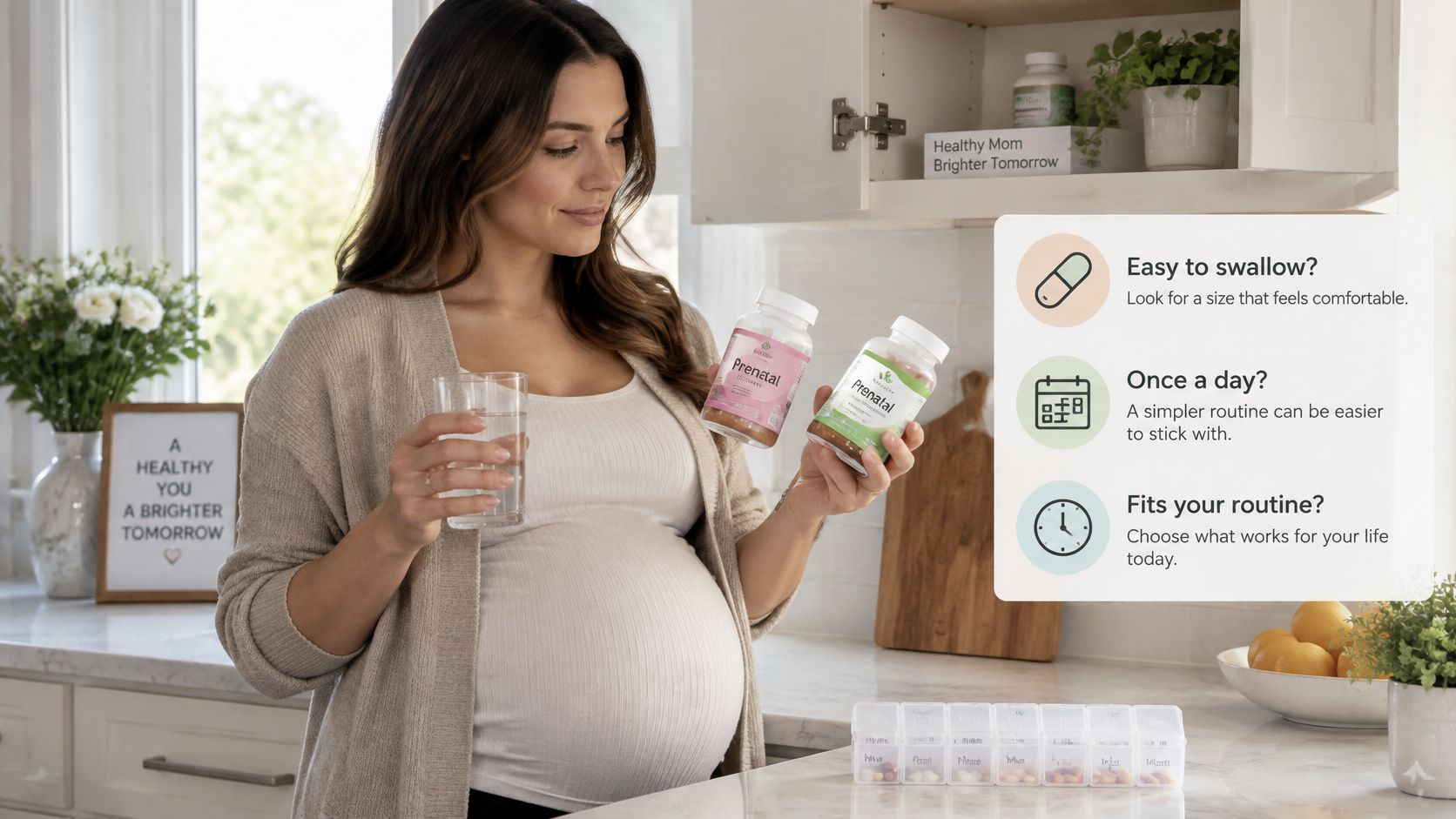
Feed Mom & Me Complete Prenatal Vitamin Plus DHA is one option from a women-owned brand built by moms Maria and Amanda for moms. The brand says the formula emphasizes DHA, choline, selenium, and methylfolate as L-5-MTHF. It's a vegetarian formula that's soy-free, gluten-free, and dairy-free, and is described as Non-GMO, without artificial colors, flavors, or chemical additives.
Choose for tolerability and fit
The product uses delayed-release vegetable capsules, with peppermint and organic ginger included for palatability and pregnancy nausea. It's manufactured in the United States. You can compare the panel and capsule format with other products, then ask your clinician whether the ingredients and amounts fit your own needs.
If you're weighing capsule types, ingredients, and label details, this guide to choosing a prenatal vitamin offers another set of questions to bring to your provider. The product is available as a single bottle or a three-month supply, and a subscription is an option for staying stocked. Those are convenience choices, not a substitute for checking whether the formula works for you.
A short video can be another way to review what to look for when comparing prenatal options.
What Should You Do Next With Your Provider
You don't need to walk into an appointment with the “perfect” prenatal. Bring the label you're considering and a clear picture of where you are in your journey. Your OB-GYN, midwife, or dietitian can help connect the product to your medical history, eating pattern, and current stage.
Bring a short question list
- Your stage: Are you planning a pregnancy, pregnant, postpartum, or breastfeeding?
- Your history: Have you had a pregnancy affected by a neural-tube defect, or do you have a condition or medication that may affect your nutritional plan?
- Your routine: Does nausea make pills difficult to take? Do dietary restrictions limit food sources?
- Your product: Can you review the Supplement Facts panel together and ask whether your food and supplement cover folate, iron, iodine, choline, and vitamin D?
- Your current plan: If you already have a prescribed dose, ask before changing it.
If you'd like to compare a product before your visit, Feed Mom & Me Complete Prenatal Vitamin Plus DHA highlights DHA, choline, selenium, and methylfolate, with delayed-release capsules, peppermint, and organic ginger. The women-owned brand describes its approach as made by moms for moms, and its product information, Mama Blog, and weekly pregnancy-friendly recipes are optional reading for your own research. The decision still belongs in a conversation with your healthcare provider, who can tailor advice to you.
You can start with one useful question: “Does this prenatal, together with the way I eat, fit my needs right now?”
Feed Mom & Me offers a prenatal vitamin with DHA and nutrition resources for the preconception, pregnancy, and postpartum stages, so you can compare a product and prepare questions for your visit. Review the label with your clinician, then visit Feed Mom & Me to explore the prenatal, Mama Blog, and pregnancy-friendly recipes.