
Best Vegetarian Prenatal Vitamins That Actually Work
Published:Updated:
You're probably reading this with three browser tabs open, one bottle in your cart, and a friend's recommendation in your texts that contradicts both. Every label promises it's complete, clean, and perfect for your baby, and somehow no two ingredient lists match. You're not doing this wrong, mama. The best vegetarian prenatal vitamins aren't found by picking the prettiest bottle. They're found by knowing exactly what to check, and what to ignore.
Table of Contents
- Why Choosing a Vegetarian Prenatal Feels So Hard
- What Nutrients a Vegetarian Prenatal Must Cover
- How to Read a Vegetarian Prenatal Label Like a Pro
- Comparing Formulation Styles Side by Side
- Matching the Right Prenatal to Your Real Life
- What to Do When Your Prenatal Makes You Feel Worse
- A Friendly Recommendation to Bring to Your Next Appointment
Why Choosing a Vegetarian Prenatal Feels So Hard
You're standing in the supplement aisle turning bottles around, or you're scrolling late at night comparing Supplement Facts panels that blur together. One says plant-based, another says whole food, another says natural, and none of those words tell you whether your baby's getting enough of what matters. That confusion is built into the category. A capsule can be vegetarian and still be missing the nutrients that matter most in pregnancy.
Stop hunting for one universally perfect product. Start asking five specific questions instead, because methylfolate, iron, DHA, choline, and iodine drive most of the differences between an excellent prenatal and a mediocre one wearing good marketing.
What Makes Labels So Misleading
"Complete" has no standard definition on a prenatal bottle. A brand can list a nutrient on the front and include only a trace amount inside. Capsule count tricks you too, since two small capsules aren't automatically stronger than one, and a gummy that tastes great may skip iron entirely. Allergen claims matter just as much, especially if you're avoiding soy, gluten, or dairy, because a vegetarian formula can still contain those.
Practical rule: Judge a prenatal by its Supplement Facts panel, not by the words on the front of the bottle.
Tolerability deserves equal weight. The smartest formula on paper does nothing for you if it makes you gag every morning and you stop taking it by week nine. Size, taste, timing, and capsule design aren't cosmetic details. They decide whether you stay consistent.
How to Use This Guide
Think of the next sections as a shopping tool you keep, not a ranking that expires when brands reformulate. You'll get target amounts first, then a fast label-reading method, then help matching a formula to your trimester, your labs, and your stomach.
If you want background on eating this way while pregnant, our guide on staying vegetarian during pregnancy and covering your bases pairs well with what follows. Bring a bottle you're considering, open its label online, and score it as you read. By the end, you'll spot a weak formula in under two minutes, and you won't need anyone's list to do it.
What Nutrients a Vegetarian Prenatal Must Cover
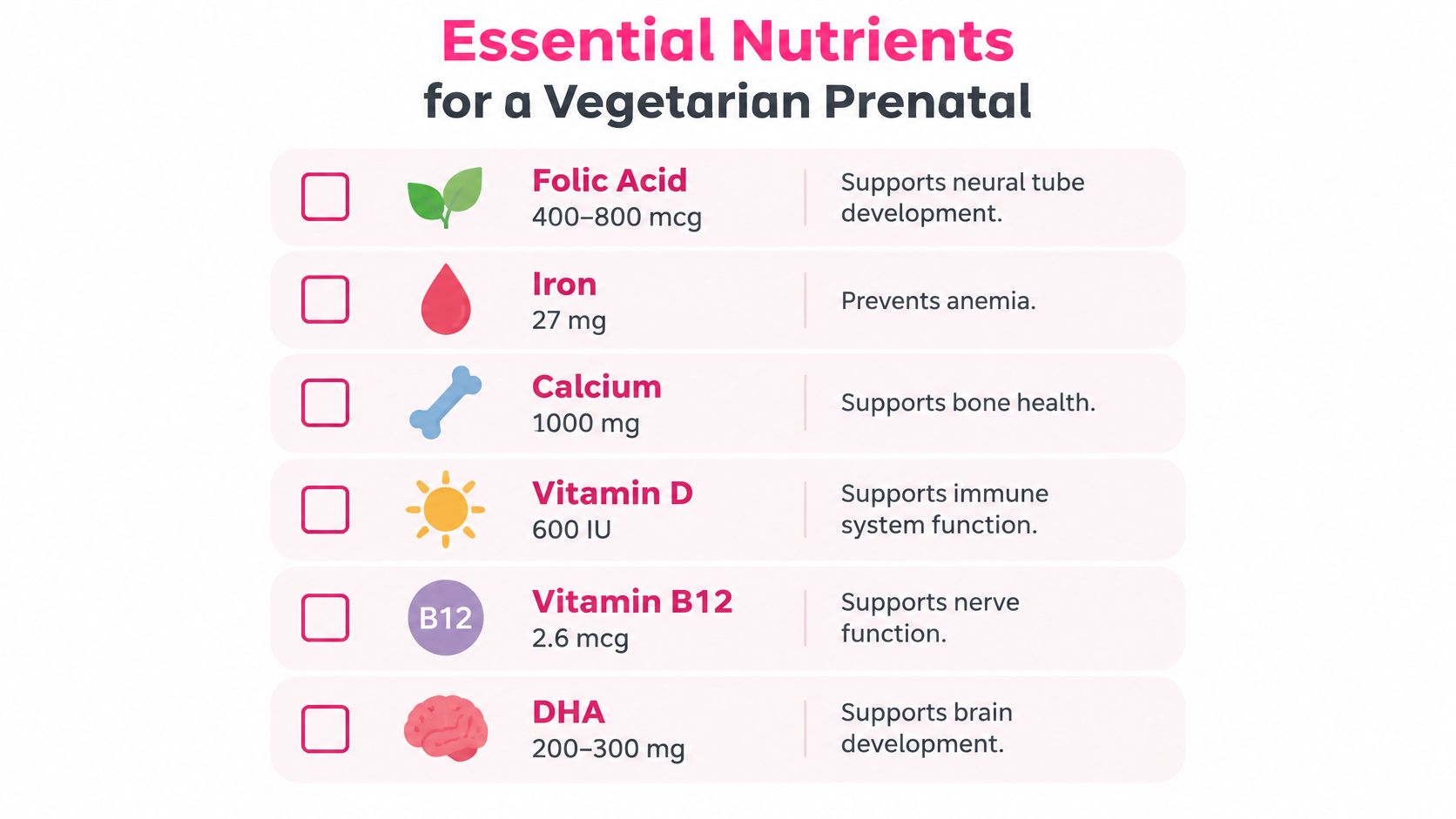
Before you compare brands, you need your target numbers. These five nutrients separate strong vegetarian formulas from ones that look healthy, and they're the lines I check first on any label, every time.
Folate and Iron Come First
Folate is the most time-sensitive nutrient in pregnancy because your baby's neural tube, which becomes the brain and spinal cord, forms very early, often before you know you're pregnant. That's why the NIH guidance on folic acid before and during pregnancy puts the preventive amount at 400 micrograms (mcg) daily if you could become pregnant, rising to 600 mcg daily once you are pregnant.
- Folate form matters: Look for methylfolate (L-5-MTHF), the active form your body uses directly, rather than assuming synthetic folic acid works equally well for everyone.
- Iron supports your blood supply: The WHO recommendation for daily iron and folic acid in pregnancy calls for 30 to 60 mg of elemental iron alongside that folic acid, started as early as possible after conception.
- Your iron need is personal: Anemia status, labs, diet, and tolerability change what dose is right, so treat any label amount as a starting point for a clinician conversation.
The Three Most Formulas Underdeliver
Choline, iodine, and DHA are where "complete" formulas fall short. The NIH pregnancy nutrient recommendations for choline, iodine, and DHA set choline's adequate intake at 450 mg per day in pregnancy, iodine's RDA at 220 mcg per day with a commonly recommended 150 mcg supplement, and omega-3 guidance at at least 250 mg of combined DHA plus EPA, with an additional 100 to 200 mg of DHA during pregnancy.
- Choline builds your baby's brain: Many pregnant women don't reach the target from food alone, and many prenatals include little or none.
- Iodine supports thyroid function: It's frequently absent or too low, so check the exact microgram amount.
- DHA should come from algae: Fish oil isn't vegetarian, so confirm an algal source and a real dose, not just a front-label mention.
Vegetarian eaters also need to watch vitamin B12, since plant foods don't reliably provide it. Our overview of multivitamin considerations for vegan and vegetarian women explains why B12 deserves a line-by-line check too. Screenshot these targets, mama. They're your shopping list now.
How to Read a Vegetarian Prenatal Label Like a Pro
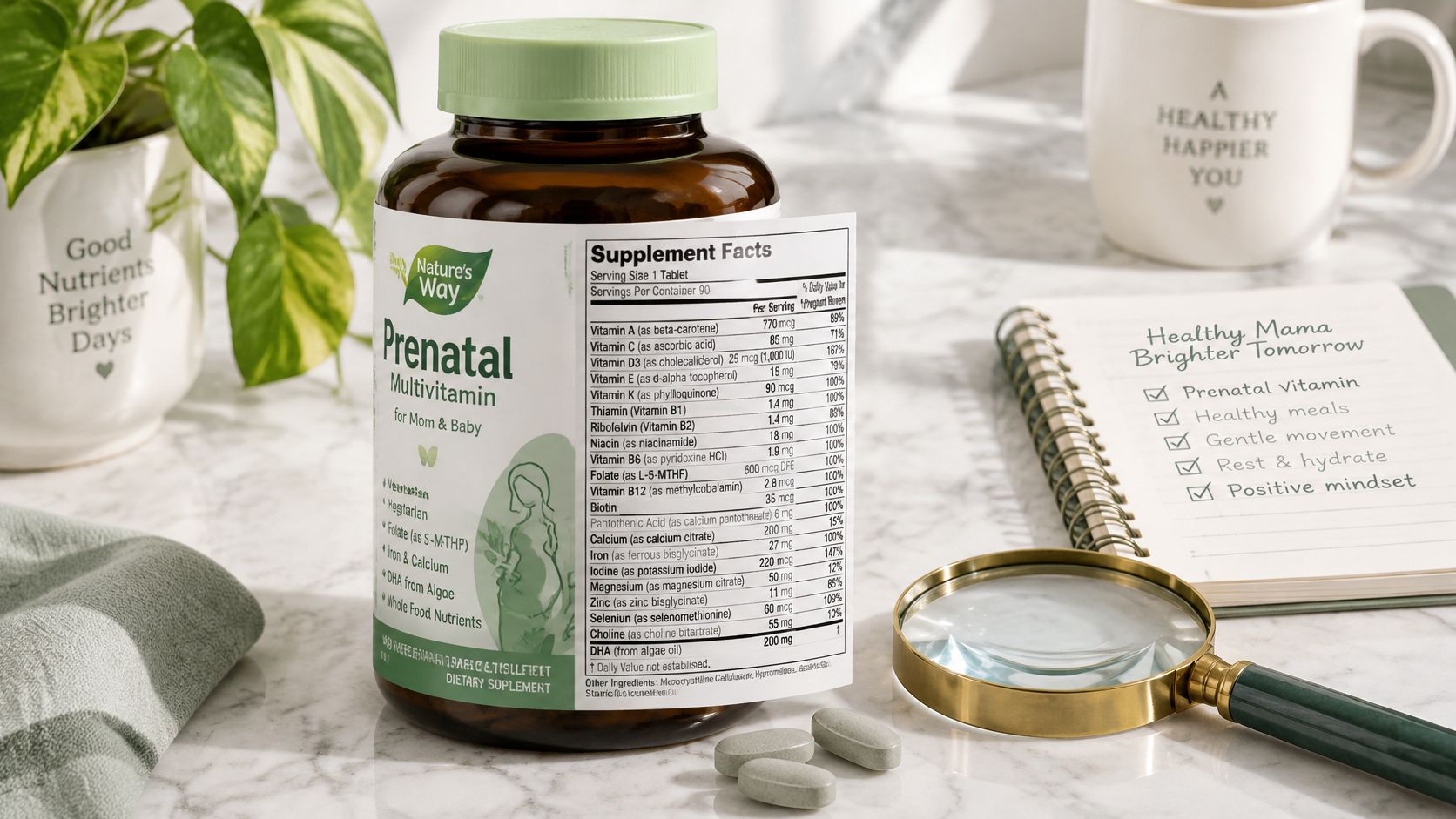
Flip the bottle over. The front is advertising, the back is evidence, and you can scan that evidence in about two minutes once you know the order.
Here's a typical bottle setup so you can picture what you're scanning.
Your Two-Minute Scan
Start with the folate line. Does it say methylfolate or folic acid, and does the amount sit near the targets from the section above? Next, find iron and note both the dose and the form. Ferrous bisglycinate tends to be gentler for many women than ferrous sulfate, so the form predicts how your stomach will feel. Then check DHA for an explicit algal source. "Contains DHA" with no source listed is a red flag on a vegetarian product.
- Circle exact amounts: Milligrams and micrograms are facts you can compare.
- Ignore proprietary blends: A blend hides individual doses, which means you can't verify anything.
- Check the capsule itself: Vegetable capsules fit a vegetarian routine, gelatin doesn't.
- Read the allergen statement last: Confirm soy, gluten, and dairy status in writing, not from front-label vibes.
Clean-label thinking helps beyond supplements, too. I like how Smokey Rebel's seasoning advice pushes readers to question ingredient lists generally, and that same skepticism serves you here. A nutrient listed at a tiny fraction of its target still lets a brand print "with choline" on the box. Listed is not the same as delivered.
This short video walkthrough shows the scanning order in action.
Finally, look for independent verification. Our explainer on why third-party testing matters for prenatal supplements covers what testing can and can't prove. If a brand won't show exact forms, exact amounts, and testing, that's your answer. Move on to one that will.
Comparing Formulation Styles Side by Side
You'll mostly meet three formulation styles, and none of them wins for everyone. Your job is matching a style to your stomach, your labs, and how many pills you'll realistically take on a tired Tuesday.
Vegetarian Prenatal Formulation Styles Compared
| Style | Best For | Main Trade-off |
|---|---|---|
| All-in-one capsule with DHA | Mamas who want one simple routine | Fewer chances to adjust single nutrients |
| Multivitamin plus separate algae DHA softgel | Women who want flexible dosing | More pills and more bottles to track |
| Lower-iron gentle or food-based formula | Nausea-prone first-trimester users | May not meet higher iron needs |
Reading the Trade-Offs Honestly
An all-in-one wins on consistency. You open one bottle, you're done, and that simplicity is valuable when you're exhausted. The stack approach wins on flexibility, since you can change your DHA or iron without replacing everything, but pill fatigue is real and every extra step is a chance to skip. Gentle lower-iron formulas win on comfort, yet comfort becomes a problem if your labs say you need more iron.
The decision that matters most isn't capsule versus gummy. It's whether you need higher iron for a documented deficiency, or you're optimizing for tolerability with healthy stores.
Food-based marketing deserves special scrutiny. Our breakdown of whole food prenatals and what that label really means explains why the source story matters less than verified amounts. A nutrient extracted from broccoli still has to show up at a meaningful dose.
Gummies sit inside this conversation too, and if pill swallowing is your barrier, it helps to find vegan-friendly prenatal vitamins in gummy form and then score them with the same checklist. Just know gummies often omit iron, so you'd need a plan for that gap.
My honest take, mama, is that most women do best with an all-in-one they'll finish. Choose the stack only if you enjoy fine-tuning, and choose lower-iron only with your provider's blessing and recent labs in hand.
Matching the Right Prenatal to Your Real Life
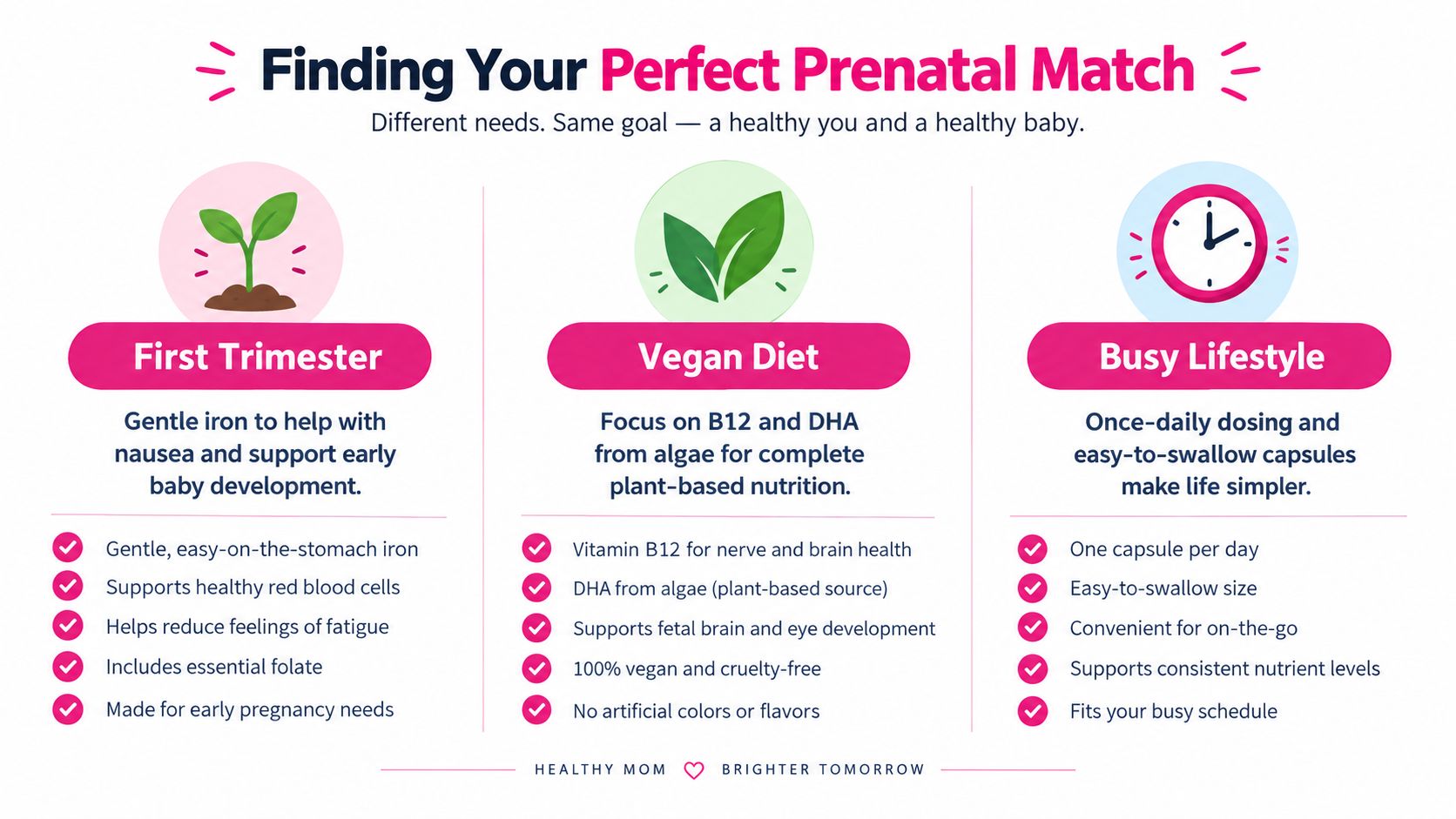
Same checklist, three different women, three different right answers. See which profile sounds like you, because your trimester, your plate, and your bloodwork should steer this choice more than any ranking ever could.
Profile One, the First-Trimester Stomach
You're eight weeks along, crackers are a food group, and your current prenatal comes back up twice a week. You need a gentle, lower-iron formula you can keep down now, plus a written plan with your provider for rechecking iron once nausea eases. Delayed-release capsules taken with food or before bed often help. Escalate quickly if you can't keep fluids down, you're losing weight, or dizziness shows up, because that's medical territory, not supplement shopping.
Profile Two, the Mostly Plant-Based Eater
You eat little dairy and few eggs, so your food doesn't cover the gaps other vegetarians get by default. Your priorities shift hard toward choline, B12, iodine, and algal DHA, and an all-in-one that includes meaningful amounts of each saves you from assembling four separate bottles.
- Check B12 form and amount: Your diet won't backfill a weak dose.
- Verify iodine on the panel: Don't assume iodized salt covers you.
- Ask about labs early: Baseline iron and B12 results make later decisions easy.
Profile Three, Twins or Anemia History
You're carrying twins, or anemia has shown up in a past pregnancy. Your iron math is different, full stop, and a gentle low-iron formula chosen for comfort could underserve you. You want a formula with substantial iron in a tolerable form, and you want your obstetric clinician actively managing the dose against your labs.
Escalate to your provider before switching anything if fatigue deepens, you feel breathless with mild effort, or your labs trend down. None of these profiles is doing pregnancy wrong, mama. They're just solving different problems, and your prenatal should solve yours.
What to Do When Your Prenatal Makes You Feel Worse
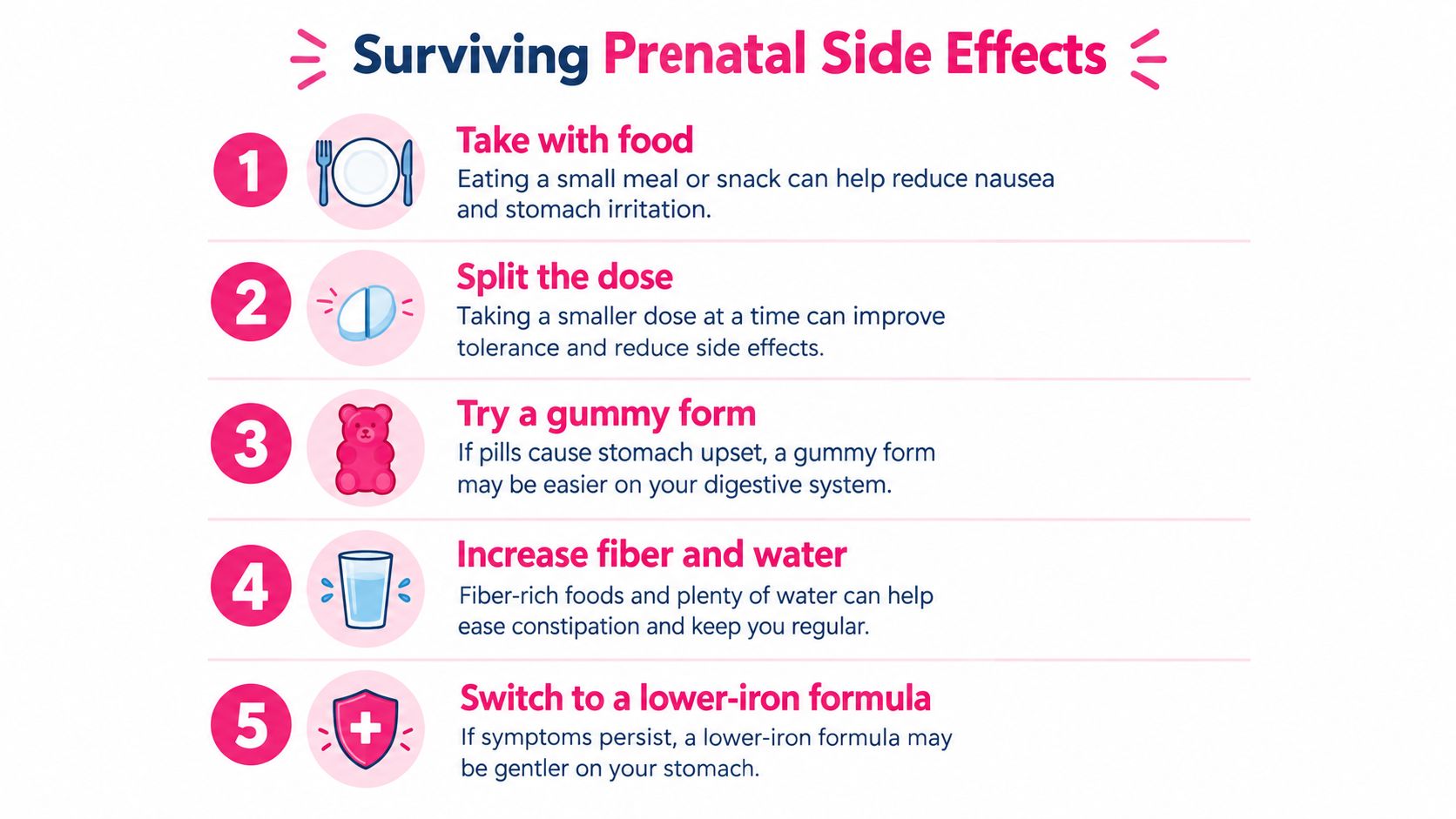
Let's challenge the story you've probably heard, that iron is always the villain behind prenatal nausea. It might contribute for you personally, but the evidence is messier than the internet admits, and that nuance changes what you should try first.
In one 2025 study of barriers to prenatal vitamin adherence, non-adherent users cited forgetfulness at 23.7%, nausea at 14.4%, abdominal pain at 13.4%, and unpleasant taste at 11.3%. Yet a Cochrane review discussed in that same research found no difference in nausea, heartburn, or constipation between iron-folic-acid supplementation and placebo in the included trials. Both things can be true. Your experience is real, and iron may not be its main cause.
A Tiered Plan Worth Trying
- Change the timing first: Take your dose with food or right before bed instead of on an empty morning stomach.
- Anchor it to a habit: Forgetfulness beat nausea as a barrier, so pair your capsule with toothbrushing or your phone charger routine.
- Try a delayed-release capsule: Releasing later can mean less stomach drama and less taste.
- Use peppermint or ginger: Both can make the ritual itself easier to face.
- Split doses only with approval: Splitting changes absorption dynamics, so clear it with your clinician first.
Our guide on what to do when your prenatal is causing nausea walks through these adjustments in more detail. Here's my firm line, though. Don't unilaterally drop to a low-iron formula if you're treating diagnosed iron deficiency. Routine supplementation and deficiency treatment are different jobs, and swapping one for the other without labs can leave you depleted. Call your provider instead if vomiting is persistent, constipation becomes painful, or you spot black stools with stomach pain. You deserve a formula you can take and a plan that's medically sound.
A Friendly Recommendation to Bring to Your Next Appointment
After all that label reading, you deserve one concrete name to take to your provider. Mine is the Feed Mom & Me Complete Prenatal Vitamin Plus DHA, and I'll show you exactly how it scores against your new checklist so you can judge it like any other bottle.
It uses methylfolate (L-5-MTHF) rather than synthetic folic acid, which is the active form you learned to look for. It includes choline and selenium alongside the standard prenatal panel, addressing two nutrients that many formulas skip, and it pairs the multivitamin with DHA in a vegetarian routine. Those choices map directly onto the gaps covered earlier, instead of asking you to trust a front-label promise.
How It Handles the Tolerability Problem
The formula is soy-free, gluten-free, and dairy-free, it's Non-GMO, and it contains no artificial colors or flavors. It uses a delayed-release vegetable capsule with peppermint and organic ginger, which speaks to the nausea and taste barriers from the previous section. It's women-founded, built by moms for moms, and made in the United States, which matters to many women in this community.
Bring the actual label to your appointment and score it together. A good provider welcomes that conversation, and a good brand survives it.
If you're cross-checking other roundups while you decide, this overview of the best prenatal vitamins for pregnancy 2026 gives you more labels to practice your two-minute scan on. Run every contender, including this recommendation, through the same five questions. Check the folate form, the iron form and dose, the algal DHA, the choline and iodine amounts, and the allergen statement.
Whatever you choose, mama, choose it deliberately and take it consistently. Talk it through with your healthcare provider, especially if your labs, medications, or symptoms complicate the picture. You've got the skills now. Trust them, and trust yourself. You're already doing the research so many people skip, and your baby benefits from that care.
If you're ready to put that checklist to work, visit Feed Mom & Me to read the full label for the Complete Prenatal Vitamin Plus DHA, score its methylfolate, choline, and delayed-release capsule against everything you just learned, and explore the mama blog and weekly recipes built to support you from preconception through postpartum.