
Best Prenatal DHA Supplements for Pregnancy
Published:Updated:
You're standing in the supplement aisle, phone in one hand and a bottle in the other, trying to work out whether the label's big "omega-3" number tells you how much DHA you'll get. The shelves are crowded, the claims sound similar, and you may be wondering whether to choose fish oil, algae oil, or a prenatal that already includes DHA.
This guide is different from a simple product ranking. You'll learn how to assess a supplement's DHA dose, source, quality testing, and tolerability, so you can compare any brand with more confidence. The information can help you prepare questions for your OB, midwife, or dietitian, but it can't replace personal medical advice. If you're looking for help understanding pregnancy-related care roles, this overview of an obstetrics and gynecology scribe offers useful context about the clinical setting.

| What to compare | What a useful label or product page tells you |
|---|---|
| DHA dose | The amount of DHA per serving, listed separately from total oil |
| Source | Whether the DHA comes from fish or algae |
| Quality information | Testing or documentation for identity, contaminants, and freshness |
| Serving and use | How many capsules make a serving, and how to store the product |
| Fit for you | Whether the ingredients and format suit your diet and routine |
Table of Contents
- Why Prenatal DHA Deserves Your Attention Right Now
- What DHA Actually Does for You and Baby
- How Much DHA You Actually Need During Pregnancy
- Algae vs Fish DHA Which Source Fits You Best
- How to Read a Prenatal DHA Label Like a Clinician
- How to Pair DHA With Your Prenatal Multivitamin
- When More DHA Is Not Automatically Better
- Your Friendly Checklist for Choosing and Using Prenatal DHA
Why Prenatal DHA Deserves Your Attention Right Now
It's easy to assume that a bottle with a large omega-3 number must be the stronger choice. But that number may refer to total fish oil or total omega-3s, not the amount of DHA, the specific omega-3 you're trying to compare. A clearer label makes it easier to decide whether a product belongs in your cart or whether you need to ask a few more questions.
Rather than choosing a brand because its label looks polished, start with a few practical details:
- The actual DHA amount: Find the milligrams of DHA per serving, not just the total oil weight.
- The serving size: Check whether the amount applies to one capsule or several.
- The source and testing: Look for fish- or algae-derived DHA and accessible information about quality checks.
- Your whole routine: Account for seafood, your prenatal multivitamin, and any advice from your care team.
That approach is useful whether you're choosing your first prenatal, switching products because a capsule is hard to tolerate, or reviewing your routine postpartum. The aim isn't to find a universally perfect bottle. It's to understand the trade-offs well enough to make a choice that fits your diet and health needs.
Best prenatal DHA supplements aren't necessarily the ones with the most oil, the most capsules, or the boldest front-label claims. They're the products you can evaluate clearly and use in a way that makes sense for you. As you compare options, you'll see how DHA differs from other omega-3s, how seafood intake fits in, and why a higher dose isn't automatically a better match.
What DHA Actually Does for You and Baby
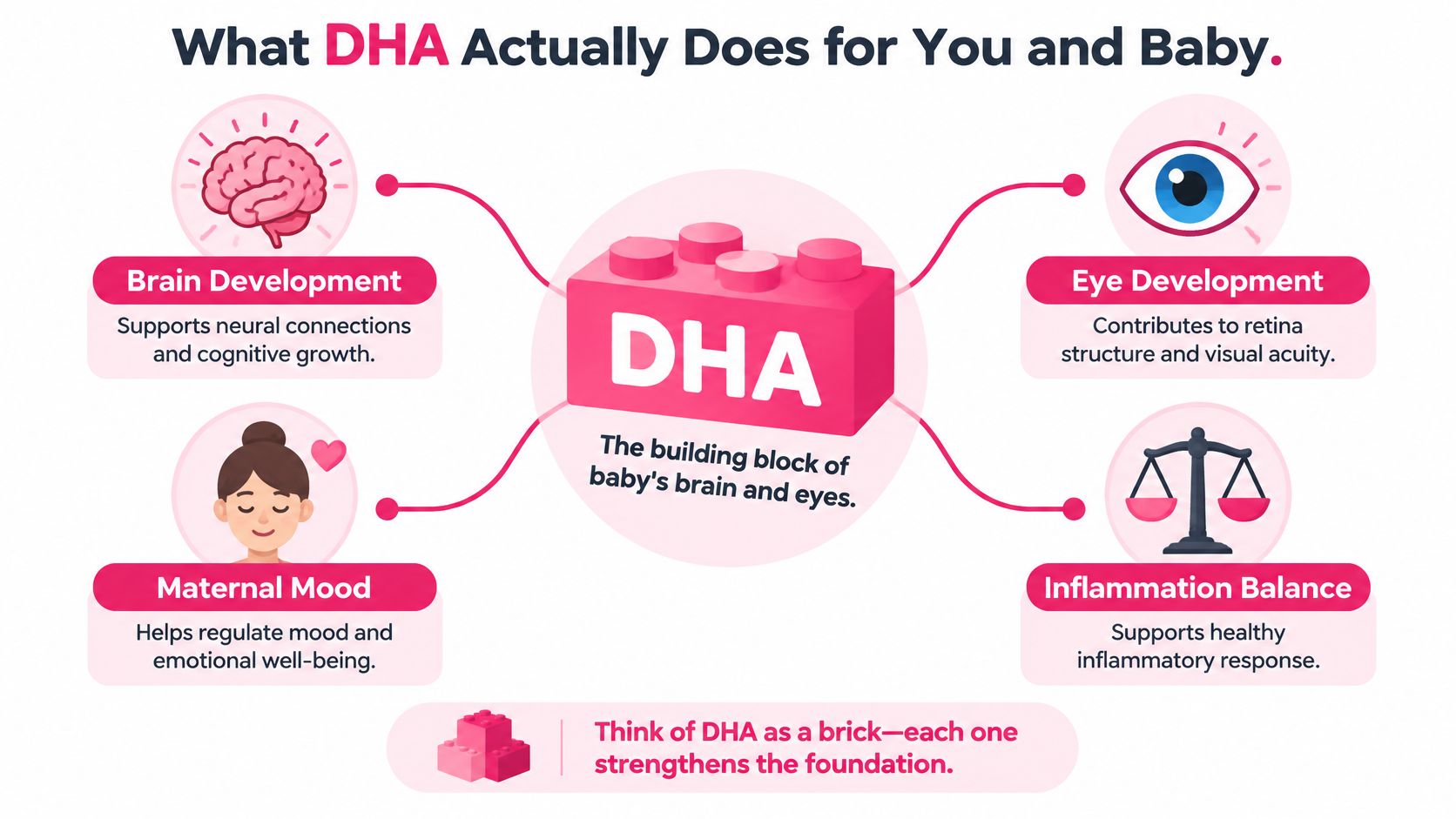
During pregnancy, a fetal brain and retina are building new tissue at a fast clip, and DHA is one of the fatty acids the body can use inside those cell membranes. DHA works more like a structural material than a switch: having enough available helps the body meet a demand that already exists, while a capsule cannot rewrite genetics, guarantee a milestone, or replace medical care.
Label math gets easier once DHA and EPA stop being lumped together. Both are long-chain omega-3 fats, and many fish oils carry some of each, but algae products often supply mostly DHA. A front label that says “1,000 mg omega-3” may still leave the DHA amount unclear, which is why clinicians read the fatty-acid panel instead of trusting the biggest number.
The outcome evidence is hopeful and still bounded. A Cochrane review reported that omega-3 long-chain fats were associated with fewer preterm births before 37 weeks and fewer early preterm births before 34 weeks in the trials it analyzed. The same review makes clear that evidence across studies is uneven, so those findings cannot promise that one supplement will change one pregnancy. Read the Cochrane review on omega-3s in pregnancy.
What's known, and what's still being studied
The clearest case for DHA is structural: it is concentrated in brain and retinal tissue, and pregnancy raises the stakes because the fetal supply depends on the pregnant person's intake and stores. Claims beyond that deserve a calmer read. Maternal mood, inflammation, and later childhood outcomes are active research questions, not promises a bottle can make. NIH's omega-3 professional fact sheet, linked in the dosing section below, notes that effects of EPA and DHA supplements on infant health and development remain uncertain.
Your life stage also changes the question. Before pregnancy, DHA may be one part of building a steady routine. During pregnancy, nausea, seafood aversions, or a prenatal already containing DHA can shift what “enough” looks like. After birth, breastfeeding keeps the same nutrient relevant, with diet and clinician guidance still doing the heavy lifting.
How Much DHA You Actually Need During Pregnancy
Say you pick up a prenatal DHA bottle at the pharmacy, and the front label says "1,000 mg fish oil." That number tells you almost nothing on its own. DHA guidance looks confusing for the same reason: different authorities publish different targets, and product labels use different units. The simplest way to sort it out is to separate the general omega-3 benchmark from the added DHA guidance for pregnancy, then compare both against what you eat and what your supplement contains.
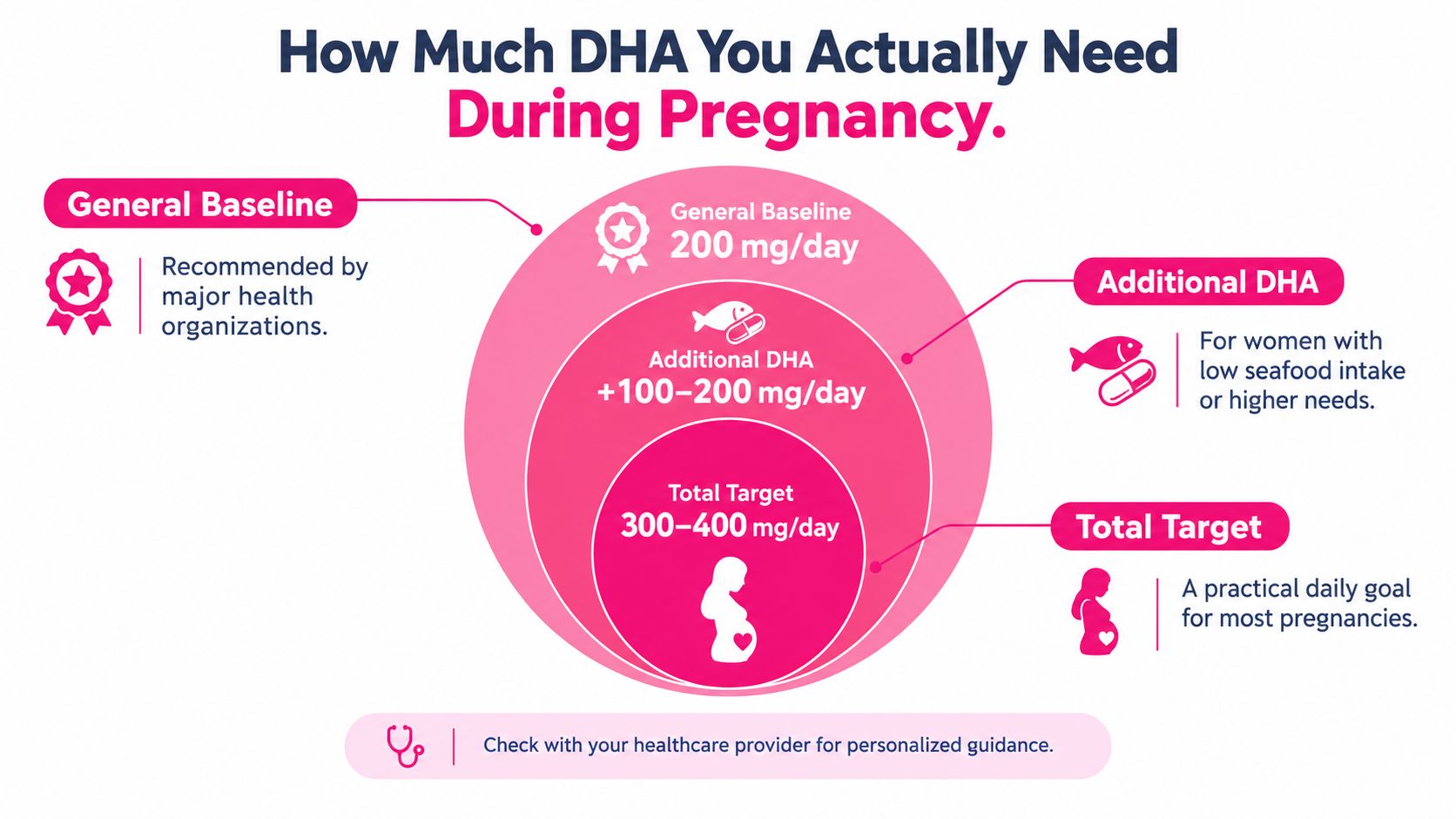
Three sets of numbers show up again and again in guidance and research:
- Combined DHA and EPA: The Food and Agriculture Organization recommends at least 300 mg per day of DHA and EPA together, including 200 mg of DHA, during pregnancy. A clinical practice guideline cited in NIH's omega-3 professional fact sheet (linked earlier in this guide) recommends at least 250 mg per day of DHA plus EPA for women of childbearing age and pregnant women, with an additional 100–200 mg of DHA per day during pregnancy.
- Seafood as part of the plan: U.S. federal guidance recommends 8–12 ounces of lower-mercury seafood per week for pregnant and breastfeeding women. Choices such as salmon, sardines, trout, and herring can provide DHA and EPA. The EPA explains seafood choices for pregnancy.
- A higher-dose evidence range: A broader Cochrane summary identified 500–1,000 mg per day of long-chain omega-3 fats, including at least 500 mg of DHA, beginning around 12 weeks of pregnancy, as a promising regimen. That is a protocol from trial evidence to discuss with your clinician, rather than a universal prescription. See the full Cochrane review.
Match the numbers to a real label
Back to that bottle. The bold figure on the front may be total fish oil, total omega-3, or the combined amount of DHA and EPA, and none of those is the same as DHA alone. Turn the bottle around and look for DHA and EPA listed separately in the supplement facts panel. Then check whether the quantities refer to one capsule or the full serving, since a "serving" is sometimes two or three softgels.
A seafood meal and a supplement do not have to be competing choices. If you eat lower-mercury fish regularly, bring that up with your care team before adding a pill. If you rarely eat seafood, ask whether a supplement fits your needs. Breastfeeding belongs in that same discussion, since your DHA needs do not end at birth.
Algae vs Fish DHA Which Source Fits You Best
Fish-derived and algae-derived DHA can both be useful options. The right choice depends on what you eat, what you avoid, how you feel about fish-based products, and whether the label gives you enough information to judge quality. Neither source is automatically the best fit for everyone.
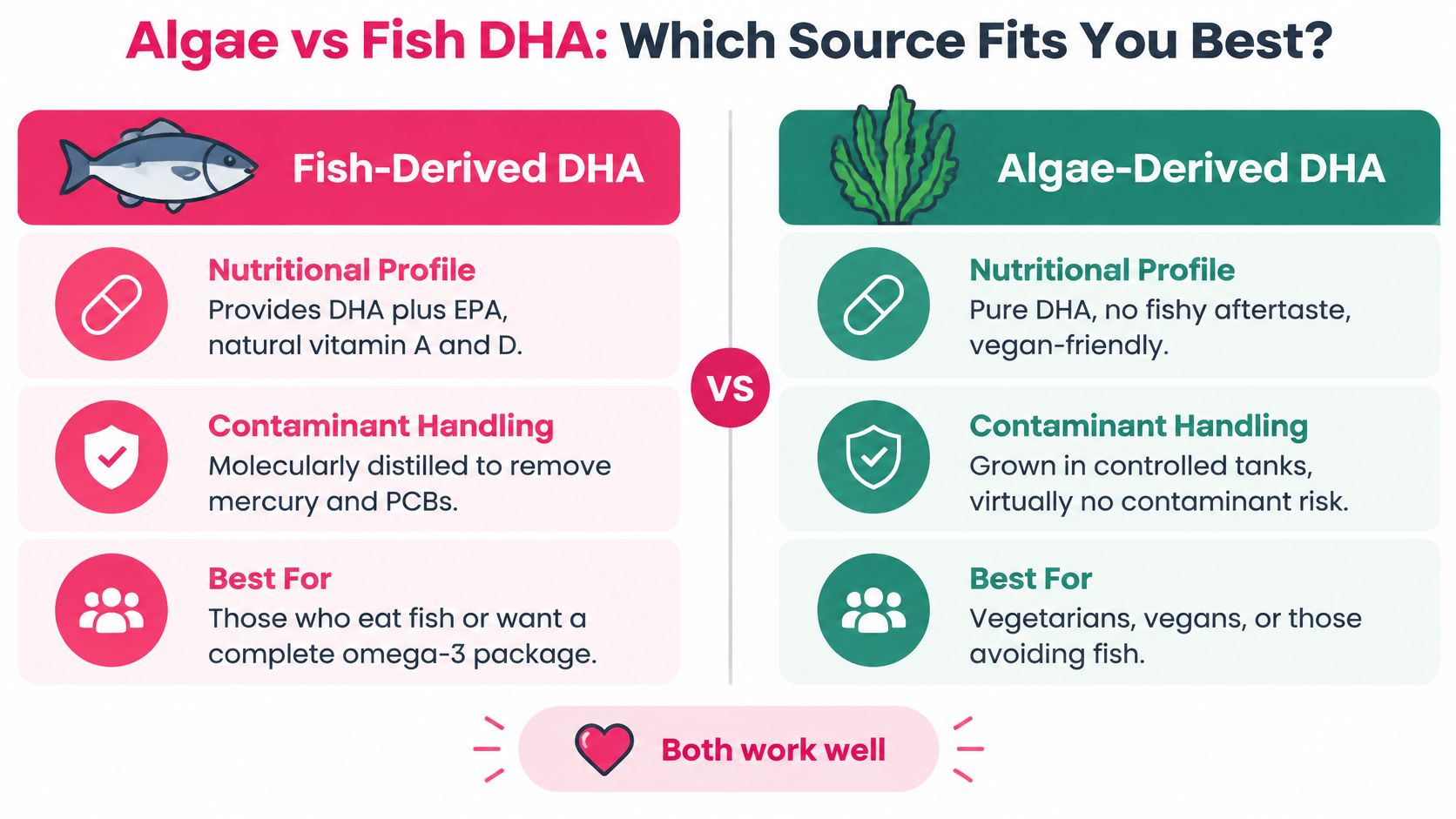
| Consideration | Fish-derived DHA | Algae-derived DHA |
|---|---|---|
| Dietary fit | May suit you if you already eat fish and are comfortable with fish-based products | May suit vegetarians, vegans, or people avoiding fish |
| What to check | DHA and EPA amounts, source, and contaminant testing | DHA amount, production details, and batch-level quality information |
| Routine and taste | You may want to consider how you tolerate fish oil or its aftertaste | May be appealing if you prefer to avoid fishy taste or fish ingredients |
| What it offers | Some products provide both DHA and EPA | Some products emphasize DHA |
“Purified” or “fish-free” isn't the same thing as complete proof of quality. A fish-based product should offer information about contaminants and freshness; an algae-based product still deserves a clear label and quality documentation. A certificate of analysis or independent testing information can help you assess what the manufacturer verifies. People with fish allergies or other dietary restrictions should check ingredient and allergen statements and ask a healthcare professional if they're unsure.
Make the choice fit your life
If you eat seafood and want a supplement that includes both DHA and EPA, a fish-derived option may be worth comparing. If you don't eat fish, prefer a vegetarian product, or find fish oil unpleasant, an algae product could make your routine easier. If you already eat lower-mercury seafood, tell your clinician what and how often you eat before deciding how much supplemental DHA makes sense.
Sustainability, price, and availability may matter too, but a label alone may not settle every question about them. Start with the nutritional amount, source, and documentation, then weigh those against your own priorities. For meal ideas that can help you explore food sources, see omega-3-rich foods for pregnancy.
How to Read a Prenatal DHA Label Like a Clinician
A useful product label answers a simple question: How much DHA will I take in a day, and what evidence supports the product's quality? A large bottle or a high total-oil number can distract from the details that answer it.
Check the label in this order:
- DHA per serving: Find the stated DHA amount. Don't assume the “fish oil” or “omega-3” number is the DHA amount.
- EPA and total omega-3: Read these as separate values. They provide context, but they don't replace the DHA figure.
- Serving size: Confirm how many capsules or softgels make up one serving, then calculate the amount you'd take based on the directions.
- Testing and documentation: Look for information about identity, DHA/EPA assay accuracy, heavy metals, persistent contaminants, and oxidation markers.
- Storage and expiration: Check storage instructions and the product's expiration information. Freshness matters for an oil-based supplement.
- Tolerance and restrictions: Review allergens, dietary statements, capsule form, and features such as delayed release. Choose a product you can comfortably take as directed.
The NIH consumer fact sheet identifies fishy taste, heartburn, nausea, stomach discomfort, and diarrhea as possible effects of omega-3 supplements. A delayed-release capsule or other tolerability feature may make a product easier for you to use consistently, but it doesn't replace checking its dose or testing information. Review NIH's consumer guidance on omega-3 supplements.
A quick shopping script: “How much DHA is in my daily serving? Is it listed separately from EPA and total oil? What quality testing and freshness information can I verify?”
That checklist also helps when comparing a standalone DHA product with a prenatal that includes multiple nutrients. If you're weighing different prenatal formats, this resource on raw code prenatal options may help you think about what product details to compare. You can also review what third-party testing means for supplements.
How to Pair DHA With Your Prenatal Multivitamin
You may already take a prenatal multivitamin, so the first step is to see whether it includes DHA and how much. Some products combine nutrients in one routine; others leave DHA for a separate softgel. Neither format is automatically more effective for you. What matters is knowing what you're taking and avoiding an accidental double-up.
| Scenario | What to Check on the Label | Suggested Next Step |
|---|---|---|
| Your prenatal includes DHA | DHA per serving and how many capsules make the serving | Compare the stated amount with your seafood intake and clinician's advice |
| Your prenatal has no DHA | Whether a separate product identifies DHA apart from EPA and total oil | Ask your provider whether adding a DHA supplement suits your routine |
| Your prenatal contains a small DHA amount | Whether the listed DHA fits your overall dietary plan | Bring the label to your next appointment before adding another product |
| You take several supplements | Duplicate ingredients and total amounts across products | Ask a clinician or pharmacist to review the full list |
DHA is a fat, so taking it with a meal may be a practical choice for some people, especially if that's easier on the stomach. Follow the product's directions, and ask your clinician or pharmacist about timing if you take other medications or supplements. There's no need to assume that DHA must be separated from iron or calcium based on the information here; if your prenatal's directions or your provider's advice says otherwise, follow that guidance.
If your prenatal already includes DHA, use the label and your seafood intake to guide the conversation before adding a second product.
If your prenatal doesn't contain DHA, a separate product may be simpler than switching a multivitamin you already tolerate. If you're deciding between combined and separate options, this guide to prenatal multivitamins with DHA can help you compare the format and label details.
When More DHA Is Not Automatically Better
It's tempting to think the highest-dose bottle must offer the most support. But dose recommendations differ, and the evidence doesn't mean every pregnant person needs the same amount. Your seafood intake, dietary pattern, health history, and clinician's advice all matter.
The higher-dose range discussed earlier comes from evidence reviews, not a blanket instruction to increase your dose. NIH also summarizes a clinical-practice recommendation for people with low DHA intake or status, described as under 150 mg per day: they may be advised to take 600–1,000 mg per day of DHA plus EPA or DHA alone, beginning in the second trimester and no later than 20 weeks. That guidance applies to a particular group and shouldn't be treated as a target for everyone. NIH's pregnancy and omega-3 professional guidance discusses the evidence and its limitations.
Safety limits deserve a place in the conversation
The FDA consumer guidance recommends no more than 3 g per day of combined EPA and DHA, including no more than 2 g per day from supplements. Higher therapeutic doses should involve healthcare supervision because of potential bleeding concerns. NIH also notes possible interactions with anticoagulants such as warfarin. If you take an anticoagulant, have a bleeding concern, or receive specialist pregnancy care, check with your clinician before changing your dose.
Long-term child development evidence also remains unsettled. The NIH pregnancy guidance describes a 2025 randomized trial in which 400 mg per day of DHA didn't materially change common infant morbidity symptoms through 12 months; reviews have reported that benefits may be limited to specific cognitive or behavioral areas rather than broad, consistent developmental effects. That's a reason to keep expectations realistic, not a reason to panic.
If you're considering a fish liver oil, ask specifically about its ingredients and suitability for pregnancy rather than assuming all fish-oil products are alike. This overview of organic cod liver oil can support that discussion with your care team.
Your Friendly Checklist for Choosing and Using Prenatal DHA
A good decision doesn't require memorizing every study or finding one bottle that checks every possible box. It starts with a few clear questions about your diet, your label, and what you can comfortably take.
Before choosing a product, ask yourself:
- Can I find the DHA amount? Make sure the label lists DHA separately, then check the serving size.
- Does the source fit me? Decide whether fish-derived or algae-derived DHA better suits your diet, preferences, and restrictions.
- Can I verify quality details? Look for batch-level testing information, freshness markers, storage directions, and an expiration date.
- Does it fit with my prenatal? Check for DHA already included in your multivitamin and discuss the combined plan with your healthcare provider.
- Can I tolerate it? A product that makes your routine difficult may not be a practical choice. If fishy taste is a concern, this article on fish oil burps offers some context to discuss with your clinician.
Bring your supplement labels to an appointment and ask direct questions: “Does this DHA amount fit my seafood intake?” “Should I use a separate DHA supplement with my prenatal?” “Are there any concerns with my medications or health history?” If you're breastfeeding or planning to continue a supplement postpartum, include that in the conversation.
One option to discuss is Feed Mom & Me Complete Prenatal Vitamin Plus DHA. It combines DHA with prenatal nutrients including folate, vitamin D3, iron, calcium, and choline; the DHA amount is 50 mg per serving, so check with your clinician about whether that amount fits your individual needs. The brand is women-owned and built by moms, for moms, and its vegetarian, soy-free, gluten-free, dairy-free formula uses delayed-release capsules with peppermint and organic ginger. Your healthcare team can help you decide whether it suits your routine or whether another product is a better match.
Feed Mom & Me offers a Complete Prenatal Vitamin Plus DHA alongside nutrition education for pregnancy and early parenthood. If you're comparing prenatal routines, visit Feed Mom & Me to review the product details and resources, then bring any questions to your healthcare provider.