
Prenatal Vitamins During Breastfeeding: What You Need
Published:Updated:
You're on the couch with your baby tucked against you, yesterday's hair bun still hanging on, and your prenatal bottle within reach. You remembered the diaper bag and the feeding supplies, but now you're wondering whether the vitamin you took through pregnancy still belongs in your routine.
Table of Contents
- Sitting With Your Prenatal in One Hand and Your Baby in the Other
- Why Your Nutrient Needs Change Once Baby Arrives
- The Five Nutrients That Matter Most While Breastfeeding
- Should You Keep Your Prenatal or Switch to a Postnatal
- When and How to Take Your Vitamins Without Upsetting Your Stomach
- What Your Prenatal Does and Does Not Do for Your Baby
- When to Check In With Your Clinician
- A Gentle Plan for the Months Ahead
Sitting With Your Prenatal in One Hand and Your Baby in the Other
The label still says prenatal. Your baby is already here. It's reasonable to wonder whether you should finish the bottle, switch products, or put supplements behind you altogether.
That question can feel surprisingly loaded when you're already making decisions about feeding, sleep, recovery, and everything your newborn needs. You want to take care of yourself without buying something unnecessary or missing something important.
The useful question isn't just whether to keep your prenatal. It's what you need, what your baby needs, and which supplement addresses each need.
Start with separate plans for you and baby
Think of your care as separate packing lists for the same trip. Your list includes your food intake, recovery, medical history, and supplement label. Your baby's list belongs with the pediatrician and includes feeding, birth circumstances, and preventive care.
Those lists overlap, but they aren't interchangeable. A maternal supplement and an infant supplement can serve different purposes, as described in this NIH-hosted review of nutrition during lactation.
You don't need a perfect supplement routine. You need a plan that makes sense for your household and gets reviewed when your circumstances change.
Rather than judging a bottle by the word prenatal or postnatal, bring it into the conversation with your clinician. Include any separate vitamins, powders, or other supplements you're taking, even if they seem unrelated.
- Your starting point: What you eat and can realistically keep eating.
- Your medical context: Any diagnosed deficiency, dietary restriction, or condition your clinician is monitoring.
- Your baby's plan: What the pediatrician recommends directly for your infant.
Mama, you're allowed to ask for a simple answer. A useful recommendation should tell you what to take, why you're taking it, and when to review it, not leave you decoding a crowded supplement shelf.
Why Your Nutrient Needs Change Once Baby Arrives
Breastfeeding is a different nutritional stage, not an automatic return to your prepregnancy routine. The CDC's guidance on maternal diet during breastfeeding identifies increased needs for vitamin B12, folate, vitamins D and A, iodine, and choline, with daily targets of 290 mcg of iodine and 550 mg of choline during lactation.
Those targets describe total intake, not necessarily the amount you should get from a pill. Your clinician considers food and supplements together when deciding whether you have a gap.
This visual offers a starting point for thinking about postpartum nutrition, rather than a prescription for extra doses.
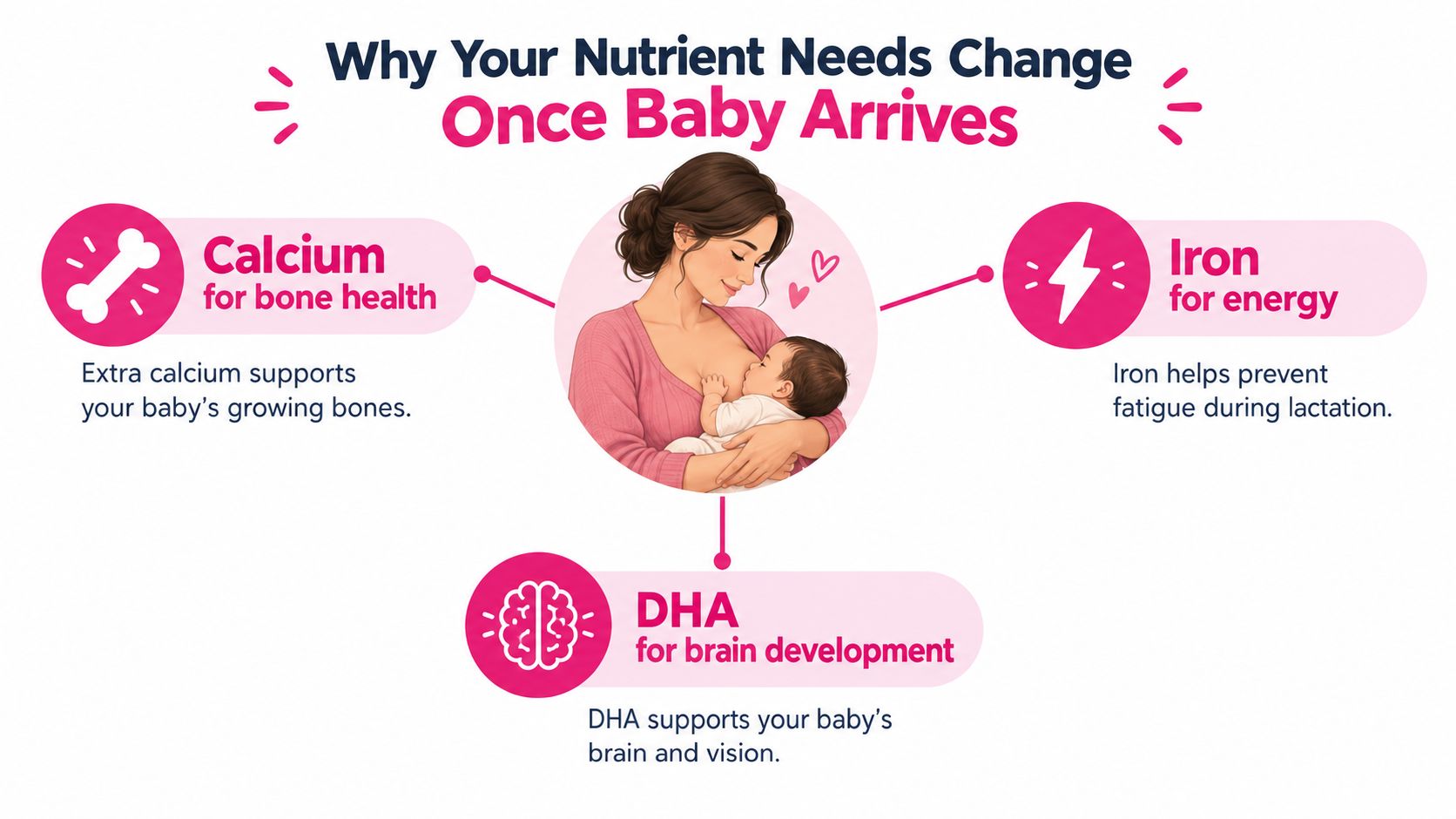
Think of a nutrition budget, not an unlimited pipeline
A household budget is a more useful analogy than imagining that everything you swallow passes straight into milk. You have your own nutritional needs, and producing milk adds another demand. That doesn't mean taking more of every nutrient improves your milk.
Keep these groups on your label-review list:
- B vitamins: Look for B12 and folate rather than assuming the word multivitamin guarantees an appropriate formulation.
- Vitamins A and D: Ask about both the amount and any separate products you already use.
- Iodine and choline: Compare your combined food and supplement intake with the lactation targets.
The CDC also notes that diet alone may not ensure adequate nutrition for every breastfeeding woman. Restricted diets, food access, nutritional status, and medical conditions can all affect the usefulness of a multivitamin.
For meal-planning support, these postpartum nutrients and food ideas can help you prepare questions for a dietitian.
If jaw discomfort complicates eating, Pain and Sleep Therapy Center's resource on vitamin absorption for TMJ patients is a related discussion to bring to your care team, not a replacement for breastfeeding-specific guidance. Tell your clinician about practical barriers to eating, not just what's printed on your supplement bottle.
The Five Nutrients That Matter Most While Breastfeeding
DHA, choline, iron, vitamin D, and B12 deserve a deliberate place in your supplement conversation. They aren't a complete nutrition checklist, and they don't all call for the same approach.
Some questions concern your everyday intake. Others depend on a diagnosis or belong to your baby's pediatric care. That's why a single dosage range for every breastfeeding mother would be misleading.
Key nutrients during breastfeeding at a glance
The food column below offers meal-planning prompts, not a calculation of how much you receive from a particular serving. Ask a dietitian to help translate your usual meals into an intake assessment.
| Nutrient | Why It Matters | Food Sources | Daily Target While Breastfeeding |
|---|---|---|---|
| DHA | A nutrient to discuss when reviewing dietary fats and lactation supplements | Discuss fish choices or an algae-based option with your clinician | Ask for an individualized recommendation |
| Choline | A nutrient with increased requirements during lactation | Consider eggs, soy foods, and other protein foods in your food review | Use the lactation target given above, counting food and supplements |
| Iron | Maternal treatment may be needed when anemia is diagnosed | Review meat, beans, lentils, and fortified-food choices | Base supplemental dosing on your clinical assessment |
| Vitamin D | Your intake and your infant's preventive care require separate decisions | Review fish and foods labeled as vitamin D fortified | Ask your clinician about your maternal intake |
| B12 | Maternal nutritional status matters when evaluating lactation nutrition | Review animal foods or specifically B12-fortified choices | Discuss intake and whether testing or targeted supplementation is appropriate |
Read the amount, not just the ingredient name
DHA may appear in a combined prenatal or a separate supplement. Record the actual amount on your bottle so your clinician can assess it rather than relying on a front-label mention.
For choline, compare the label with your food intake and the target already discussed. A product can contain choline without supplying your full daily requirement. That isn't automatically a flaw, because supplements are only part of your intake.
Iron deserves a more personal conversation. If you've been prescribed treatment for anemia, don't replace it with an ordinary multivitamin without checking. This guide to postpartum iron supplements can help you organize questions about the role of each product.
For vitamin D, keep your own supplement instructions separate from your baby's. Don't transfer an adult dose or product into an infant routine.
With B12, describe your actual diet rather than saying you eat well. If you avoid animal foods, bring photos of fortified-food labels and supplements so your clinician can review what you're receiving.
- Dosage check: Record the amount per serving and the serving size.
- Duplication check: Include stand-alone nutrients, not just your multivitamin.
- Purpose check: Ask whether each supplement fills a dietary gap or treats a documented problem.
You don't need the longest ingredient list. You need amounts that fit your circumstances and instructions you can follow.
Should You Keep Your Prenatal or Switch to a Postnatal
A familiar prenatal can be a reasonable starting point for review. A postnatal can also be worth considering. Neither label tells you, by itself, whether the formula fits your needs.
Use this comparison as a conversation starter rather than a verdict about which category is better.
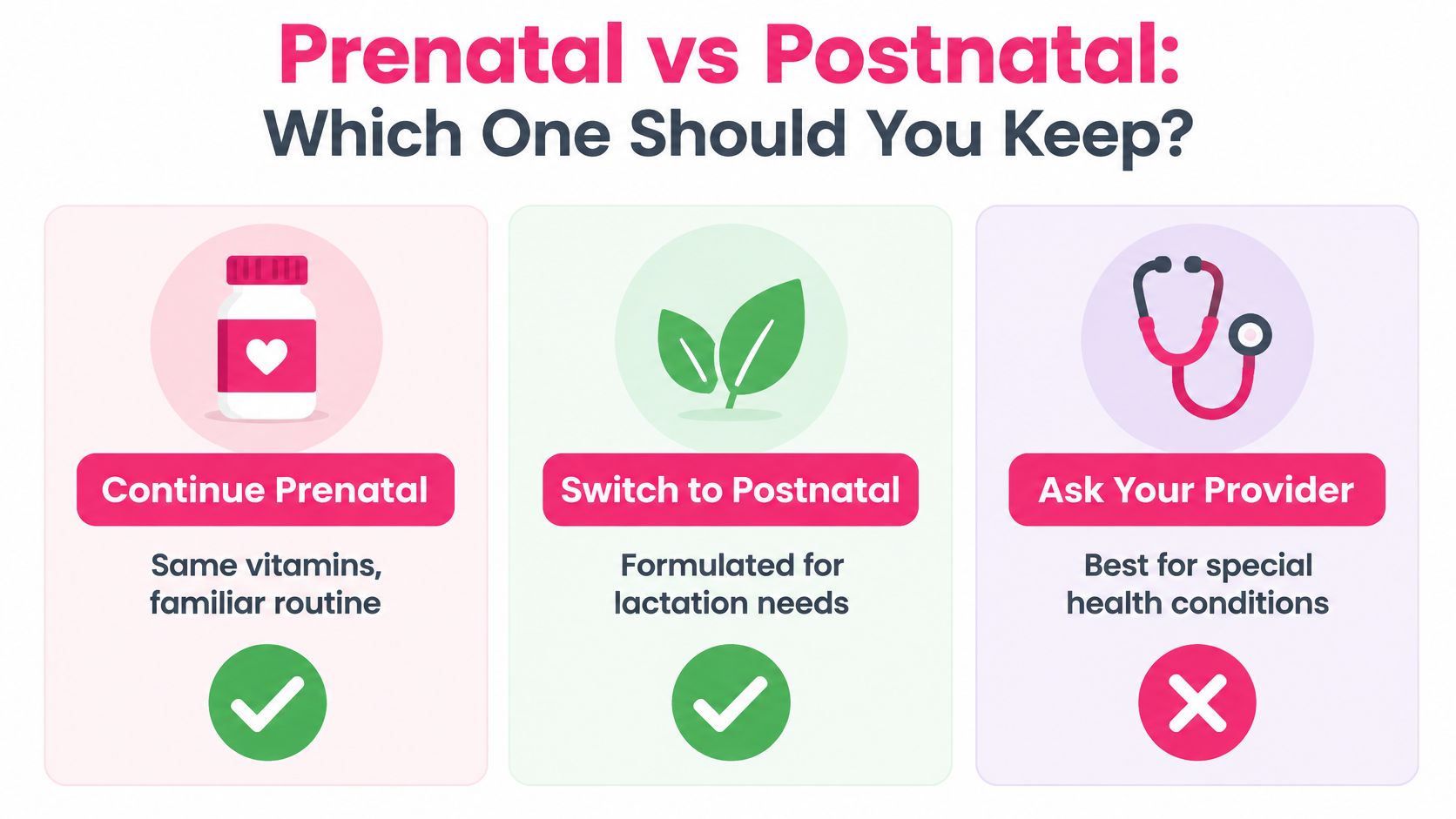
| Option | When to consider it | What to check |
|---|---|---|
| Continue your prenatal | You tolerate it and want to maintain a familiar routine | Whether its formulation still matches your current needs |
| Switch to a postnatal | You want to compare a different formulation | The actual ingredients and amounts, not the product category |
| Use targeted supplements | Your clinician identifies a specific gap or treatment need | Whether the addition duplicates anything you already take |
Pay particular attention to iron and vitamin A
Continuing a prenatal during breastfeeding isn't automatically harmful. NIH LactMed's information on oral iron during lactation reports that ordinary oral iron intake doesn't affect breast-milk iron concentration, and even higher therapeutic doses have minimal effects on milk iron when prescribed for maternal anemia.
That's reassuring, but it isn't a reason to take extra iron without a purpose. Your clinician should consider your anemia history, delivery blood loss, diet, and any relevant testing when reviewing the dose.
Vitamin A also calls for attention to dose and chemical form, particularly when a separate product supplies preformed retinol. Don't stack a prenatal with high-dose vitamin A or iron products without clinical justification.
Practical rule: Change supplements to solve an identified problem, not simply because your pregnancy has ended.
For example, if you tolerate your prenatal but a review identifies a particular dietary gap, the conversation may be about a targeted addition rather than replacing everything. If the existing formula no longer fits, switching may make more sense.
Bring the label to your postpartum appointment before buying a replacement. Ask your clinician to write down what to continue, what to stop, and what needs reassessment. That's much easier to follow than a general instruction to take a good vitamin.
When and How to Take Your Vitamins Without Upsetting Your Stomach
A supplement routine has to fit real life, including your stomach. If taking your vitamin feels unpleasant, tell your clinician or pharmacist rather than assuming discomfort is something you have to tolerate.
Keep the routine simple enough to repeat on a busy day.

Build around the label and your day
Start with the product's directions. If your prescription or pharmacist's instructions differ from general advice you've read online, ask for clarification before changing anything.
A practical checklist can make that conversation more specific:
- Ask about food: If taking the vitamin on an empty stomach feels unpleasant, ask whether you can take your particular product with a snack or meal.
- Choose a workable cue: Consider the meal you're most likely to remember rather than aiming for a theoretically perfect time.
- Check before splitting: Ask whether divided servings are appropriate. Don't crush, open, or alter capsules without checking.
- Describe the problem: Note whether you're dealing with nausea, difficulty swallowing, an unpleasant taste, or another concern.
- Discuss formulation: Ask whether a different capsule or product would fit better instead of adding more products yourself.
Delayed-release capsules, peppermint, and ginger may appear in products designed with tolerability in mind, but those features aren't a guarantee that a formula will suit you. Your experience matters.
These questions about prenatal-related nausea can help you prepare for a pharmacist or clinician conversation.
You can also watch this video and note any questions you'd like to discuss with your own care team.
If you've missed doses because the product bothers you, say so plainly. That information helps your clinician recommend a manageable routine, not an idealized one that leaves the bottle untouched.
What Your Prenatal Does and Does Not Do for Your Baby
Taking prenatal vitamins during breastfeeding doesn't mean your baby's supplement needs are automatically covered. This distinction matters even when you're consistent with your own routine.
The clearest example is vitamin D. The CDC recommends that breastfed infants receive 400 IU of vitamin D daily beginning shortly after birth, because breast milk typically doesn't provide enough on its own; confirm the product and instructions with your pediatrician.
Vitamin D supports healthy bone development and helps prevent rickets, a condition involving weak or deformed bones. Your prenatal shouldn't be treated as a substitute for your infant's recommended drops.
Keep a mother–infant decision map
Separate written instructions can prevent an understandable mix-up, especially when different caregivers handle medicines and feeding.
| Question | Your care team's role | Your baby's care team's role |
|---|---|---|
| Is my intake adequate? | Review your diet, supplements, and medical history | Consider whether your nutritional situation affects the infant's assessment |
| Does my baby need a direct supplement? | Share relevant maternal health information | Select the infant product, dose, and timing |
| Is testing needed? | Decide whether you need maternal testing | Decide whether your infant needs evaluation |
| Has feeding or health changed? | Reassess your plan when appropriate | Review the baby's plan separately |
The NIH-hosted review mentioned earlier discusses direct infant vitamin D, vitamin K, and B12 needs, with iron decisions depending on age, reserves, and clinical circumstances. These aren't instructions to buy a bundle of infant supplements. They're reasons to keep pediatric care separate from your prenatal routine.
Your own iron treatment also doesn't replace direct infant iron prevention or treatment when your baby needs it.
Your supplement supports your care. Your pediatrician determines your baby's supplement plan.
If you're exploring a DHA supplement while breastfeeding, bring that question into the maternal side of the discussion. Don't assume a maternal product changes any instruction your pediatrician has given.
Ask the pediatric office to show you exactly how to measure an infant product. Then keep those instructions with the bottle so anyone caring for your baby follows the same plan.
When to Check In With Your Clinician
You don't have to wait until you're certain there's a deficiency. A question about your diet, symptoms, or supplement label is enough reason to ask for help.
Use this checklist as a reminder to reach out, not as a way to diagnose yourself.
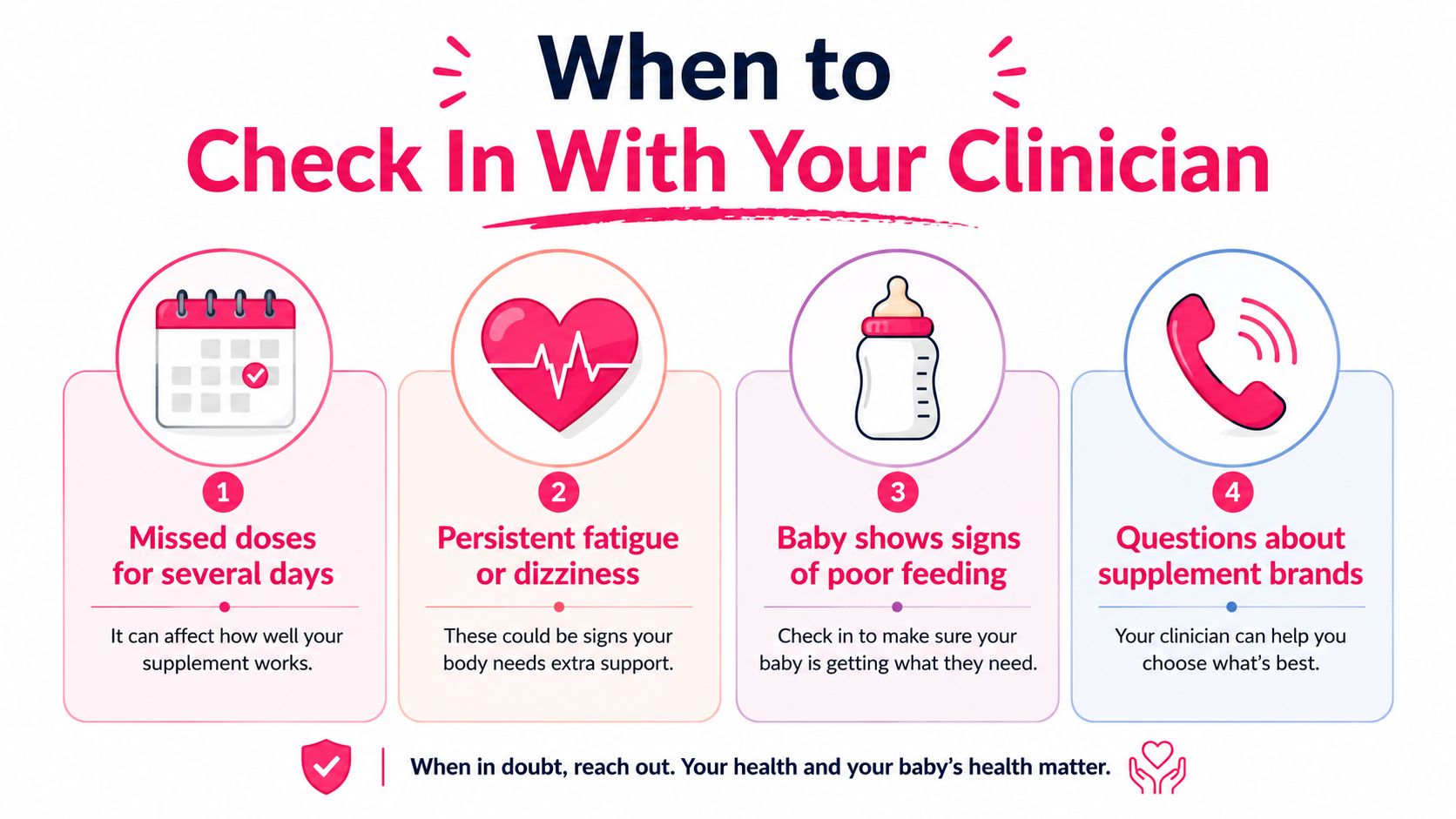
Bring your circumstances, not just your bottle
Ask for a personalized review if any of these apply:
- Anemia or delivery blood loss: Tell your clinician about previous treatment and any follow-up plan.
- Vegan or restricted eating: Describe what you avoid and which fortified foods or supplements you use.
- Limited food access: Ask for nutrition support that fits your budget and circumstances.
- Prematurity or exclusive breastfeeding: Make sure your pediatrician has given you clear infant-specific instructions.
- Persistent symptoms: Report fatigue, dizziness, hair changes, or mood changes without assuming a vitamin deficiency is the cause.
- Feeding concerns: Contact your baby's care team about poor feeding rather than trying to solve it by changing your prenatal.
For a dosing discussion, bring your bottle alongside these prenatal vitamin dose questions. Include all separate supplements so the clinician can review the whole routine.
Ask how long your plan should continue
There isn't a universal stopping date. A WHO and UNICEF technical document on maternal supplementation describes iron–folate supplementation for 6 months during pregnancy and an additional 3 months postpartum in settings where anemia prevalence is at least 40%.
That document also discusses supplementation through exclusive breastfeeding, generally about 6 months, and potentially the full breastfeeding period, described as up to 24 months, where feasible. Those are public-health strategies shaped by local circumstances, not instructions to take any prenatal formula for that entire period.
A useful closing question at your appointment is, “When should we review this again?” Ask what would change the plan, including changes in diet, feeding, symptoms, or test results.
A Gentle Plan for the Months Ahead
You don't need to turn postpartum nutrition into another full-time job. Start with a short note on your phone and make the plan clear enough that you won't have to reconstruct it during a tiring week.
The most useful plan connects each product to a purpose. It also leaves room for your clinician to adjust things as your circumstances change.
Make your next appointment easier
Prepare a small set of practical details:
- Photograph your labels: Capture the ingredients, amounts, and serving directions for everything you take.
- Describe a typical eating day: Include what's realistic right now, not the meals you wish you were making.
- Write down tolerability concerns: Be specific about what makes taking the product difficult.
- Keep infant instructions separate: Store the pediatrician's recommendations with your baby's care information.
- Request a review point: Know whom to contact and what changes should prompt another conversation.
You can ask your clinician for a written summary rather than relying on memory. A short list of products to continue, stop, or discuss further can be more useful than a long list of nutrients.
Let the plan be practical
If remembering your supplement is the sticking point, choose a routine cue. If cost or access is the problem, say that directly. If you're uncertain whether a product fits, ask someone qualified to review the label rather than trying to settle it through competing social-media advice.
Taking care of yourself belongs in postpartum care. It doesn't have to look polished, and it doesn't require buying every supplement marketed to new mothers.
Mama, you deserve the same thoughtful attention you're giving your baby. A clear, clinician-guided routine can help you move forward without treating every meal or missed capsule as a test you have to pass.
Feed Mom & Me offers prenatal supplements and accessible nutrition education from a women-owned team built by moms, for moms. Its Complete Prenatal Vitamin Plus DHA, containing DHA, choline, and methylfolate, is one option to discuss with your clinician when reviewing your breastfeeding routine. Visit Feed Mom & Me to explore the formulation and bring its label to your next appointment.