
Prenatal Vitamins with DHA and Choline: What to Look For
Published:Updated:
Most pregnant women fall short on choline, even when they're eating well and taking a prenatal every day. That's not a failure on your part, mama. It's often a label problem, because many prenatal vitamins with DHA and choline on the front contain only a little choline, or none at all, on the back.
You don't need to memorize biochemistry to choose well. You need three things: your daily targets, a rough picture of what you already eat, and a calm, two minute check of the Supplement Facts panel. Bring those three pieces to your provider, and you're making an informed decision instead of guessing from marketing language.
Table of Contents
- How Much DHA and Choline Do You Need Each Day?
- What Does DHA Do for You and Your Baby?
- What Does the Research Show About Choline and DHA?
- Are You Getting Enough Choline From Food?
- Which Safety Points Matter Most Before You Choose?
- How Do You Check a Label for DHA and Choline?
- What Changes While You Are Breastfeeding?
- Confirm Your Plan With Your Provider
How Much DHA and Choline Do You Need Each Day?
You don't need to carry these numbers in your head forever. You only need them long enough to check a label and start a useful conversation at your next visit.
Your Daily Targets at a Glance
| Nutrient | Pregnancy daily target | Lactation daily target | Source |
|---|---|---|---|
| Choline | 450 mg per day | 550 mg per day | NIH Office of Dietary Supplements |
| DHA plus EPA baseline | at least 250 mg per day | No lactation figure in this guidance, ask your provider | NIH Office of Dietary Supplements |
| Extra DHA during pregnancy | 100 to 200 mg per day | No lactation figure in this guidance, ask your provider | NIH Office of Dietary Supplements |
| Combined omega-3 target in pregnancy | at least 350 to 450 mg per day | No lactation figure in this guidance, ask your provider | NIH Office of Dietary Supplements |
The U.S. National Institutes of Health Office of Dietary Supplements pregnancy guidance recommends that women of childbearing age consume at least 250 mg per day of combined DHA and EPA from food or supplements, with an additional 100 to 200 mg of DHA per day during pregnancy. Put together, that's where the at least 350 to 450 mg per day combined target comes from. It's simple addition, not a separate rule to stack on top.
These are intake targets for healthy people, not doses to chase or double. If you're eating fish a few times a week, part of your total is already covered before a capsule enters the picture. If fish rarely makes it to your plate, that's useful information too, and our guide to foods rich in DHA can help you spot options you'd enjoy.
Three Steps You Can Take Today
- Write down your targets. Note 450 mg for choline and the 100 to 200 mg extra DHA range for pregnancy.
- Count your usual week. Tally how many fish, egg, and dairy servings you typically eat, without judgment.
- Bring both lists to your visit. Your provider can help you see whether food, a prenatal, or a mix of both closes the gap.
A target is a starting point for a conversation, not a grade on your pregnancy.
One honest gap in the table matters. This guidance summary gives no lactation DHA figure, so those cells stay open on purpose. That's a question for your provider rather than something to fill in with a guess, and asking it puts you ahead of most label shoppers.
What Does DHA Do for You and Your Baby?
Your baby's body works like a house under construction. DHA is part of the wiring and insulation going into the walls. It is a fat that becomes part of your baby's brain, retina, and nervous system, and it is built in steadily rather than all at once.

Much of that construction happens in the later stages of pregnancy, when your baby's brain and eyes are growing quickly. A steady daily intake across the whole pregnancy matters more than a big push in one week. Small, consistent amounts match the way your baby uses this nutrient.
What DHA Does for You
DHA is not only for your baby. It helps support your immune system and may support your mood during pregnancy and postpartum. It acts as a supporting nutrient, not a treatment. If you are struggling with low mood or signs of postpartum depression, talk with your provider right away. No supplement replaces that care.
Where DHA Comes From
Fatty fish are the richest food sources. Choosing lower-mercury options keeps the habit simple.
- Salmon: A familiar, versatile choice for regular meals.
- Sardines: Small fish, big DHA, and naturally low in mercury.
- Herring: Another oily fish with strong omega-3 content.
- Trout: A mild option if stronger tasting fish put you off.
Health guidance recommends regular servings of lower-mercury seafood during pregnancy rather than a strict weekly number to chase. The fish to limit or skip are the high-mercury ones: swordfish, shark, king mackerel, and tilefish. If you are comparing omega-3 products more broadly, this fish oil guidance for health-conscious adults comes from a supplement product page and covers forms and quality.
If you are vegetarian, or the smell of fish has been impossible since week six, algae-based DHA is an option. Algae are where fish get their DHA in the first place. A supplement may help fill the gap when fish is hard to fit in. Ask your clinician which DHA product and amount suit you, and read the Supplement Facts panel so the milligrams are clear before you buy.
What Does the Research Show About Choline and DHA?
DHA is the cargo, and phosphatidylcholine is the delivery truck that carries it out of your liver and into your bloodstream, where it can reach the placenta. Choline is a key material used to build that truck.
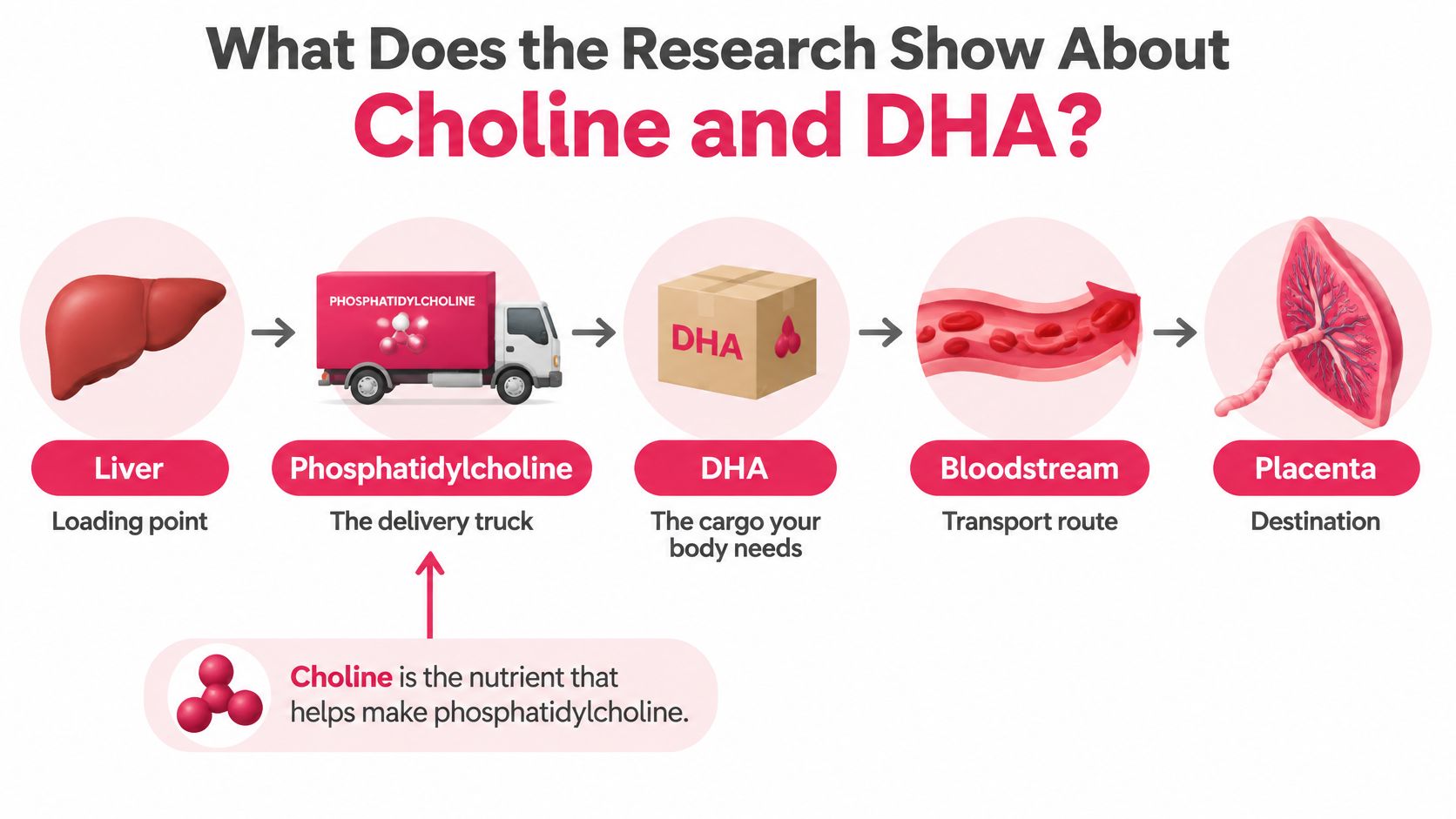
In plain terms, choline supplies methyl groups for a liver pathway called PEMT, which converts phosphatidylethanolamine into phosphatidylcholine. Without enough choline, your body may build fewer trucks, even if plenty of DHA cargo is sitting at the warehouse. That's why a prenatal with DHA but little or no choline may be an incomplete answer, especially when your diet is low in choline to begin with. It's also why the Supplement Facts panel deserves a close look before you buy. Many prenatals list little or no choline, so estimate what you already eat from eggs, meat, fish, dairy, and plant sources, then compare that with the amount on the label.
What One Small Trial Found
A randomized trial published through PubMed Central followed 30 pregnant participants, all of whom received 200 mg per day of DHA. The intervention group received 550 mg per day of supplemental choline from approximately gestational weeks 12 to 16 through delivery, while controls received 25 mg per day. Compared with control, choline supplementation increased plasma phosphatidylcholine-DHA by approximately 32 to 38% and red-blood-cell total DHA by 8 to 11% at late pregnancy and/or delivery.
Read those numbers with the caveat right beside them. These are biomarkers, meaning lab measures in blood, not proof of better infant brain development. One red-blood-cell phosphatidylcholine-DHA comparison wasn't statistically significant either. The trial tells us the delivery system responded, which is interesting, but it doesn't tell us the babies developed differently.
This short video walks through the nutrient partnership in visual form, which can help if the pathway names feel heavy.
What the Wider Evidence Says
A 2025 systematic review in Nutrition Reviews identified only four randomized trials and five observational studies, concluding that evidence was insufficient to confirm or refute improved child neurodevelopment from higher prenatal choline intake. Trials in that review used approximately 550 to 1,000 mg per day without adverse effects reported, but research doses aren't self-prescribing advice. Guidance commonly places adequate intake in the mid-hundreds of milligrams per day, and an adequate intake is a nutrition target, not a clinically proven treatment dose.
A labeled amount tells you what is in the capsule, not what it will do for your baby.
So choline is biologically important, and the honest evidence is still developing. Both things are true at once, and any product promising more certainty than that is overselling. The same habit of separating a plausible mechanism from proven outcomes applies whenever you read a health claim, whether the topic is prenatal nutrients or oral microbiome insights from Mouthology.
Carry three questions forward from here. How much choline am I already getting from food? How much does this product add? And what evidence supports taking more than that? If you can answer the first two and ask your provider the third, you're using the research exactly as you should.
Are You Getting Enough Choline From Food?
This number surprises almost everyone. The NIH Office of Dietary Supplements choline fact sheet reports that approximately 90% to 95% of pregnant women consume less than the recommended amount, against a target of 450 mg per day for pregnant teens and adults. If you're in that group, you're in very normal company.
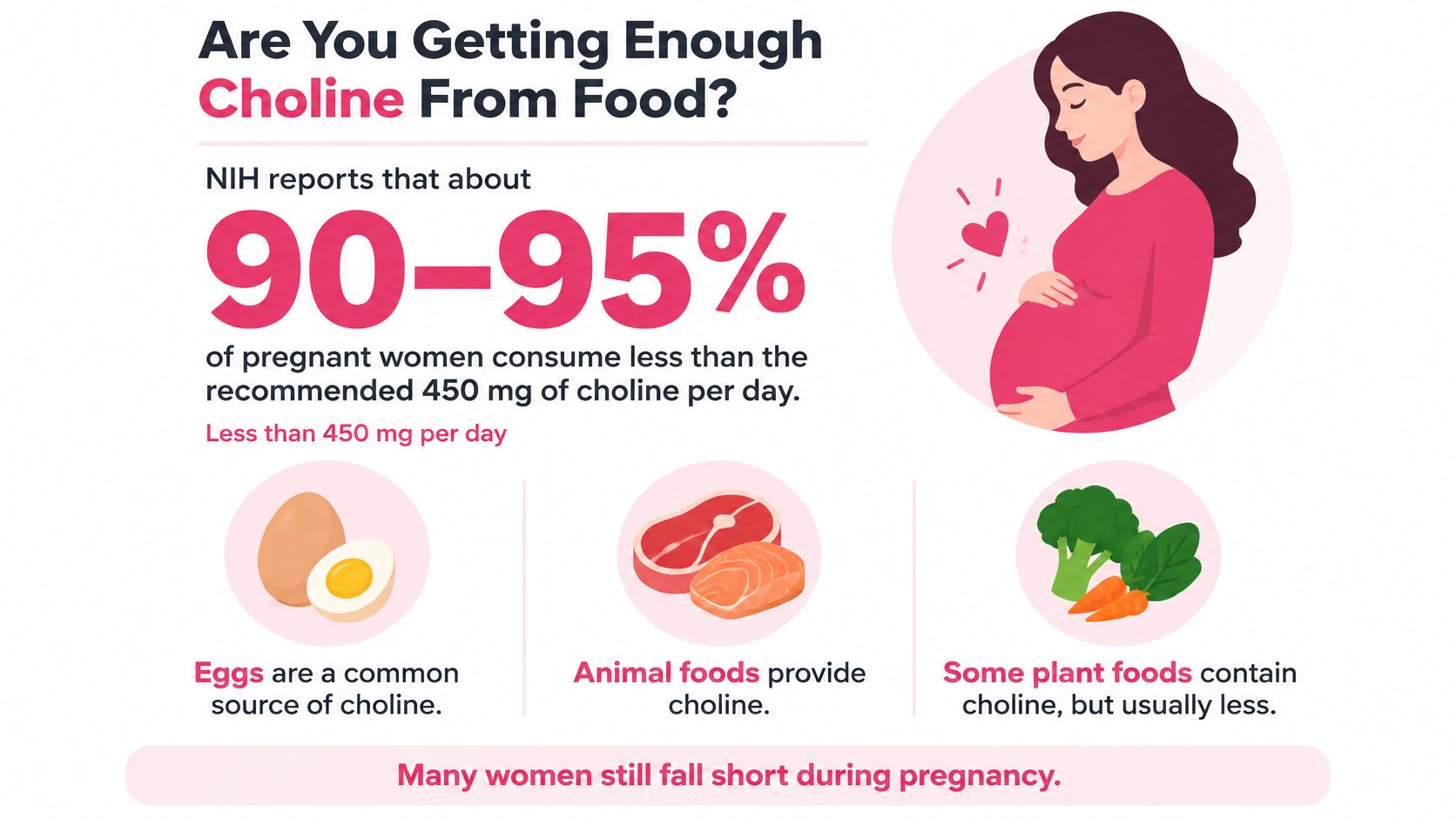
Choline helps support cell structure, nerve signaling, and the development of your baby's brain and nervous system. The tricky part is that it's concentrated in foods that are easy to skip on busy or nauseous days. Eggs are the benchmark many use, with roughly 145 mg in one large egg as a useful planning figure, and meat, poultry, fish, and dairy are also rich sources.
Plant Foods That Help You Build Intake
Plant sources generally provide less per serving, but they add up across a day.
- Potatoes: An easy, pregnancy friendly staple.
- Broccoli, Brussels sprouts, and cauliflower: Cruciferous vegetables that contribute steadily.
- Beans: Affordable and filling, with choline as a bonus.
- Nuts and seeds: Handy snacks when full meals feel hard.
- Whole grains: A background contributor in breads and cereals.
If you eat mostly plant based, or you avoid eggs or dairy, you'll likely need more deliberate planning. Our roundup of foods that support your baby's brain development can help you build meals that pull double duty.
A Four Step Self-Check
- List yesterday's meals. One honest day beats a perfect imagined week.
- Estimate your choline. Count eggs first, then animal foods, then vegetables and grains.
- Check your Supplement Facts panel. Look for choline listed in milligrams, not just named in a blend.
- Compare your total. Measure it against 450 mg, or 550 mg while breastfeeding.
Many prenatals contain little or no choline, so the label check is the only reliable way to know where you stand. Needs also vary with your diet, medical history, and nutrients like folate and vitamin B12. Bring your numbers to your provider before adding a standalone choline product, and you'll get advice matched to your actual intake.
Which Safety Points Matter Most Before You Choose?
Safety talk can sound scary, so let's frame it calmly. A target is a guide for adequacy, not a ceiling you should chase, and more isn't automatically better.
The NIH omega-3 fatty acids fact sheet cites a clinical practice guideline reporting that intakes up to 1,000 mg per day of DHA or DHA plus EPA do not raise safety concerns for pregnant women. That same summary puts the everyday guidance at at least 250 mg per day of DHA plus EPA, with an additional 100 to 200 mg per day of DHA during pregnancy. The space between those figures is room for clinical judgment, not an invitation to max out.
Situations to Raise With Your Clinician
- Medications that affect bleeding: Fish oil can matter here, so mention every product you take.
- A high-risk pregnancy: Your dose decisions deserve individualized input.
- Fish oil from several sources: A prenatal plus a separate omega-3 plus fortified foods can stack up.
- A change in your health: New prescriptions or symptoms are a reason to recheck your routine.
Choline Stacking Deserves a Look Too
Choline adds up from more places than people realize. Eggs, fortified foods, lecithin in processed foods or supplements, and postpartum products can all contribute on the same day. Total your sources first, then decide with your provider whether a standalone choline product makes sense. Folate choices sit in the same conversation, and this overview of folic acid during pregnancy is useful background before that appointment.
Comfort counts: A prenatal only works if you can actually take it every day.
Iron is the usual culprit when a prenatal causes nausea or constipation. Approaches worth discussing include delayed-release capsules, taking your dose with food, or splitting doses across the day. We use delayed release vegetable capsules partly for this reason, since a gentler routine is one you'll keep. Don't stop a supplement because it upsets your stomach, since your provider often has a simple fix.
Allergen and diet fit are simpler than they sound. Read the panel for soy, dairy, and gluten statements, check whether the capsule is gelatin or vegetable based, and look for artificial colors if you prefer to avoid them. Our own formula is free of artificial colors and flavors, chemicals, preservatives, dairy, and gluten, and it's gelatin-free as well. Third-party testing is a helpful quality signal, and you can read about how third-party testing works before you buy. Each batch of our prenatal vitamins is tested for identity, purity, strength, and composition, but even strong testing never replaces your provider's review of the full label.
How Do You Check a Label for DHA and Choline?
A label looks dense, but you can run this check in about two minutes once you know the order. Treat the table below as your checklist, and work from top to bottom.
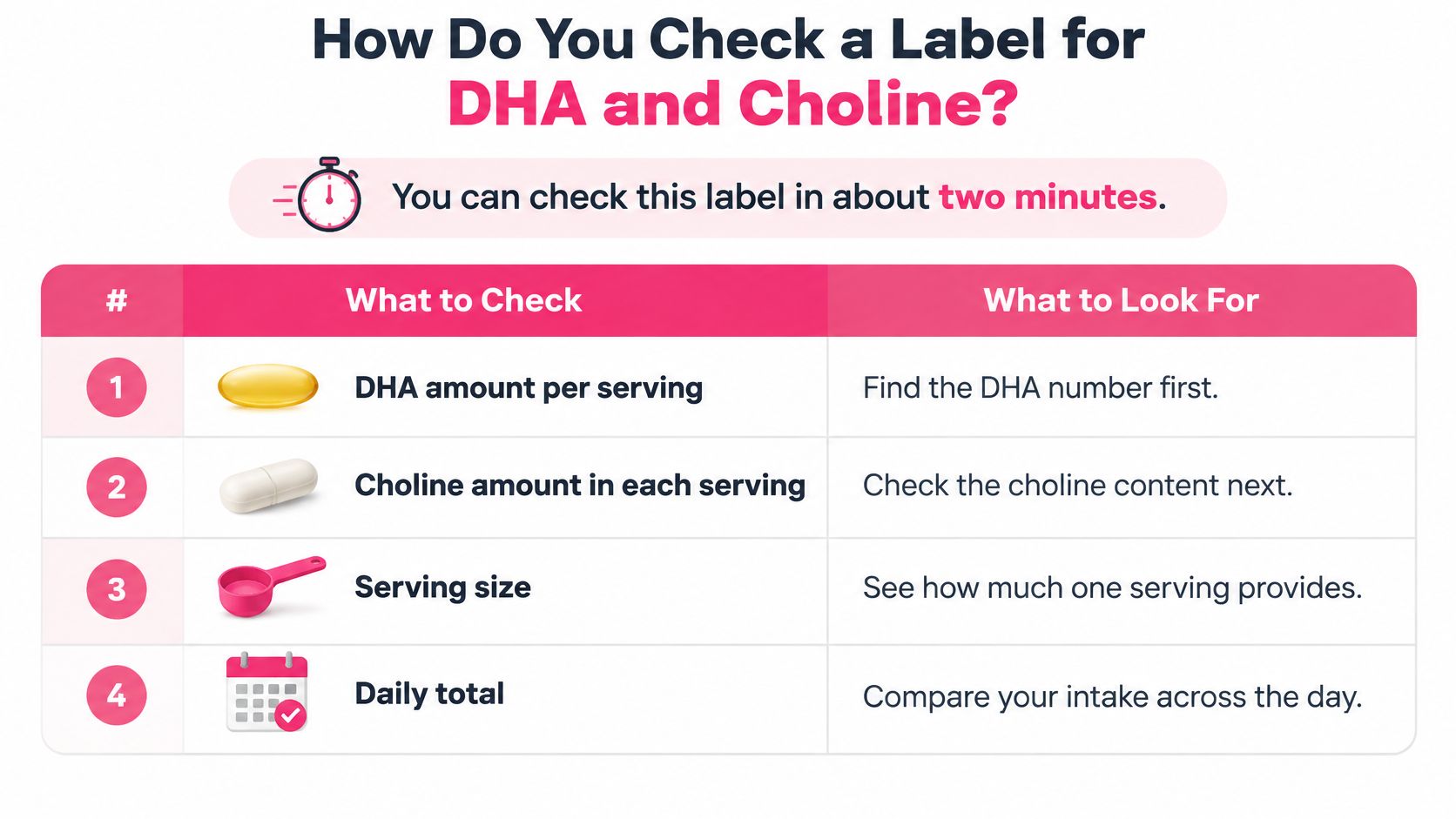
| Label item | What to look for | Why it matters |
|---|---|---|
| DHA amount | Milligrams per serving on the Supplement Facts panel | Shows how far the product sits from the 100 to 200 mg pregnancy add-on |
| Choline amount | Milligrams of choline per serving | Many prenatals list little or none, and the pregnancy target is 450 mg |
| Folate form | Folic acid or L-methylfolate (L-5-MTHF) | The form affects how folate is used, so discuss your preference with your provider |
| Iron | Milligrams per serving and the iron form | Iron can cause nausea or constipation, and the form affects tolerability |
| Capsule type | Vegetable or gelatin, standard or delayed release | Matters if you avoid gelatin or have stomach sensitivity |
| Allergen and diet statements | Soy-free, dairy-free, gluten-free, vegetarian | Check against your restrictions before buying |
| Testing and manufacturing | Third-party testing or FDA-registered facility statements | Signals independent checks, but does not replace provider review |
| Serving size | Number of capsules per daily dose | Confirms whether the listed amounts apply to the full day |
One row deserves a plain language note. Folic acid is the synthetic form of folate, while L-methylfolate (L-5-MTHF) is the active form your body uses directly. Some people prefer the active form, and your provider can tell you whether it matters for you personally. Neither choice makes you a better or worse mama.
A Five Step Decision Sequence
- Confirm both nutrients appear. DHA and choline should both be on the Supplement Facts panel with amounts.
- Add the label to your food estimate. Use the self-check numbers you already worked out.
- Compare the day's total with your targets. Look at the whole day, not the capsule alone.
- Check form, capsule, and allergen fit. Match the product to your body and your restrictions.
- Shortlist two products. Review both with your provider before you commit.
If you want a broader walkthrough beyond these two nutrients, our guide on how to choose a prenatal vitamin covers the full decision. A product with DHA but no choline is a partial fit, and any gap is best filled through food or a separate product only after review. One product rarely covers every target alone, and that's normal, because the whole day matters more than a single label.
What Changes While You Are Breastfeeding?
If you're reading this with a baby on your chest, welcome to the next chapter, mama. Your choline target rises to 550 mg per day while breastfeeding, so a prenatal that contained little choline may leave a gap that matters more now than it did before.
DHA needs a different kind of answer. The NIH guidance summary used for the pregnancy targets gives no lactation DHA figure, so ask your provider whether your breastfeeding intake needs a separate DHA target. Compare that advice with your current fish intake, and you'll know whether food alone is carrying the load.
A Practical Food Plan for Busy Days
- Eggs and animal foods: Your most choline dense options, useful at any meal.
- Salmon, sardines, and trout: Lower mercury fish that supply DHA.
- Potatoes, beans, broccoli, and whole grains: Plant sources that build choline intake across the day.
Postpartum routines are beautifully chaotic, so pair your eating with a habit you already have. Eggs with the morning feed, a bean soup reheated at lunch, or salmon on the nights someone else cooks all count. Our guide to prenatal vitamins during breastfeeding goes deeper on what carries over after delivery.
A postpartum or breastfeeding supplement is a separate decision from your prenatal, not an automatic continuation. Your needs, medications, and recovery picture may have changed since delivery, so review the switch with your clinician. Feeding your baby is an act of care, and feeding yourself well is part of it. You don't have to solve every target in one week.
Confirm Your Plan With Your Provider
Gather four things before your next appointment: your estimated food intake, the Supplement Facts panel from any product you're considering, your current medications, and your diet restrictions. Ask your OB, midwife, or dietitian to check your daily total against your targets and shape a plan around your body and your history.
Questions Worth Bringing
- Is my choline total adequate for pregnancy or breastfeeding?
- Is my DHA add-on covered by food, a product, or a mix of both?
- Does my folate form matter for me personally?
- Should we review iron tolerability or how I take my dose?
One option to include in that conversation is our Feed Mom & Me Complete Prenatal Vitamin Plus DHA, from a women-founded, mom-built brand. It contains choline and L-methylfolate alongside its other key nutrients, and it uses L-Methylfolate Calcium instead of synthetic folic acid. It provides 50 mg of DHA per serving, so compare that listed amount with the 100 to 200 mg pregnancy add-on and review your full day, including food, with your provider.
You're doing a wonderful job, mama. One informed conversation at a time is enough.
Visit Feed Mom & Me to explore our Complete Prenatal Vitamin Plus DHA, with choline and L-methylfolate in a delayed release vegetable capsule made for real pregnancy routines. Read the label alongside your food estimates, bring your questions to your provider, and choose the plan that fits you and your baby.