
Vegan Prenatal Vitamins Whole Foods: A Label Guide
Published:Updated:
A "whole-food" or "vegan" label can sound like a complete answer, but neither tells you whether a prenatal contains the nutrients and forms you need. For a vegan pregnancy, the more useful question is what's really in the serving you'll take each day. A vegan diet can support a healthy pregnancy, and a carefully chosen supplement can help cover gaps without replacing nourishing meals.
Table of Contents
- Which Nutrients Need the Closest Look in a Vegan Pregnancy
- Why Whole Foods Alone Often Fall Short in Pregnancy
- Why Folate and B12 Need a Reliable Source
- Where Your DHA Comes From When You Skip Fish
- How to Read a Vegan Prenatal Label Line by Line
- Tolerability and Allergens Matter as Much as Amounts
- Confirm Your Vegan Prenatal Plan With Your Provider
Which Nutrients Need the Closest Look in a Vegan Pregnancy
A vegan pregnancy can be nutritionally sound. The practical first step is to check a short list of nutrients, then compare your food routine and supplement label with the amounts below.
| Nutrient | Pregnancy target | Main vegan sources | What to check on the label |
|---|---|---|---|
| Folate | 600 mcg DFE per day | Beans, lentils, leafy greens, fortified grains | Amount and form: folic acid or methylfolate |
| Choline | 450 mg per day | Soybeans, beans, nuts, cruciferous vegetables | Whether choline is listed and how much |
| Iodine | 220 mcg per day | Iodized salt, fortified foods, seaweed | Amount per serving; Irish guidance advises 120–150 mcg in a vegan multivitamin |
| Iron | 27 mg per day | Lentils, tofu, pumpkin seeds, fortified cereals | Elemental iron amount and form |
| Vitamin B12 | 2.6 mcg per day | Fortified plant milks, fortified cereals, nutritional yeast | Dose per serving and that it's listed clearly |
| DHA | 100–200 mg per day during pregnancy | Algae-derived DHA only | DHA listed by name, not just omega-3 |
| Vitamin D | 600 IU per day | Fortified plant milks, sunlight | Amount per serving |
| Calcium | 1,000 mg per day | Calcium-set tofu, fortified soy milk, kale, almonds | Amount per serving; often too bulky to fit in a prenatal |
| Zinc | 11 mg per day | Chickpeas, hemp seeds, cashews, oats | Amount; high doses can compete with iron absorption |
Think of the table as a set of questions, not a scorecard. The target is a reference point, not proof that you personally need every nutrient in a separate pill. Your clinician may recommend a different plan based on your health, food intake, lab results, and the other supplements you take.
A few label terms deserve a closer look. DFE, or dietary folate equivalents, helps account for differences between folate in food and folic acid in supplements. For iron, look for the amount of elemental iron, the amount of iron available from the listed compound. For DHA, check that the label names DHA and identifies algae as its source. A general “omega-3 blend” doesn't tell you how much DHA the product provides.
Use this as a checklist while you read the rest of the label. A product's vegan badge can tell you something about ingredients, but it can't replace checking each nutrient and dose.
Why Whole Foods Alone Often Fall Short in Pregnancy
Think of your meals as deposits into a savings account, mama, and a prenatal as an automatic transfer for the nutrients you may not get reliably on a busy Tuesday. Food remains the foundation; the supplement helps make the plan more consistent. Even thoughtful meals can be uneven from day to day, and some nutrients take deliberate planning to include.
U.S. guidance sets the pregnancy adequate intake for choline at 450 mg per day, compared with 425 mg per day for nonpregnant women, and notes that most pregnant women don't reach the recommended amount. Iodine needs rise to 220 mcg per day during pregnancy. Among U.S. pregnant women, median iodine intake from food was 216 mcg per day. Including supplements, the median was 235 mcg, yet 10.2% still consumed less than the estimated average requirement, according to the NIH Office of Dietary Supplements' pregnancy guidance.
Iodine illustrates why meal planning alone can be hard to predict. Its presence in your diet depends on whether you use iodized salt, which fortified foods you choose, and whether you eat seaweed. Choline-rich foods such as soybeans, beans, some nuts, and cruciferous vegetables can contribute, too, but a label check helps you see whether a supplement adds any.
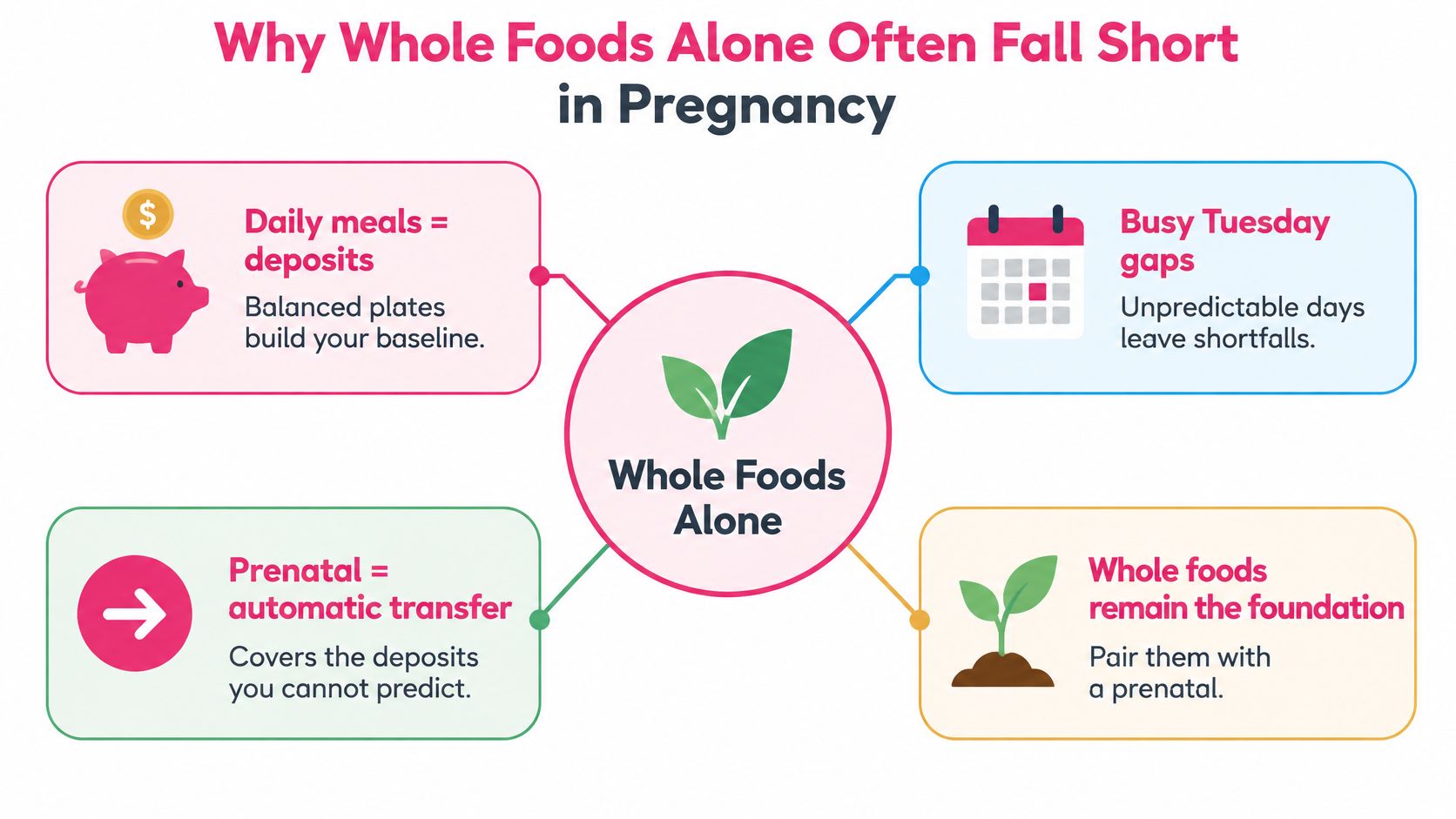
“Whole food” describes a style of eating or how ingredients are sourced. It doesn't guarantee that a meal or product contains every nutrient you need. A bowl of lentils, greens, and seeds can be an excellent meal while still leaving questions about B12, iodine, or DHA.
A 2023 Vegetarian Resource Group article reported that more than 70% of pregnant and lactating people in the United States use at least one dietary supplement, most commonly a prenatal supplement, according to its article on prenatal supplements. For ideas on building meals alongside a supplement routine, see this guide to vegetarian eating during pregnancy. The goal isn't to replace meals with capsules. Pair a varied diet with a verified supplement, then discuss any special needs with your obstetric clinician or registered dietitian.
Why Folate and B12 Need a Reliable Source
A vegan badge does not tell you whether a prenatal provides dependable amounts of folate and B12. Check the nutrient lines and forms: whole foods can contribute folate, but many pregnant people do not get enough from food alone to meet the recommended intake.
Folate supports the body's production of DNA and other genetic material. The recommended intake rises from 400 mcg DFE per day for nonpregnant women to 600 mcg DFE per day during pregnancy. For people who could become pregnant, the CDC recommends 400 mcg of folic acid daily. The CDC's information on neural-tube defects explains this recommendation. Folic acid is the form specifically shown to reduce neural-tube defects, which develop very early in pregnancy, so a reliable source matters before pregnancy is known as well as during it.

Build a steady folate and B12 routine
Folate-rich foods make a useful foundation. Add beans or lentils to soups, salads, and grain bowls; work leafy greens such as spinach or kale into meals; and check whether fortified grains list added folic acid. These foods support a varied diet, while the prenatal label helps you see what additional folate it provides.
Labels may list folate as DFE, folic acid, or methylfolate, also called L-5-MTHF. Those terms describe different forms or ways of expressing folate, so check both the amount and the form. A clinician or dietitian can help interpret them for your situation, especially if you have a history of neural-tube defects, take certain medications, or have a condition that affects absorption.
B12 needs a dependable source of its own. Unfortified plant foods don't reliably supply vitamin B12, so look for a clearly stated amount in your prenatal or another source. Fortified plant milks, breakfast cereals, and nutritional yeast may contribute, but amounts vary by product. This guide to vitamin B12 during pregnancy explains why people following a vegan diet may need to discuss B12 supplementation with a provider.
Ask your clinician about unusual fatigue, numbness or tingling, balance changes, or a sore tongue rather than trying to identify the cause yourself. These symptoms can have many explanations. A consistent routine starts with a clearly labeled source, taken regularly, and a conversation with your clinician about whether testing is appropriate.
Where Your DHA Comes From When You Skip Fish
DHA is a long-chain omega-3 fat found in the brain and retina. It contributes to development, and levels build most rapidly in the third trimester. Seafood is one source, while algae-derived DHA offers a fish-free option for vegan pregnancies.
The NIH Office of Dietary Supplements' omega-3 guidance summarizes guidance of at least 250 mg per day of DHA plus EPA for women of childbearing age, with an additional 100–200 mg per day of DHA during pregnancy. It also cites 600–1,000 mg per day for pregnant women with low DHA intake or status, starting in the second trimester and no later than 20 weeks. That higher range is not a general self-directed dose. Ask your clinician whether it applies to you, especially if your DHA intake is low or you have a history of preterm birth.
Seafood-intake guidance applies to people who eat fish; it does not directly address a vegan diet. A commercial roundup of fish oil guidance for Canadian gym-goers covers a different audience, so it is not a basis for choosing a vegan prenatal. For a plant-based option, this overview of an algae-based DHA supplement explains the source. Check that your own label states the DHA amount and identifies its source.
Chia seeds, flaxseed, hemp hearts, and walnuts provide ALA, another omega-3 fat. The body converts only a limited amount of ALA into DHA, so these foods do not replace a direct DHA source. Include them as nutritious foods, but keep the distinction clear: ALA on a food label is not the same as DHA in milligrams on a supplement label.
Label rule: Look for DHA listed in milligrams and confirm that it's algae-derived. “Omega-3” alone doesn't show how much DHA the product provides.
How to Read a Vegan Prenatal Label Line by Line
A vegan badge tells you what a product leaves out, not whether its nutrient amounts and forms fit your needs. Check the label itself, then confirm your plan with your clinician. Irish public-health guidance advises vegan pregnant people to look for 120–150 mcg of iodine in a pregnancy multivitamin and recommends daily B12 supplementation. Its Health Service Executive guidance for vegetarian and vegan diets in pregnancy also recommends an individualized review of nutrients.
Keep the bottle nearby and follow the label from serving size to ingredients:
- Find the serving size. Check servings per container and whether the listed amounts apply to one capsule or the full daily serving.
- Check folate. Compare the amount with your pregnancy plan, and note whether it is listed as folic acid or methylfolate (L-5-MTHF).
- Review iodine. Check the amount per serving and consider other dietary sources, such as iodized salt and fortified foods.
- Look for B12. Confirm that the label lists B12 clearly and shows its amount for the serving you take.
- Verify DHA. Look for DHA by name, an amount in milligrams, and an algae source. A general omega-3 blend doesn't show how much DHA it provides.
- Compare other nutrients. Check choline, iron, zinc, vitamin D, and calcium against the targets that apply to you.
- Read ingredients and allergy statements. Check the capsule material, vegan or vegetarian wording, allergens, and any “may contain” or facility notice.
- Add up your routine. Include the prenatal, fortified foods, and separate supplements so you and your clinician can spot accidental duplication.
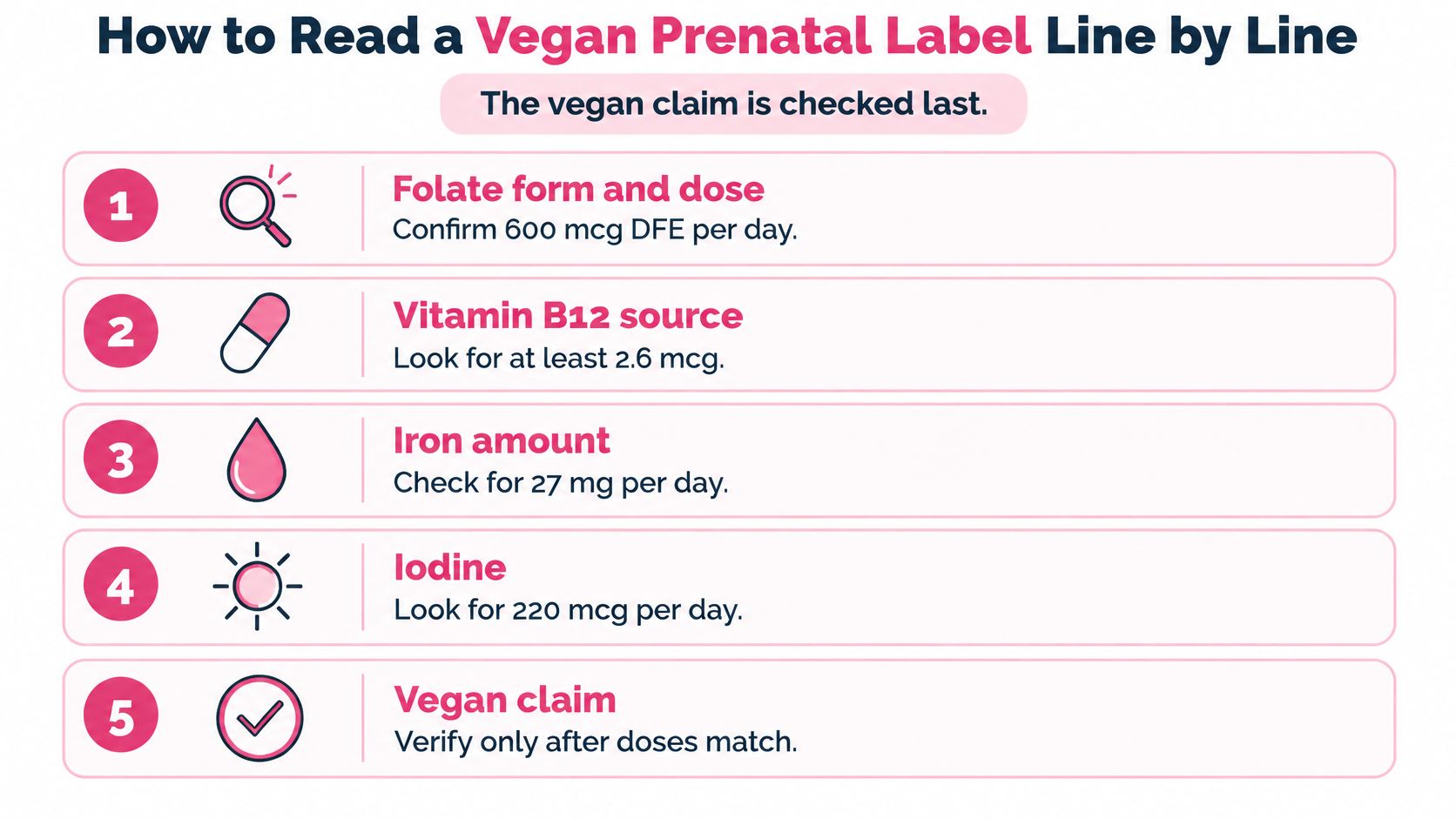
Here's a worked example. A label lists 600 mcg DFE of folate and 150 mcg of iodine, but describes DHA only as part of an omega-3 blend. The folate amount is clear, and the iodine falls within the range Irish guidance advises for vegan pregnancy. The DHA amount remains unknown. Ask the manufacturer how much DHA the serving contains and where it comes from, or bring the label to your clinician.
A label can list methylfolate or DHA and still leave questions about iodine, choline, iron, B12, calcium, vitamin D, or tolerability. Irish guidance also recommends that providers assess whether each person needs supplementation with iron, B12, choline, zinc, iodine, or EPA/DHA. For questions about manufacturing and testing, read this explanation of third-party supplement testing. To compare regional advice, Venus Health's Australian prenatal vitamin guide offers another perspective. Your clinician can help apply guidance to your circumstances.
Tolerability and Allergens Matter as Much as Amounts
A prenatal can have a thoughtful nutrient panel and still be a poor fit if nausea or discomfort makes it hard to take consistently. The practical question isn't only what the product contains, but whether its capsule, flavor, and ingredients work for you.
Delayed-release vegetable capsules are designed to be easier on the stomach. Peppermint or ginger flavoring may make a supplement more palatable, but ask your clinician about ginger, since the form and amount matter. If nausea is interfering with your routine, these ideas for managing nausea from prenatal vitamins can help you prepare questions for your care team.
Iron can cause constipation or stomach upset for some people. If your clinician agrees, taking it with food may be more comfortable. Calcium can interfere with iron absorption when taken together, so ask whether you should separate them by a few hours. Don't reduce or stop prescribed iron without discussing it with your clinician.
Next, check the physical capsule and the full ingredient list. A vegetable capsule is different from a gelatin capsule, and “soy-free,” “gluten-free,” or “dairy-free” claims should match the ingredients and any allergen statements. Read “may contain” and facility notes carefully if you have a severe allergy, because cross-contact can matter even when an allergen isn't an intentional ingredient.
Before you settle on a product, ask yourself:
- Allergens: Does the label name every allergen I avoid?
- Capsule: Does the capsule type suit my stomach and dietary needs?
- Flavor: Does the flavor make it easier or harder to take?
- Iron: Does the iron dose feel comfortable alongside my diet and clinician's advice?
Confirm Your Vegan Prenatal Plan With Your Provider
A vegan label alone cannot tell you whether a prenatal fits your needs. Compare the amounts and forms on the label with your typical meals and health history, then bring specific questions to your clinician.
| Option | What it covers | Best fit | Question for your clinician |
|---|---|---|---|
| Whole foods only | Many nutrients from meals; B12, DHA, and iodine may be harder to obtain | A plan reviewed with your clinician, rather than one assumed to cover every need | Do I need blood tests or a separate B12 source? |
| Vegan prenatal alone | May provide folate, choline, iodine, iron, and B12; DHA amounts vary by product | Someone whose clinician agrees the label fits their diet and needs | Does this label address the gaps in my typical diet? |
| Vegan prenatal plus algae DHA | Adds DHA to the amount in the prenatal | Low DHA intake or a history of preterm birth | Is a daily DHA range of 600–1,000 mg appropriate for me? |
| Prenatal plus fortified foods and separate B12 | Lets you manage sources and amounts separately, with a risk of doubling nutrients | A plan guided by your clinician and testing | Am I getting the same nutrient from more than one source? |
A reliable B12 source is a common part of vegan pregnancy planning. In an Irish-guidance context, most surveyed healthcare professionals recommended B12 for vegan pregnancies. The PubMed-indexed study reports survey findings, but they do not set your personal dose. Your clinician can help decide whether your diet, supplement, and any testing point to a different plan.
Bring the prenatal bottle or a clear photo of its Supplement Facts panel. A few days of food notes can show your provider what you regularly get from meals, making it easier to compare food sources with the amounts in your supplement.
Make the appointment useful: Ask how to assess iodine, DHA, and B12, including whether testing or supplementation makes sense for you. Review the amounts in your prenatal, fortified foods, and separate supplements together so you can spot overlap.
Feed Mom & Me offers a vegetarian prenatal formula with DHA, choline, selenium, and methylfolate (L-5-MTHF). Its delayed-release vegetable capsules include peppermint and organic ginger, and the formula is soy-free, gluten-free, and dairy-free. Bring its product information to your appointment and ask whether the nutrients, amounts, and forms match your individual plan.

Your needs may change during pregnancy and postpartum, so revisit the plan with your provider rather than treating it as a one-time decision. Consult your healthcare provider for personalized advice, especially if you have thyroid disease, anemia, absorption concerns, a previous deficiency, or take other supplements.
If you want a product to compare with your whole-food routine, review Feed Mom & Me's label alongside your nutrient checklist. Then discuss with your healthcare provider whether it fits your plan.