
Vegetable Capsules vs Gelatin Capsules for Moms
Published:Updated:
Your prenatal bottle is on the counter again, and you're doing what you do most nights now: turning it over to read the small print. Somewhere between the folate percentage and the DHA dose, a line catches your eye. Vegetable capsule. Or maybe gelatin capsule, on the bottle you almost bought instead. Both promise what you and your baby need. Only one fits how you eat, and neither tells you on its own whether the vitamins inside are worth taking.
Here's the idea that settles a lot of that worry. The shell is the envelope, and the vitamins are the letter. The envelope decides how well the letter is protected and whether you're willing to open it. It doesn't rewrite the words inside.
So the useful question isn't which shell wins. It's which shell fits your diet, your stomach, and the nutrients in the fill. Vegetable capsules vs gelatin capsules comes down to four things worth checking on any label: where the shell comes from, how it handles moisture, how and when it opens, and what else sits in the formula besides the shell.
Table of Contents
- How Do Vegetable Capsules vs Gelatin Capsules Compare
- Does the Shell Change What Your Body Absorbs
- Which Capsule Handles Moisture Better in a Prenatal
- Can Either Shell Give You Delayed Release
- Will Either Shell Feel Easier on Your Stomach
- Which Capsule Fits Your Diet During Pregnancy
- How Do You Pick a Capsule for Your Prenatal
How Do Vegetable Capsules vs Gelatin Capsules Compare
Here's the short answer before the weeds. Reach for a vegetable HPMC capsule when you want a plant-based shell and a drier one for moisture-sensitive powders. Keep gelatin in your decision when the fill is oxygen-sensitive, or when the product is an oil softgel, which is built differently from a two-piece hard capsule. Neither shell writes a better vitamin.
Think about what the envelope does. It keeps the letter dry, keeps it from getting crushed, and decides who is willing to open it. A prenatal in a vegetable shell and the same prenatal in a gelatin shell are still the same prenatal, as long as the maker tests the finished product.
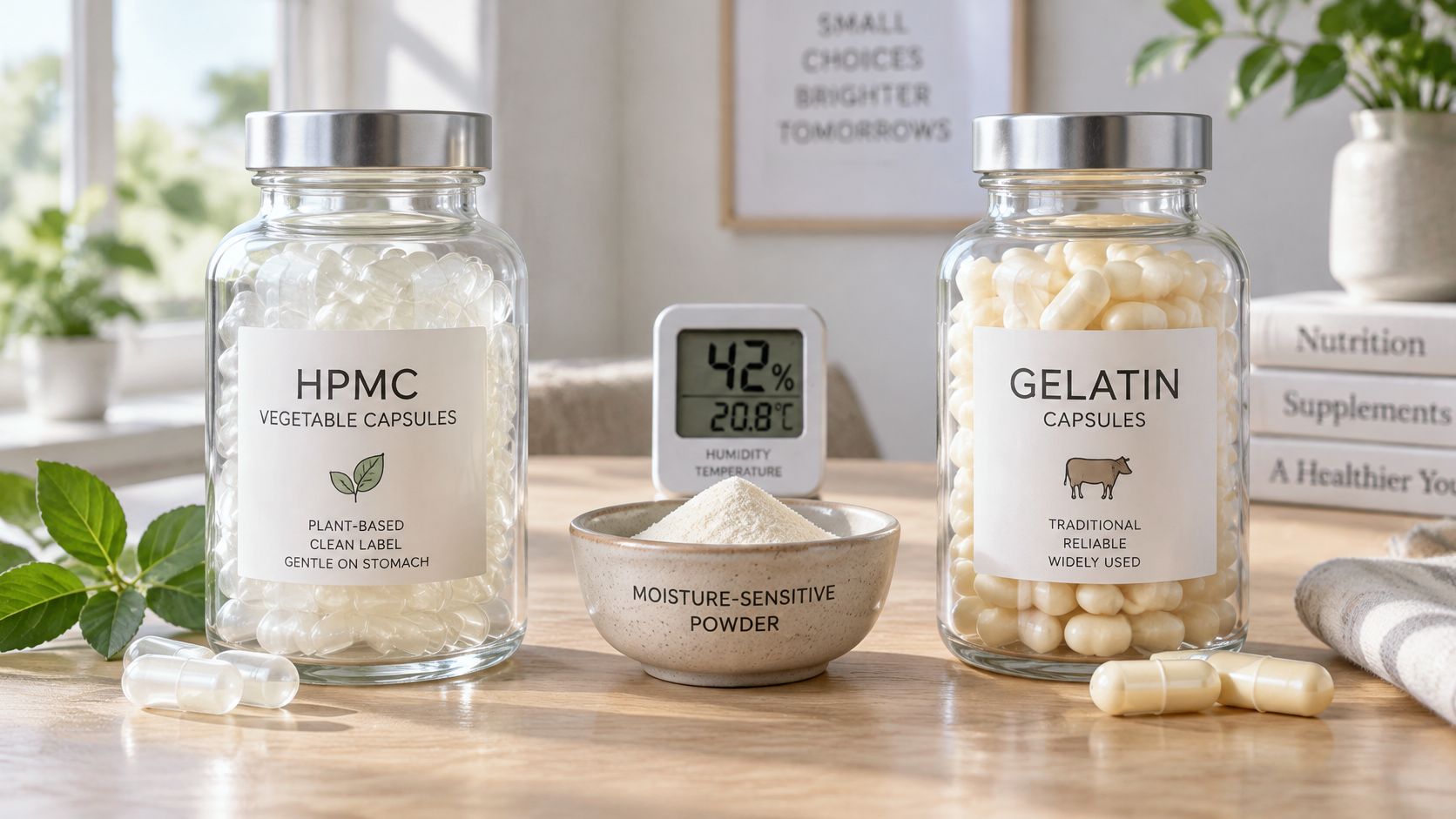
What each shell is made of
Gelatin is processed animal collagen, most often bovine or porcine. HPMC, short for hydroxypropyl methylcellulose, is plant cellulose that's chemically modified so it can be molded into a two-piece shell. That single difference drives nearly every row in the table below, from diet fit to how each shell behaves in a warm bathroom cabinet.
The history matters more than you'd expect. The hard gelatin capsule goes back to 1834, when French pharmacist F. A. Mothes formed early capsules from small leather pouches coated in gelatin. Gelatin stayed the conventional material for more than 150 years, and the first HPMC vegetarian hard capsules reached the market in 2001, as the Rousselot comparison of gelatin and vegetarian capsules documents. Vegetable shells are the newer technology. Newer isn't the same as better.
Vegetable is a materials platform, not a quality grade. It earns its place when its trade-offs in moisture, oxygen protection, and formulation design match the product.
| Criterion | Vegetable HPMC | Gelatin |
|---|---|---|
| Origin | Plant cellulose, hard capsules from 2001 | Animal collagen, hard capsule from 1834 |
| Diet fit | Plant-based shell, but the fill still needs checking | Not vegan, often bovine or porcine |
| Moisture behavior | Lower shell moisture, less cross-linking from humidity | Higher shell moisture, can cross-link and slow dissolution |
| Oxygen barrier | More permeable, so sensitive fills may need extra protection | Very low oxygen permeability |
| Release | Depends on capsule design, not on the word vegetable | Often immediate release unless specially designed |
| Best prenatal fit | Vegetarian powders and moisture-sensitive nutrients | Some oxygen-sensitive fills and many oil softgels |
Two rows deserve a closer look. Gelatin can cross-link after exposure to inappropriate heat, humidity, or aldehydes, which can slow dissolution and delay how fast the shell opens. HPMC doesn't run into that particular problem, which is why formulators reach for it when the powder inside hates moisture. The trade flips on oxygen, where gelatin's very low permeability is an advantage and HPMC may need extra protective measures in the formula.
Vegetable shells aren't a niche anymore either. In 2025, non-gelatin capsules, primarily hard HPMC capsules, made up 54.6% of the global hard-capsule market and generated $1.31 billion, against 45.4% and $1.09 billion for gelatin, according to DataIntelo's hard HPMC capsule market report.
How to use the table without hunting for a winner
Don't. Circle the one constraint that's yours. If your kitchen is vegan, the shell question is settled before anything else. If your stomach turns on standard prenatals, you're chasing release design, not shell origin. If your DHA arrives as a fish oil, that softgel may be gelatin no matter what the multivitamin beside it says.
Everything else, absorption, moisture protection, release timing, stomach comfort, and diet fit, answers one question at a time.
Does the Shell Change What Your Body Absorbs
You set two prenatal bottles side by side, one vegetable and one gelatin, and wonder which shell will put more iron or folate into your blood. The shell is not the nutrient. Hard HPMC and hard gelatin can perform similarly once they are in your body.
Research comparing vegetable and gelatin hard capsules has found no statistically significant difference in in-vivo bioavailability between the two shell types. A shell that splits quickly in a beaker and a nutrient that reaches your bloodstream are two separate events. A fast lab split works like a tea bag that opens in hot water. The strength of the cup still depends on what was packed inside.
Absorption follows the active ingredient, the dose, the way the powder is formulated, your gastric conditions, and the release design built into the product. Differences you can measure in a dissolution bath often do not become a meaningful difference after you swallow the capsule.
"Vegetable capsule" is not one uniform technology. Two plant-based shells can behave quite differently from each other, just as two gelatin shells can. The front label does not tell you which design you are holding.
Many prenatal DHA oils still sit in gelatin softgels. That softgel is a different container from the hard capsule around a powdered multivitamin. A hard-shell comparison does not mean the oil will absorb like the powder, and changing the multivitamin shell will not raise the DHA in your blood.
Nausea-friendly delay is a designed release, not a vegetable label. A coating or a timed formula slows the dose. The word vegetable does not. If a capsule gives you reflux or queasiness, bring that to your provider as a tolerability and timing question. It is not proof that the other material absorbs better.
Finished-product testing is what separates a careful formula from a label claim. Dissolution and stability checks on the nutrients, in that shell, tell you more than the word on the bottle.
A capsule that dissolves faster in a lab isn't automatically giving you more of anything. Dose, formulation, and release design do most of the work.
Which Capsule Handles Moisture Better in a Prenatal
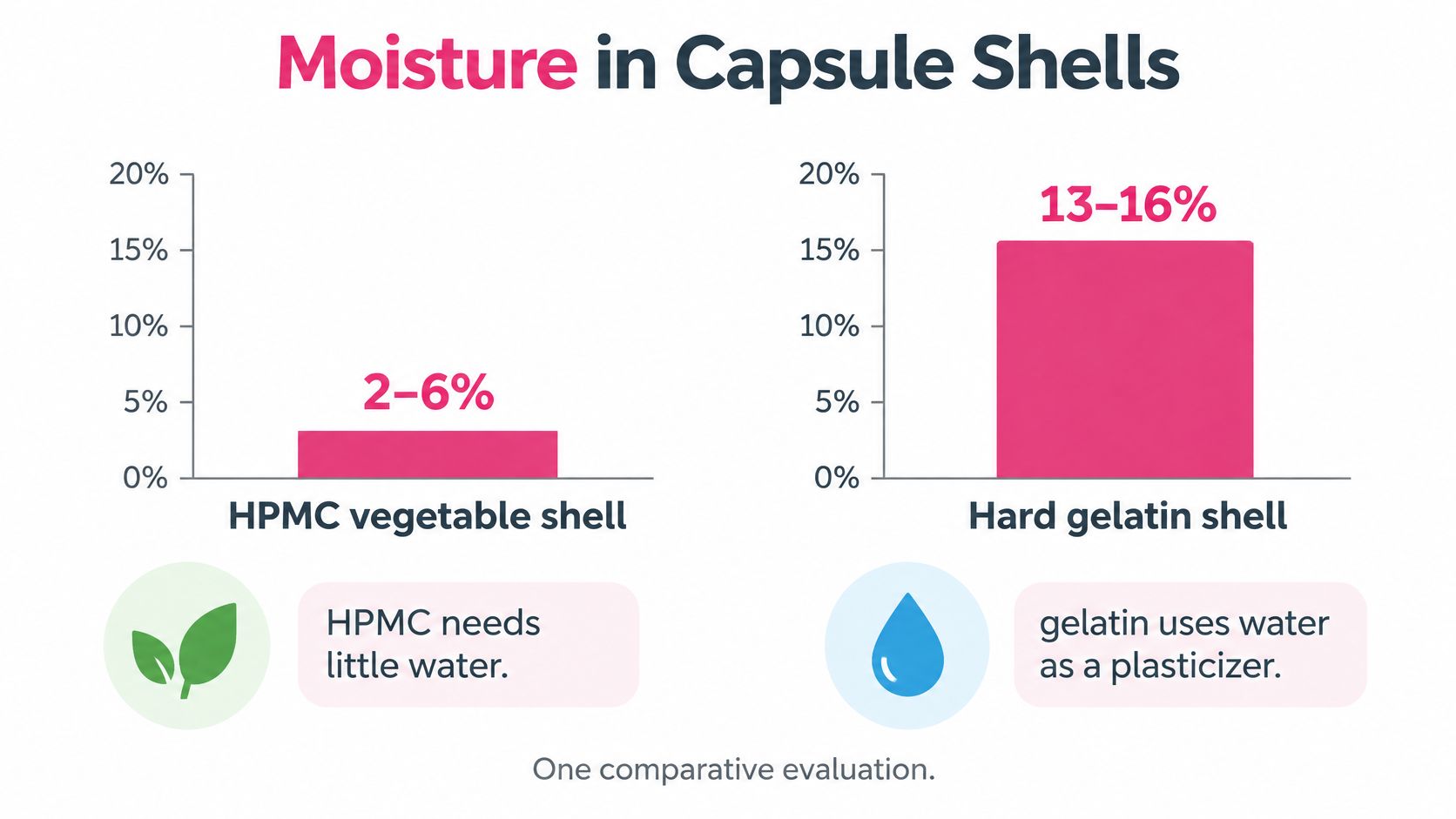
You leave the bottle open on the counter while you mix a smoothie, and the powder inside starts to care about the air. That is the practical version of a lab gap. One comparative evaluation measured roughly 2–6% moisture in HPMC vegetable shells against about 13–16% in hard gelatin shells, as reported in the PMC comparison of capsule shell performance. Formulators use that gap when a prenatal fill clumps, crystallizes, or breaks down if it picks up water.
Why gelatin carries so much water
Gelatin uses water as a plasticizer. The water works like the moisture in a soft candy: it keeps the shell bendy. Dry the room too far and that same shell can turn brittle and crack. HPMC does not lean on that water to stay flexible, so it can hold its shape at a lower moisture level when humidity swings.
A drier shell is still a shell. It is not the folate, iron, or DHA inside. Hard HPMC and hard gelatin can behave similarly once they are in you. Many prenatal DHA oils still sit in gelatin softgels, a different format from these hard shells. A nausea-friendly delay is a release design built into the product, not a feature you get from the word vegetable.
| Measure | HPMC shell | Gelatin shell |
|---|---|---|
| Shell moisture, comparative evaluation | about 2–6% | about 13–16% |
| Active ingredient after 18 months, technical report | 2% degradation | 8% degradation |
In that technical report, the tracked active lost about 2% in the HPMC shell and about 8% in the gelatin shell over 18 months. That is one stability snapshot, not a promise for every prenatal on the shelf.
What the shell can't do for you
Comparative testing found that neither HPMC nor gelatin capsules fully protected a hygroscopic powder from the humidity around it. Less water in the shell can mean less moisture migrating into a sensitive fill. It does not turn the capsule into a sealed jar.
The bottle, the liner, the cap seal, and any desiccant do the heavy humidity work. Those choices come from water-vapor transmission data and stability results on the finished formula, not from the material name on the front.
If you have ever wondered how long an opened bottle stays good, our guide on whether supplements expire walks through dates, storage, and when to let a bottle go. This short video covers how the two shell materials behave in practice.
The habits that protect potency are ordinary, and they work:
- Close it properly every time. A cap clicked shut all the way keeps room humidity out.
- Skip the bathroom shelf. Steam from showers is the opposite of a cool, dry place.
- Keep it out of the car. A hot dashboard is hard on any shell, gelatin or plant-based.
- Follow the storage line on your label. It was written for that formula, not for capsules in general.
A drier shell is a manufacturing advantage for moisture-sensitive fills. It is not proof that every vegetable prenatal stays more potent for months, and it does not replace testing the finished batch.
Can Either Shell Give You Delayed Release
A vegetable shell is not automatically delayed release. HPMC and gelatin capsules can both release their contents, while a delayed-release capsule is designed to open later in the digestive tract.
In an in-vitro comparison, gelatin capsules showed immediate-release behavior across the tested media, while some specified HPMC formulations did not consistently match that profile. All tested formulations disintegrated within 30 minutes, meeting the cited USP criterion for botanical preparations, according to the Science.gov capsule release and disintegration record.
| Capsule or study | Release result |
|---|---|
| Gelatin hard capsule | Immediate release across tested media |
| Specified HPMC formulas | Did not consistently match gelatin's release profile; all disintegrated within 30 minutes |
What delayed release actually means
A delayed-release capsule is engineered to pass through the stomach before opening. Its release behavior comes from the capsule's design and formulation, not from whether the shell is vegetable-based or gelatin.
Feed Mom & Me prenatal vitamins come in a delayed-release vegetable capsule. For more on how this design works, read the guide to how delayed-release capsules work. A customer described the vitamins as gentle on her stomach: “I love your new vitamins. They are also gentle on my stomach!” That experience is personal, and how a prenatal feels can vary.
Ask your provider before changing when you take a prenatal, especially if you also take thyroid medicine, iron, or other prescriptions. The timing of each may affect how it is absorbed.
Will Either Shell Feel Easier on Your Stomach
The shell alone rarely decides this. Start with the fill, the dose you take at once, the time of day, and whether the capsule opens where you expect it to.
The complaints are predictable: queasiness, heartburn or reflux, and trouble swallowing a large capsule. Neither material has been proven gentler than the other in a head-to-head sense. A delayed-release design is a product feature you confirm on the label and in the maker's testing, not a quality that comes with plant cellulose or animal collagen.
Tolerability is a formula and timing problem far more often than a shell problem. Change one variable at a time so you can tell what helped.
Five steps that make a prenatal easier to keep down
- Take it with a small snack unless your label says otherwise. A little food in your stomach changes how a capsule feels going down.
- Ask your provider whether splitting the dose across the day suits you. Two smaller moments can be easier than one big one.
- If swallowing is the barrier, ask about a different form before changing anything yourself. Capsules can be opened and mixed into a smoothie when the label allows it, and the full powder still needs to be consumed to get the same nutrients.
- Keep a two-line note of which times of day feel calmer. Patterns show up fast, usually within a week.
- Call your provider promptly if heartburn, vomiting, or stomach pain is intense or persistent. That's a clinical question, not a capsule comparison.
If nausea is your main struggle, our guide to prenatals that cause nausea has more tactics you can try today.
Which Capsule Fits Your Diet During Pregnancy
The origin is simple. Gelatin is an animal-derived protein traditionally obtained by processing collagen, while HPMC is a cellulose-based shell derived from plant sources, commonly wood pulp, as Capsugel's HPMC capsule white paper explains. That makes an HPMC shell itself suitable for many vegetarians, vegans, and households keeping religious dietary rules that avoid bovine or porcine ingredients.
Now the line that matters. A vegetable shell does not prove the powder inside is vegan, gluten-free, allergen-free, or appropriate during pregnancy. Those claims depend on the whole formulation and the manufacturing controls behind it.
Read the label past the shell
Flip to the Supplement Facts and Other Ingredients panels and scan for the ingredients that commonly travel with a capsule or softgel:
- Gelatin, which can hide in the shell of a companion softgel even when your multivitamin uses a plant capsule.
- Fish or fish oil, relevant if you're watching allergens rather than diet style.
- Beeswax and lanolin, animal-derived and often present in softgel and vitamin D sources.
- Soy, gluten, and dairy, which may appear as carriers or excipients rather than main ingredients.
Diet fit is a label question. The word vegetable tells you about the shell and nothing about the other eleven lines.
Three routines, three different answers. A vegan household has to confirm the entire formula, not just the capsule, because fill ingredients and DHA sources can undo a plant-based shell. A mama asking about bovine versus porcine gelatin for kosher or halal practice needs the gelatin's source and certification, since the two aren't interchangeable under either set of rules. A home avoiding gluten or dairy is reading a longer list, where the shell is one line among many.
Here's the prenatal twist that's easy to miss: your multivitamin powder may sit in a vegetarian hard capsule while your DHA oil arrives in a gelatin softgel. In 2025, gelatin shells held 81.72% of the global softgel-capsule market, according to Mordor Intelligence's softgel capsule report, which is exactly why one routine can contain both shell types. Our prenatal vitamins are gluten-free and gelatin-free, so the capsule question is settled before you get to the rest of the panel. If you're building a fully vegetarian routine, our guide to vegetarian prenatal vitamins with DHA covers how to match the two.
How Do You Pick a Capsule for Your Prenatal
Four rules, each one matched to a situation rather than to a universal winner.
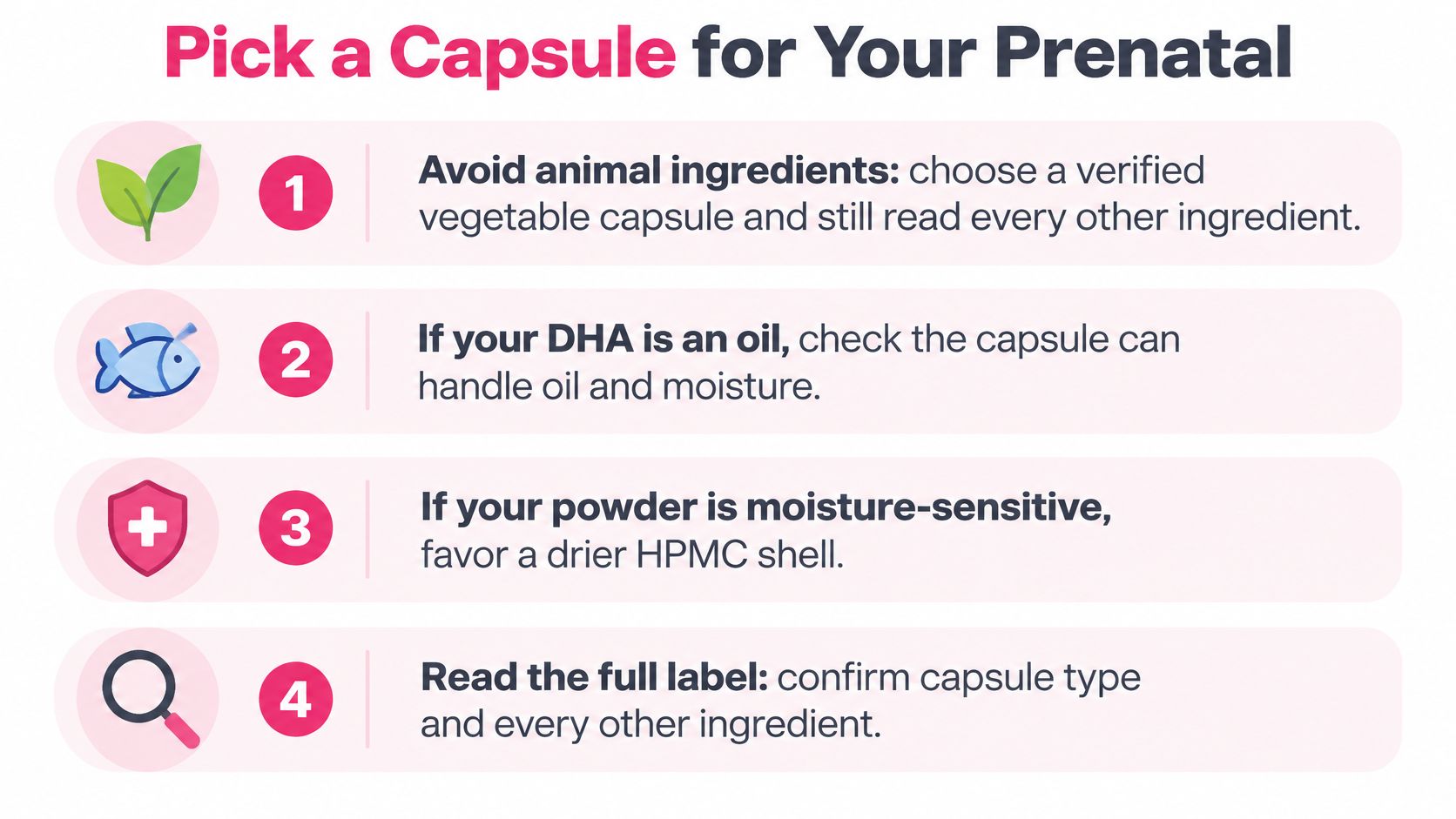
- If you avoid animal ingredients, pick a verified vegetable capsule, then read every other ingredient anyway. The shell is one line.
- If your DHA is an oil, expect a softgel, and check whether that label names a non-animal shell.
- If standard prenatals bother your stomach, look for a delayed-release design and ask your provider whether taking it with food helps.
- If you're choosing for freshness, treat a drier vegetable shell plus a sealed, well-made bottle as helpful, then look for batch testing rather than the capsule word alone.
Pregnancy has a way of sending you to labels on everything, including the products nobody talks about at the baby shower. If hemorrhoids have you reading ingredient panels on other products too, this Revivol-XR suppository ingredient breakdown is a useful reminder that format and ingredient list both matter, whichever end of your body you're shopping for.
One option built around this exact mix is Feed Mom & Me Complete Prenatal Vitamin Plus DHA. It comes in delayed-release vegetable capsules, the formula is gelatin-free, and it uses L-Methylfolate Calcium, a form of folate found naturally in food, instead of synthetic folic acid. Organic ginger and peppermint powders are added to help relieve queasiness from morning sickness. The formula was created by an OBGYN and a Registered Dietitian, and the brand is women-owned and built by moms. If you're still weighing formats, our walkthrough on how to choose a prenatal vitamin breaks down what else to compare.
Either shell can be the right call when the finished prenatal matches your diet, your stomach, and your care plan. That last part is yours and your provider's to decide together.
Feed Mom & Me makes a Complete Prenatal Vitamin Plus DHA in delayed-release vegetable capsules, gelatin-free and built by a women-owned team of moms, with L-Methylfolate Calcium and added organic ginger and peppermint for queasiness. If this comparison helped you narrow down what you need from a shell, you can see the full formula and how to take it at Feed Mom & Me. Bring the label to your next appointment and let your provider weigh in on what fits your pregnancy or postpartum plan.