
What Is Methylfolate Used for? Uses and Limits
Published:Updated:
Methylfolate, also written 5-MTHF or L-5-MTHF, is the active form of folate, the version your body can use directly for DNA building and cell division, and it now shows up in a growing number of prenatal supplements. Its job in those bottles is to supply folate, the nutrient behind your baby's developing brain and spinal cord. Folic acid is the form named in CDC prevention guidance for anyone who could become pregnant, which is exactly what makes the methylfolate label worth a second look.
So here you are at 11 p.m., bottle in one hand, phone in the other. The label says methylfolate. The word sounds closer to food than "folic acid" does. Nobody at the store mentioned whether that means better, worse, or different.
Fair question, and the answer beats a flat yes or no. Methylfolate does real biochemical work in your body. It arrives like a key already cut, ready to fit the lock your cells use for building DNA. Real work and proven prevention are two different claims, though, and methylfolate earns different marks on each. Once you hold those two ideas apart, every supplement label gets easier to read, mama.
Table of Contents
- What Is Methylfolate Used For at a Glance?
- How Does Methylfolate Work in Your Body?
- When Does Folate Matter Most for Your Baby's Development?
- How Do Methylfolate and Folic Acid Differ Side by Side?
- Does an MTHFR Result Mean You Need Methylfolate?
- Where Do You Get Folate in Food?
- How Much Folate Do You Need, and When Is More Not Better?
- What Can Methylfolate Not Do, and What Should You Check?
- How Do You Confirm Your Folate Plan with Your Provider?
What Is Methylfolate Used For at a Glance?
Methylfolate is a supplemental form of folate, the B vitamin your cells rely on for basic housekeeping. The NIH folate fact sheet describes it as a way to supply the body with a biologically active folate compound, one that participates in one-carbon metabolism, the reaction set behind DNA synthesis, normal cell division and methylation.
Useful, yes. But "useful" covers a wide range of situations, and the reported uses of methylfolate don't all sit on the same evidence footing. Some rest on strong public-health data. Some are biochemically reasonable but unproven for the outcome you care about. A few are pure marketing.
Pregnancy is the most established context. Neural-tube defects such as spina bifida and anencephaly are serious birth defects of the brain and spine, and getting enough folate in the earliest weeks lowers the risk. What deserves your attention is a quieter detail: the prevention evidence behind that advice was built on folic acid, not on methylfolate itself.
That gap matters more than it sounds like it should. "Biochemically plausible" means the chemistry makes sense on paper. It does not mean a trial showed the outcome improved. A label can be scientifically honest about the first and silent about the second.
Methylfolate uses by situation and evidence strength
| Use | Evidence Strength | What It Means for You |
|---|---|---|
| Folate supply before conception and in early pregnancy | Strongest context, but the proven prevention evidence is for folic acid | A useful folate source; ask which form your prenatal uses |
| Folate source in prenatal formulas for people who prefer 5-MTHF | Biochemically plausible, not proven for pregnancy outcomes | A reasonable option to discuss with your provider |
| Folate support with an MTHFR C677T variant | Inconclusive | Routine MTHFR testing is not recommended by CDC; do not self-dose |
| Energy, mood, fatigue or infertility | Not established | Get evaluated for causes such as iron, B12 or thyroid problems |
Notice the shape of that table, mama. The strongest row is about folate itself, not about which name sits on the label. The weakest rows are the ones supplement copy tends to lead with, and they lean on the same word: "supports." Supporting a process your body already runs is a much smaller promise than preventing a specific outcome.
The rule to carry forward: methylfolate can support your folate nutrition, but it is not a proven substitute for the standard folic acid recommendation without your clinician's guidance. The NIH is clear that the CDC advice doesn't switch to methylfolate even for women carrying an MTHFR C677T variant.
How Does Methylfolate Work in Your Body?
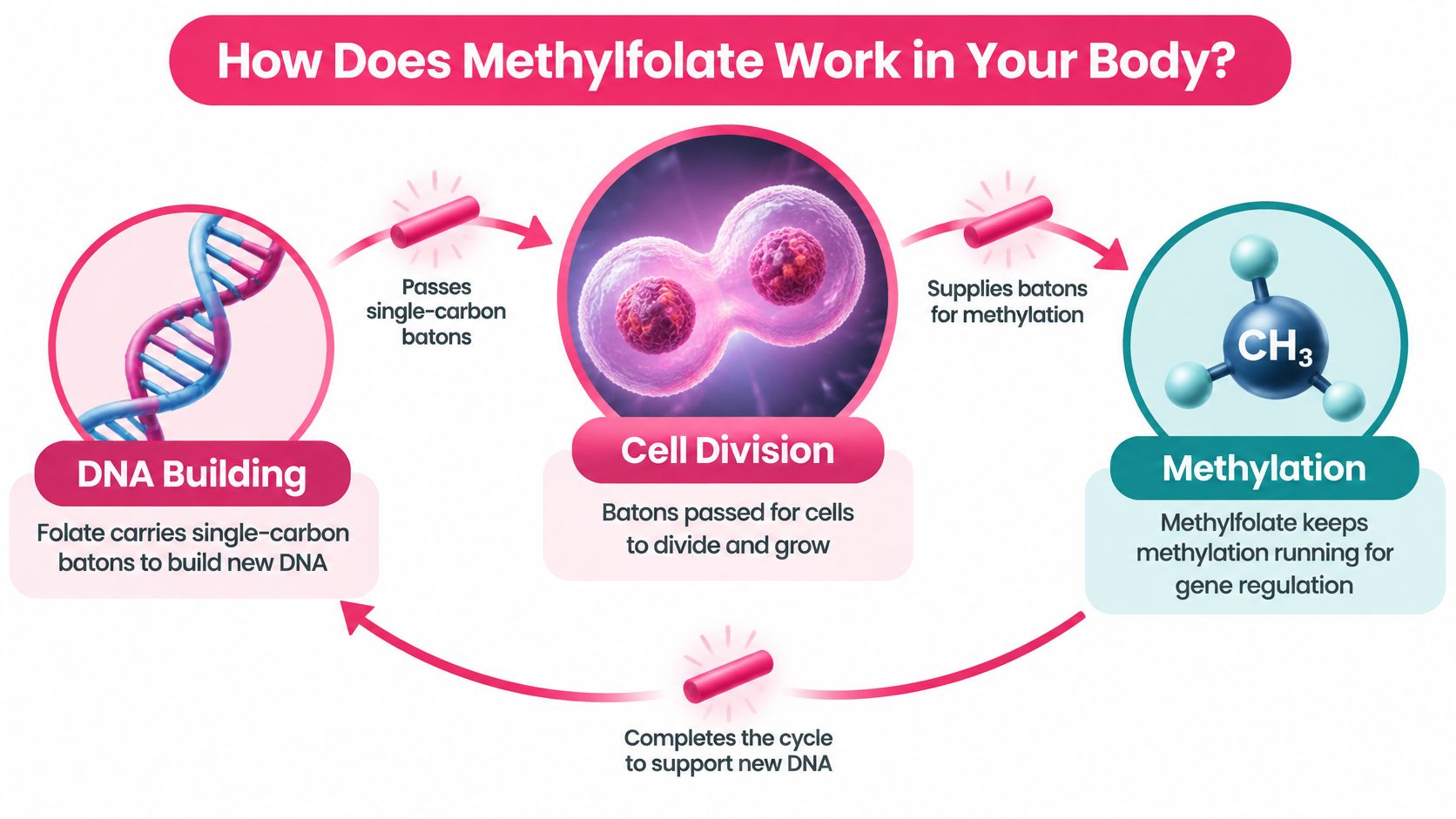
Think of your cells as runners in a relay race that never ends. Every second, they pass tiny single-carbon batons from one molecule to the next so they can build new DNA, divide, and keep a set of switches called methylation in working order. Folate is the runner carrying those batons. Methylfolate is that same runner already in position, arm out, ready to hand off without a detour.
Folic acid, the synthetic form used in fortified foods and many supplements, is a runner who has to change shoes first. Enzymes, including one called DHFR, process it into a usable form before it can join the race. Your body does that work on its own, every day, which is why folic acid still functions perfectly well in everyday use.
The handoff that does the most work
The best-known handoff happens when methylfolate gives up its methyl group to turn homocysteine into methionine. Methionine then becomes S-adenosylmethionine, usually shortened to SAMe, which is the body's main methyl donor. SAMe supplies the chemical tags used to regulate gene activity, build neurotransmitters and maintain cell membranes.
Those batons feed three everyday jobs:
- Building DNA. Your cells need folate-dependent building blocks to copy genetic material accurately before each division.
- Dividing cells. Rapidly growing tissue, which includes a placenta and a fetus, runs through those building blocks faster than resting tissue does.
- Running methylation. Methylation acts like a set of switches that turns genes up or down, and methylfolate keeps the switches supplied.
If you want to go deeper on the nutrients that feed this cycle, our guide to methyl donor supplements walks through how they work together.
When the relay runs short of runners, the fastest-dividing cells feel it first. In pregnancy, that's your baby's.
Your body handles many of these conversions itself, and food folate and supplements both feed the same relay. That's why a prenatal capsule, a bowl of lentils and a fortified cereal all count toward one shared total.
When Does Folate Matter Most for Your Baby's Development?
Folate's most time-sensitive job begins before you're pregnant. Your baby's neural tube, the structure that becomes the brain and spinal cord, forms and closes in the first weeks after conception. The NIH folate fact sheet for health professionals puts that closure at approximately 21 to 28 days after conception, often before anyone suspects a pregnancy.

When the tube doesn't close completely, the result is a neural-tube defect. Spina bifida affects the spine. Anencephaly affects the brain. Both are serious, and both explain why folate advice starts before conception rather than at your first prenatal appointment.
A planning sequence that works at any starting point
- Talk with your provider before you start trying. Bring up folate specifically, even if you're months away from conceiving.
- Ask which folate form and how much is in your prenatal. The form matters less than knowing what you're taking.
- Keep folate going through early pregnancy. Continuity beats a late start.
- Tell your provider about any past pregnancy affected by a neural-tube defect. That history changes the plan.
- Start where you are if the pregnancy was a surprise. A late discovery is common and it isn't a failure. The plan can begin the day you know.
For a closer look at how folate supports each stage, read our guide to the benefits of folate during pregnancy.
This short video walks through early development so you can picture the timeline.
Methylfolate's role inside this window is still being studied. The NIH notes that folic acid, not 5-MTHF, remains the only folate form proven in clinical trials to reduce neural-tube-defect risk, which is why the next comparison is worth reading closely.
How Do Methylfolate and Folic Acid Differ Side by Side?
Reading a Supplement Facts panel gets easier once you know which rows matter. The table below puts the two folate sources next to each other on the features that affect your decision.
Methylfolate and folic acid compared
| Feature | Folic Acid | Methylfolate (5-MTHF) |
|---|---|---|
| Chemical form | Synthetic form | Naturally occurring, biologically active form |
| Conversion needed before use | Yes, through enzymes such as DHFR | No, already active |
| Evidence for preventing neural-tube defects | Proven in clinical trials | Not tested in clinical trials for this outcome |
| Role in CDC prevention guidance | Named as the recommended form | Not named in CDC guidance |
| Common label names | Folic acid | 5-MTHF, L-5-MTHF, L-methylfolate |
| Where it fits best | Standard prevention guidance | Option some people prefer after provider review |
Start with the label names, because that's where confusion usually begins. Methylfolate hides under several spellings: 5-MTHF, L-5-MTHF, L-methylfolate, and L-Methyl Folate Calcium. If the panel says "folic acid," you're looking at the other column entirely.
Conversion is the row people fixate on, and the difference is real. Folic acid needs enzymes such as DHFR to become usable, while methylfolate doesn't. That's a genuine biochemical shortcut, which is why some women ask about it in the first place.
Evidence is where the two columns stop being close. Folic acid is the only folate form proven in clinical trials to lower neural-tube defect risk, and methylfolate hasn't been tested for that outcome at all. Neither column is "better" in the abstract. They fit different situations.
What to do with the label: photograph the Supplement Facts panel and the ingredient list, then bring both to your next appointment. The form and the exact amount in DFE are the two details your provider needs.
Does an MTHFR Result Mean You Need Methylfolate?
The MTHFR gene makes an enzyme that helps convert folate into its active form. A common variant, C677T, makes that enzyme work less efficiently, which sounds alarming until you learn how many people carry it and how few have any related problem. A result is information, not a verdict.
The CDC page on MTHFR and folic acid is direct about the practical side. Routine MTHFR testing isn't recommended, and folate advice doesn't change based on genotype alone. People who could become pregnant are still advised to follow the standard folic acid guidance even when they carry a variant.
Methylfolate may be easier for some C677T carriers to use at the biochemical level. Whether that translates into better pregnancy outcomes is inconclusive. That gap between "easier to use" and "shown to protect" is exactly where supplement marketing tends to sprint ahead of the science.
If my prenatal contains methylfolate instead of folic acid, am I protected against neural-tube defects? That question hasn't been answered in clinical trials, and the honest answer is that this protection hasn't been shown for methylfolate.
Three steps instead of a Google spiral
- Don't read an MTHFR result as a diagnosis. A variant isn't the same thing as folate deficiency, and most carriers have normal folate status.
- Don't self-prescribe high doses. More folate isn't a stronger version of the recommendation, and high intakes can hide a vitamin B12 problem.
- Bring the result and the product's folate amount in DFE to an obstetric clinician. That conversation, not a forum thread, is where the decision gets made.
Our article on choosing a prenatal vitamin for an MTHFR variant covers the label-reading side in more detail.
Where Do You Get Folate in Food?
Folate arrives from three places: food, folic acid added to fortified products, and supplements. All three count toward your daily total, mama, which is why a food-first habit makes the supplement math simpler.
Foods you probably already eat cover most of it:
- Dark leafy greens. Spinach, romaine and collards are the classic sources, and they work raw in a salad or wilted into eggs.
- Legumes. Lentils, black beans and chickpeas deliver folate alongside fiber and plant protein.
- Green vegetables. Asparagus, broccoli and Brussels sprouts all contribute, and asparagus is one of the richest.
- Citrus and berries. Oranges, orange juice and strawberries add folate with vitamin C.
- Fortified and enriched grains. Fortified breakfast cereals, enriched breads and enriched pastas are often the biggest single contributors in the United States.
- Smaller contributors. Eggs, avocado and sunflower seeds add a little to the total.
Naturally occurring food folate is absorbed less efficiently than the folic acid added to fortified foods, which is why nutrition labels express intake in a unit that adjusts for the difference. Cooking also takes a bite: boiling spinach leaches folate into the water, so lightly steamed or raw greens keep more of it.
Folate is one piece of a bigger routine rather than the whole picture. The Happy Bump's pregnancy self care guide covers sleep, movement and the daily habits that support everything else you're doing.
A habit that helps: jot down which folate foods and fortified products you eat on a normal day, then bring that list to your provider so your total can be checked together.
How Much Folate Do You Need, and When Is More Not Better?
Here are the numbers first. The U.S. pregnancy folate Dietary Reference Intake is 600 mcg of dietary folate equivalents (DFE) per day, compared with 400 mcg DFE for nonpregnant women, according to the NIH folate fact sheet.
Why pregnancy raises the need comes down to speed. Fetal and placental cells divide quickly and require folate-dependent nucleotide synthesis, so the demand for building blocks climbs while your blood volume does too.
Why DFE exists
Folate in food and folic acid in supplements aren't absorbed identically, so the DFE unit squares the difference. One microgram of folic acid taken with food counts as 1.7 micrograms DFE, while a microgram of food folate counts as one. That's why a fortified cereal can look surprisingly generous on paper.
Breastfeeding keeps your needs higher too, so postpartum mamas should review totals rather than assume the prenatal can be dropped without a conversation. More isn't better, either. For adults, the tolerable upper limit for folic acid from supplements and fortified foods is 1,000 mcg daily, and exceeding it over time can mask a vitamin B12 deficiency while nerve damage progresses unnoticed.
Daily folate recommendations by life stage
| Life Stage | Daily Folate Recommendation | Who Sets the Dose |
|---|---|---|
| Nonpregnant adults | 400 mcg DFE | Your diet and prenatal or multivitamin label, reviewed with your provider |
| Pregnancy | 600 mcg DFE | Your prenatal plan with your obstetric clinician |
| Breastfeeding | Needs stay elevated while milk production continues, so add up your totals | Your provider, while reviewing prenatal or B-complex products |
| Previous neural-tube defect pregnancy | 4,000 mcg folic acid under supervision | Your obstetric clinician only |
| Folate deficiency or malabsorption | Individualized, set after testing | Your clinician, after testing |
The 4,000 mcg row is the one exception where high-dose guidance exists. The NIH consumer folate page explains that people with a previous neural-tube-defect pregnancy may be advised to use 4,000 mcg of folic acid daily beginning one month before conception through the first three months, and that this regimen requires medical supervision.
Write the product's folate amount in DFE on your phone and bring it to your next visit. Our guide to prenatal vitamin dose helps you read that number correctly.
What Can Methylfolate Not Do, and What Should You Check?
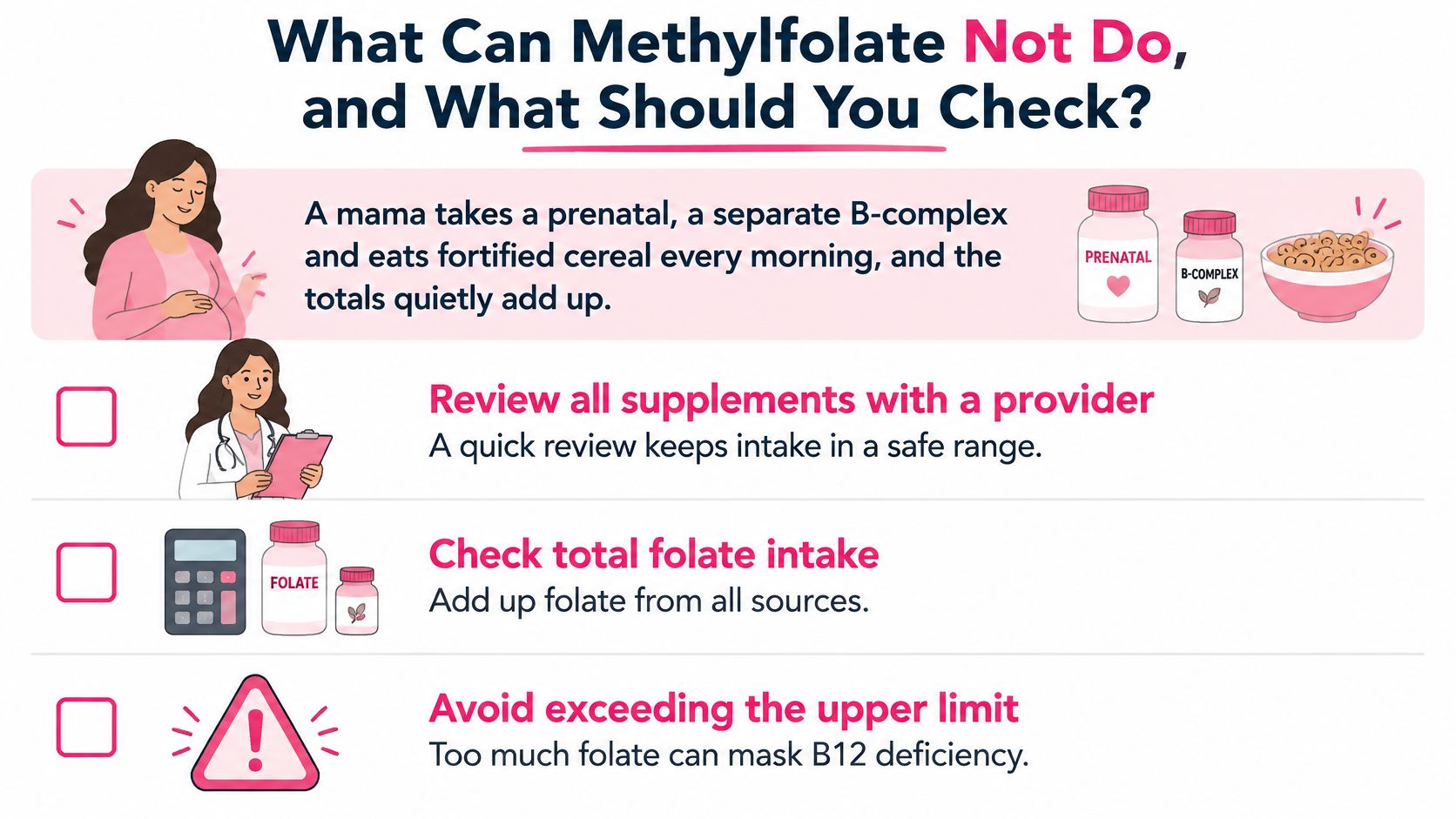
Say you take a prenatal in the morning, add a separate B-complex after lunch because a friend recommended it, and eat fortified cereal most mornings. Each choice is reasonable on its own. Together, those totals add up faster than most women realize, and a quick review with your provider keeps the whole thing in a healthy range.
The NIH folate fact sheet makes the distinction plain. Folate is required for nucleic-acid synthesis, and recommended intake rises from 400 mcg DFE for nonpregnant adults to 600 mcg during pregnancy. Methylfolate supplies that nutrient. It is not a universal treatment for fatigue, infertility, depression or high homocysteine.
Symptoms worth raising with your provider
- Tiredness that doesn't lift after rest, especially with pale skin or breathlessness on stairs.
- Mouth sores or a sore tongue that keep coming back.
- Changes in mood or concentration that feel out of proportion.
- Numbness or tingling in hands or feet, which points toward B12 rather than folate.
Conditions and medications that change folate needs
Iron or vitamin B12 deficiency, thyroid disease, malabsorption conditions, certain anti-seizure medications, and a prior neural-tube defect pregnancy all shift the picture. So does anything that limits how much you absorb from food.
Then there's the postpartum question most articles skip. Ask whether continuing a prenatal while breastfeeding makes sense for you, and add up folate from fortified foods, supplements and any B-complex product so the total is visible. Our post on 5-methylfolate side effects covers what to watch for.
Worth knowing: high doses of folate can correct the anemia caused by low B12 while the nerve damage continues, so persistent symptoms deserve a test rather than another supplement.
How Do You Confirm Your Folate Plan with Your Provider?
Appointments move fast, mama, and folate questions are easy to forget once you're sitting on the exam table. Four moves cover it.
- Bring your current supplement label. The actual bottle, or a photo of the panel.
- Ask which folate form is in it and how much DFE it provides. Those two answers settle most of the confusion.
- Share your health history and anything you already take. Your provider adds up the full picture, fortified foods included.
- Ask whether follow-up testing makes sense for you. Symptoms and lab work answer different questions, and your provider knows which one matters in your case.
One distinction is worth making at that visit. The folate form on a label describes the chemistry, meaning the nutrient arrives in a state your body can use directly. What the evidence proves for prevention is a separate question. A methylfolate label tells you the first answer, and your provider helps you weigh the second instead of letting the label imply it.
Feed Mom & Me Complete Prenatal Vitamin Plus DHA is one option worth putting on the table. The formula uses L-Methyl Folate Calcium, a form of folate found naturally in food, instead of synthetic folic acid, and it includes DHA alongside choline. Feed Mom & Me is a women-founded brand, and its prenatal formula was developed by co-founders Maria and Amanda, one of whom is a registered dietitian, together with an OB. Confirm the exact nutrient amounts, including folate in DFE, on the Supplement Facts panel before you commit.
Your needs aren't identical to anyone else's, and your healthcare provider is the best guide to what fits. Bring the questions. That's what the appointment is for.
Methylfolate belongs in a prenatal conversation, and Feed Mom & Me makes that conversation easier with a Complete Prenatal Vitamin Plus DHA built on L-Methyl Folate Calcium rather than synthetic folic acid, plus DHA and choline in the same daily routine. If you're sorting out which folate form fits your pregnancy or postpartum plan, start with our prenatal vitamins and bring the label to your next appointment, so you and your provider can decide together with the numbers in front of you.