
Best DHA Supplement for Pregnancy: A Mom's Guide
Published:Updated:
You're standing in the supplement aisle, or scrolling on your phone after everyone else is asleep, trying to figure out which DHA bottle belongs in your pregnancy routine. One says fish oil, another says algae, and your prenatal already mentions omega-3s. You don't need another impressive-looking label, mama. You need to know what you're getting and whether it fits your diet, your stomach, and your provider's advice.
The best DHA supplement for pregnancy isn't automatically the strongest capsule or the most expensive bottle. It's an option with a clear DHA amount, a source you're comfortable with, quality information you can check, and a daily routine you can realistically maintain.
Table of Contents
- Why DHA Matters When You're Growing a Baby
- How Much DHA You and Baby Actually Need
- Algal DHA vs Fish Oil DHA Compared
- What the Research Says About DHA and Preterm Birth
- Which DHA Form Fits Your Real Life
- How to Read a DHA Label Like a Pro
- Making the Call and Talking to Your Provider
- Quick Answers Moms Ask Most
Why DHA Matters When You're Growing a Baby
DHA, short for docosahexaenoic acid, is an omega-3 fat involved in your baby's brain, nervous-system, and eye development. Think of pregnancy nutrition as gathering building materials. DHA is one of those materials, not the whole construction crew and certainly not a substitute for a varied diet.
That distinction matters because supplement marketing can turn a nutrient's biological role into a promise about your future child. Supporting normal development isn't the same as guaranteeing better learning, sharper eyesight, or a particular birth outcome. You can care about nutrition without expecting a capsule to control everything about pregnancy.
A nutrient, not a parenting test
Choosing a DHA supplement shouldn't feel like a measure of whether you're doing pregnancy correctly. If you haven't been eating fish, can't tolerate your prenatal, or only just noticed DHA on the label, you have a useful question to bring to your provider, not a reason to blame yourself.
Start by separating the terms that bottles sometimes blur together:
- DHA is the specific omega-3 you're looking for when comparing prenatal DHA products.
- EPA is another omega-3 that may appear alongside DHA.
- Fish oil or algal oil describes the source, not the amount of DHA you'll receive.
- Prenatal plus DHA describes a combination product, but doesn't tell you whether its DHA contribution fits your needs.
A helpful first move is to look at what you already eat. The guide to foods rich in DHA can help you identify food options before deciding what a supplement needs to contribute.
A reassuring starting point: You're choosing a way to support your nutrition, not buying a guarantee about your baby's future.
Your actual decision has several parts: dietary intake, the supplement's DHA content, source, quality documentation, and tolerability. Keeping those separate makes shopping much easier. A bottle can fit your dietary preferences yet provide less DHA than your provider recommends, or supply an appropriate amount in a format you can't comfortably take.
The useful question isn't whether a product contains DHA. It's whether that particular product helps complete your pregnancy nutrition plan.
How Much DHA You and Baby Actually Need
A daily nutrient recommendation and a weekly seafood recommendation describe different things. One helps you evaluate omega-3 intake; the other helps you plan meals. You don't need to convert every dinner into a laboratory calculation, but you do need to understand the difference before comparing bottles.
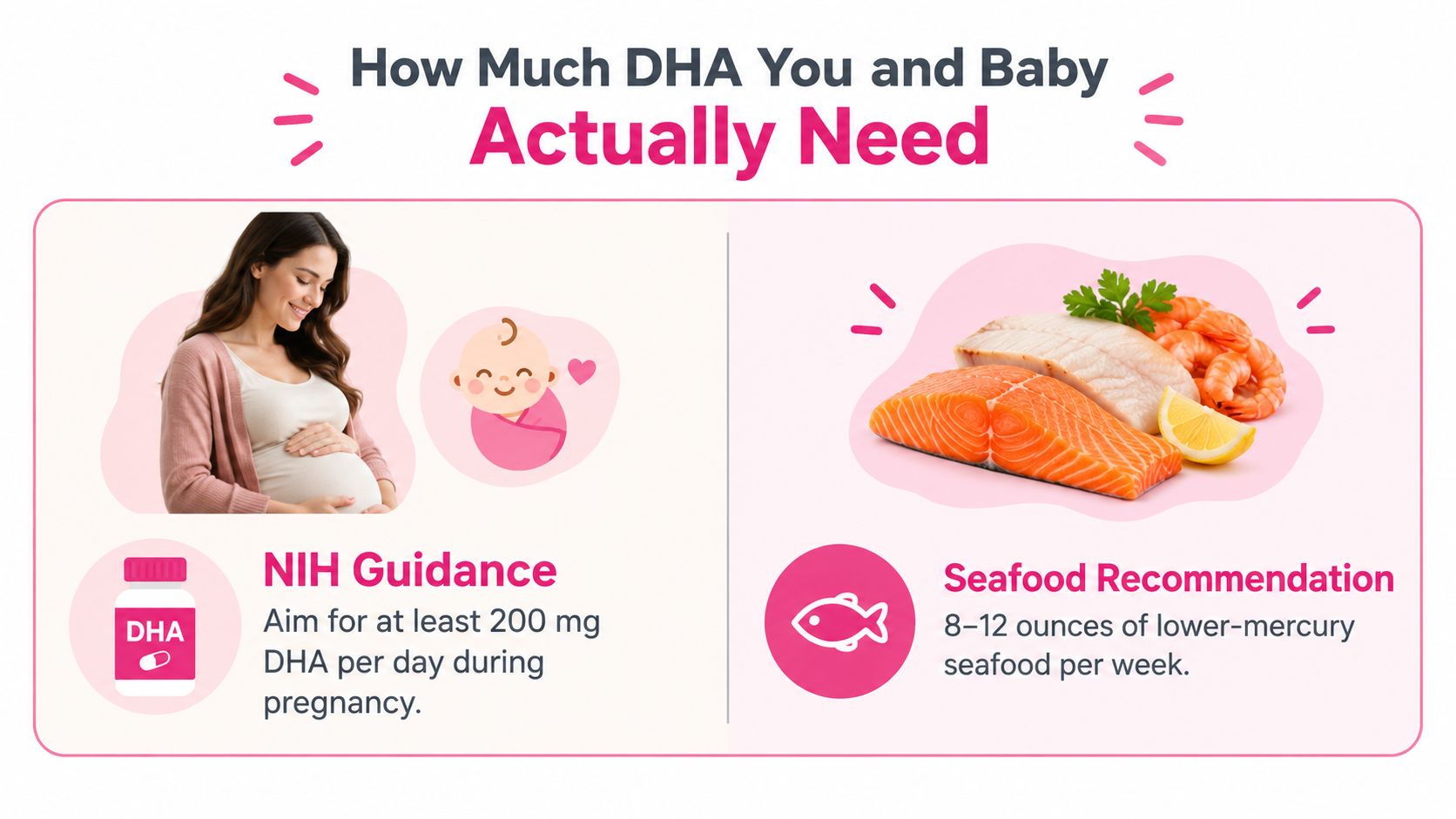
The NIH pregnancy nutrition guidance reports that expert groups recommend at least 250 mg daily of combined DHA and EPA for women of childbearing age, plus an additional 100–200 mg of DHA daily during pregnancy. That's a combined dietary benchmark, not a statement that every pregnant person needs the same standalone capsule.
Put the recommendations on your plate
For most pregnant and breastfeeding women, EPA and FDA fish advice recommends 8–12 ounces of lower-mercury seafood weekly, equivalent to 2–3 servings of 4 ounces each.
Their guidance identifies useful lower-mercury choices and fish to avoid:
- Lower-mercury options include salmon, sardines, anchovies, trout, and Pacific oysters.
- Fish to avoid include shark, swordfish, king mackerel, marlin, orange roughy, Gulf of Mexico tilefish, and bigeye tuna.
A realistic meal plan might include salmon at dinner and sardines at lunch on another day. If those foods sound completely unappealing right now, mama, tell your provider that rather than planning around meals you won't eat.
This visual offers a quick reference, but its simplified supplement target shouldn't replace the fuller dietary guidance above.
Decide what the supplement needs to add
Use your usual diet, not your ideal diet, as the starting point. Someone who regularly eats recommended seafood choices has a different conversation from someone who avoids seafood entirely.
- If you eat seafood regularly, ask how your existing prenatal fits alongside those meals.
- If you rarely eat seafood, ask what daily supplemental DHA amount would address that gap.
- If you take several supplements, bring all the labels so your provider can assess the combined intake.
Seafood also supplies nutrients beyond omega-3s. A DHA capsule can contribute to your plan, but it doesn't replace everything a nutritious meal provides.
Algal DHA vs Fish Oil DHA Compared
Your first source decision is straightforward: do you want a fish-derived product or a fish-free option? Both choices still require a careful label check. Neither source tells you the DHA dose, testing standard, capsule ingredients, or how comfortably you'll tolerate it.
Algae-derived DHA offers a fish-free route that can be particularly relevant for vegetarian pregnancies. It's described as a mercury-safe alternative to fish oil in peer-reviewed discussion of omega-3 nutrition during pregnancy. That doesn't mean every algal product has identical quality controls.
Algal DHA vs Fish Oil DHA at a Glance
| Attribute | Algal DHA | Fish Oil DHA |
|---|---|---|
| Source | Algae-derived oil | Fish-derived oil |
| DHA amount | Check the actual daily serving | Check the actual daily serving |
| EPA content | Don't assume EPA is included | Check the listed EPA amount |
| Mercury and contaminants | Fish-free source; still request quality documentation | Request contaminant-testing information |
| Vegetarian or vegan fit | Check the entire formula and capsule shell | Doesn't fit a fish-free diet |
| Kosher or halal fit | Verify product-specific certification | Verify product-specific certification |
| Taste and tolerance | Fish-free doesn't guarantee no digestive symptoms | Consider your sensitivity to fishy taste or burping |
| Sustainability | Ask about sourcing and production practices | Ask about sourcing and production practices |
The table's main lesson is that source and quality are separate questions. Algal DHA may match your values, but you still want to know what's in the finished product. Fish oil may fit your diet, but you shouldn't substitute reassuring packaging for testing information.
Match the source without assuming a winner
If you're vegetarian, algae is the logical source to investigate. If you eat fish and feel comfortable with a documented fish-oil product, you don't need to switch just because another bottle sounds more natural.
Vegan suitability requires checking more than the oil. Review the capsule shell and the other ingredients, too. Likewise, neither algae nor fish oil automatically establishes kosher or halal suitability; look for certification that applies to the actual product you're buying.
Sustainability also deserves a specific question rather than a blanket verdict. Ask the manufacturer what sourcing practices it documents and whether any certification applies to the finished product or only an ingredient.
The DHA versus fish oil pregnancy guide offers another way to think through this source decision. Your goal isn't to pick the universally superior oil. It's to identify a suitable product whose details you can verify.
What the Research Says About DHA and Preterm Birth
The preterm-birth research gives a meaningful reason to discuss omega-3 intake with your pregnancy care team. It doesn't give a reason to panic, buy the highest-dose bottle, or assume a brand can reproduce a study result.
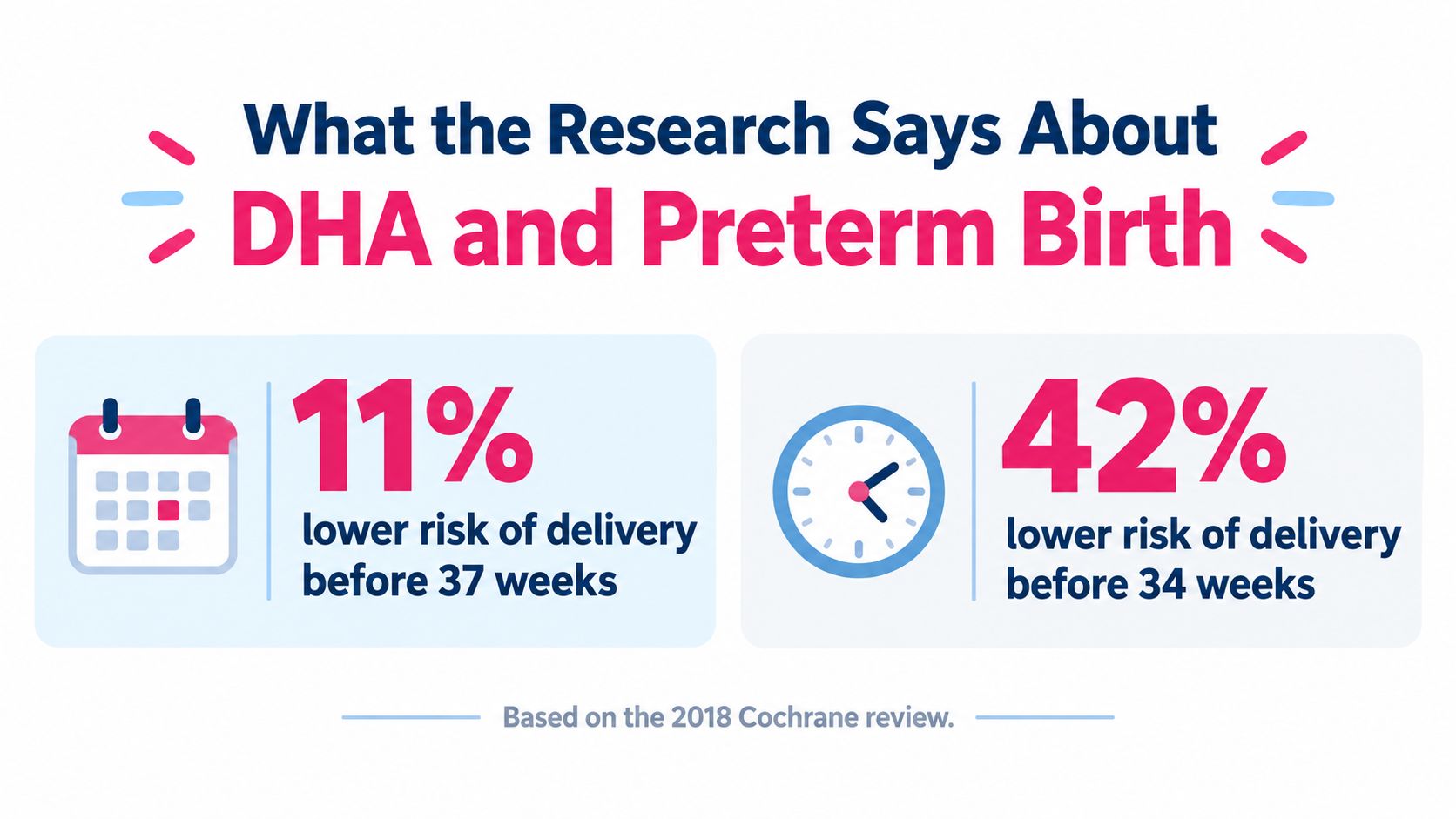
The 2018 Cochrane review of omega-3 supplementation during pregnancy found an 11% lower relative risk of birth before 37 weeks across 26 trials involving 10,304 participants, and a 42% lower relative risk of birth before 34 weeks across 9 trials involving 5,204 participants.
The graphic summarizes those findings, although the research evaluated omega-3 interventions broadly, not DHA alone or a particular prenatal brand.
Understand relative risk without overreading it
Relative risk reduction describes the difference between study groups. It isn't an individual prediction, and it isn't the same as an equivalent percentage-point decrease in your personal chance of delivering early.
The review also doesn't establish one universally optimal DHA product or dose for every pregnancy. Participants received omega-3 interventions under trial conditions, and the results can't be transferred automatically to any bottle that says DHA on the front.
A meaningful research finding can support a conversation with your provider without becoming a promise on a supplement label.
Translate the evidence into a sensible purchase
Use the research to ask better questions, rather than to choose more milligrams by default:
- Dose should match a personalized recommendation, not a potency slogan.
- Timing belongs in the discussion with your provider, especially if you're concerned about preterm birth.
- Consistent use requires a product and schedule you can tolerate.
- Expectations should stay realistic, particularly for claims about long-term learning or intelligence.
DHA's role in development and proof that supplementation improves a particular developmental outcome are different questions. Biological importance alone doesn't establish that a higher supplemental dose produces a better result.
If you're already anxious about delivery, mama, you don't have to interpret trial headlines alone. Ask your clinician how, if at all, this evidence changes your own plan.
For an additional viewing resource, you can watch the video below and bring any questions it raises to your appointment.
Which DHA Form Fits Your Real Life
A supplement can look ideal on paper and still be wrong for your daily life. Your food preferences, medication list, swallowing comfort, and stomach all deserve a place in the decision.
Use the scenarios below as starting points, not prescriptions. They help you identify which questions matter most before you settle on a product.
If you're vegetarian or vegan
Start with an algal DHA product, then verify the finished formula's dietary suitability. Ask your provider whether you need DHA alone or a product that also supplies EPA, and what amount fits your usual meals.
Don't assume a vegetarian prenatal and a vegan standalone DHA capsule are interchangeable. The nutrients outside the oil may differ, and those differences matter to your overall prenatal plan.
If your stomach is already sensitive
A fish-free source may be worth considering if fishy taste is your main obstacle. If swallowing is the issue, discuss another delivery format rather than repeatedly buying capsules you can't take.
The guide to fish oil burps is a useful resource for thinking through that particular frustration. Ask about serving instructions and alternatives, but don't treat burping alone as proof that an oil is contaminated.
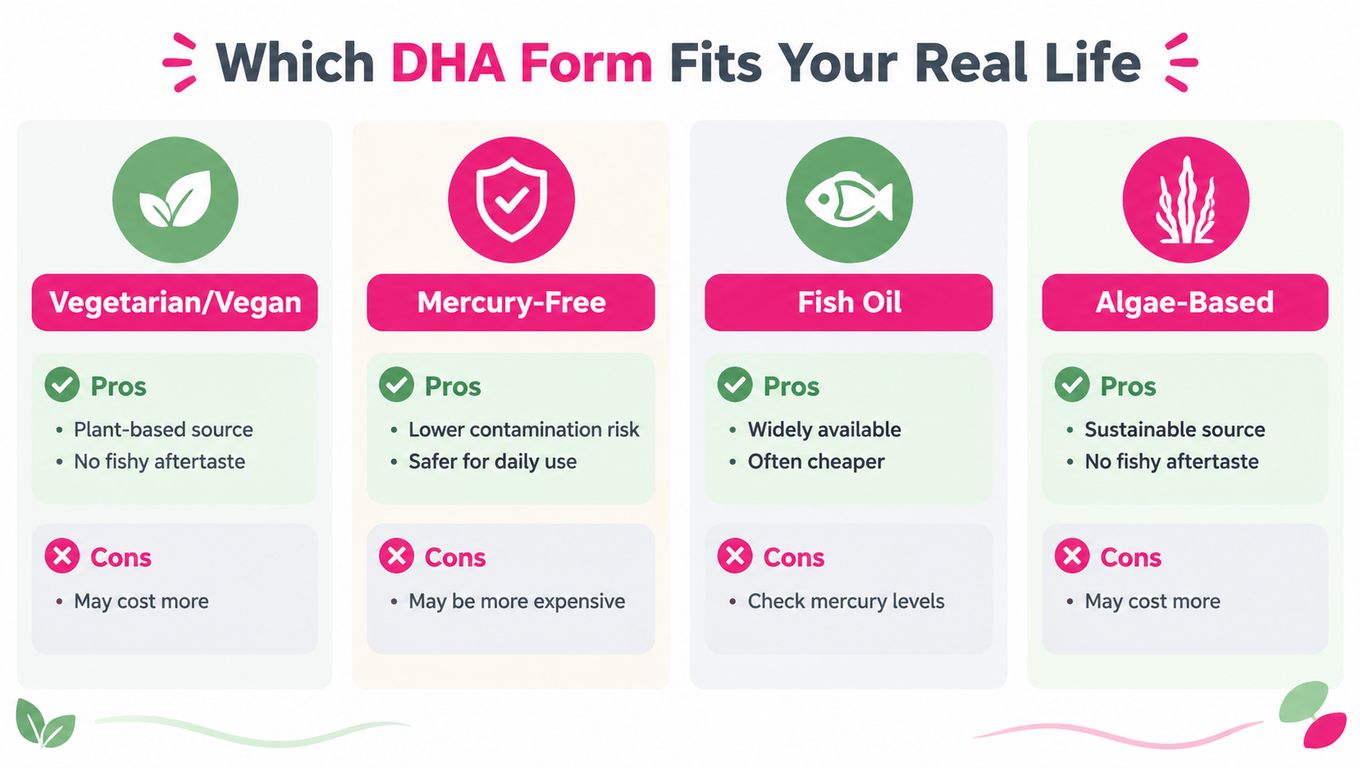
This chart offers a starting comparison. Taste, price, and comfort still depend on the individual product, so its broad descriptions aren't guarantees.
If you barely eat fish
Either an appropriate fish-oil product or an algal product may fit. The important next step is establishing what the supplement needs to contribute, using the dietary benchmark discussed earlier.
You don't need to force yourself into a seafood routine you dislike. You do need to tell your provider what you eat so the recommendation reflects your actual intake.
If you take anticoagulants or have a high-risk pregnancy
Bring your medication list before adding DHA or increasing an existing dose. The NIH consumer omega-3 fact sheet discusses bleeding concerns at large intakes, medication interactions, and mild supplement side effects.
Symptoms worth discussing include:
- Digestive discomfort, such as heartburn, nausea, or diarrhea.
- Taste-related effects, including unpleasant taste or bad breath.
- Other symptoms, such as headache.
Tell your healthcare professional if you take warfarin or another anticoagulant, have a bleeding disorder, or are preparing for a procedure. Switching from fish oil to algae doesn't remove the need for that safety conversation.
How to Read a DHA Label Like a Pro
Turn the bottle around before judging it. The front label is designed to catch your attention; the Supplement Facts panel is where you can evaluate the proposed daily serving.
Start with the ingredient you're trying to compare. A large fish-oil amount isn't the same thing as the DHA amount, and a combined omega-3 total doesn't tell you how much of each omega-3 is present.
Your supplement-aisle checklist
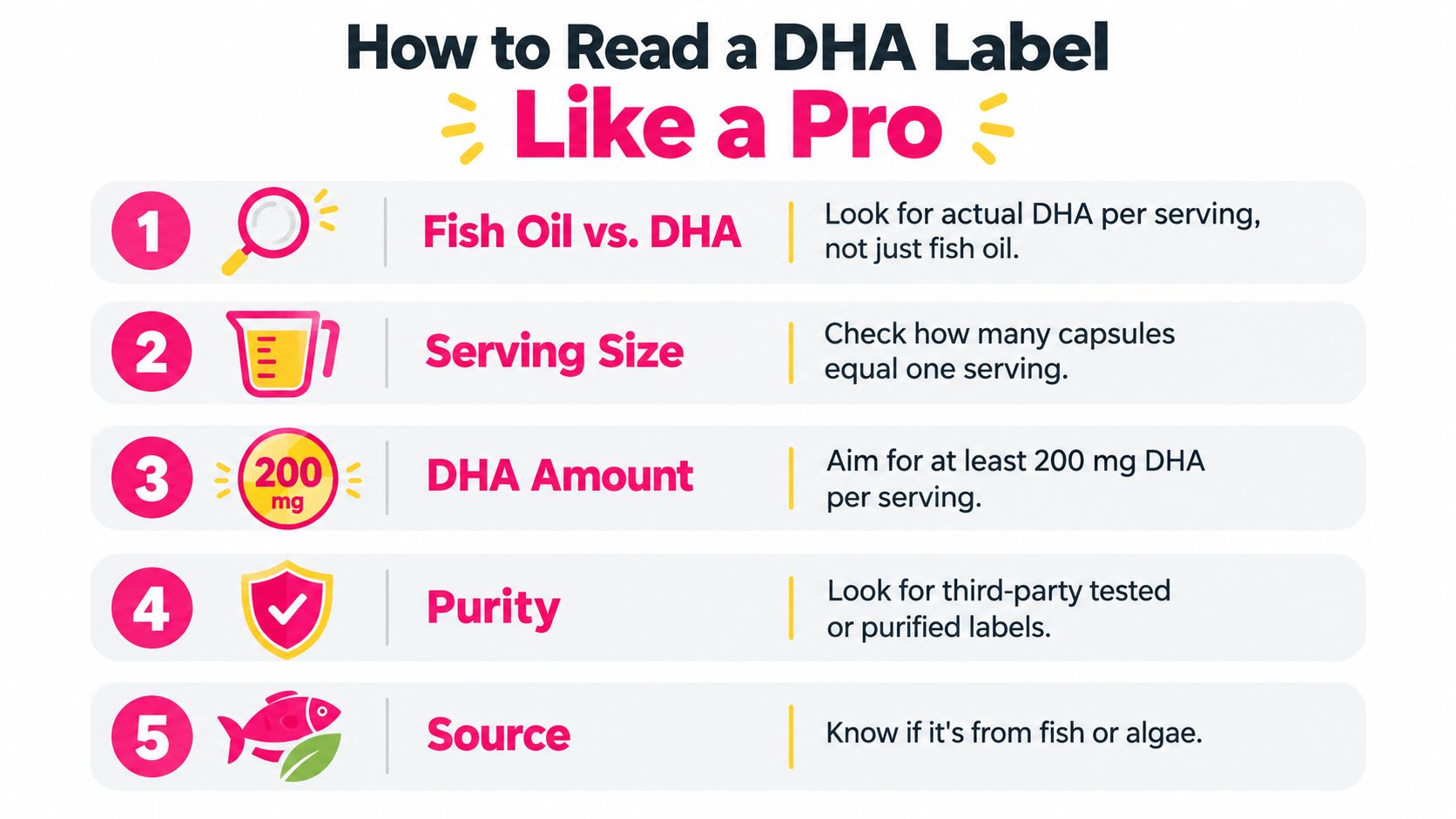
- Find actual DHA rather than relying on the oil's total weight.
- Check serving size so you know how many capsules make up the listed amount.
- Identify EPA separately if your provider wants you to account for both.
- Review the full ingredient list for capsule materials, allergens, and ingredients that don't fit your dietary needs.
- Check expiration and storage instructions before buying a bottle you'll use over time.
- Request testing details instead of accepting the word purified as complete documentation.
The illustration below simplifies the label check. Its suggested amount is a screening cue, not a substitute for the individualized intake discussion.
Ask what testing actually covers
If you see USP, NSF, or IFOS named on packaging, ask which program applies, whether the finished product is covered, and how to verify its current status. Don't assume different seals assess identical things.
Useful manufacturer questions include whether testing covers declared ingredient amounts, contaminants, and oxidation, and whether documentation is available for the product you're buying. The resource on third-party-tested supplements can help you prepare those questions.
Shopping rule: A quality claim is more useful when the manufacturer can explain exactly what was tested.
Follow the bottle's storage directions, and contact the manufacturer or pharmacist if the product's smell or appearance changes. Freshness concerns deserve a real answer, not a guess based on flavoring.
For the bigger question of are supplements worth taking, Lake City Physical Therapy offers a general resource to consider alongside pregnancy-specific advice. The practical purchasing question remains personal: does this supplement address an identified need, and can you verify what it provides?
Making the Call and Talking to Your Provider
Bring your provider a proposed plan, not just a bottle. A picture of your prenatal label, any separate omega-3 supplement, your usual seafood habits, and your medication list gives them something concrete to review.
You can keep the conversation simple: tell them which source you prefer, what's been hard to tolerate, and whether you're hoping to avoid another separate supplement. You're allowed to prioritize convenience, mama. A workable routine matters.
Questions that make the appointment useful
- What should this add to my diet? Ask for a supplemental DHA recommendation that accounts for your existing intake.
- Does my prenatal contribute enough? A combination product may still leave a gap.
- Which format fits my situation? Discuss dietary restrictions, swallowing difficulty, and digestive symptoms.
- Is anything else in this bottle unnecessary? Review overlapping ingredients across your supplements.
- Should my plan change after delivery? Make postpartum nutrition part of the conversation before life gets busier.
A vegetarian, delayed-release prenatal with DHA and complementary nutrients can be one option for someone who wants a simpler routine. Another option is a prenatal paired with a separate algal or fish-oil supplement. The deciding factor is whether the combination meets your reviewed needs, not whether everything comes in the same bottle.
If you're considering cod liver oil specifically, bring the whole ingredient panel rather than treating it as interchangeable with a standalone DHA product. The organic cod liver oil discussion can help you formulate questions for that review.
Choose a plan you can maintain
Once your provider helps you choose, follow the agreed serving instructions rather than adjusting the dose whenever a new headline appears. Keep a note of what you're taking so future medication or supplement discussions are easier.
You don't have to become a nutrition researcher to make a thoughtful decision. Clear labels, honest dietary information, and a clinician who knows your pregnancy are a strong foundation.
Quick Answers Moms Ask Most
Can you take DHA in the first trimester?
The pregnancy guidance isn't framed as something reserved only for later pregnancy. Ask your provider when to begin and how DHA should fit with your current prenatal and diet.
Is DHA the same as omega-3?
DHA is a specific omega-3, not a synonym for every omega-3 ingredient. If a label lists only a total, ask your provider or pharmacist to help identify its DHA content.
Do you need extra DHA if your prenatal already contains it?
Not automatically. Have your provider compare the prenatal's contribution with your dietary intake before adding another capsule or increasing the prenatal serving.
Can you keep taking DHA while breastfeeding?
Breastfeeding is a good time to review your nutrition plan rather than automatically stopping or continuing every pregnancy supplement. Ask your provider which products and amounts still fit your diet, medications, and postpartum needs.
Feed Mom & Me offers Complete Prenatal Vitamin Plus DHA, a vegetarian option containing DHA, choline, selenium, and methylfolate, with delayed-release vegetable capsules designed for tolerability. Built by moms, for moms, the women-owned brand also provides nutrition education to support informed conversations. Visit Feed Mom & Me to review the formula with your provider and ask whether its DHA contribution needs to be complemented by food or a separate supplement.