
Best Methylfolate Supplement for MTHFR: A Mom’s Guide
Published:Updated:
Are you looking for the best methylfolate supplement for MTHFR because you've been told that folic acid won't work for your body? That idea is common, but it leaves out an important part of the evidence.
If you're pregnant, trying to conceive, or newly postpartum, you deserve more than a supplement label promising “active folate.” You need to know what MTHFR means, where methylfolate may fit, when folic acid remains the better-supported choice, and how to choose a prenatal without turning nutrition into another source of stress.
Table of Contents
- Why Choosing the Right Prenatal Folate Can Feel Confusing
- What Is MTHFR and Why Does It Matter for Folate?
- Do You Really Need Methylfolate If You Have MTHFR?
- Folic Acid vs Methylfolate - What the Evidence Shows
- How to Choose a Prenatal-Friendly Methylfolate Supplement
- When Methylfolate May Be the Better Fit for You
Why Choosing the Right Prenatal Folate Can Feel Confusing
You're standing in the vitamin aisle, comparing three bottles. One says folic acid, another says methylfolate, and a third lists L-5-MTHF in tiny print. Then you remember your genetic test mentioned MTHFR, and suddenly a simple prenatal decision feels like a test you didn't study for.
That confusion makes sense. Supplement labels often use “folate,” “methylfolate,” and “active folate” as though they mean exactly the same thing. They're related, but they aren't interchangeable labels, and the most appropriate choice depends on your pregnancy stage, medical history, laboratory results, and your clinician's advice.

A helpful starting point is to separate what a nutrient does in the body from what a marketing claim suggests. Folate supports cell division and DNA production, which makes it especially important during pregnancy. Methylfolate is a form your body can use more directly, while folic acid is the form with the clearest evidence for preventing neural tube defects.
| What you're comparing | Folic acid | Methylfolate, or 5-MTHF |
|---|---|---|
| What it is | A synthetic form of folate | An active form of folate |
| Why people choose it | It's the form recommended by public-health guidance for neural tube defect prevention | It may be more bioavailable in some supplement contexts |
| What to check | The amount of folic acid and the full prenatal formula | The exact 5-MTHF form and labeled dose |
| What requires personal guidance | Higher-risk pregnancy plans or unusual laboratory results | Pregnancy dosing, B12 status, homocysteine, and total folate intake |
Your goal isn't to find a magical bottle. It's to choose a clear, prenatal-appropriate formula that fits your needs and doesn't duplicate ingredients unnecessarily. You can also read this practical guide to extra folate and folic acid during pregnancy before your next appointment.
A calmer shopping rule: Choose transparency over buzzwords. You should be able to identify the folate form, dose, supporting nutrients, and manufacturer without detective work.
What Is MTHFR and Why Does It Matter for Folate?
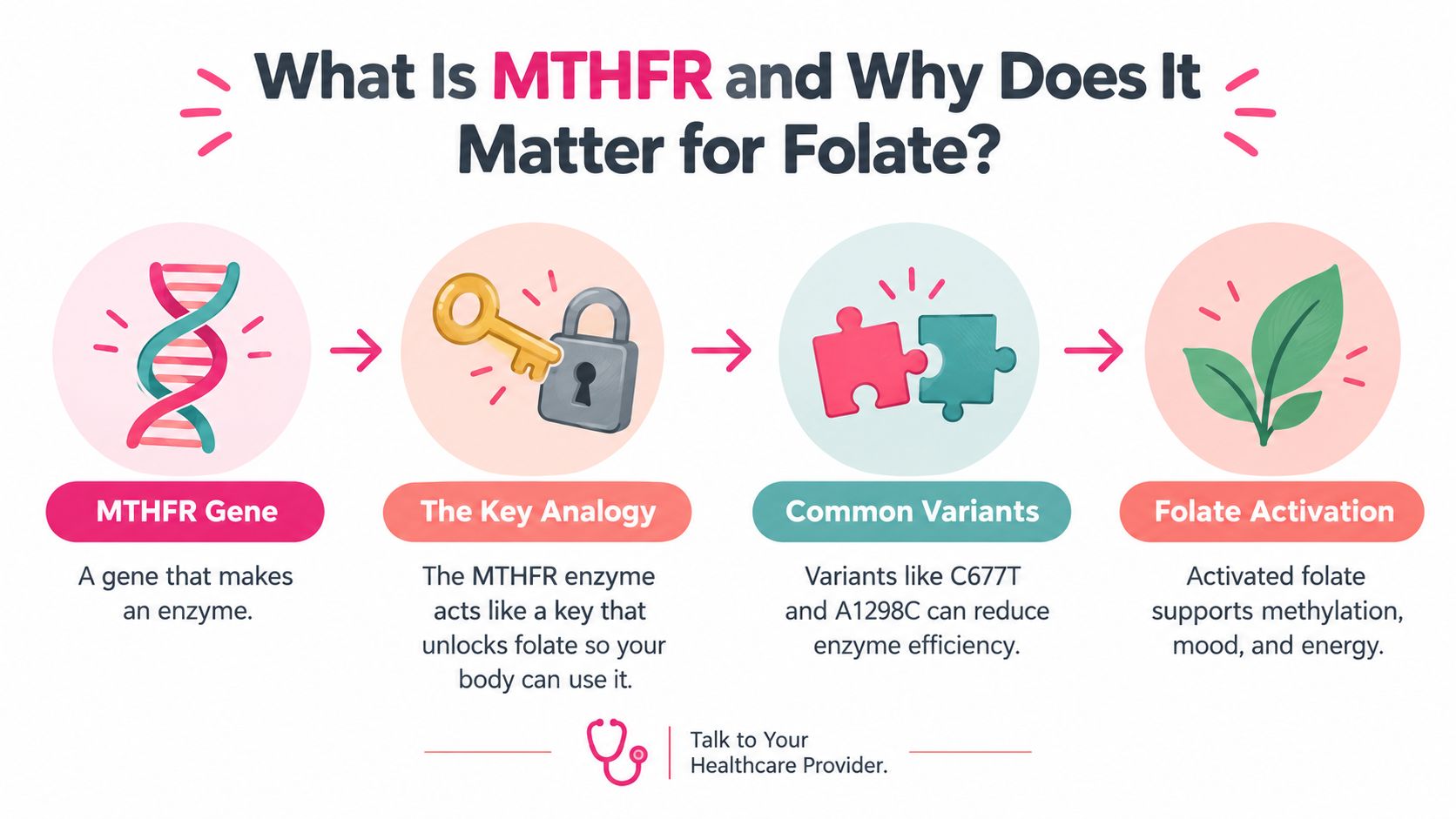
Why does an MTHFR result make choosing folate feel more complicated? Folate must be processed before the body can use it in certain pathways. The MTHFR enzyme helps convert some folate into 5-MTHF, a form involved in folate and methylation processes. A genetic variant can make that enzyme less efficient, but it does not remove your body's ability to use folate.
The MTHFR C677T variant is one of the most commonly discussed folate-metabolism variants among people considering methylfolate. The NIH Office of Dietary Supplements reports that about 25% of Hispanics, 10% of Caucasians and Asians, and 1% of African Americans are homozygous for the 677C>T polymorphism. Its NIH folate fact sheet explains that this variant reduces the enzyme's ability to convert folate into active 5-MTHF.
What the variant can change
For some people, reduced conversion is associated with:
- Lower available 5-MTHF: Less folate may be available in its active form.
- Methylation changes: Methylation is a group of chemical reactions cells use for several normal functions.
- Higher homocysteine: Homocysteine is an amino acid measured through bloodwork.
- Pregnancy-related concern: The NIH links the variant with increased neural tube defect risk while also emphasizing folic acid's protective role.
These associations help explain why a mama may search for the best methylfolate supplement for MTHFR. Methylfolate enters the pathway in a form that requires less conversion, much like a key already shaped for a lock. That reasoning may matter for some people, but it does not identify the safest product, dose, or folate form for every pregnancy. Folic acid remains the form with the clearest evidence for neural tube defect prevention, so a genetic result alone is not a reason to dismiss it.
Genetic testing is one part of the picture. A provider may also review your prenatal history, diet, medications, B12 status, folate status, and homocysteine instead of interpreting a gene result by itself. This plain-language guide to 6-S-5-methyltetrahydrofolate explains the form in more detail.
Here's a short visual explanation of the pathway:
An MTHFR variant is information, not a verdict about your pregnancy or your ability to have a healthy baby.
Do You Really Need Methylfolate If You Have MTHFR?
Not necessarily. Having an MTHFR variant doesn't automatically mean you must replace folic acid with methylfolate, particularly when the goal is preventing neural tube defects.
The CDC recommends that all women who could become pregnant take 400 mcg of folic acid daily, including women with an MTHFR C677T variant. The agency explains that folic acid intake matters for blood folate levels more than genotype does, and that 400 mcg per day can raise blood folate regardless of MTHFR genotype. The CDC also reports that people with the MTHFR TT genotype have blood folate levels only about 16% lower than people with the CC genotype when they consume the same amount of folic acid. Those figures and recommendations appear in the CDC guidance on MTHFR and folic acid and its clinical overview of folic acid.
The pregnancy outcome distinction
Methylfolate may improve certain folate biomarkers, but biomarker improvement isn't the same as proof that a supplement prevents a specific pregnancy outcome. The NIH states that folic acid is the only folate form currently proven to reduce neural tube defect risk, and that 5-MTHF hasn't been tested in clinical trials for that outcome in its pregnancy folate fact sheet.
UK guidance takes a similar position. UKTIS guidance on methylfolate in pregnancy says routine prenatal methylfolate use instead of folic acid can't currently be recommended. It continues to advise folic acid before conception and through at least the early weeks of pregnancy, with a higher prescribed dose reserved for higher-risk situations.
A 2024 review also complicates the popular “MTHFR means you can't use folic acid” message. The review reports that 40% to 60% of the population has genetic polymorphisms that can impair conversion of supplemental folic acid to L-methylfolate, yet concludes that folic acid can still produce folate levels similar to 5-MTHF regardless of MTHFR variant. You can read the peer-reviewed review on folic acid and MTHFR polymorphisms for that analysis.
The practical answer: Methylfolate can be a reasonable option, but an MTHFR result alone doesn't prove that folic acid is ineffective or unsafe for you.
If you're curious about how folate fits with other nutrients, this guide to methyl donor supplements can help you prepare questions for your OB-GYN, midwife, or dietitian. Your provider can help you distinguish a genetic finding from a measurable nutritional need.
Folic Acid vs Methylfolate - What the Evidence Shows
Which folate form makes the most sense during pregnancy? The answer depends on what you are comparing: how the nutrient is processed, what happens to blood folate levels, how well you tolerate it, or whether it has proven pregnancy outcomes.
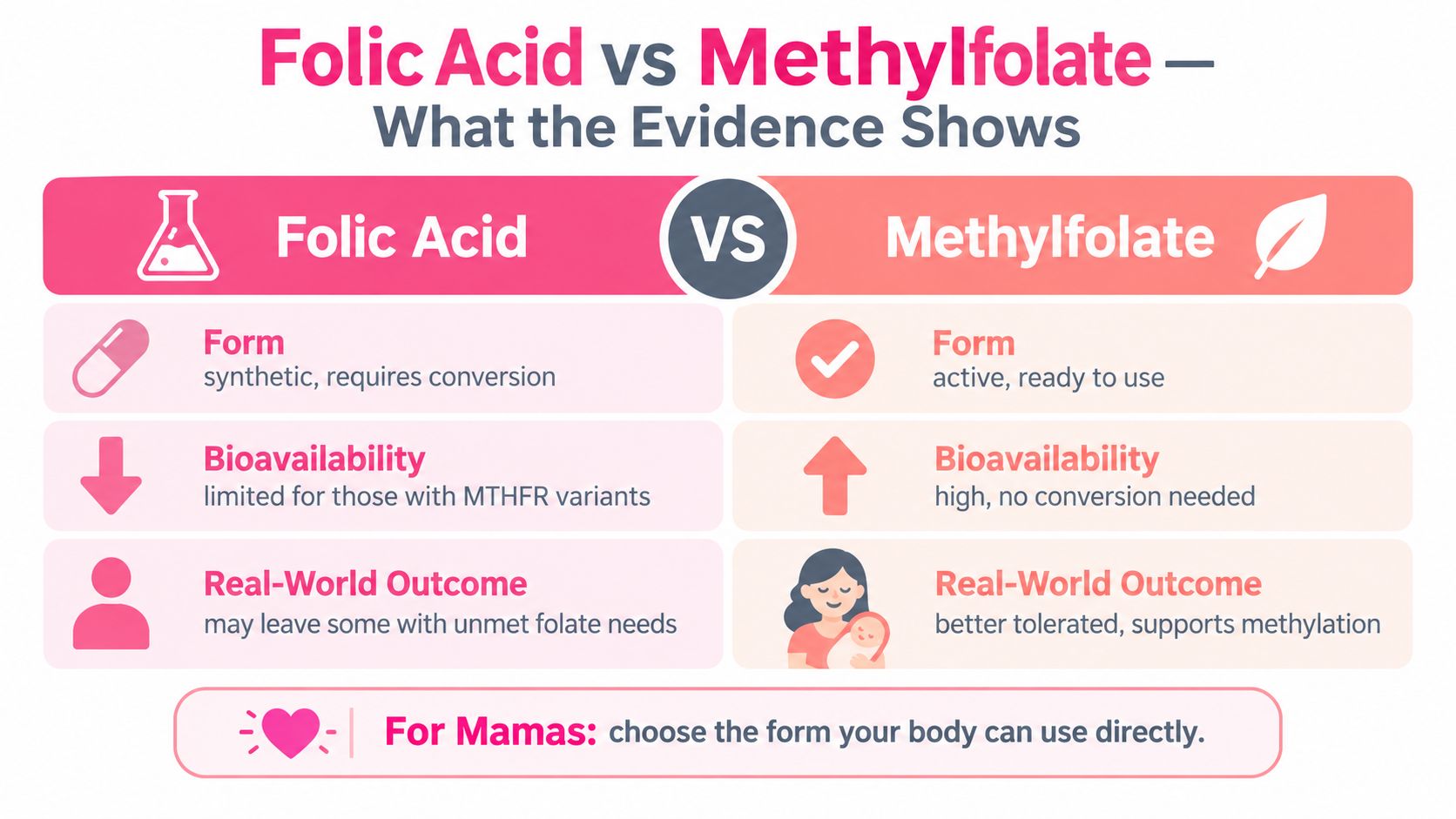
Folic acid remains the form with the strongest public-health evidence for reducing neural tube defect risk. L-5-MTHF, also called 5-MTHF or methylfolate, is already in an active form and may be more bioavailable in some supplement settings. That difference can make methylfolate appealing, but it does not automatically make folic acid the wrong choice.
Bioavailability in plain language
Bioavailability means how much of a nutrient becomes available for your body to use. 5-MTHF arrives in an active form, while folic acid needs an additional conversion step before the body can use it. Both forms can support folate status, but that processing difference may matter in certain supplement situations.
A 2022 review indexed by EFSA reported that, at 400 mcg per day, 5-MTHF was more bioavailable than folic acid. It proposed a dietary folate equivalent conversion factor of 2.0 for food supplements providing at least 400 mcg per day, compared with 1.7 for folic acid. Under that framework, 400 mcg of methylfolate may contribute about 800 mcg DFE, so read the label carefully. For a side-by-side breakdown of forms and doses, see this comparison of methylfolate vs folic acid.
What pregnancy research can and can't tell us
A 2026 randomized trial in pregnant women in Canada found that (6S)-5-MTHF and folic acid were similarly effective at maintaining maternal folate status. The 5-MTHF group had less unmetabolized folic acid in maternal plasma. The Canadian randomized trial shows a difference in a blood marker, not that methylfolate prevents neural tube defects better than folic acid.
Folate effects can also depend on genotype and B12 status. If B12 is low or uncertain, taking more folate alone may not address the underlying nutritional issue.
For product comparisons, look for a specific form such as L-5-MTHF or (6S)-5-MTHF, along with a clearly stated amount. “Folate blend” gives you less information than a label that identifies exactly what you are taking.
How to Choose a Prenatal-Friendly Methylfolate Supplement
A good prenatal label should make your decision easier, not create another research project. Start with the folate line, then assess the whole formula.
Read the folate panel first
Look for:
- Exact form: The label should identify L-5-MTHF, 5-MTHF, or another specific methylfolate form rather than using only “active folate.”
- Clear dose: Check whether the amount is listed as the compound itself, dietary folate equivalents, or both.
- Total intake: Add up folate from your prenatal, separate supplements, fortified foods, and any prescription product.
- Pregnancy fit: Don't assume a high-dose methylfolate product is appropriate just because a genetic report shows MTHFR.
The CDC's position remains important here. It says women who could become pregnant should get 400 mcg of folic acid daily, and that recommendation still applies with an MTHFR C677T variant because folic acid intake affects blood folate levels. If you're considering a prenatal without folic acid, discuss the choice directly with your healthcare provider. This overview of pregnancy vitamins without folic acid can help you organize that conversation.
Check the supporting nutrients
Folate works within a broader nutritional plan. Ask whether your prenatal also provides vitamin B12, and whether your diet or laboratory results suggest you need additional attention to other nutrients. Choline and DHA may also matter in a complete prenatal plan, although your exact needs depend on your diet and medical history.
Evaluate comfort and quality
Pregnancy can make swallowing and digestion harder. A delayed-release capsule, vegetarian capsule, or formula without ingredients you avoid may improve your ability to take the prenatal consistently. Peppermint or ginger may make a product more palatable, but they don't replace a clear nutrient label.
Look for transparent manufacturing information, allergen statements, expiration details, and contact information. Be cautious with products that use dramatic MTHFR promises, hide the actual folate form, or encourage you to combine several high-dose B-vitamin products without clinical guidance.
Bring the bottle to your appointment. Your provider can compare its folate amount with your prenatal plan, medications, lab results, and pregnancy history.
When Methylfolate May Be the Better Fit for You
Methylfolate may make sense when your healthcare provider wants you to use a directly active folate form, when you've had difficulty tolerating a particular product, or when your broader nutritional assessment supports that choice. Your clinician may also consider methylfolate alongside results such as folate status, B12 status, or homocysteine rather than relying on the gene result alone.
Extra care is needed if you've had a pregnancy affected by a neural tube defect or have another established risk factor. In those situations, don't self-prescribe a methylfolate product or change the recommended folic acid plan. Ask your OB-GYN, maternal-fetal medicine specialist, midwife, or dietitian which form and dose match your history.
A prenatal option such as Feed Mom & Me Complete Prenatal Vitamin Plus DHA contains L-5-MTHF, DHA, choline, and selenium. Its formula is vegetarian, soy-free, gluten-free, and dairy-free, with delayed-release capsules designed with tolerability in mind. The brand is women-owned and built by moms for moms, which may appeal if you want a maternal wellness company that combines supplements with accessible nutrition education.
Whether you choose folic acid, methylfolate, or a clinician-guided combination, you don't have to make the decision from fear. Bring your genetic report and supplement label to your next visit, ask what your pregnancy plan requires, and let measurable health information guide the conversation.
Feed Mom & Me offers a Complete Prenatal Vitamin Plus DHA with L-5-MTHF, DHA, choline, and selenium in a vegetarian, soy-free, gluten-free, dairy-free formula with delayed-release capsules. If you're comparing prenatal options for pregnancy or postpartum nutrition, visit Feed Mom & Me to review the product and educational resources with your healthcare provider's advice in mind.