
Prenatal Vitamin with Iron: A Complete Guide for Moms
Published:Updated:
Standing in the supplement aisle, you may have picked up a prenatal, checked the folate and DHA, and then paused at the words “with iron.” Maybe you're wondering whether iron is necessary, whether it will make nausea or constipation worse, or whether the amount in your bottle is enough. Mama, those are sensible questions, especially when pregnancy already feels like a full-time nutrition puzzle.
A prenatal vitamin with iron is usually designed to help prevent deficiency, not to treat confirmed anemia. The right choice depends on your diet, symptoms, tolerance, and lab results. Here's how to understand the label, take iron more comfortably, recognize when routine support may not be enough, and have a useful conversation with your healthcare provider.
Table of Contents
- Why Iron Is Part of Nearly Every Prenatal Vitamin
- How Much Iron Do You Really Need in Pregnancy
- Who Needs Extra Iron Beyond a Standard Prenatal
- Smart Ways to Take Iron Without the Side Effects
- How Iron Plays With Other Nutrients You Take
- Talking With Your Provider and Choosing a Gentle Prenatal
Why Iron Is Part of Nearly Every Prenatal Vitamin
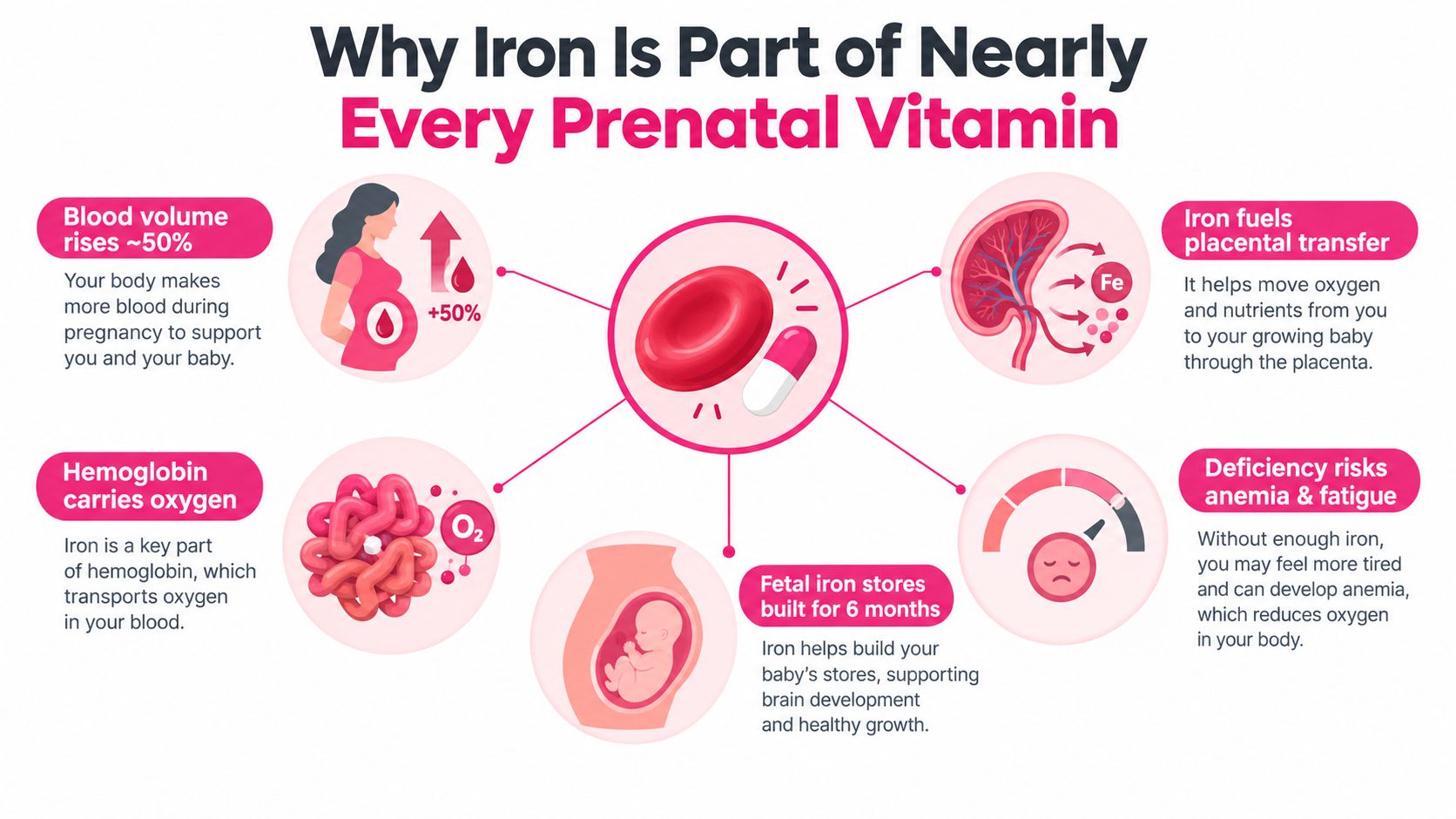
Iron earns its place in a prenatal because your body needs it to make hemoglobin, the protein in red blood cells that carries oxygen. Think of hemoglobin as a fleet of delivery vans. During pregnancy, your body is building and supplying more routes, including the placenta and your growing baby, so it needs enough vans and enough fuel to keep oxygen moving.
Mayo Clinic explains that iron supports blood production for oxygen delivery to the fetus and helps support the placenta and fetal development. Your body also draws on iron for red blood cell production, fetal development, and the iron stores your baby will need after birth. That makes iron a basic pregnancy nutrient, not an optional wellness add-on.
What iron is doing behind the scenes
A prenatal with iron supports several overlapping jobs:
- Red blood cell production: Your blood has more work to do as pregnancy progresses, and iron helps you make hemoglobin for oxygen transport.
- Placental support: The placenta transfers oxygen and nutrients between you and your baby, so it depends on an adequate maternal supply.
- Fetal development: Your baby uses iron while growing, including during important stages of brain and nervous-system development.
- Recovery around delivery: Pregnancy and birth place demands on your iron stores, so entering delivery with healthier stores gives your body more reserve.
Low iron can feel frustratingly ordinary. Fatigue, breathlessness, dizziness, pale skin, and restless legs can overlap with normal pregnancy discomforts, which is why symptoms alone can't diagnose deficiency. The U.S. Preventive Services Task Force summarizes pregnancy data showing iron deficiency at about 18% overall, rising from 6.9% in the first trimester to 14.3% in the second and 28.4% in the third.
A reassuring starting point: The iron in a standard prenatal is generally there to prevent a problem before it develops. It isn't automatically a sign that you have anemia or that your supplement is “too strong.”
How Much Iron Do You Really Need in Pregnancy
The number you see most often on a prenatal label is 27 mg of elemental iron per day. That amount matches the U.S. pregnancy RDA and is common in nonchewable prenatal formulas. It's intended as routine nutritional support, especially for someone without known deficiency who is eating a varied diet.
Guidance isn't identical everywhere. The World Health Organization discusses 30 to 60 mg of iron daily during pregnancy as a public-health supplementation range, with a higher amount reserved for established anemia. The WHO's guidance on daily iron and folic acid supplementation reflects settings where anemia prevention is a major population-health priority.
Prevention and treatment aren't the same
A standard prenatal is like a small umbrella you carry before the rain starts. It helps cover routine needs, but it isn't the same as a treatment plan after testing shows depleted iron stores or anemia.
| Source | Daily iron target | Purpose |
|---|---|---|
| U.S. pregnancy RDA | 27 mg | Total daily target used for routine pregnancy nutrition |
| Typical nonchewable prenatal | About 27 mg | Routine prevention and nutritional support |
| WHO pregnancy supplementation guidance | 30 to 60 mg | Public-health prevention in pregnancy |
| WHO guidance for established anemia | 120 mg | Treatment under clinical guidance, not self-prescribing |
The NIH Office of Dietary Supplements pregnancy fact sheet explains that screening and supplementation decisions should be connected to individual care. In the United States, anemia screening is recommended at the first prenatal visit and again at 24 to 28 weeks, according to the USPSTF resource cited above.
Your personal target can shift with baseline iron stores, dietary pattern, pregnancy stage, multiple gestation, bleeding history, and lab results. If your provider recommends more than the amount in your prenatal, don't stack products without checking the total. A helpful label-reading guide is how much iron is in a prenatal vitamin, especially when one serving contains more than one capsule.
Who Needs Extra Iron Beyond a Standard Prenatal
A prenatal can be perfectly appropriate and still not fully address your needs. The key question is whether you're using iron for prevention or responding to evidence that your body's stores are running low.
Iron deficiency often becomes more likely later in pregnancy. U.S. survey data summarized by the USPSTF found a clear rise across trimesters, while a separate U.S. analysis reported in a 2023 review found deficiency in 25% of pregnant people overall, with rates of 7% in the first trimester, 24% in the second, and 39% in the third. Those figures come from different analyses, so they shouldn't be treated as one universal estimate, but they point in the same direction: pregnancy can steadily increase the pressure on iron stores.
Situations worth discussing early
Ask your OB, midwife, or other pregnancy clinician whether you need closer monitoring if you have:
- A history of heavy periods: You may begin pregnancy with less stored iron.
- Pregnancies close together: A short interval can leave less time to replenish nutrient stores.
- A multiple pregnancy: More than one developing baby can increase nutritional demands.
- A vegetarian or vegan diet: Plant foods can provide iron, but nonheme iron is absorbed differently and may require careful pairing and monitoring. This guide to multivitamins for vegan women can help you think through the broader supplement picture.
- A prior anemia diagnosis: Previous deficiency gives your provider a reason to look closely at current labs.
- Teen pregnancy or other health considerations: Your clinician can determine whether your needs differ from routine prevention.
A standard prenatal may be enough for a low-risk pregnancy with reassuring labs. It may not be enough when ferritin is low, anemia is present, oral iron causes significant intolerance, or your provider identifies a higher-demand situation. In those cases, the answer might be a separate iron supplement, a different formulation, a revised schedule, or another medical approach. The decision should come from testing and clinical judgment, not from symptoms alone.
Signs to put on your provider's radar
Mention symptoms that persist, worsen, or interfere with daily life:
- Unusual or ongoing fatigue
- Shortness of breath with ordinary activity
- Dizziness or feeling faint
- Pale skin
- Restless legs
- Pica, such as cravings for ice or other nonfood substances
These signs can have several causes in pregnancy, so they aren't proof of iron deficiency. They are still worth bringing up, particularly if you're taking a prenatal consistently and don't feel well.
Smart Ways to Take Iron Without the Side Effects
Constipation, nausea, metallic taste, stomach discomfort, and darker stools can make a prenatal with iron hard to keep taking. You're not failing if the bottle makes you dread your daily dose. The practical goal is a routine your body can tolerate while your provider makes sure the dose is appropriate.
Start with timing and tolerance
Try one adjustment at a time so you can tell what helps:
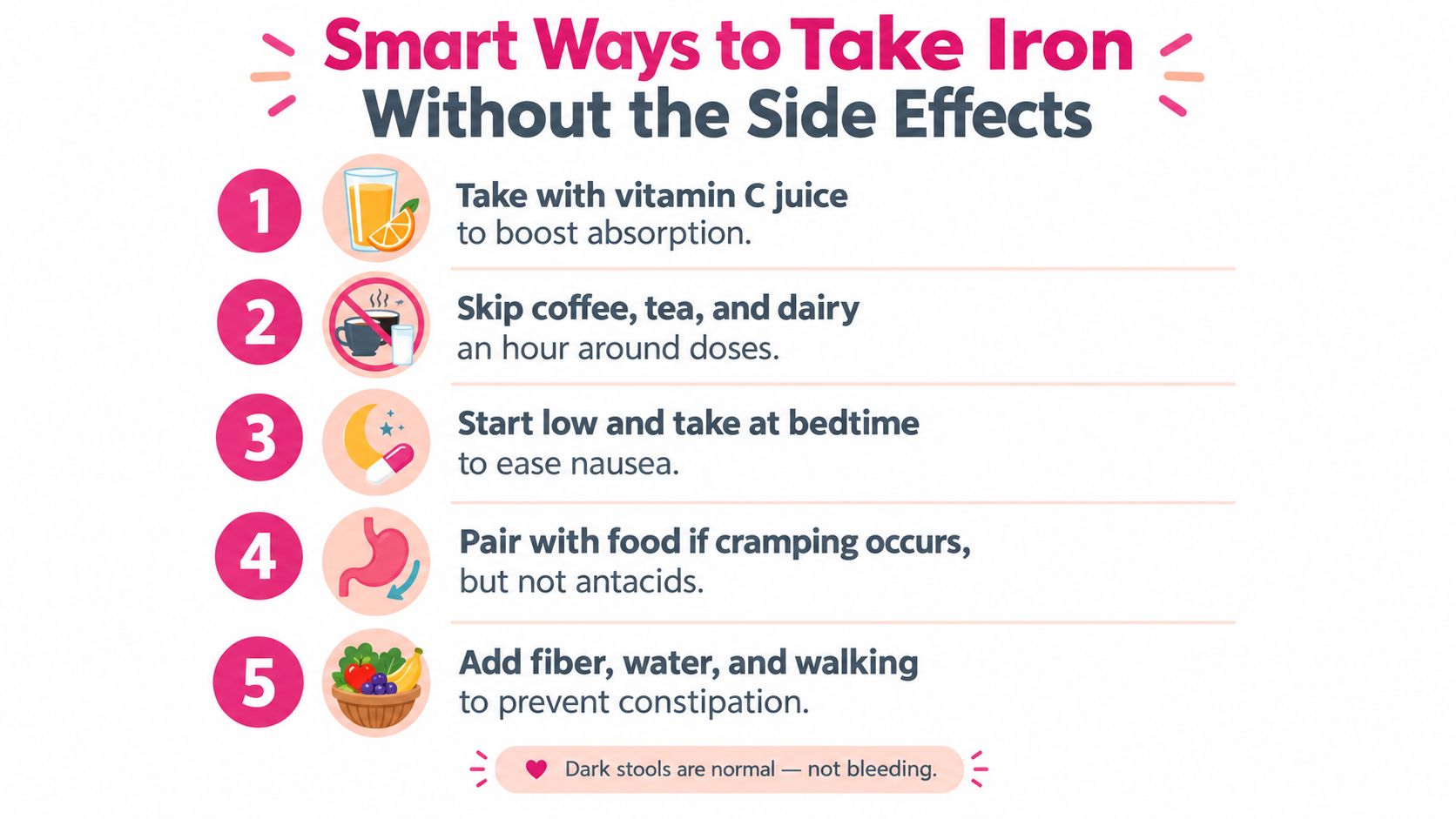
- Use a small snack: Iron is often absorbed best away from food, but taking it with a small snack may be a reasonable compromise if an empty stomach causes nausea or cramping.
- Try bedtime: An evening dose may be easier if morning sickness or daytime nausea is your biggest barrier.
- Ask before splitting: Some products can be divided, while others are delayed-release or designed as a single serving. Check the label or ask a pharmacist first.
- Compare forms: Ferrous bisglycinate, heme iron polypeptide, and carbonyl iron are options some people find gentler than ferrous sulfate. They may also provide a different amount of elemental iron per pill, so compare the actual iron amount, not just the compound name.
- Protect absorption: Vitamin C can improve nonheme iron absorption. Calcium, tea, coffee, and phytate-rich foods can reduce it.
Nonheme iron absorption is limited and regulated by the body, which is why timing and formulation can matter. The peer-reviewed review of iron absorption and supplementation discusses empty-stomach absorption, calcium interference, dietary inhibitors, vitamin C, and the role of individualized approaches when side effects are difficult.
Dark green, brown, or black stools can happen with oral iron and are often expected. Constipation may improve with fluids, fiber-rich foods, gentle movement, and a stool softener if your provider says one is appropriate. Don't double a missed dose, and don't add a second iron product without checking your total intake.
Call your provider promptly for severe abdominal pain, vomiting that prevents you from keeping fluids down, fainting, unusual bleeding, signs of an allergic reaction, or stools that concern you rather than simply looking darker after iron.
If constipation is becoming the reason you skip doses, this practical discussion of constipation from prenatal vitamins may give you ideas to raise at your next visit.
How Iron Plays With Other Nutrients You Take
The timing of a prenatal can matter almost as much as the label. Iron and calcium can compete during absorption, while vitamin C can help the body absorb nonheme iron when you take them together. That doesn't mean you need to organize your whole day around supplements, mama. It means a few small separations can make your routine more sensible.
| Nutrient or substance | Effect on iron | Practical guidance |
|---|---|---|
| Calcium | Can reduce iron absorption when taken together | Separate a calcium supplement, calcium-rich meal, or dairy serving from iron by about two hours, if your provider agrees |
| Vitamin C | Can improve nonheme iron absorption | Pair iron with a vitamin C food such as citrus, strawberries, tomatoes, or bell peppers |
| Coffee and tea | Can inhibit uptake because of dietary compounds | Keep them away from your iron dose when possible |
| Antacids | May interfere with absorption depending on the product and timing | Ask your pharmacist or clinician how to space them |
| Phytates | Can reduce nonheme iron uptake | Don't avoid nutritious beans, grains, nuts, or seeds; focus on overall timing and dietary variety |
A common real-life snag is taking your prenatal with breakfast, then having coffee and yogurt at the same time. If that routine is comfortable and your labs are normal, your clinician may not ask you to change it. If your iron stores are low, moving the prenatal to another time may be useful.
A simple daily rhythm
You might take your prenatal with a small vitamin C-containing snack in the evening, then take a separate calcium supplement at another meal. If nausea is worse at night, your provider may suggest a different schedule or formulation. The right plan is the one that respects both absorption and adherence.
Your prenatal may already contain calcium or other minerals, and you may also use magnesium for a separate reason. Before adding or rearranging products, review the full label and your medication list. This overview of magnesium in prenatal vitamins can help you identify where overlap may occur.
Talking With Your Provider and Choosing a Gentle Prenatal
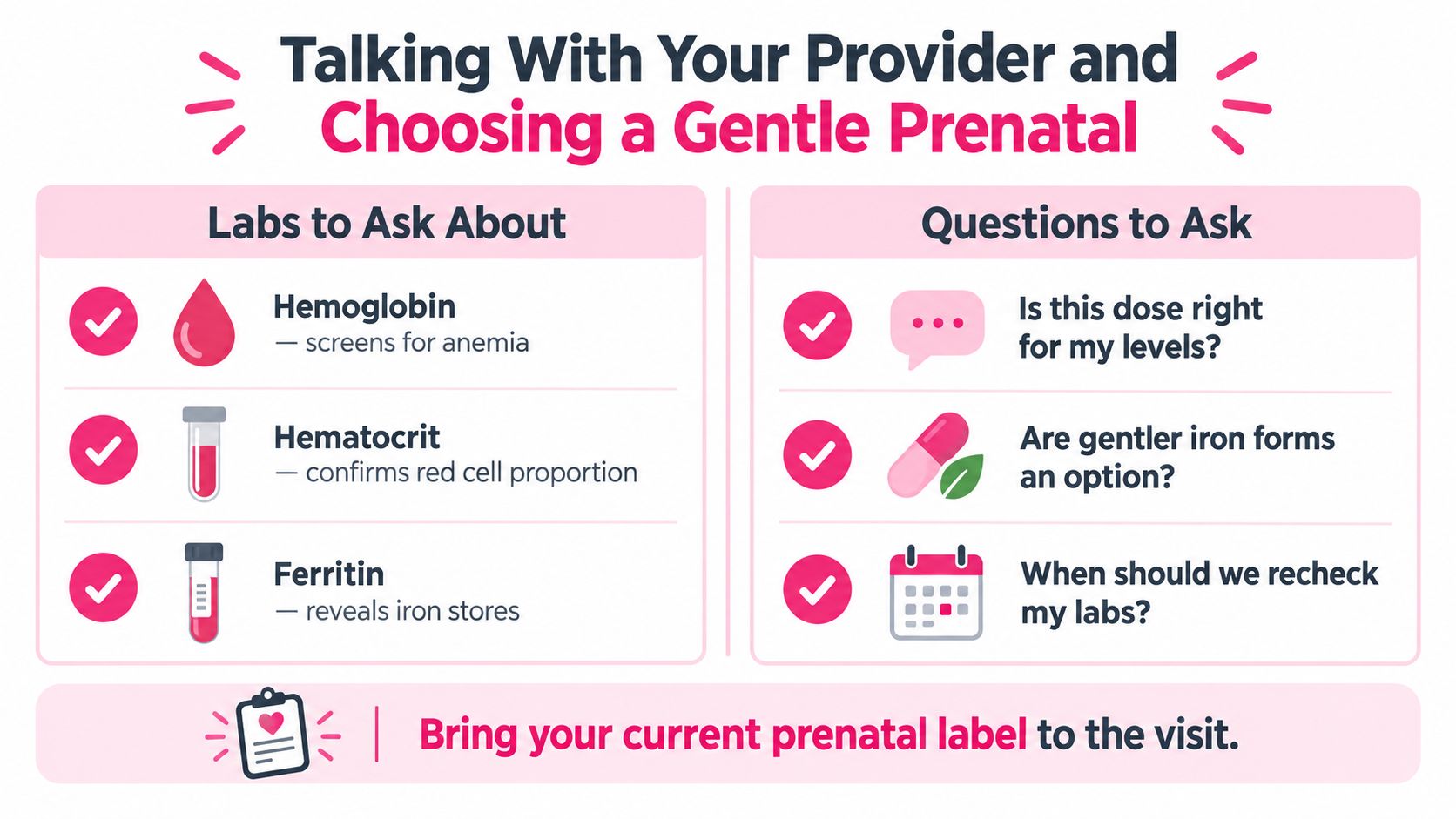
You don't need to arrive at an appointment with a perfect supplement plan. Bring the bottle, a photo of the Supplement Facts panel, and a short list of symptoms. Your provider can connect the label to your bloodwork and decide whether routine prevention is enough.
Labs that give the fuller picture
Hemoglobin helps screen for anemia, but it doesn't always tell the entire iron story. Hematocrit measures the proportion of your blood made up of red blood cells. Ferritin gives information about stored iron, while transferrin saturation helps show how much iron is available for transport.
Ferritin is especially useful when symptoms and hemoglobin don't line up. A person can have declining stores before developing obvious anemia, although inflammation and other health conditions can affect ferritin interpretation. Your clinician may consider ferritin alongside hemoglobin, hematocrit, transferrin saturation, medical history, diet, and pregnancy stage.
The NIH professional fact sheet on iron reports that daily iron supplementation in pregnancy reduced the risk of anemia at term by 70% and iron deficiency at term by 57% in a Cochrane Review. Those findings support routine prevention, but they don't mean every person should take a treatment-level dose or that a prenatal can replace follow-up testing.
Bring these questions to your visit
- Dose: Does the iron amount in my current prenatal fit my bloodwork and pregnancy history?
- Testing: Should we check ferritin as well as hemoglobin and hematocrit?
- Timing: When should my labs be repeated?
- Tolerance: Could a different iron form or schedule help with nausea or constipation?
- Interactions: How should I space iron from calcium, antacids, coffee, tea, or other supplements?
- Escalation: What symptoms should prompt a faster call?
- Treatment: If I have iron-deficiency anemia, do I need prescription oral iron or another option?
Three common situations
If you have a low-risk pregnancy, normal labs, and good tolerance, a typical prenatal dose may be all your provider recommends. Keep taking it consistently, eat a varied diet, and follow the testing schedule your care team gives you.
If ferritin is borderline, your provider may recommend dietary changes, closer monitoring, a different formulation, or additional iron. Borderline results deserve context, not panic. Ask what the result means for you and when you should recheck it.
If testing confirms iron-deficiency anemia, a routine prenatal may not be enough. Your clinician may prescribe a separate treatment dose, adjust the schedule, investigate another cause, or discuss intravenous iron when oral iron isn't tolerated or isn't working adequately. Don't try to recreate a treatment plan by combining multiple over-the-counter products.
The upper limit matters too. Mayo Clinic states that the maximum daily amount of iron for adults is 45 mg from food and supplements combined, although clinicians may prescribe more for a diagnosed condition with monitoring. The same source lists 1,000 mcg per day as the maximum amount of folic acid from supplements for adults. More isn't automatically better, particularly when products overlap.
When choosing a prenatal, look beyond the iron number. Consider the capsule format, serving size, dietary restrictions, delayed-release design, and whether the nutrients you and your provider want are actually present. A guide to choosing a prenatal vitamin can help you compare labels without getting distracted by glossy promises.
Feed Mom & Me Complete Prenatal Vitamin Plus DHA is one option to discuss with your provider. Its product information lists 18 mg of iron, along with DHA, methylfolate, and other prenatal nutrients, so it should be viewed as a formula for routine support rather than a substitute for treatment when labs show anemia. The brand describes itself as women-owned and built by moms for moms, with a vegetarian, soy-free, gluten-free, and dairy-free formula that uses delayed-release capsules and includes peppermint and ginger for palatability.
A prenatal should support your care, not make you feel like you have to solve every lab result alone. If iron leaves you nauseated, constipated, or uncertain, tell your care team early. You deserve a plan that protects your iron status and fits the reality of your pregnancy.
Feed Mom & Me offers prenatal nutrition support, including the Complete Prenatal Vitamin Plus DHA, alongside accessible education for pregnancy and early parenthood. If you're comparing prenatal vitamin with iron options or want a gentler daily routine to discuss with your provider, visit Feed Mom & Me to explore the formula and resources.