
EPA DHA Omega 3 Dosage: Prenatal Guidance for You
Published:Updated:
You're staring at a prenatal label, trying to make sense of fish oil, DHA, EPA, and a serving size that may not even mean one capsule. If you're pregnant, planning to conceive, or breastfeeding, the question is understandable: how much EPA and DHA omega-3 do you need each day?
The answer becomes much clearer when you separate the two fatty acids, compare your intake with pregnancy-specific guidance, and read the Supplement Facts panel instead of relying on the large number on the front of a bottle. Here's a practical guide to help you find a sensible target without turning nutrition into another source of stress.
Table of Contents
- Why DHA and EPA Matter for Your Growing Family
- What the Experts Say About Your Daily Target
- How Dosage Shifts from Preconception to Postpartum
- Food Sources versus Supplements Which Path Fits You
- Reading Supplement Labels to Find Your Actual DHA and EPA
- Safety Limits and What Large Intakes Mean for You
- Making a Simple Daily Routine That Actually Sticks
- Why Many Mamas Choose a Trusted Prenatal Brand
- Key Takeaways and Quick Reference Table
Why DHA and EPA Matter for Your Growing Family
A mama named Lena once held two omega-3 bottles in a pharmacy aisle. Both promised support for pregnancy, but one displayed a large fish oil number while the other highlighted DHA. She wondered whether the bigger number meant better coverage. It didn't necessarily. The useful comparison was the amount of DHA and EPA, not the total oil in the capsule.
DHA, or docosahexaenoic acid, is a long-chain omega-3 that forms part of the structure of brain and retinal cells. EPA, or eicosapentaenoic acid, supports other functions, including normal immune and inflammatory signaling. Think of them as two related building materials. DHA is especially important for cell structure, while EPA contributes to the body's broader communication systems.
During pregnancy, your baby depends on nutrients supplied through you. DHA receives particular attention because the brain and eyes are developing rapidly, and during breastfeeding, DHA can also enter breast milk. That doesn't mean you need to panic over a single missed capsule. Your overall pattern matters more than perfection.
Plant foods such as walnuts, chia, and flax provide ALA, another omega-3 fatty acid. Your body can convert some ALA, but direct DHA and EPA from suitable seafood, algal oil, or a supplement make it easier to identify what you're receiving. For a child-focused explanation of these fats, you can also explore omega-3 fatty acids for kids.
Pregnancy planning also brings practical questions beyond nutrition, including how you'll protect your family financially. A resource on Coveredly policy options for expecting families can help you review that part of preparation separately, while you focus here on your daily nutrient routine.
A calm starting point: You don't need to memorize every omega-3 term. Find the DHA and EPA amounts, compare them with your life-stage target, and ask your healthcare provider about anything unusual in your medical history.
What the Experts Say About Your Daily Target
Major independent guidance now points to a practical baseline rather than one mysterious “ideal” capsule. For women of childbearing age, the commonly cited foundation is at least 250 mg per day of combined DHA and EPA. During pregnancy, guidance commonly adds 100 to 200 mg per day of DHA to that baseline, particularly when seafood intake is limited. The NIH Office of Dietary Supplements pregnancy guidance summarizes recommendations from EFSA and international clinical guidance.
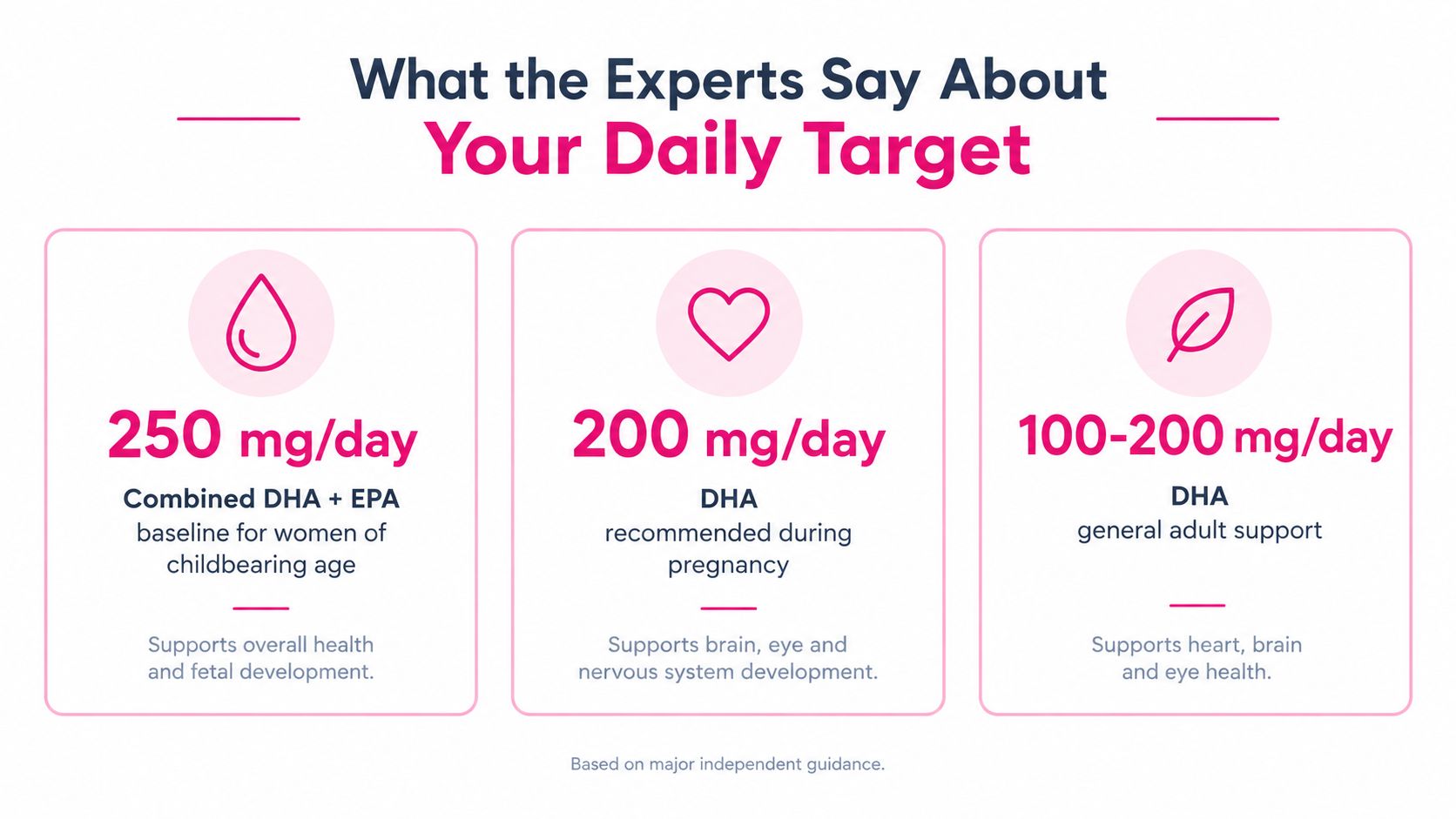
That wording can feel confusing, so break it into layers:
- Baseline: Aim for at least 250 mg/day of combined DHA plus EPA when you're of childbearing age, based on the NIH summary of independent guidance.
- Pregnancy addition: Add 100 to 200 mg/day of DHA during pregnancy, especially if your seafood intake is low.
- Higher clinical discussion: Some guidance says women with low DHA intake or status may benefit from 600 to 1,000 mg/day of DHA or DHA plus EPA, beginning in the second trimester and no later than 20 weeks gestation. Discuss this with your obstetric clinician rather than choosing the higher range independently.
A separate German maternal nutrition recommendation centers pregnancy around 200 mg/day of DHA, obtained from fish or supplements, and explains why prenatal formulas often emphasize DHA specifically. The guidance also notes that 1,000 mg/day of DHA plus EPA may be recommended in selected situations involving low stores and very preterm birth risk. You can review the German maternal DHA guidance for that international perspective.
DHA and EPA aren't interchangeable line by line. DHA is the nutrient most directly emphasized for fetal brain and eye development, while EPA accompanies it as part of combined omega-3 intake. A prenatal label may therefore highlight DHA even when it contains both fatty acids. The DHA versus fish oil pregnancy comparison can help you understand why those label terms aren't synonyms.
How Dosage Shifts from Preconception to Postpartum
Your omega-3 routine can stay surprisingly steady across the parenting journey, even though the reason for paying attention changes.
Before conception
Build a reliable food and supplement pattern before pregnancy if you can. A baseline of at least 250 mg/day of combined DHA and EPA is the central reference for women of childbearing age, and it gives you a clear label-checking starting point. If you're already taking a prenatal, review its DHA amount rather than assuming the formula covers the full omega-3 target.
During pregnancy
Pregnancy guidance commonly adds 100 to 200 mg/day of DHA to the baseline. This is why many prenatal plans prioritize DHA, particularly for women who rarely eat suitable fish. Your clinician may suggest a different amount if you have low intake, low status, a high-risk pregnancy, or another relevant medical consideration.
While breastfeeding
Breastfeeding keeps DHA relevant because your milk is one route through which your baby receives fatty acids. The DHA supplement guide for breastfeeding mothers offers additional maternal nutrition context, but your own clinician should help you account for your diet, prenatal formula, and any postpartum health needs.
A simple way to think about the three stages is:
- Preconception: Establish a dependable baseline.
- Pregnancy: Check that your routine includes the pregnancy-specific DHA addition.
- Postpartum: Continue reviewing your intake while considering breastfeeding, diet, and your healthcare provider's advice.
The target doesn't need to become a daily math exercise. Choose a source you tolerate, keep the label accessible, and adjust only when your care team gives you a reason to do so.
Food Sources versus Supplements Which Path Fits You
Food and supplements can serve the same nutritional goal in different ways. Suitable fatty fish provides DHA and EPA directly, along with protein and other nutrients. A supplement offers a measured serving that may be easier to repeat when nausea, a busy schedule, food preferences, or limited access to seafood gets in the way.
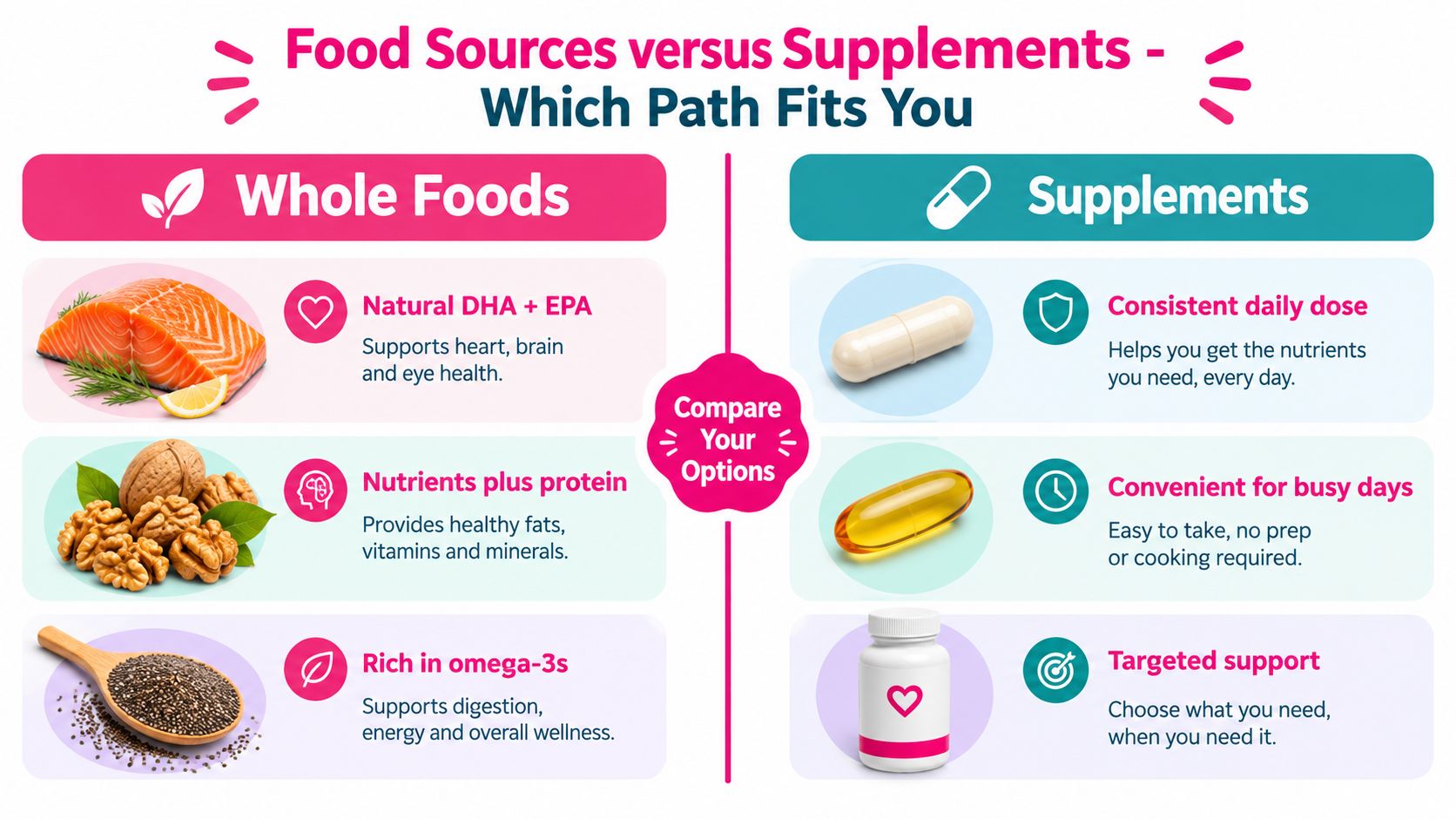
If fish fits comfortably into your meals, it can be part of a balanced pregnancy eating pattern. Choose pregnancy-appropriate, lower-mercury options and follow current guidance from your obstetric clinician or public health authority. If fish doesn't appeal to you, an algal DHA product may offer a vegetarian route, while fish oil may suit someone comfortable with marine ingredients.
A supplement makes the most sense when you want consistency or when your meals don't reliably provide DHA and EPA. It also lets you see the exact amount on the label, although you still need to check whether the listed serving matches your pregnancy target.
| Your situation | A practical starting approach |
|---|---|
| You regularly eat suitable fish | Track the overall pattern and discuss whether your food intake appears to cover your target. |
| Fish triggers nausea or simply isn't appealing | Consider a pregnancy-appropriate DHA or omega-3 supplement after reviewing the label with your provider. |
| You follow a vegetarian diet | Look for an algal source and confirm the actual DHA amount. |
| You use a prenatal already | Add the prenatal's DHA to any separate omega-3 product before deciding whether you need more. |
Walnuts, chia, and flax can still contribute valuable ALA and variety to your diet, but they shouldn't be treated as a direct substitute for a clearly measured DHA source. For meal ideas and a more detailed food discussion, browse foods rich in DHA.
There's no prize for choosing one path over the other. Many mamas use a combination of nourishing meals and a supplement to make daily intake more predictable.
Reading Supplement Labels to Find Your Actual DHA and EPA
The front of a bottle can make omega-3 look simple. The back label tells you what you're really getting.
Start with the Supplement Facts panel and locate the serving size. Then find the individual amounts of DHA and EPA. Add those amounts together. That combined figure is the number to compare with your daily target.
The label numbers that matter
- Total fish oil: This describes the entire oil quantity, not necessarily the DHA and EPA content.
- DHA: This is the pregnancy-focused omega-3 to watch closely.
- EPA: Add it to DHA when you're calculating combined intake.
- Serving size: Confirm whether the listed amounts apply to one capsule, several capsules, or a liquid measure.
- Other ingredients: Look for duplicated vitamins, herbal ingredients, allergens, or oils in the rest of your supplement routine.
A peer-reviewed review indexed in PubMed Central reports that many prenatal vitamins contain up to 200 to 300 mg of DHA. That means a prenatal may provide part of the pregnancy target, but you shouldn't assume every formula reaches the higher end of expert recommendations.
Label habit: Write down the DHA and EPA amounts from every omega-3-containing product you take. Compare the daily totals, not the marketing language.
A product showing a large total fish oil number may still provide a modest amount of DHA and EPA. Conversely, a smaller-looking bottle may provide a more concentrated serving. For a broader explanation of serving sizes and Supplement Facts panels, you can read Peak Performance's supplement guide.
Finally, look for clear sourcing, expiration information, directions, and quality testing details. The third-party-tested supplement discussion can help you think through quality questions without confusing testing language with dosage.
Safety Limits and What Large Intakes Mean for You
You are checking your prenatal label after adding a separate omega-3 capsule. The totals matter more than the size of either bottle. During pregnancy, the goal is a sensible combined intake, not the largest dose available.
The U.S. Food and Drug Administration recommends no more than 3 g/day of combined EPA and DHA, including up to 2 g/day from dietary supplements, according to NIH guidance on omega-3 fatty acid safety. Count every relevant source, including your prenatal, standalone omega-3, and other products containing DHA or EPA.
Use the label in three steps
- Find the serving size.
- Add the listed DHA and EPA amounts.
- Multiply that total by the servings you take each day, then add other supplements.
Pregnancy guidance also reports that intakes up to 1,000 mg/day of DHA or combined DHA and EPA do not raise safety concerns in pregnant women. That figure is a reference point, not a personal prescription. Higher amounts may be discussed when intake or status is low, with the dose chosen alongside your obstetric provider.
Ask before increasing your intake if you take medication that affects clotting, have a bleeding condition, have a planned procedure, or use several supplements. Cod liver oil needs its own label check because it may provide vitamins A and D as well as omega-3.
A fishy aftertaste or mild digestive discomfort can occur. Persistent symptoms deserve a conversation with your clinician. Use the supplement label as a set of facts for a shared decision with your care team, rather than treating it as individualized medical advice.
Making a Simple Daily Routine That Actually Sticks
A routine has to work on difficult days, whether you are tired, nauseated, or holding a sleepy baby. Attach your omega-3 to a meal already built into your day, such as breakfast, lunch, or dinner. Food can also make the supplement gentler on your stomach.

Choose the anchor that matches your real schedule:
- Breakfast anchor: Keep the bottle beside an item you use every morning.
- Dinner anchor: Pair it with your most dependable meal if mornings change often.
- Prenatal anchor: Store both products together, then check each serving before taking them.
- Refill anchor: Set a reminder when the bottle is running low, so a missed delivery does not break the habit.
A visible cue works like a small signpost. It connects the capsule with an action you already remember, instead of asking you to create a separate task.
If you forget a dose, do not double the next one. Resume your usual schedule unless your healthcare provider has given you different instructions. Trouble swallowing is also a reason to ask whether the product can be opened or whether another form would suit you.
The FDA boundary described earlier in this article applies here too: no more than 3 g/day combined, including up to 2 g/day from supplements. Add the DHA and EPA from your prenatal, standalone omega-3, and other products before deciding whether your routine fits that limit.
If reflux continues after you take the supplement with a meal, ask your provider or pharmacist about its form, ingredients, and whether another source may suit you better.
Why Many Mamas Choose a Trusted Prenatal Brand
A prenatal can simplify the daily puzzle by bringing several pregnancy-focused nutrients into one routine, but it still needs label review. Look for the DHA amount, serving size, ingredient list, allergen information, and directions. A single product may not provide every part of your personal omega-3 target, so compare it with your diet and any separate supplement.
Feed Mom & Me is a women-founded brand built by moms for moms. Its Complete Prenatal Vitamin Plus DHA is a vegetarian formula described as soy-free, gluten-free, dairy-free, non-GMO, and free from artificial colors, flavors, and chemical additives. The product also uses delayed-release vegetable capsules and includes peppermint and organic ginger as part of its formulation.
The product provides 50 mg of DHA per serving, with directions to take 3 vitamins daily, according to the product information supplied for this article. That amount is useful to know because it shows why a mama should compare the label with the pregnancy-specific DHA target rather than assume that “plus DHA” means full coverage.
A prenatal brand can make consistency easier when it fits your preferences and your stomach. Delayed-release capsules may appeal to someone sensitive to standard prenatal pills, and the site says the capsules can be opened and added to smoothies. Still, check every ingredient with your healthcare provider, especially if you have allergies, take medication, or are combining products.
For broader family-routine ideas, HYDAWAY healthy parents tips offers another practical resource. Use any brand as one part of your plan, not as a replacement for individualized medical advice.
Key Takeaways and Quick Reference Table
By now, the label should feel less like a riddle. You're looking for the actual DHA and EPA amounts, comparing them with your stage of life, and checking the combined total across all supplements.
| Stage | Daily Target | Notes |
|---|---|---|
| Women of childbearing age | At least 250 mg/day combined DHA and EPA | Use this as a baseline reference from independent guidance. |
| Pregnancy | Baseline plus 100 to 200 mg/day DHA | DHA is emphasized when seafood intake is limited. |
| Pregnancy with low DHA intake or status | Up to 600 to 1,000 mg/day DHA or DHA plus EPA may be discussed | Use higher targets only with your healthcare provider's guidance. |
| Breastfeeding | At least 250 mg/day combined DHA and EPA, with pregnancy-specific guidance often adding DHA | Account for your diet, prenatal, and postpartum needs. |
| Total from all sources | No more than 3 g/day combined EPA and DHA | FDA guidance includes up to 2 g/day from dietary supplements. |
Keep these label checks handy:
- Read DHA and EPA separately. Total fish oil isn't the same as active omega-3 content.
- Check the serving size. The listed amount may apply to more than one capsule.
- Add overlapping products. Include your prenatal, omega-3 supplement, and fortified products.
- Ask before using a high dose. Your provider can account for medications, bleeding risks, allergies, and pregnancy history.
- Choose consistency over perfection. A tolerable routine is more useful than a product you avoid taking.
If you're looking for one option to evaluate, Feed Mom & Me Complete Prenatal Vitamin Plus DHA combines prenatal nutrients with DHA and also emphasizes choline, selenium, and methylfolate in its formulation. Review its 50 mg DHA per serving against your personal target, then discuss whether you need additional DHA with your clinician.
Feed Mom & Me offers a women-founded prenatal routine with DHA, choline, selenium, methylfolate, peppermint, and organic ginger in a delayed-release vegetarian capsule formula. Visit Feed Mom & Me to review the Complete Prenatal Vitamin Plus DHA and choose the next step that fits your pregnancy or postpartum plan.