
Soy Free Prenatal Vitamins with DHA: A Mama's Guide
Published:Updated:
You're standing in the prenatal aisle with your phone in one hand and two nearly identical bottles in the other. One says “prenatal with DHA,” the other says “vegetarian,” and neither makes it obvious whether soy is hiding in the capsule, whether the DHA comes from fish, or whether you'll be able to swallow it on a queasy morning.
The question is simple, but the label rarely is: Can you find a soy-free prenatal with a meaningful DHA dose that also covers the nutrients pregnancy demands? You're looking for something compatible with your allergies or dietary preferences, gentle enough to take consistently, and transparent enough that you don't have to decode every ingredient like a nutrition detective.
This guide walks through that decision one piece at a time. If you're also preparing for a new baby and looking for thoughtful support beyond supplements, you can find the perfect gift with That Blanket for an expecting parent. For a closer look at how prenatal formulas differ, this guide to the best prenatal multivitamin with DHA can help you compare your options.
Table of Contents
- What You Really Want From a Soy Free Prenatal with DHA
- Why DHA Belongs in Your Prenatal in the First Place
- How to Read a Prenatal Label Without Losing Your Mind
- Algae vs Fish DHA and What Vegetarian Really Means
- Tolerability Features That Make a Prenatal Easier to Take
- Subscriptions, Bundles, and Staying Stocked All Pregnancy Long
- Smart Questions to Bring to Your Next Prenatal Visit
What You Really Want From a Soy Free Prenatal with DHA
A practical soy-free prenatal wish list often includes more than a single claim on the front of the bottle. You may want:
- Soy-free ingredients and manufacturing information, especially if you react to soy or avoid hidden derivatives.
- At least 200 mg of DHA, a commonly discussed pregnancy target supported by clinical guidance and reviews. Cleveland Clinic's review of prenatal vitamins notes that pregnant people should aim for at least 200 mg of DHA daily.
- A clearly identified DHA source, such as algae or fish oil.
- Methylfolate, if you and your healthcare provider prefer L-5-MTHF instead of folic acid.
- Choline, since the pregnancy adequate intake is 450 mg per day. The NIH-hosted review on choline and pregnancy explains why this nutrient deserves attention alongside folate and DHA. Read the review on choline during pregnancy.
- A tolerable capsule, particularly if nausea, reflux, constipation, or fishy aftertaste already makes supplements difficult.
- A vegetarian format, when gelatin or animal-derived ingredients don't fit your choices.
The challenge is that “complete” doesn't always mean “right for you.” A formula can include plenty of nutrients and still contain a soy-derived inactive ingredient, use fish oil when you need algae DHA, or provide a capsule so large that you skip it half the time.
A prenatal only helps when you can take it consistently.
That's why the best choice isn't necessarily the bottle with the longest Supplement Facts panel. It's the one whose ingredients, source, dose, format, and quality controls match your medical needs and daily reality. Your OB, midwife, or dietitian can help personalize the decision, especially if you have allergies, follow a restrictive diet, or have been advised to take additional nutrients.
Why DHA Belongs in Your Prenatal in the First Place
DHA, or docosahexaenoic acid, is an omega-3 fatty acid involved in fetal brain and eye development. The body's demand for DHA becomes especially relevant later in pregnancy, but building a steady intake doesn't need to wait until the third trimester.
The U.S. NIH summarizes guidance that recommends at least 250 mg per day of DHA plus EPA for women of childbearing age, with an additional 100 to 200 mg per day of DHA during pregnancy. It also describes guidance recommending 600 to 1,000 mg per day of DHA plus EPA or DHA alone for pregnant people with low DHA intake, beginning in the second trimester and no later than 20 weeks' gestation. Review the NIH pregnancy and omega-3 guidance.
Those figures aren't a reason to self-prescribe a high-dose supplement. They're a reminder to check what your prenatal provides and ask whether your diet and medical history call for more. Many prenatal products contain roughly 200 to 300 mg of DHA, while some guidance discusses higher supplemental amounts for people with low baseline intake. See the peer-reviewed review of DHA recommendations in pregnancy.
DHA and EPA are related but not interchangeable
Both DHA and EPA are omega-3 fats, but they play different roles in the body. Prenatal labels often emphasize DHA because pregnancy guidance specifically discusses DHA intake in relation to fetal development. A product may list both nutrients, or it may focus on DHA alone.
Clinical evidence has also connected omega-3 supplementation with lower risks of preterm birth in pooled trials. Expert guidance cites a reduction in preterm birth risk with a relative risk of 0.89, with a 95% confidence interval of 0.81 to 0.97, across 26 randomized controlled trials involving 10,304 participants. The same evidence reports a relative risk of 0.58, with a 95% confidence interval of 0.44 to 0.77, for early preterm birth across 9 trials involving 5,204 participants. Review the cited evidence and guidance.
A soy-free combined prenatal can also simplify your routine. Some people who avoid fish look for algae DHA, while others use fish oil separately. Checking the inactive ingredients matters because a standalone omega-3 product may include excipients or vitamin E ingredients that don't fit your allergy needs. If you're comparing combined formulas with separate capsules, bring both labels to your prenatal appointment. You can also read more about DHA benefits during pregnancy.
How to Read a Prenatal Label Without Losing Your Mind
Start at the front of the bottle, but don't stop there. “Soy-free” is a useful claim only when the company clearly explains ingredients and allergen controls.
Begin with the active ingredients
Look for the nutrient amounts first. A prenatal label should identify the form and quantity of its folate, iron, vitamin D, choline, and DHA rather than hiding them inside an unnamed blend.
Then check the folate form. Folic acid is a synthetic form of folate used in many supplements. Methylfolate, often listed as L-5-MTHF, is a form some people prefer, particularly when their healthcare provider has discussed an MTHFR variant or a personal response to folic acid. An MTHFR result doesn't automatically tell you which prenatal to choose, so use it as a conversation point with your clinician rather than a reason to make a major change alone.
Choline deserves its own line of attention. The pregnancy adequate intake is 450 mg per day, compared with 425 mg per day for women of reproductive age and 550 mg per day during lactation, according to the NIH-hosted review cited earlier. Since soy is one dietary source of choline, people avoiding soy may want to look carefully at food intake and whether their prenatal includes choline.
Then inspect the Other Ingredients panel
Soy can appear under several names, including:
- Soy lecithin, an emulsifier used in some supplements.
- Soy oil or soybean oil, which may appear as a carrier or processing ingredient.
- Tocopherols derived from soy, a form of vitamin E sometimes used to protect oils from oxidation.
- Soy protein or soy flour, which may be easier to recognize but still belongs on the checklist.
For a strict avoidance plan, don't rely only on the words “soy-free.” Check the full panel and ask the manufacturer whether the product is made on shared equipment. Also scan for fish, shellfish, milk, gluten, and tree nuts if those matter to you.
Know what testing seals can and can't tell you
Marks such as USP and NSF indicate that an outside organization has evaluated specific aspects of a product, such as identity, purity, strength, or manufacturing controls. ConsumerLab is another independent testing organization, but products may be reviewed through different programs, so read the actual claim behind the seal.
A quick label checklist can keep the shopping trip manageable:
- Folate form: Is it folic acid, methylfolate, or both?
- DHA amount: Does the serving provide a meaningful amount for your plan?
- DHA source: Is it algae, fish oil, or unspecified?
- Iron amount and form: Could it worsen constipation or nausea?
- Inactive ingredients: Do soy derivatives appear anywhere?
- Allergen statement: Does it address shared equipment or facilities?
- Quality verification: Is the testing organization named clearly?
For a broader label-reading framework, use this guide on how to choose a prenatal vitamin.
Algae vs Fish DHA and What Vegetarian Really Means
Algae and fish oil can both provide DHA, but they fit different routines. Fish oil DHA comes from marine fish and may suit pescatarian shoppers who already tolerate fish-based supplements. Algae DHA comes from cultivated algae, the original source of DHA that fish obtain through the food chain, and it usually fits vegetarian or vegan preferences more naturally.
The exact DHA concentration varies by product, so compare the amount per serving rather than assuming one source is automatically stronger. Also check whether the softgel or capsule contains gelatin. A “vegetarian capsule” usually refers to a plant-based shell, commonly cellulose, while a gelatin capsule is animal-derived.
| Feature | Algae DHA | Fish Oil DHA |
|---|---|---|
| Source | Cultivated algae | Oil extracted from fish |
| Dietary fit | Often suitable for vegetarian and vegan plans | May suit pescatarian plans |
| Fish allergy concern | May be a better fit, but verify the full allergen statement | Requires careful review for fish allergy |
| Capsule format | May be available in vegetarian capsules | Often sold in softgels, which may contain gelatin |
| Taste and tolerance | Can still produce an aftertaste, depending on the formula | May cause fishy burps for some people |
| Soy-free suitability | Depends on all ingredients and facility controls | Depends on all ingredients and facility controls |
“Vegetarian” doesn't automatically mean “free from every allergen.” Shared equipment can matter, especially if you have a serious reaction. Ask whether the manufacturer tests for cross-contact and whether the product is packaged in a facility that handles soy, fish, shellfish, dairy, or tree nuts.
If your prenatal contains little or no DHA, a separate algae or fish-oil supplement may be reasonable, but it should fit your overall nutrient plan. A separate capsule also gives you more control over source and dose, while a combined product removes one item from your daily routine. You can compare formats in this overview of an algae-based DHA supplement.
The simplest decision rule is this: if you regularly eat fish and tolerate fish oil, fish-derived DHA may fit. If you avoid fish or want a vegetarian option, algae DHA is often the cleaner match. If you have an allergy, let your clinician and the manufacturer's allergen statement make the final call.
Tolerability Features That Make a Prenatal Easier to Take
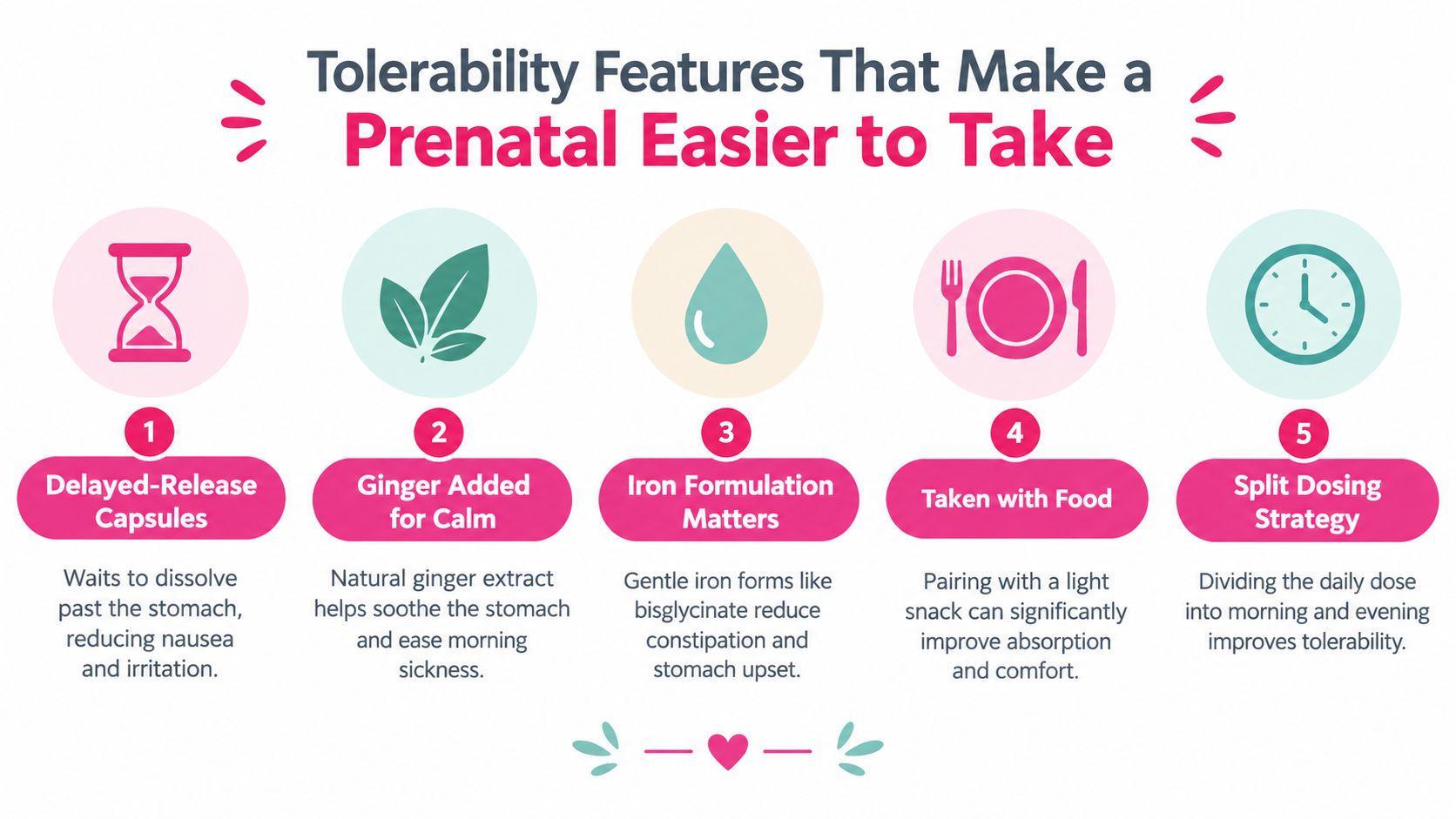
A prenatal can look excellent on paper and still fail your real-life test if it triggers nausea every morning. Delayed-release capsules are designed to dissolve farther along the digestive tract rather than opening immediately in the stomach. That may improve comfort for some people, although individual responses vary.
Other design choices include smaller capsules, beadlets, powders, or split servings. Peppermint may make the experience more pleasant, while ginger has a stronger evidence base for pregnancy-related nausea. A peer-reviewed review examined ginger doses from 250 mg to 1,000 mg per day and reported reductions in vomiting episodes, nausea severity, and symptom duration. Read the review of ginger for nausea and vomiting in pregnancy.
Another review found that ginger reduced mild-to-moderate nausea and vomiting before 16 weeks' gestation and reported no increase in congenital abnormalities, prenatal mortality, fetal death, low birth weight, or low Apgar scores with ginger use in pregnancy. Review the evidence on ginger during pregnancy. Still, tell your healthcare provider about the amount and form you plan to take, especially if you use other supplements or medications.
Watch for practical trouble spots:
- Iron on an empty stomach: Iron can worsen nausea or constipation for some people. Ask whether a different form, timing plan, or separate dose would be appropriate.
- Strong fishy odor: A powerful smell can make a difficult morning harder, especially when the DHA capsule has been stored in warmth.
- Large tablets: A “one-a-day” product isn't helpful if the tablet is too large to swallow.
- Unclear serving instructions: Confirm whether the listed nutrients come from one capsule or a multi-capsule serving.
- Added botanicals: Check every herb with your healthcare provider instead of assuming “natural” means suitable for you.
A prenatal that comes back up isn't supporting your routine. Tolerability is a health consideration, not a cosmetic preference. For more nausea-focused ideas, see this guide to the best prenatal vitamin for nausea.
Here's a visual walkthrough of the design features that may make a prenatal easier to manage:
Subscriptions, Bundles, and Staying Stocked All Pregnancy Long
Running out of a prenatal late in pregnancy is frustrating, but it's also preventable. Before choosing a subscription, check how often the company ships, whether you can pause or change the delivery date, and how cancellation works. A monthly auto-ship plan may suit you if your needs change often. A multi-month bundle may reduce decisions and make it easier to keep the same formula nearby.
Think about the moments that disrupt routines:
- Nausea gaps: If you can't tolerate your usual capsule for a while, avoid letting the supply run down before you find an alternative.
- Travel: Keep enough product for the trip and store it in the original container.
- Postpartum continuation: Ask your clinician whether continuing the prenatal or DHA plan during breastfeeding makes sense for you.
- Dose changes: If your provider changes your iron or adds a separate nutrient, review your remaining supply before placing another order.
Subscription pricing and bundle value vary by company, so compare the total order cost, shipping terms, renewal schedule, and cancellation policy. Don't assume a larger package is cheaper until you calculate the cost per serving. If you use a separate DHA softgel, include that product in the comparison instead of looking only at the prenatal bottle.
Store capsules in a cool, dry place away from humidity, heat, and direct sunlight. A bathroom cabinet may be convenient, but shower moisture can be a poor match for supplements. Keep the lid closed and follow the expiration date. If the product develops a strong rancid odor, ask the manufacturer or pharmacist whether it should be replaced.
Smart Questions to Bring to Your Next Prenatal Visit
“More complete” sounds reassuring, but more nutrients aren't automatically better. A formula can combine several products and unintentionally push your total intake higher than your clinician intended, especially when you add separate iron, vitamin D, vitamin A, or DHA.
Ask about your personal nutrient plan
Bring the bottle, a photo of the Supplement Facts panel, and a list of every separate supplement you take. Ask focused questions such as:
- Do I need extra DHA beyond what's in this prenatal?
- Does my diet provide enough choline, or should I look for a prenatal that includes it?
- Should I use methylfolate or folic acid based on my history and any MTHFR testing?
- Is the iron amount and form appropriate for my labs and digestion?
- Could any of my supplements duplicate vitamin A, iron, or another nutrient?
The choline and DHA relationship is worth discussing, too. An NIH-hosted randomized controlled trial found that prenatal choline supplementation during the second and third trimesters significantly improved biomarkers of maternal DHA status in participants who were already consuming supplemental DHA. Review the randomized trial on choline and maternal DHA status.
Ask how quality and allergen controls work
A testing seal can be useful, but it doesn't answer every question. Ask whether the finished product is tested by USP, NSF, ConsumerLab, or another named organization, and what that testing covers. You can also ask for a Certificate of Analysis, or COA.
A COA may show test results for a specific production batch, such as identity, potency, microbial limits, heavy metals, or contaminants. The useful questions are whether the document applies to the exact product and batch, whether an independent laboratory performed the testing, and whether the results meet a stated standard.
If soy avoidance is medically important, ask:
- Is soy present in the active or inactive ingredients?
- Is the product made on shared equipment with soy, fish, shellfish, dairy, gluten, or tree nuts?
- Does the company test for cross-contact, or only review supplier paperwork?
- Are the capsule shell and vitamin E source soy-free?
- How should the product be stored so the oils remain stable through the expiration date?
Remember that upper limits matter
Fat-soluble vitamins, including vitamin A, can accumulate in the body, so taking multiple products deserves caution. Iron can also create problems when the amount doesn't match your needs, particularly if you're combining a prenatal with a separate iron product.
A product reference for prenatal DHA warns that formulas may contain allergens such as soy, fish, or shellfish, and consumer testing has found that some prenatal supplements exceed tolerable upper intake levels for certain nutrients. That's why “more complete” doesn't automatically mean safer. Review the prenatal DHA safety and ingredient information.
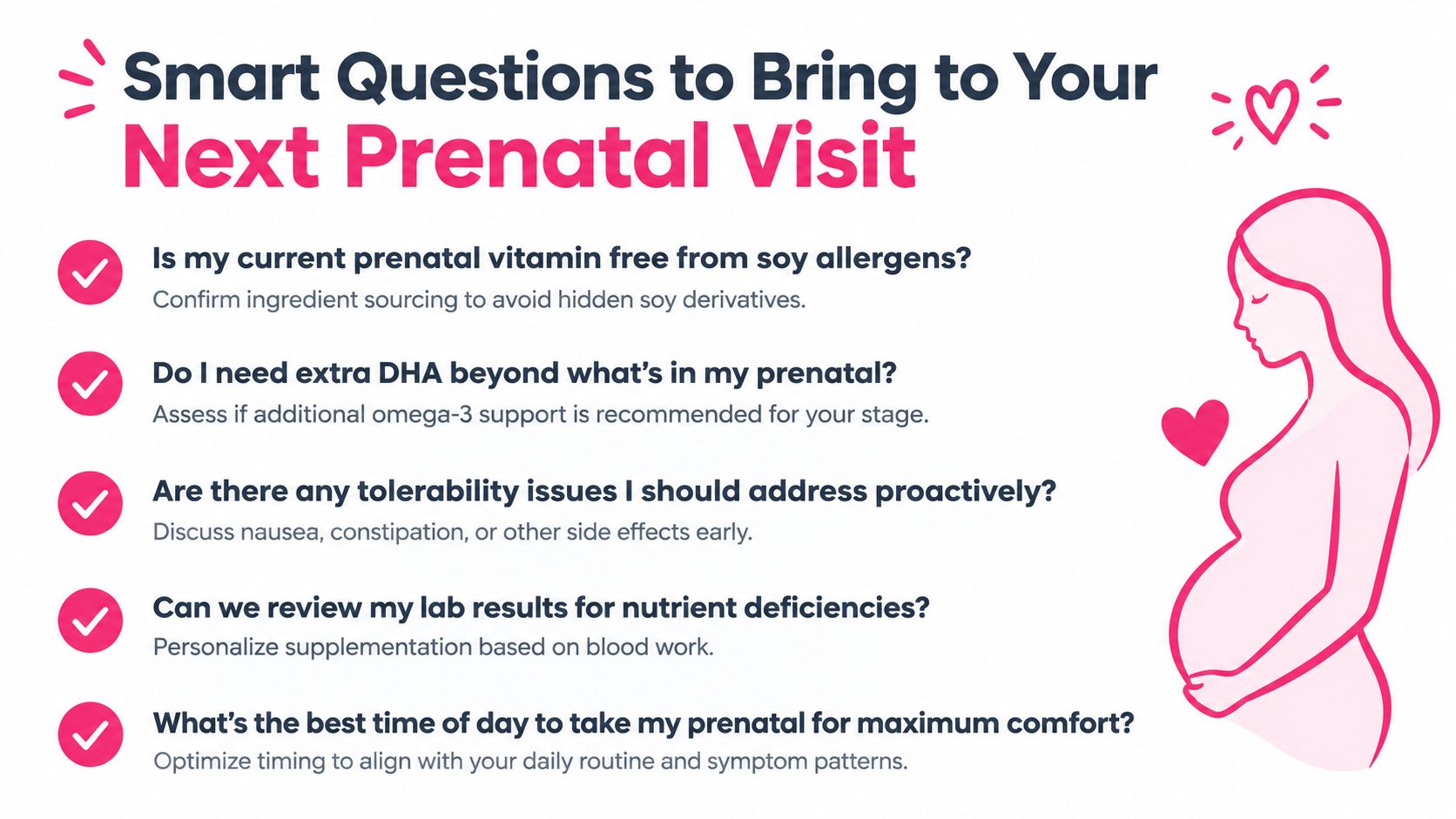
Bring a short list, not the entire internet. Start with your allergy concerns, DHA needs, folate preference, tolerability symptoms, and recent lab results.
Before your appointment, write down the three questions that would change your decision. That might be whether algae DHA fits your allergy plan, whether your current iron amount is appropriate, or whether your prenatal already covers enough choline. A focused conversation gives your provider room to tailor advice to your pregnancy instead of reviewing every supplement aisle option at once.
Feed Mom & Me offers a Complete Prenatal Vitamin Plus DHA, along with prenatal bundles and subscription options designed to support routines from preconception through postpartum. Its formula is described as vegetarian, soy-free, gluten-free, and dairy-free, with DHA, choline, iron, and methylfolate included for families comparing soy free prenatal vitamins with DHA. Visit Feed Mom & Me to review the product details and choose the questions you'd like to bring to your healthcare provider.