
DHA Supplement Vegetarian Guide for Pregnant Moms
Published:Updated:
Your prenatal label says "vegetarian DHA" in friendly green letters, so why does your midwife still ask how many milligrams you're getting? Because the word tells you where the DHA came from, and the number tells you how much reaches your body. Those are two different questions, and only one of them is printed in large type on the front of the bottle.
Here's the gap most buying guides skate past. An algae-based DHA supplement solves the fish problem completely. It doesn't solve the dose question at all. A capsule can be vegan, mercury-free, sustainably produced and still carry far less DHA than the target your clinician has in mind for you and your baby.
You don't need a nutrition degree to close that gap. You need three things: a target number from someone who knows your pregnancy, the DHA milligrams on the Supplement Facts panel, and a capsule gentle enough that you'll still be taking it in your third trimester.
Table of Contents
- DHA Amounts Experts Recommend in Pregnancy
- Why Algae Is the Vegetarian Source of DHA
- Does Algal DHA Absorb as Well as Fish Oil?
- How to Read a DHA Label Before You Buy
- What Pregnancy Trials Found About Algal DHA
- Filling the Other Gaps in a Vegetarian Diet
- When Should Your DHA Dose Change, and What Should You Ask?
DHA Amounts Experts Recommend in Pregnancy
Screenshot this before you shop. These are the numbers a clinician is likely holding in mind when they look at your bottle.
| Guidance | Amount | What it means for you |
|---|---|---|
| Combined DHA and EPA for women of childbearing age (NIH summary of expert advice) | At least 250 mg per day | Baseline target from food and supplements together |
| Extra DHA during pregnancy (NIH summary of expert advice) | An additional 100 to 200 mg per day | Added on top of the baseline |
| FAO/WHO pregnancy target (cited in trial literature) | 200 to 300 mg DHA per day | Minimum DHA target for pregnancy |
| Omega-3 ALA adequate intake in pregnancy (NIH) | 1.4 g per day | Plant ALA, not preformed DHA |
| Omega-3 ALA adequate intake during lactation (NIH) | 1.3 g per day | Plant ALA, not preformed DHA |
| Upper range discussed in research | Up to 1,000 mg DHA per day | Research-level dosing, not a self-selected dose |
Read the top two rows as a stack, not a menu. The 250 mg of combined DHA and EPA is the baseline for women of childbearing age, and the pregnancy top-up of 100 to 200 mg of DHA sits on top of it. Together they give you a working range to compare against any label.
International expert guidance commonly lands on 200 to 300 mg of DHA per day as a pregnancy target, even though the U.S. National Academy of Medicine has never set a formal DHA Dietary Reference Intake, and the pregnancy trial literature records intakes up to 1,000 mg per day during pregnancy and lactation as a range under discussion. What U.S. guidance does set is clearer: the NIH omega-3 guidance for health professionals lists an adequate intake for total omega-3 ALA of 1.4 g per day in pregnancy and 1.3 g per day during lactation for women 19 to 50, and no specific recommended intake for DHA or EPA themselves.
Three plain truths keep that table from feeling like a wall of numbers.
- These are targets, not prescriptions. A target is a destination your clinician helps you pick. Nobody should be reading a table on the internet and doubling their dose on a Tuesday.
- Plant ALA is not the same thing as DHA. The 1.4 g and 1.3 g rows are grams of a precursor fat. A flaxseed muffin doesn't fill the DHA row.
- Your number depends on your plate and your history. How much seafood you eat, what your prenatal already contains, and any bleeding-risk medication all move the answer.
Think of DHA as bricks arriving at a construction site. Your baby's brain and eyes are going up fast, and DHA is a structural fat concentrated in exactly those tissues, so the crew needs a steady delivery schedule rather than one dramatic truckload. A modest delivery most days builds better than a big Monday and an empty rest of the week. That's why the weekly total matters more than any single capsule.
Your action this week: find the DHA milligrams per serving on the bottle you already own, write them down, and put that number next to the target your clinician gives you. If you'd like the arithmetic walked through month by month, how much DHA you need during pregnancy covers the same figures in more detail. And if you take a blood thinner or have a condition that affects bleeding, raise it before you change any dose.
Why Algae Is the Vegetarian Source of DHA
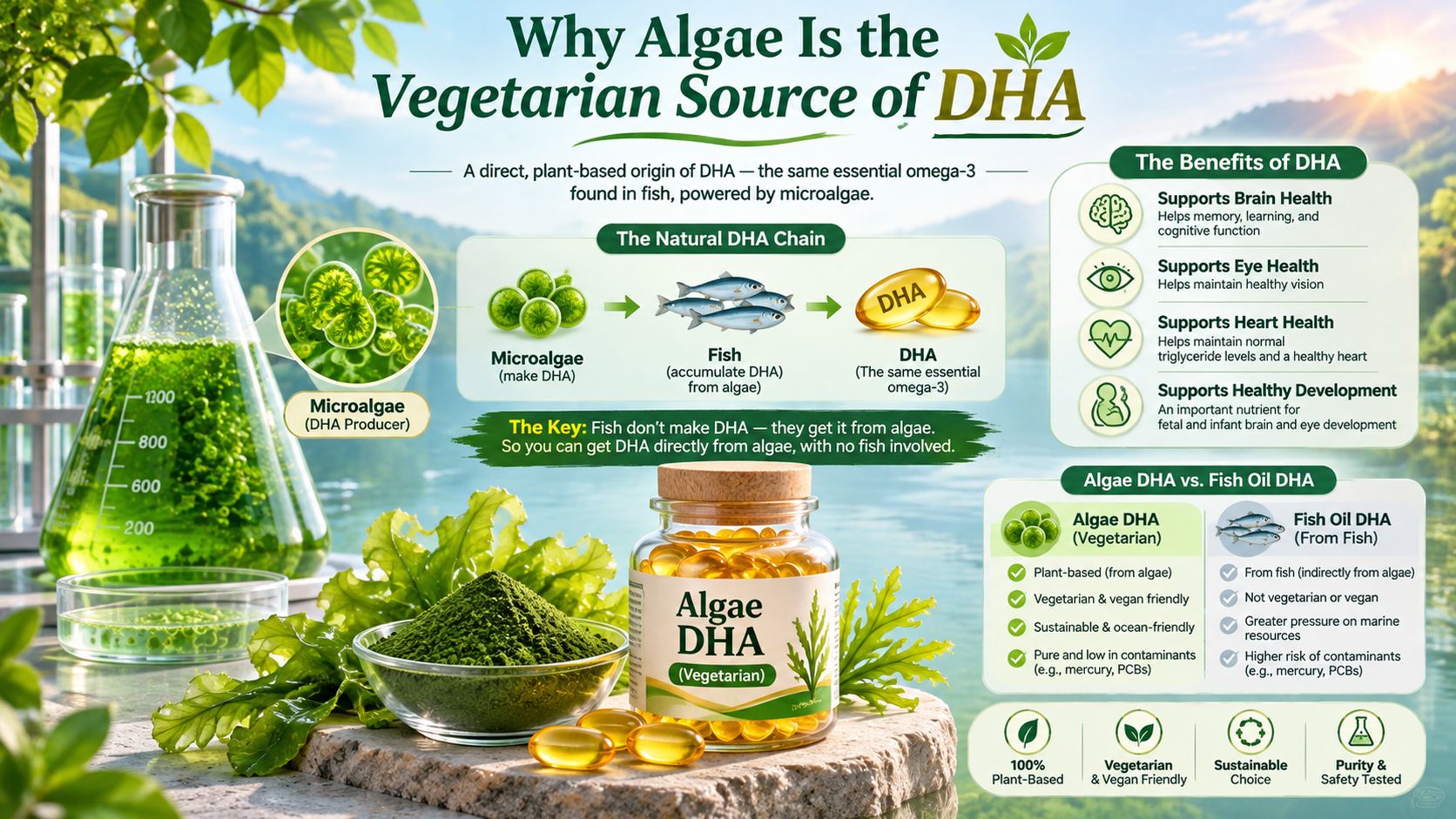
Follow one DHA molecule from the water up. Single-celled microalgae make it. Small fish eat the algae, bigger fish eat the small fish, and the DHA travels up the food chain until it lands on a dinner plate. Fish never manufactured it. They collected it.
That's why algal oil exists. A microalgae-based supplement goes straight to the original producer and skips every step in between.
An algal capsule takes delivery from the source instead of waiting on the courier.
The NIH identifies algal oil as a vegetarian source of DHA and notes that plant-based algal products usually provide approximately 100 to 300 mg of DHA per serving, with some formulas adding EPA as well (NIH omega-3 consumer fact sheet). That's the range you'll see across most brands, which is precisely why the milligram line matters more than the word "plant-based."
Now the confusing part, the one that trips up plenty of careful mamas: flaxseed, chia, walnuts and canola oil don't do the same job. They supply alpha-linolenic acid, or ALA, which is a precursor. Your body has to build DHA out of it, and that conversion is limited and varies from person to person (NIH omega-3 consumer fact sheet).
Picture ALA as raw lumber dropped at your door and DHA as the finished cabinet. Your body's workshop is small and slow, so a lot of lumber turns into very little cabinetry. Someone eating a thoughtful vegetarian diet can still come up short on preformed DHA while hitting every ALA target in the book.
The history here matters more than people realize. Algal DHA separated the nutrient itself from dependence on fish, which made preformed DHA reachable for people avoiding fish because of vegetarian or vegan diets, allergies, sustainability preferences, or mercury concerns. It's the same reason a vegetarian DHA supplement shows up in prenatal discussions at all.
Here's how the sources line up.
| Source | Preformed DHA | Vegetarian | What to check |
|---|---|---|---|
| Algal oil DHA capsule | Yes | Yes | Declared DHA mg per serving, EPA listed separately, softgel shell |
| Algal oil DHA with EPA | Yes, plus EPA | Yes | Total DHA and EPA per serving, usually about 100 to 300 mg DHA |
| Fish oil | Yes | No | Mercury exposure and fish intake, not suitable for vegetarians |
| Flaxseed, chia, walnuts | No, ALA precursor only | Yes | Conversion to DHA is limited and variable |
So decide two things before you spend money. Does your diet deliver preformed DHA at all, and does your current prenatal already include it in a stated amount?
If the answer to either is shaky, that's a conversation for your clinician, not a checkout page. For a closer look at food-first options and what they can realistically cover, vegetarian sources of DHA is a good next read.
Does Algal DHA Absorb as Well as Fish Oil?
Yes. Algal DHA isn't a biologically inferior stand-in for fish oil, and this question was tested in adults long before it became a marketing talking point. A controlled adult comparison found microalgal-oil DHA and EPA in plasma phospholipids to be statistically non-inferior to fish oil, with both sources producing substantial increases in circulating omega-3 levels (bioavailability comparison of microalgal and fish oil). Earlier randomized work found equivalent DHA responses from two different algal-oil preparations across 200, 600 and 1,000 mg per day.
The dose you're most likely to meet on a label has also been tested in vegetarians specifically. A 2024 randomized crossover trial published in Food & Function gave 250 mg of microalgae DHA per day for 5 weeks to 98 Spanish vegetarians and omnivores (Food & Function crossover trial). That's a useful anchor, because it sits squarely in the middle of the range most algal capsules declare.
Here's the idea that decides how much of that dose your body uses. DHA is a passenger, and the fat in your meal is the bus. DHA is fat-soluble, so it needs a ride through digestion, and a meal with some fat in it provides one. Swallow the capsule with water on an empty stomach and you've made the trip harder than it needed to be.
Three things matter more than the algae-versus-fish question:
- Take it with fat. A breakfast with eggs, avocado, yogurt or nut butter gives the DHA something to travel with. This single habit does more for absorption than switching brands.
- Formulation beats origin. Delivery format and antioxidant protection change performance far more than whether the oil came from a fermenter or a fishery.
- Capsule weight isn't potency. A hefty 1,000 mg softgel might carry a fraction of that as actual DHA. Read the nutrient line, not the capsule size.
One small crossover study found a specialized nanoemulsion algal oil absorbed faster than bulk algal oil, but that's preliminary work and it doesn't prove better pregnancy outcomes. Don't pay a premium for it on that basis alone.
For vegetarian mamas, the question isn't whether algal DHA works. It's how much you take and what you eat alongside it. For a side-by-side on the two oil types, DHA versus fish oil in pregnancy lays out the trade-offs.
How to Read a DHA Label Before You Buy
A bottle can be vegan, beautiful and useless for your target all at once. The label is where you find out which one you're holding.
Here's the summary card for the numbers that matter.
Run through this list in the supplement aisle, in this order.
- Find the DHA milligrams per serving, not the total omega-3 or the oil weight. "Omega-3" on a front label can include ALA or other fats, and "500 mg algal oil" describes the oil, not the DHA inside it. The Supplement Facts panel is the only place the DHA number is required to appear.
- Check whether EPA is listed separately. Some algal formulas add EPA, and that changes your combined DHA plus EPA total. If you're comparing two bottles, compare the same nutrient line on both. Total omega-3 on a softgel isn't the same as usable EPA and DHA, and this explainer on fish oil strength versus actual EPA is a helpful cross-check on why that label math matters.
- Confirm the capsule shell is vegetarian. The oil can come from algae while the softgel itself is made with gelatin. Look for "vegetable capsule" or "vegetarian capsule" rather than assuming.
- Count how many capsules make one serving. A serving might be two or three capsules. If you'd never take three a day, the effective dose on your nightstand is lower than the label suggests.
- Look for third-party testing and oxidation control. Independent testing for purity and potency tells you the DHA is there and the heavy metals aren't. Oxidation control matters because a rancid oil is a poor delivery vehicle, and a sharp fishy or paint-like smell is your cue to return it.
- Plan to take it with a meal containing fat. Absorption depends on it, so pick the meal you never skip and make that your DHA meal.
Capsule weight deserves its own warning, because it's the most common misread.
In the aisle: if the front of the bottle doesn't give you a DHA milligram figure, turn it around. If the back doesn't either, put it down.
Vegetarian capsules, excipients and coatings vary, so read the full ingredient list rather than stopping at the "vegetarian" badge. Gelatin, dairy-derived ingredients and soy can turn up elsewhere in the bottle even when the oil is plant-based.
If the DHA milligrams and the capsule type match your target and your diet, you've done your homework. Bring the bottle, or a photo of the label, to your provider and ask for a clear yes or no. That's a much better conversation than "is this one okay?" about a product nobody can see.
For a walk through what to look for beyond the omega-3 line, vegetarian prenatal vitamins with DHA covers the rest of the label.
What Pregnancy Trials Found About Algal DHA
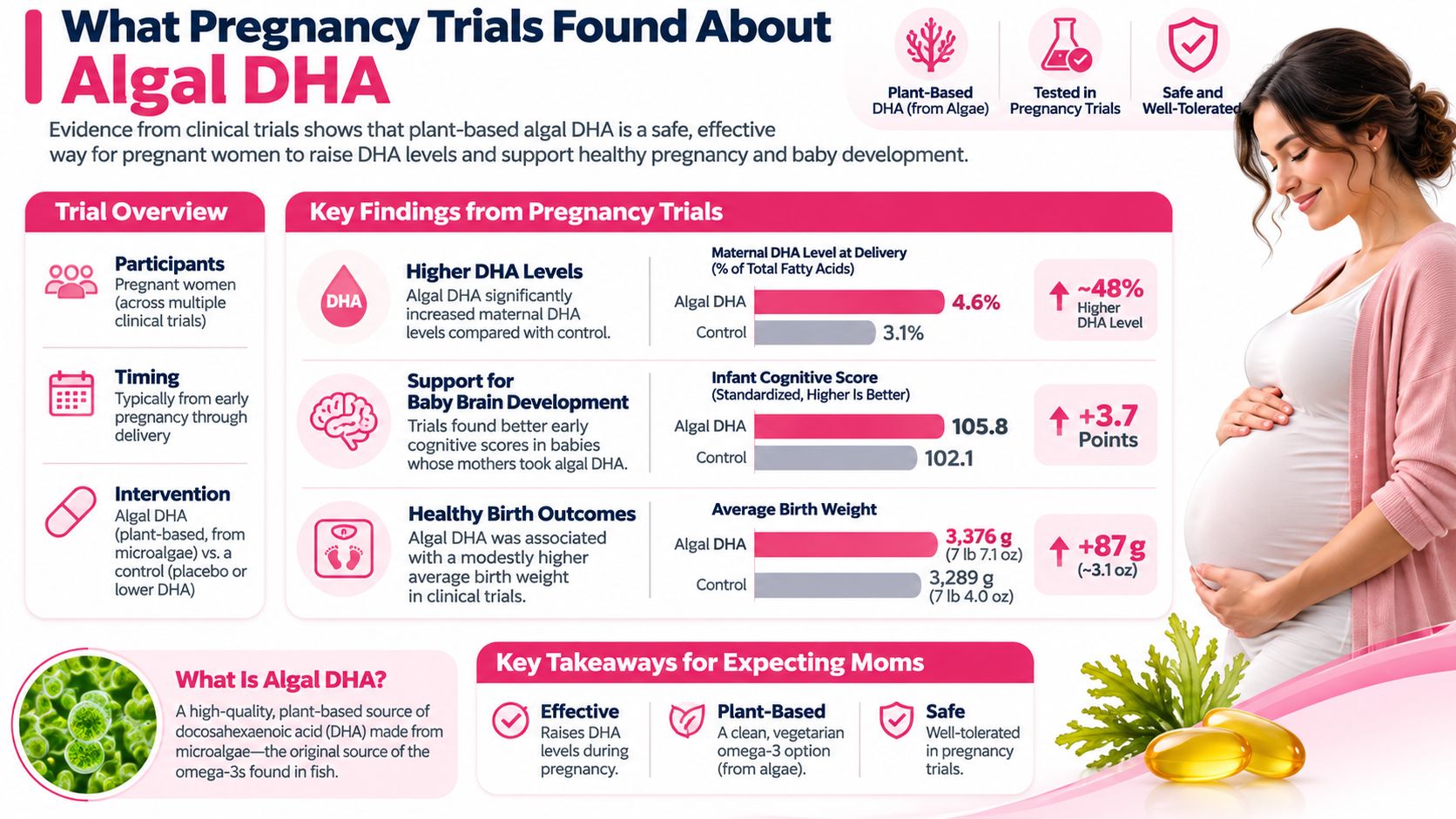
Algal DHA isn't a boutique idea that skipped the research. It has been tested in a large maternal population, with a placebo, at doses in the same general range as international recommendations.
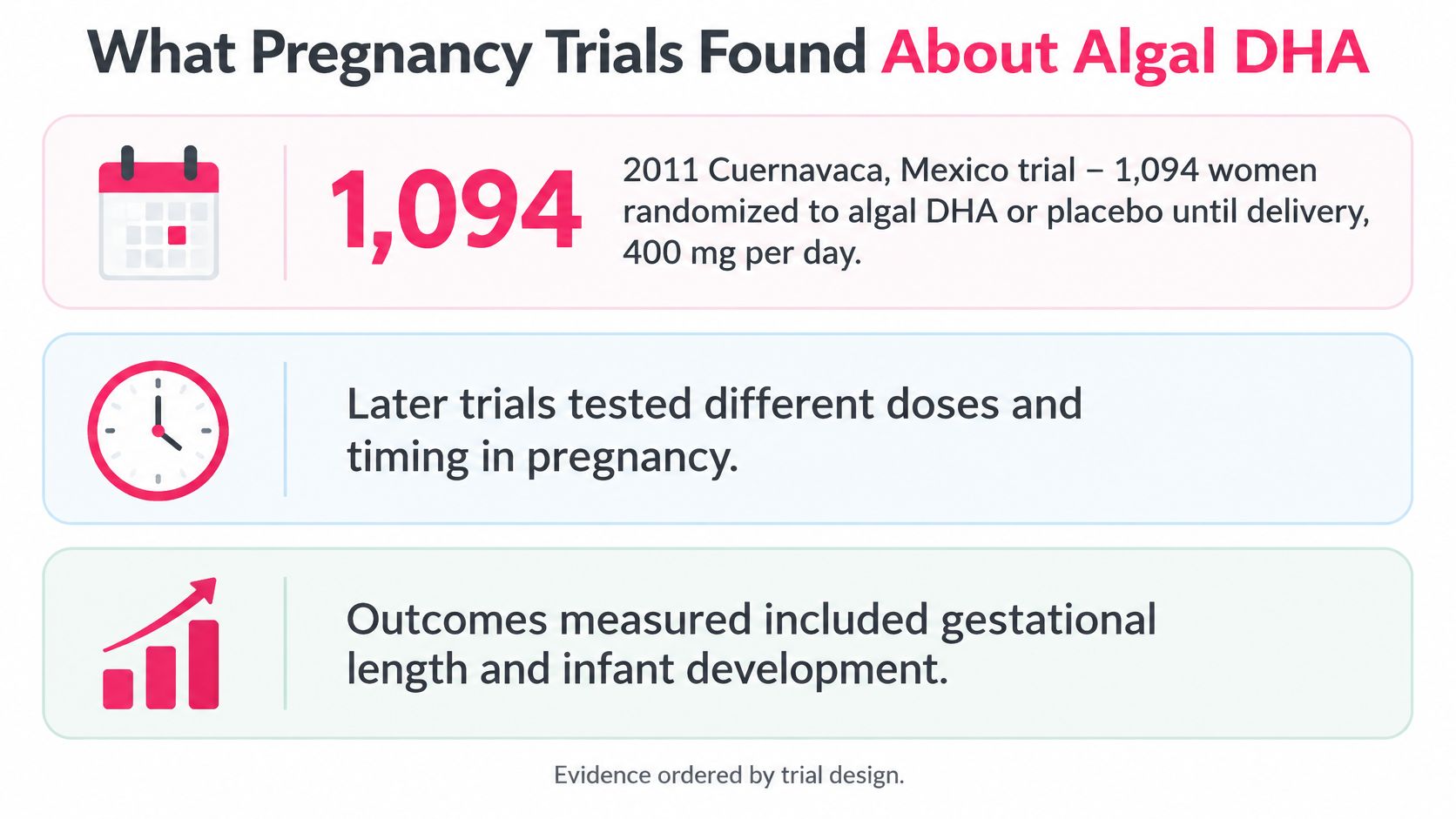
The landmark is a double-blind, randomized, placebo-controlled trial in Cuernavaca, Mexico, published in 2011. Researchers randomized 1,094 women to receive either algal DHA or placebo until delivery, with the intervention providing 400 mg of algal DHA daily in capsules containing 200 mg DHA each. Of those randomized, 1,040 began treatment and 973 completed the study, producing 973 live-born infants, including 963 singleton births and 5 sets of twins (pregnancy research summary on omega-3s).
Why it matters: the oil came from algae rather than fish, and the design could compare outcomes against placebo. "Vegetarian DHA" stopped being a label concept and became something researchers could measure.
| Trial | DHA dose | What was reported |
|---|---|---|
| Cuernavaca, Mexico randomized placebo-controlled trial (2011) | 400 mg per day algal DHA | 1,094 randomized; 973 completed; live-birth outcomes reported |
| Randomized pregnancy studies (various) | About 200, 300, 400 and 600 mg per day | Dose-finding comparisons across studies |
| Large dose-comparison trial | 200 versus 1,000 mg per day | Likely fewer early preterm births before 34 weeks, especially with low baseline DHA |
The pattern across studies is that doses differ a lot, which is exactly why "take some DHA" isn't a plan. Subsequent randomized pregnancy studies have evaluated roughly 200, 300, 400 and 600 mg per day of algal DHA, and a large dose-comparison trial tested 200 versus 1,000 mg per day, reporting a likely reduction in early preterm birth before 34 weeks, especially among participants with low baseline DHA status (NIH pregnancy fact sheet).
Now the limits, because they matter as much as the headline. That finding doesn't establish that every pregnant person should self-select 1,000 mg daily, and the NIH states that the effects of EPA/DHA supplements on infant health and development remain uncertain in some contexts.
Translate it into something you can use. The higher-dose evidence is strongest for people starting with low DHA status, which is a plausible description of many strict vegetarians and vegans, and possibly of you. Whether it applies to your body is a clinician's call, made with your diet, your history and any bleeding risk in view. Anyone can buy a high-dose capsule. Matching a dose to a person is the part that takes a professional.
Filling the Other Gaps in a Vegetarian Diet
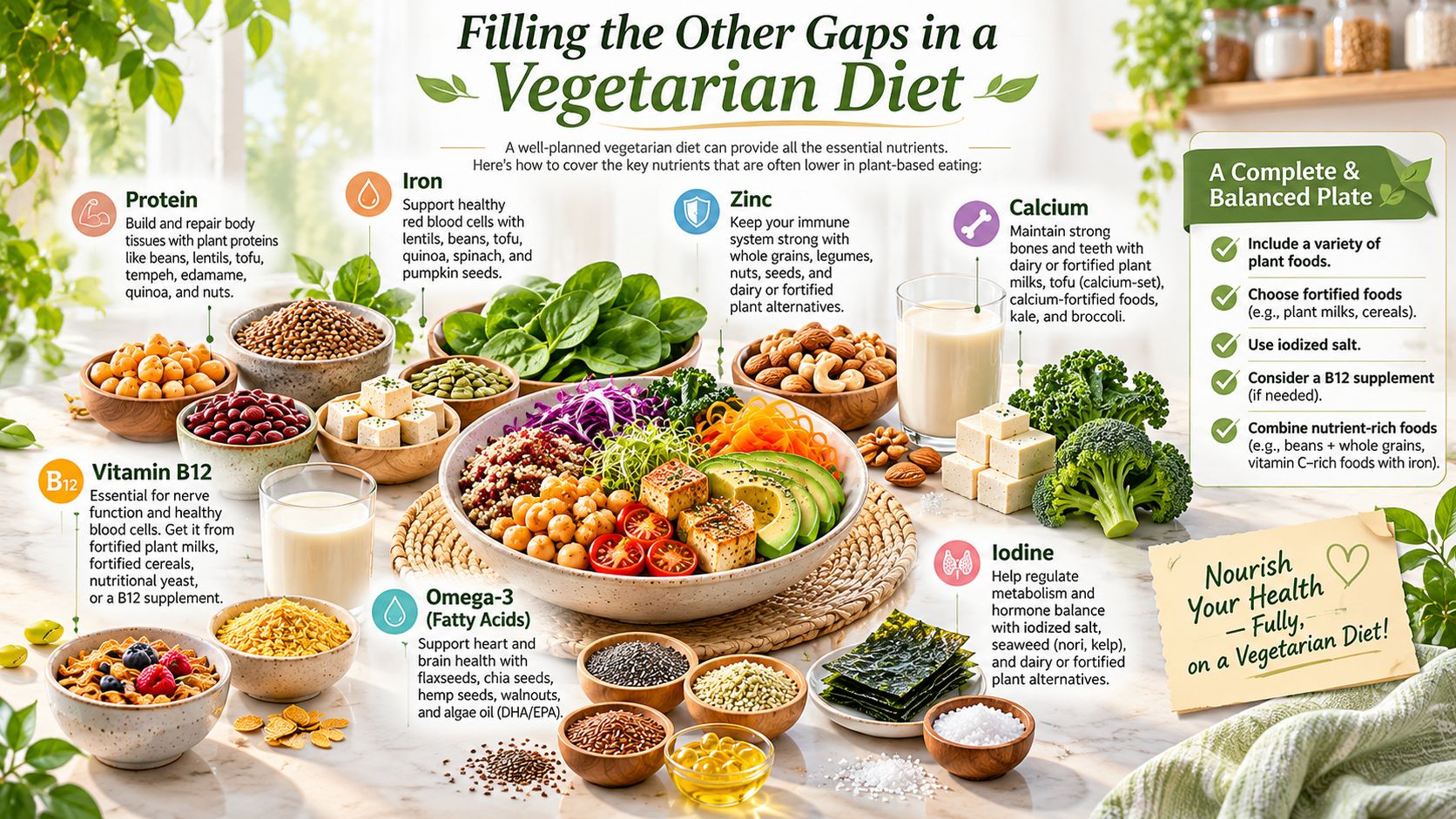
Choosing an algal DHA solves the fish-avoidance problem. It doesn't make a vegetarian prenatal regimen nutritionally complete, and treating one capsule as the whole answer is where careful planning slips.
Choline is the nutrient most often left out of the conversation. The NIH guidance notes that most pregnant people don't meet recommended choline intakes, and advises vegetarian or vegan pregnant people to ask a healthcare professional whether choline supplementation is necessary (NIH pregnancy and diet guidance for health professionals). The same guidance flags possible needs for other nutrients that plant-heavy diets can underdeliver.
- Choline: eggs and liver are the dense sources, so a vegan diet needs deliberate planning or a supplement.
- Vitamin B12: found reliably only in animal foods and fortified products, so vegans need a supplement or consistent fortification.
- Iron: ferrous fumarate in a prenatal is common, but absorption still depends on how you take it.
- Iodine: shared across prenatal products, iodized salt and dairy, which makes double-counting easy.
- Zinc: bound up in phytates in whole grains and legumes, so intake and absorption diverge.
- Vitamin A: appears in multiple products and fortified foods, and totals add up faster than people expect.
That list matters more than any single row. A prenatal with DHA, a separate omega-3 capsule, and a few fortified foods can stack iodine or vitamin A without anyone noticing, because each label looks reasonable in isolation.
Practical rule: add up every source of a nutrient before you add another product, then decide what's actually missing.
Ingredient suitability deserves its own pass too. A vegetarian label can still hide gelatin, dairy-derived ingredients, soy or allergens elsewhere in your regimen, and a capsule shell isn't always what the badge implies. Thyroid disease, bariatric surgery, past deficiencies and medication use all change what you need, which is why a generic regimen only gets you so far.
Think of your regimen as a team. A prenatal, a DHA capsule, a B12 tablet and a fortified cereal bar are all players, and you need to know who's covering which position before you sign the roster.
Three steps close the loop. List every product you take with the amount of each nutrient it supplies. Flag the nutrients you might be short on. Then hand that list to your provider or a registered dietitian and ask them to check the coverage. More background on the wider picture lives in vegetarian diets and pregnancy.
When Should Your DHA Dose Change, and What Should You Ask?
One fixed dose doesn't fit every mama, and the evidence says so plainly. A 2025 systematic review covering 45 studies found that vegetarian diets generally provide more ALA but are associated with significantly lower EPA and DHA concentrations, particularly among vegans, while microalgae DHA improved blood DHA status, including during pregnancy and lactation (2025 systematic review of omega-3 status in vegetarians).
That's the crux. A vegetarian DHA supplement answers the source question. Whether the dose fits you is a separate question, and these are the factors that move it.
- How much fish you eat. None at all, a little occasionally, or a portion most weeks each point toward a different target.
- Fortified food intake. Strict vegans and anyone who never touches fortified foods have a stronger reason to discuss their dose.
- Baseline DHA status, if your clinician decides to check it. Low status is where the higher-dose evidence looks most relevant.
- Any history of preterm birth, which makes the dose conversation more urgent rather than less.
- Blood thinners or a bleeding condition, where any change needs clinician sign-off before you touch the bottle.
Before the appointment, write down four things: your diet pattern, roughly how much fish or fortified food you eat, every medication you take, and your pregnancy history. That page turns a vague worry into a fifteen-minute conversation with a real answer.
Then ask these three questions, in this order.
- Show the bottle, or a photo of the label, with the DHA milligrams per serving clearly visible. Ask whether that number lines up with the target they want for you.
- Ask which framework they're using: the combined DHA plus EPA baseline with a pregnancy top-up, or the DHA-only pregnancy target. The two produce different shopping lists.
- Ask whether a separate omega-3 product is needed on top of your prenatal, given your diet and history. Sometimes the answer is no, and that's worth hearing.
Feed Mom & Me makes a Complete Prenatal Vitamin Plus DHA that fits this conversation as a vegetarian foundation. It contains 50 mg of DHA per serving alongside choline, selenium, methylfolate and 15 other key nutrients, comes as a delayed-release vegetable capsule designed to be gentle on the stomach, and is formulated by an OBGYN and a registered dietitian.
Be clear-eyed about that 50 mg. On its own it's a foundation, not the whole pregnancy target, and that's exactly why the label-reading habit matters so much. Plenty of clinicians will want an additional algal DHA capsule alongside a prenatal like this, and some won't. Bring the number to them and let them decide.
"You're not trying to win a supplement contest. You're trying to hit one number that your clinician helped you choose."
You're already doing the work others skip: reading past the front of the bottle and asking what's inside. That's a wonderful thing to do for yourself and for your baby, mama.
Feed Mom & Me is a women-owned, mom-built brand that makes the Complete Prenatal Vitamin Plus DHA for exactly this stage, with 50 mg of DHA per serving in a vegetarian, delayed-release vegetable capsule, formulated by an OBGYN and a registered dietitian, with every batch third-party tested twice for heavy metals, microbes and other contaminants. If you want a prenatal that gives you a clear DHA number to bring to your provider, visit Feed Mom & Me and read the Supplement Facts panel for yourself.