
5 Mthf Folate
Published:Updated:
5-MTHF (L-5-methyltetrahydrofolate) is the biologically active form of folate your body can use without conversion, and it appears in some prenatals as an alternative to folic acid. The CDC still recommends 400 mcg of folic acid daily for anyone who could become pregnant.
You may be staring at a prenatal bottle right now, wondering whether 5-MTHF folate is the smarter choice. The label might say L-5-MTHF, methylfolate, or L-methylfolate calcium, while articles online insist that folic acid is either outdated or absolutely essential. No wonder the decision feels bigger than it should.
The reassuring truth is that this conversation has three separate parts: your MTHFR genetic status, your blood folate status, and the form of folate with the strongest evidence for preventing neural-tube defects. Keeping those questions separate makes prenatal nutrition much easier to understand.
Table of Contents
- Why Does Folate Matter So Much for You and Your Baby?
- What Is 5-MTHF Folate and How Does Your Body Use It?
- How Does 5-MTHF Compare to Folic Acid?
- Why Is Folate Famous for Preventing Neural Tube Defects?
- Do You Really Need 5-MTHF if You Have an MTHFR Variant?
- How Much Folate Do You Need and How Do You Read a Prenatal Label?
- Choosing a Prenatal With 5-MTHF and Feeling Confident About It
Why Does Folate Matter So Much for You and Your Baby?
A mama named Claire might pick up a prenatal while planning to conceive and immediately turn the bottle around to read the supplement facts. She sees unfamiliar terms, several nutrient amounts, and a folate line that says “L-5-MTHF” instead of “folic acid.” Her first thought is probably familiar to many women: Have I been taking the wrong thing?
You haven't failed by feeling confused. Folate is a nutrient with several forms, and supplement labels often use technical names without explaining what they mean. The important starting point is that folate supports DNA synthesis, cell division, and normal growth and development, all of which matter during the rapid changes of early pregnancy.
Your baby's neural tube develops very early, often before you know you're pregnant. That timing is why folate guidance focuses on the period before conception and the beginning of pregnancy, rather than waiting for a positive test.
A calm way to think about it: You're choosing how to supply an important nutrient, not passing or failing a test of motherhood.
The rest of the decision becomes clearer once you know what 5-MTHF is, how it compares with folic acid, and what an MTHFR variant does and doesn't mean. You'll also learn how to read your prenatal label, when to involve your healthcare provider, and how to choose a formula without getting pulled into online fear or hype.
Core to prenatal care is a supplement that fits your routine without causing anxiety. Consistent daily intake, a balanced diet, and individualized guidance from your obstetric clinician, midwife, or dietitian matter more than chasing a perfect-sounding ingredient description.
What Is 5-MTHF Folate and How Does Your Body Use It?
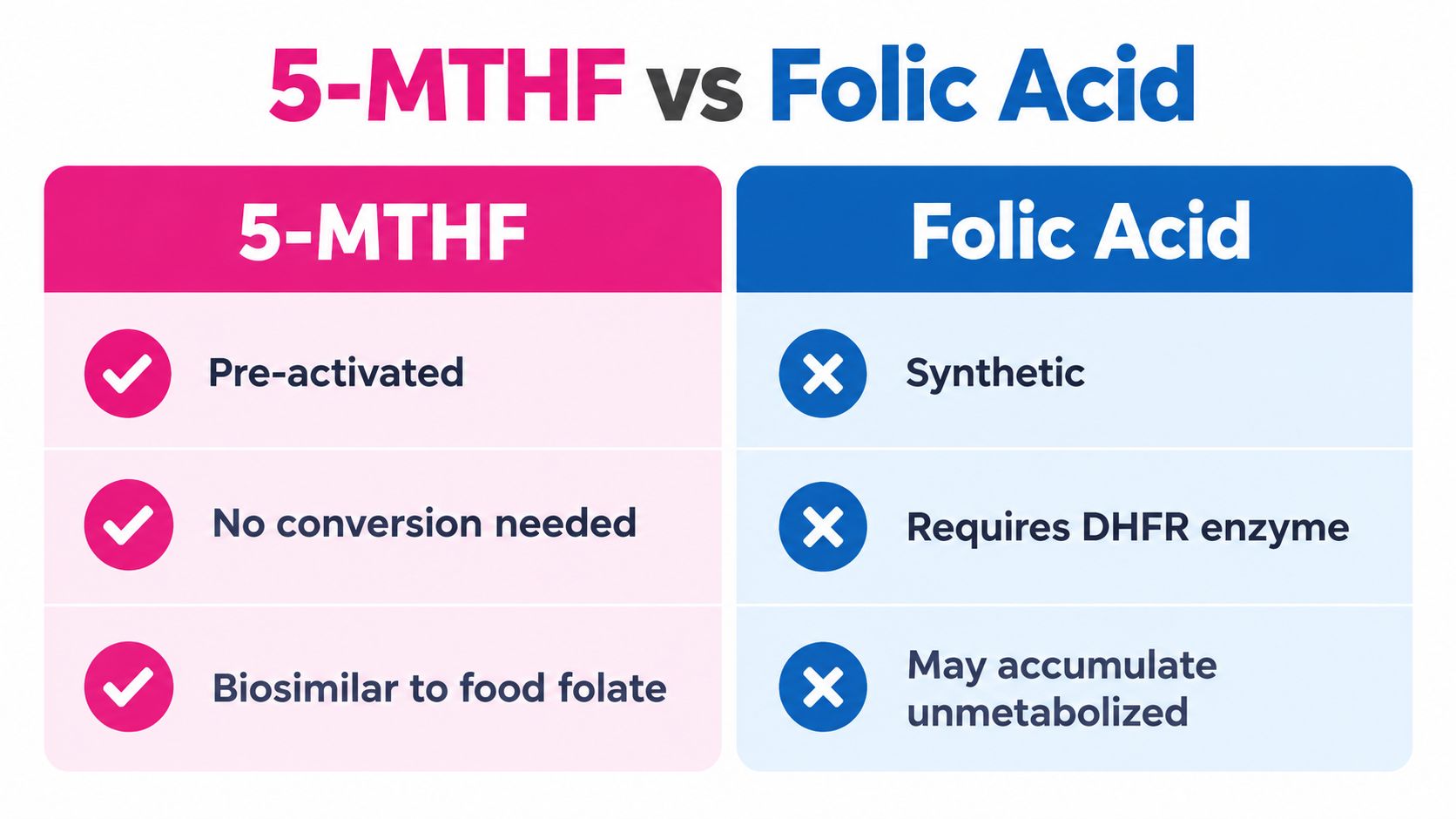
Folate is a B vitamin family with several forms. 5-MTHF, also called L-5-methyltetrahydrofolate or methylfolate, is a biologically active form used in some dietary supplements, including prenatal products. Your body normally converts folate through biochemical pathways that create active forms it can use.
A helpful analogy is to picture folate forms as different keys for the same lock. Folic acid is a key that your body processes through its own machinery before it becomes an active form. 5-MTHF arrives more like a key that has already been shaped for the lock. Both are ways to supply folate, but they take different routes through the body.
The MTHFR enzyme is part of the pathway involved in converting folate into 5-MTHF. Some genetic variants can make that enzyme work less efficiently. That doesn't mean the body's entire folate system stops working, and it doesn't automatically tell you which supplement is right for you.
What active folate helps support
Once folate is available in the body, it participates in processes that help cells grow and divide. During pregnancy, that work supports your tissues as well as your baby's developing body.
- Cell division: Folate supports the rapid production of new cells.
- DNA synthesis: It helps provide materials cells need as they copy and organize genetic information.
- Early development: Adequate folate supports the normal development of the neural tube during the first weeks of pregnancy.
- Maternal folate status: Supplementation can help maintain folate levels during pregnancy and after delivery.
The phrase “active folate” describes how 5-MTHF participates in these pathways. It doesn't, by itself, prove that a supplement prevents neural-tube defects better than folic acid. That distinction is central to making sense of the marketing language around 5 mthf folate.
For a closer look at the terminology on prenatal labels, you can read this explanation of 6S-5-methyltetrahydrofolate. The goal isn't to memorize every biochemical step. You need only to know that 5-MTHF is a usable folate form and that folic acid remains an important evidence-based option.
How Does 5-MTHF Compare to Folic Acid?
The most useful comparison begins with what researchers measure. In a randomized Canadian trial, 60 folate-replete individuals with low-risk singleton pregnancies received either 0.625 mg per day of (6S)-5-MTHF or 0.6 mg per day of folic acid for 16 weeks, beginning between 8 and 21 weeks of gestation. Both groups maintained similar maternal serum and red-blood-cell folate concentrations during pregnancy and after delivery. The trial also found approximately 50% lower plasma unmetabolized folic acid in the 5-MTHF group, but it didn't show that lower unmetabolized folic acid improved pregnancy or newborn outcomes. The published randomized trial supports comparable folate biomarker performance, not clinical superiority.
| Feature | 5-MTHF, methylfolate | Folic acid |
|---|---|---|
| Form | Biologically active folate form | Synthetic folate form |
| Processing | Can be used without the same conversion step from folic acid | Processed through the body's folate pathways |
| What research can show | Can maintain maternal folate biomarkers at a comparable dose in the cited trial | Has the strongest public-health evidence for neural-tube-defect prevention |
| What the evidence does not establish | Superior pregnancy or newborn outcomes | That every person must use this form exclusively |
| Label wording | L-5-MTHF, methylfolate, or L-methylfolate | Folic acid |
The distinction between a biomarker and a health outcome is worth slowing down for. A biomarker is a measurable sign, such as the amount of folate in blood or red blood cells. A clinical outcome is something that happens to a person, such as prevention of a neural-tube defect. A supplement may change a biomarker without being proven to improve the outcome you care about most.
That doesn't make 5-MTHF unhelpful or unimportant. It means you shouldn't be told that “active” automatically means “better for every pregnancy.” Both forms can support folate status, and the right choice may depend on your preferences, your complete prenatal formula, your diet, and your clinician's advice. You can also compare the two forms in this plain-language guide to methylfolate versus folic acid.
For many women, the practical priority is simple: choose a prenatal you can take consistently, confirm the folate form and amount on the label, and discuss any special medical circumstances with your provider.
Why Is Folate Famous for Preventing Neural Tube Defects?
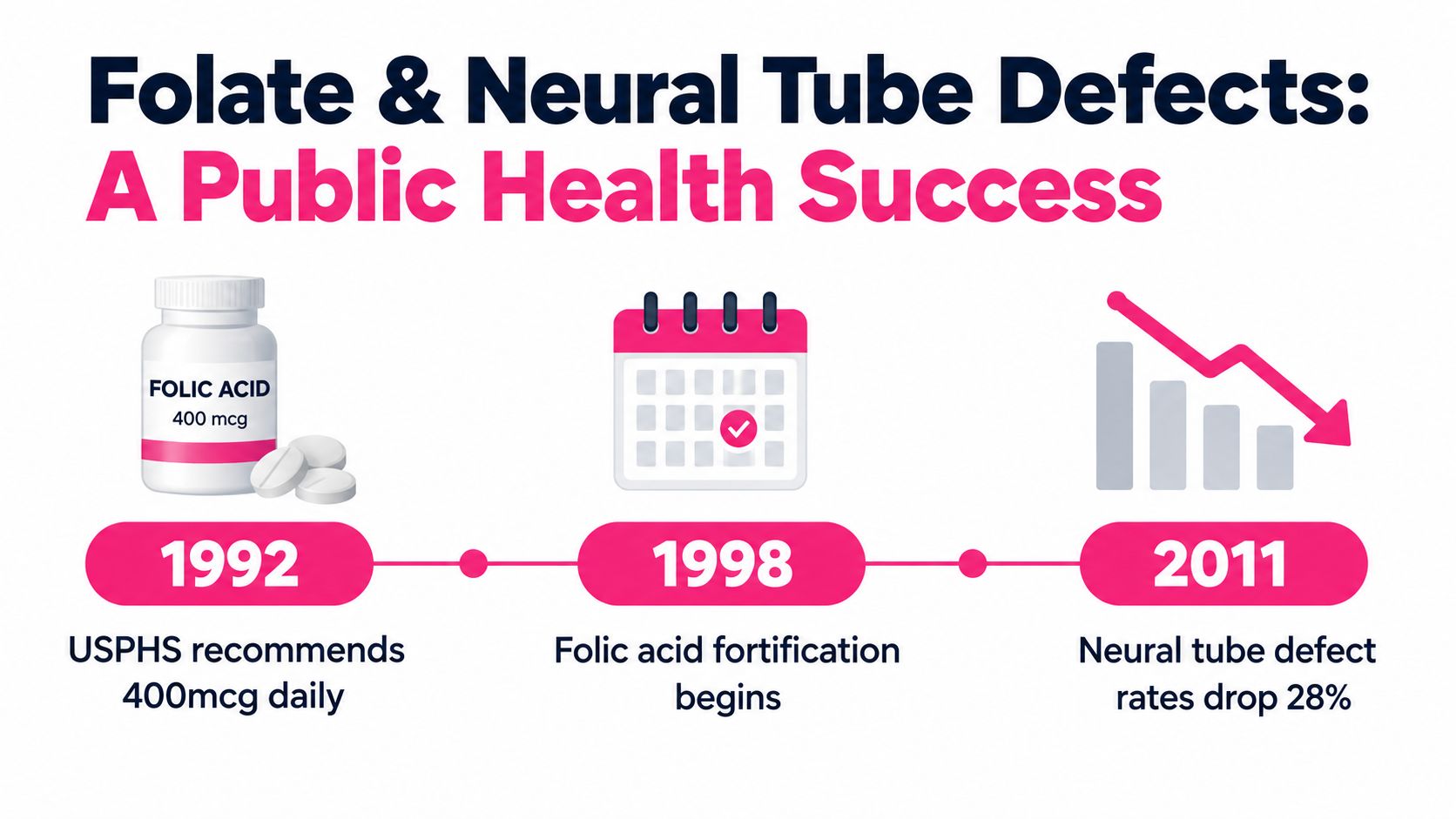
You may start taking a prenatal after a positive test, only to learn that the neural tube develops even earlier. That timing explains why folate became a major prenatal-nutrition priority. Public-health action also produced a measurable change. In 1992, the U.S. Public Health Service recommended that women capable of becoming pregnant consume 400 micrograms of folic acid daily. Beginning in 1998, the United States required enriched cereal-grain products to contain 140 micrograms of folic acid per 100 grams. Before fortification, approximately 4,000 U.S. pregnancies were affected by neural-tube defects in 1995–1996. Afterward, about 3,000 were affected in 1999–2000. Across 19 state-based birth-defect tracking programs, observed prevalence declined by 28%, and the CDC estimated that roughly 1,326 affected births were averted annually during the post-fortification period. CDC data on fortification and neural-tube defects
Those figures are not meant to frighten you. They show how nutrition guidance, food policy, and consistent folic-acid intake can work together to support families.
Why timing matters
The neural tube is the early structure that develops into your baby's brain and spinal cord. It forms and closes very early in pregnancy, sometimes before a person knows they are pregnant. Folic-acid intake before conception and during early pregnancy therefore matters before a positive test appears.
The worldwide burden has also made prevention a public-health priority. Research summarized by the CDC indicates that adequate folic-acid consumption around conception can prevent approximately 50% to 70% of neural-tube defects. Fortification programs in countries including Canada, Costa Rica, Chile, and South Africa produced declines of 25% to 50% in neural-tube-defect-affected pregnancies.
The practical lesson is encouraging: prevention evidence matters more than marketing language about a folate being “active.” Folic acid is the form with established evidence for preventing neural-tube defects. That evidence answers a prevention question. It does not, by itself, determine your MTHFR status, your blood folate status, or whether a prenatal containing 5-MTHF fits your individual situation.
If you have had a previous pregnancy affected by a neural-tube defect or have another high-risk circumstance, your provider may recommend different or additional care. That decision belongs in a personalized medical conversation rather than a one-size-fits-all online checklist.
Do You Really Need 5-MTHF if You Have an MTHFR Variant?
Many women hear that an MTHFR C677T variant means folic acid won't work for them. The available guidance is more reassuring and more nuanced.
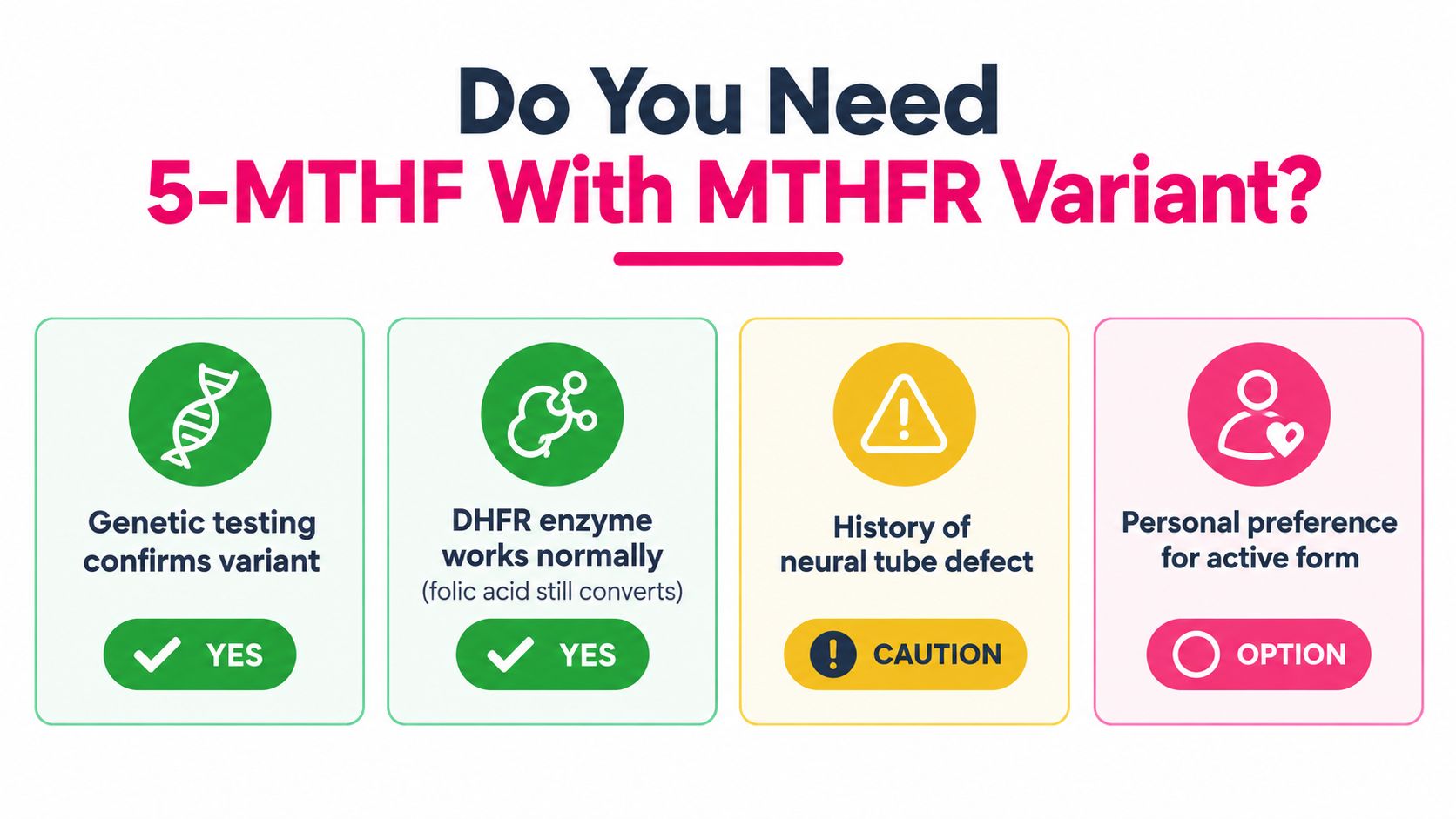
Think of the MTHFR pathway as an assembly line. A common variant can make one part of the line work less efficiently, but it doesn't mean the line stops completely or that your body can't process folate. The CDC says people with MTHFR variants can process folate, continues to recommend 400 mcg of folic acid daily for anyone who could become pregnant, and doesn't recommend routine MTHFR testing or changing folate recommendations solely because of genotype. The CDC's folic-acid recommendations explain this position.
Ask three separate questions
Question one, what is your genetic status? You may have an MTHFR variant, or you may not know. Genetic status alone doesn't measure how much folate is in your blood and doesn't establish that you need a different prenatal.
Question two, what is your folate status? A clinician can decide whether your history, diet, symptoms, medical conditions, or laboratory information calls for additional assessment. A genetic result isn't a substitute for evaluating your overall health.
Question three, what prevents neural-tube defects? The CDC identifies folic acid as the only folate form proven to prevent neural-tube defects. The NIH notes that supplements containing 5-MTHF may be easier for some people with the common C677T variant to use, but evidence that the variant requires a different supplement strategy remains inconclusive. NIH's professional folate fact sheet discusses the evidence and its limits.
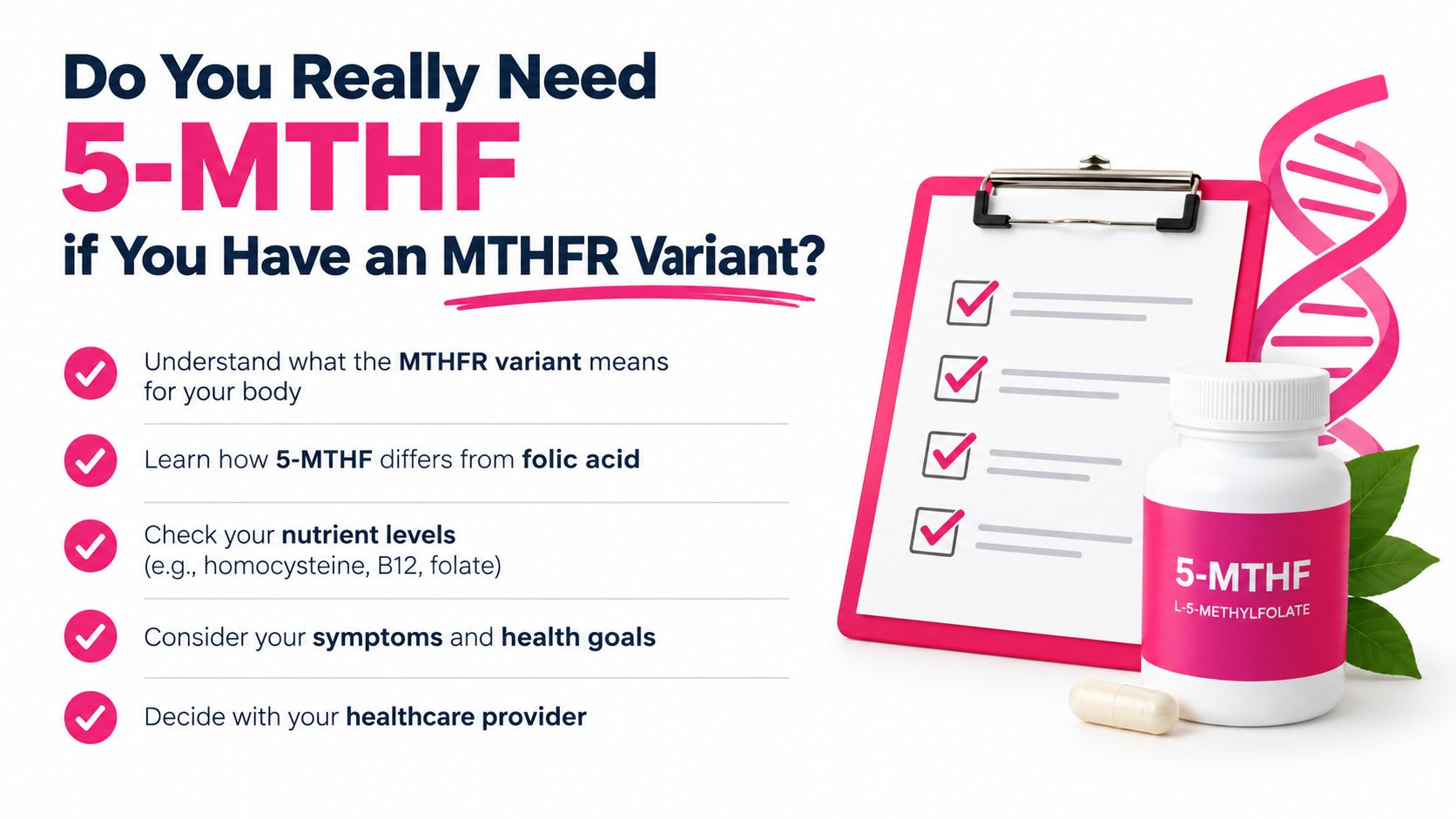
Choosing a prenatal with 5-MTHF can be a reasonable formulation preference or a clinician-directed option. It shouldn't lead you to believe that folic acid is ineffective or unsafe just because you have an MTHFR variant. The prenatal vitamin guide for MTHFR concerns can help you understand the label, but your own provider should help interpret your health history.
A useful rule: Genetic status, blood-folate status, and proven neural-tube-defect prevention are related questions, not interchangeable answers.
If an online post tells you that your genotype makes pregnancy nutrition dangerous, pause before changing your supplement. Bring the result, the prenatal bottle, and your questions to your obstetric clinician, midwife, or dietitian.
How Much Folate Do You Need and How Do You Read a Prenatal Label?
The public-health baseline is straightforward. The CDC and NIH recommend 400 mcg of folic acid daily for women and adolescent girls who could become pregnant, from supplements, fortified foods, or both. This recommendation remains in place even when an MTHFR C677T variant is present. NIH's consumer folate fact sheet explains how 5-MTHF fits into the broader folate picture.
Use these practical habits:
- Before conception: Aim for the recommended 400 mcg of folic acid daily if you could become pregnant.
- During early pregnancy: Continue your prenatal consistently and follow your healthcare provider's advice about the complete formula.
- During pregnancy and postpartum: Check the label and discuss ongoing use with your provider, especially if you're breastfeeding, have dietary restrictions, or take other supplements.
- If you have a higher-risk history: Ask your provider for individualized guidance rather than selecting a higher amount on your own.
Read the folate line
Look for one or more of these names:
- Folic acid: The synthetic form used in many supplements and fortified foods.
- L-5-MTHF: A biologically active supplemental form.
- 5-methyltetrahydrofolate: The full scientific name for 5-MTHF.
- Methylfolate: A common label term for 5-MTHF-related ingredients.
- Microgram amount: Confirm how much folate the serving provides and whether the label identifies the form clearly.
Food can contribute, too. Helpful folate-containing choices include:
- Leafy greens: Add spinach or other greens to salads, soups, or eggs.
- Lentils: Stir them into grain bowls, stews, or pasta sauces.
- Citrus: Enjoy oranges or other citrus fruit as part of a snack or meal.
- Fortified cereals: Check the package for added folic acid.
You don't need to eat perfectly or remember every label term. Consistency is the goal, and your provider can help you make sense of the total folate in your prenatal, fortified foods, and other supplements. Speak with a clinician particularly if you've had a prior neural-tube-defect pregnancy, have a condition that affects absorption, or take medication that can affect folate. The prenatal vitamin dose guide offers another way to organize your label questions.
Choosing a Prenatal With 5-MTHF and Feeling Confident About It
A thoughtful prenatal decision looks beyond the folate line. You may want a formula that includes DHA, choline, selenium, and methylfolate, while also fitting your dietary needs and your ability to tolerate supplements. Delayed-release capsules can be useful for people with sensitive stomachs, and a simpler ingredient list may make daily routines easier.
Feed Mom & Me Complete Prenatal Vitamin Plus DHA contains methylfolate along with DHA, choline, and selenium. The women-owned brand was built by moms and uses delayed-release capsules, with peppermint and organic ginger included for a more nausea-friendly experience. The formula is vegetarian and made without gluten, soy, or dairy, according to the product information. You can review the broader criteria in this guide to choosing a prenatal vitamin.
Three questions many mamas ask
Can I take 5-MTHF with folic-acid-fortified foods? Your total folate intake includes supplements and fortified foods. Review the full picture with your provider, especially if you're taking more than one supplement.
Is methylfolate safe while breastfeeding? Ask your healthcare professional to assess your prenatal or postpartum formula, diet, medications, and breastfeeding needs together.
Should I get an MTHFR test? The CDC doesn't recommend routine MTHFR testing or changing folate recommendations solely because of MTHFR genotype. Discuss testing with your clinician if it comes up in your care.
You're already doing something valuable by asking careful questions instead of accepting marketing claims at face value. A prenatal doesn't have to be complicated to be thoughtful, and your provider can help you choose a routine that feels steady and realistic.
Feed Mom & Me offers a Complete Prenatal Vitamin Plus DHA with methylfolate, DHA, choline, and selenium in a vegetarian, gluten-free, soy-free, dairy-free formula. Visit Feed Mom & Me to explore the prenatal and share the label with your healthcare provider as you decide what fits your pregnancy or postpartum routine.